You may have heard the word niggardly in a book or news story and wondered what it means — especially because it sounds similar to an offensive term. But the meaning is completely different.
Understanding niggardly meaning is important because it is a legitimate English word describing stinginess, not race or prejudice.
Quick answer: Niggardly means stingy, miserly, or unwilling to spend money or resources. It describes someone who is overly cheap.
As someone who explains vocabulary to readers and English learners, I often see confusion around this word because of how it sounds. However, niggardly has no connection to any racial term. It comes from Old Norse hnǫggr, meaning “stingy” or “tight-fisted.”
Because of the misunderstanding, the word is rarely used in modern conversation, even though it is technically correct English. Writers and speakers usually choose alternatives like stingy or cheap to avoid confusion.
People commonly search for “niggardly meaning” after seeing it in books, news articles, or discussions about language and wanting to understand its true definition and why it can be misunderstood.
Niggardly is an adjective meaning stingy, miserly, or unwilling to give or spend. The niggardly definition in English refers to someone who is overly cheap or ungenerous. If you’re asking what does niggardly mean, it simply describes a person who avoids sharing money, effort, or resources.
What Does Niggardly Mean?
“Niggardly” means being unwilling to give, spend, or share — essentially, stingy or miserly.
It’s an adjective, not slang, and is typically used in formal writing or older English literature, not in modern casual speech.
Example:
“The host was so niggardly that guests went home hungry.”
What Does Niggardliness Mean?
Niggardliness is the noun form of niggardly. It means stinginess or unwillingness to give.
Example:
“His niggardliness with tips annoyed the waiters.”
🔊 Niggardly Meaning Pronunciation
“Niggardly” is pronounced:
NIG-erd-lee
Phonetic spelling: /ˈnɪɡərdli/
The first syllable sounds like “nig,” followed by “erd-lee.” Learning the correct pronunciation helps avoid confusion with unrelated words.
Origin and Popularity
The word “niggardly” has been in English since the Middle Ages, tracing back to the Old Norse word “nigla,” meaning to fuss over small things.
It appeared in English texts as early as the 14th century, long before any modern offensive words that sound similar.
- 14th century: First recorded in Middle English as nigard (a stingy person).
- 16th century: “Niggardly” evolved as an adjective form.
- 20th century: Its use declined due to its unfortunate phonetic resemblance to a racial slur, even though they are etymologically unrelated.
Despite its decline, it occasionally appears in literature, journalism, and academic writing when describing stinginess or lack of generosity.
📜 Niggardly Origin and Etymology
The origin of niggardly comes from Middle English “nigard,” meaning a stingy person, which traces back to Old Norse “hnǫggr.” The niggardly etymology shows it developed centuries before any modern slur that sounds similar.
Searches like “where does the word niggardly come from” or “origin of word niggardly” refer to this historical background.
“Niggardly” Meaning in Different Contexts
| Context | Meaning | Tone / Example |
| In Literature | Describes stingy or miserly characters. | “The king was niggardly in rewarding his knights.” |
| In Everyday Speech | Rarely used due to confusion or discomfort. | “He’s a bit too niggardly with compliments.” |
| In Business or Writing | Occasionally used for emphasis in formal critique. | “The company’s niggardly investment slowed innovation.” |
✅ Tip: While “niggardly” is technically correct, most modern speakers prefer “stingy,” “cheap,” or “ungenerous” to avoid misinterpretation.
Examples of “Niggardly” in Sentences
Literary Example:
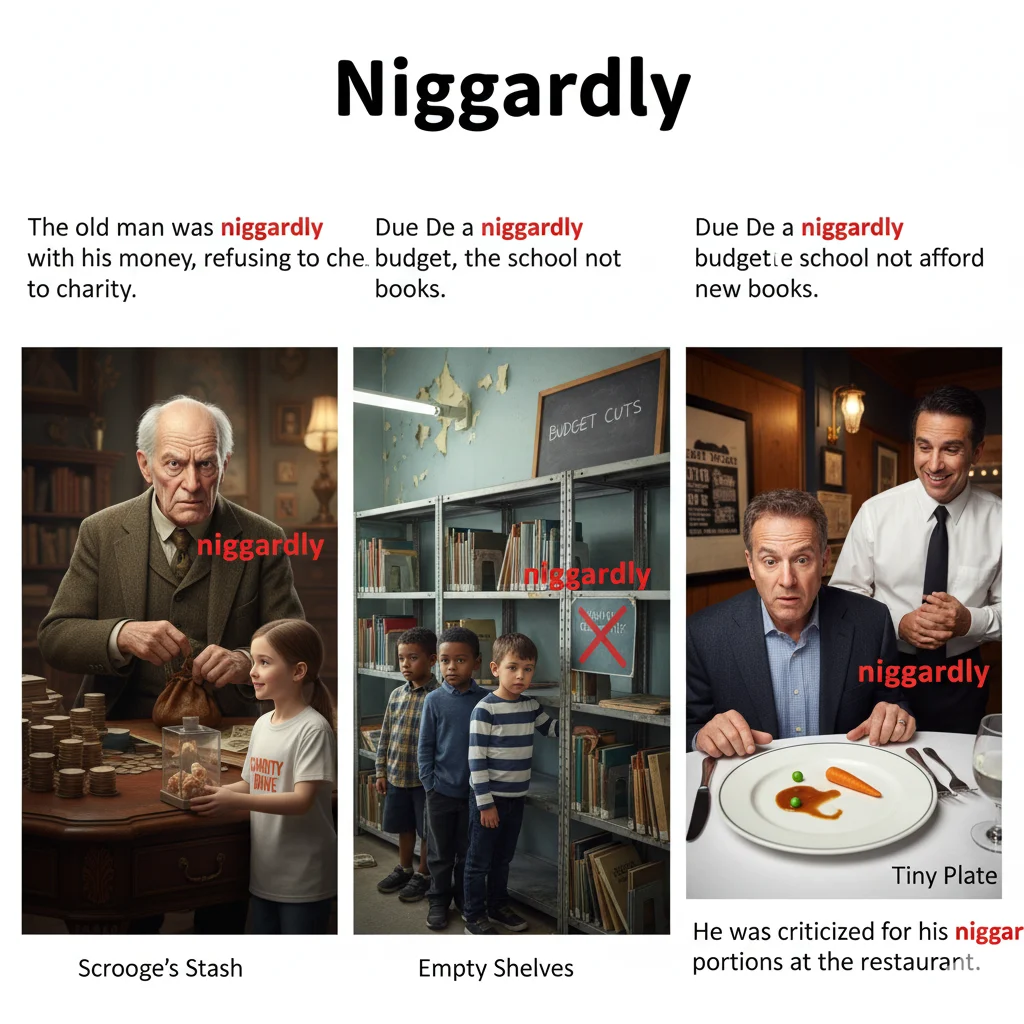
“He was too niggardly to light the fire, though the night was bitter.”
Formal Example:
“The board’s niggardly allocation of funds hindered project progress.”
Casual Example (less recommended):
“Don’t be so niggardly — share the snacks!”
Pro Tip: Use alternatives like stingy or tight-fisted in daily conversations for clarity and comfort.
More Examples of Niggardly in a Sentence
• “The manager was niggardly with bonuses.”
• “Her niggardly attitude toward charity surprised everyone.”
• “The company’s niggardly budget delayed progress.”
Similar or Related Terms
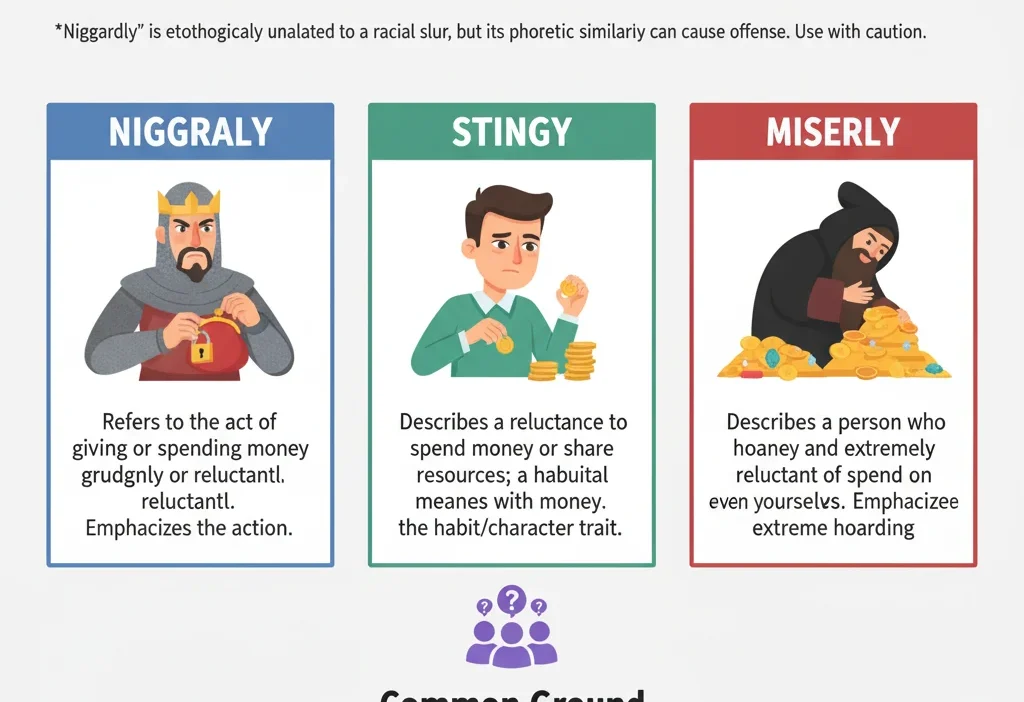
| Word | Meaning | Tone |
| Stingy | Unwilling to spend money or give generously. | Neutral / Common |
| Miserly | Extremely unwilling to spend money. | Strong / Slightly negative |
| Cheap | Not generous, or low in cost. | Informal |
| Tight-fisted | Reluctant to part with money. | Informal |
| Penny-pinching | Trying to save money in extreme ways. | Slightly humorous |
While all these share a similar meaning, “niggardly” remains the most formal and archaic among them.
Additional Synonyms of Niggardly
Other synonyms of niggardly include:
• parsimonious
• penny-pinching
• ungenerous
• tight-fisted
• miserly
These synonyms help explain niggardly meaning in English synonyms searches.
How to Use “Niggardly” Correctly
✅ Do’s:
- Use it in formal or literary writing to describe stinginess.
- Understand and, if needed, explain that it’s not offensive or racially derived.
❌ Don’ts:
- Avoid using it casually or in speech where it may be misheard or misunderstood.
- Don’t use it as slang — it’s not modern or colloquial.
Example:
✅ “The critic praised the novel’s detail but noted the author’s niggardly character development.”
❌ “He’s so niggardly with his DMs.” (Not appropriate for texting or casual use)
Common Mistakes or Misinterpretations
Because “niggardly” sounds like an offensive word, it’s often mistakenly thought to be racist — but this is entirely incorrect.
Key Clarifications:
- The word predates the racial slur by centuries.
- They have completely different origins and meanings.
- The only connection is phonetic coincidence.
Still, due to social sensitivity, most writers today avoid using “niggardly” in public or professional settings to prevent misunderstanding.
Is Niggardly a Bad Word?
Many people ask “is niggardly a bad word” or “is niggardly offensive.” The answer is no — the word itself is not racist and has a completely different origin.
However, because it sounds similar to an offensive term, many writers avoid using it to prevent misunderstanding.
🌍 Niggardly Meaning in Different Languages
Many readers search for niggardly meaning in Hindi, Urdu, or Bengali. The meaning stays the same across languages.
• Niggardly meaning in Hindi: कंजूस, कृपण
• Niggardly meaning in Urdu: کنجوس
• Niggardly meaning in Bengali: কৃপণ
In all languages, the word describes someone who is stingy or unwilling to spend.
FAQ Section
1. What does “niggardly” mean in simple words?
“Niggardly” means stingy or ungenerous. It describes someone who doesn’t like to spend or share resources freely.
2. Is “niggardly” an offensive word?
No, the word itself is not offensive and has no racial origin. However, because it sounds similar to a slur, it’s often avoided in modern use.
3. Where does the word “niggardly” come from?
It comes from Middle English “nigard” and Old Norse “nigla,” meaning to fuss about small things — a term describing meanness or stinginess.
4. Should I use “niggardly” in writing today?
It’s grammatically correct but best reserved for formal writing where readers understand its meaning. For clarity, “stingy” or “ungenerous” are safer alternatives.
5. What’s a synonym for “niggardly”?
Common synonyms include stingy, miserly, mean, frugal, or tight-fisted.
6. Why do people avoid using “niggardly”?
Because it sounds similar to a racial slur, people often avoid it to prevent misunderstanding or offense, even though the words are unrelated.
Conclusion
To sum it up, “niggardly” is a legitimate English word meaning stingy, ungenerous, or miserly, with origins in Middle English and Old Norse. Despite its long history, its phonetic similarity to a slur has led to widespread avoidance in modern speech.
Now that you know the true niggardly meaning, you can use it with confidence — or simply choose safer synonyms like stingy or cheap in casual conversations.
💡 Before you write it off completely, remember: knowing language history helps prevent unnecessary confusion!

Evie Wyld is a word-meaning specialist at Meanovia.com. She simplifies complex words, phrases, and language trends, helping readers quickly grasp the exact meaning behind every term in a clear and approachable way.