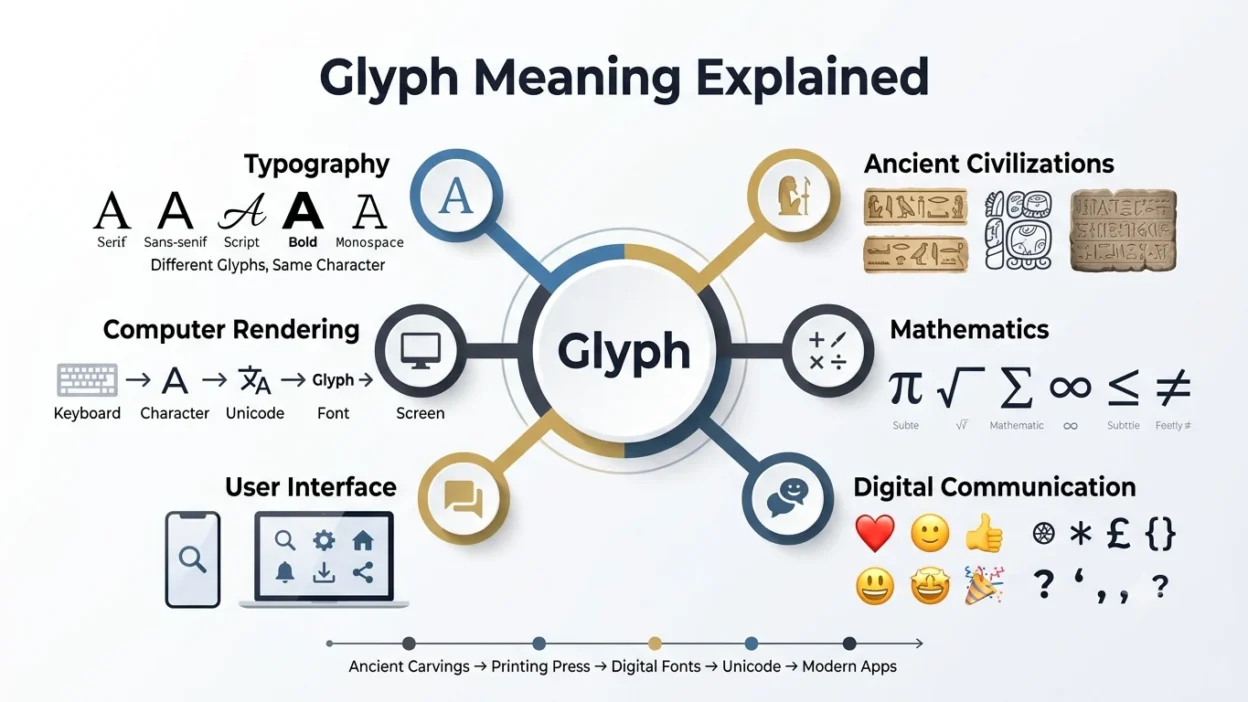
Have you ever come across the word “glyph” in typography, graphic design, Unicode, software, archaeology, or gaming and wondered why it seems to have a different meaning in each field? Glyph (pronounced GLIF) is a noun that refers to a visual symbol or shape used to represent a letter, number, character, idea, or piece of information.
Although the core idea is always a meaningful visual symbol, its exact definition changes with the context, which is why the term is often misunderstood. In typography and computing, a glyph is the visual appearance of a character, while a character is the underlying letter, number, or symbol itself.
In simple terms, a glyph is the visual form of something that conveys meaning. For example, the letter A displayed in a particular font is a glyph, while the letter A itself is the character it represents. Likewise, an ancient Egyptian hieroglyph is a glyph because it is a symbol used to communicate meaning. Today, glyphs are widely used in fonts, Unicode, graphic design, digital interfaces, icons, video games, and ancient writing systems, helping people communicate information quickly through visual symbols.
Whether you’ve encountered glyph in design software, programming, typography, history, or everyday reading, this guide explains its definition, pronunciation, origin, different meanings, real-life examples, the difference between glyph and character, and how to recognize and understand glyph confidently in any context.
What Does Glyph Mean?
Every day, you interact with hundreds of glyphs without even noticing them. The letters in this article, the numbers on your phone, the emoji in a text message, the search icon in an app, and even the mathematical symbols in a textbook are all examples of glyphs.
So, what does glyph mean?
A glyph is the visual representation of a character, symbol, or sign. It is the shape you actually see, whether it’s printed on paper, displayed on a screen, carved into stone, or shown in a digital interface.
Think of it this way:
- A character is the abstract identity, such as the letter A.
- A glyph is the way that character is drawn or displayed, such as A, 𝐀, 𝒜, or 𝔄 in different fonts.
Although each version looks different, they all represent the same character.
Glyphs are not limited to letters. They also include:
- Numbers (1, 2, 3)
- Punctuation marks (?, !, 🙂
- Mathematical symbols (π, √, ∞)
- Currency signs ($, €, £)
- Emojis (😊, ❤️)
- Software icons (🔍, ⚙️)
- Ancient carvings and inscriptions
In short, whenever information is communicated through a recognizable visual sign, you’re looking at a glyph.
Quick Fact: Most modern fonts contain thousands of glyphs, supporting multiple languages, mathematical symbols, punctuation marks, currency signs, and special characters—not just the English alphabet.
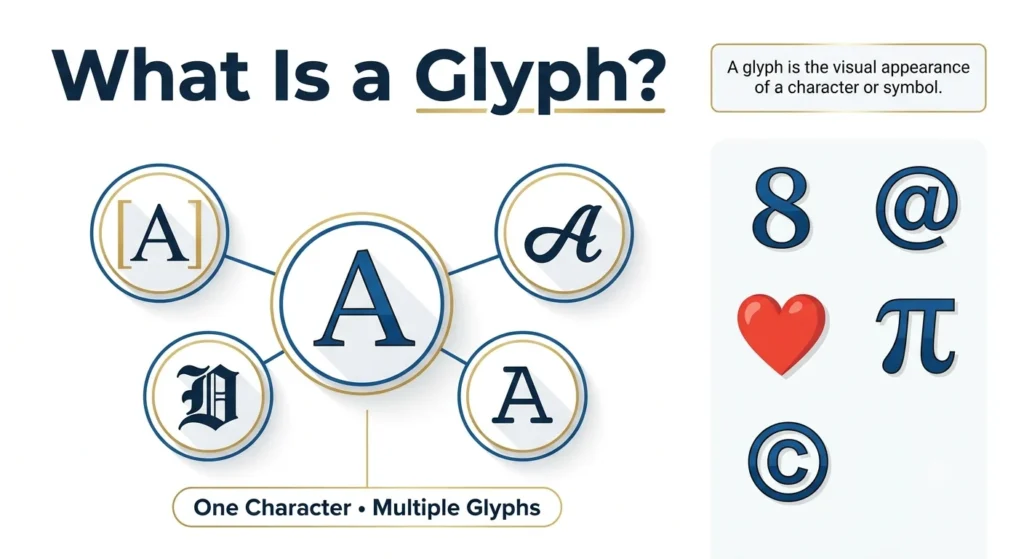
Glyph Definition
A glyph is the visible shape or graphical form used to represent a letter, number, punctuation mark, symbol, or other character in a writing system, font, or digital interface.
Simple Definition
A glyph is the visual appearance of a character or symbol.
For example, the character A can appear in many different fonts. Each visual version is a different glyph, even though the underlying character remains the same.
This distinction is especially important in typography, graphic design, publishing, software development, and digital communication.
What Is a Glyph?
A glyph is the specific visual design used to display a character or symbol. It determines how that character looks rather than what it represents.
Imagine writing the same word in different handwriting styles. The letters still represent the same word, but their appearance changes. Each appearance is a different glyph.
Glyphs can represent:
- Letters
- Numbers
- Punctuation
- Mathematical notation
- Musical symbols
- Currency signs
- Technical symbols
- Emojis
- Ancient writing
Real-World Example
The character A is always the same abstract letter.
However, these are different glyphs of the same character:
- A
- 𝐀
- 𝑨
- 𝒜
- 𝔄
The identity doesn’t change—only the visual design does.
Expert Insight: In digital typography, computers store characters as coded values (such as Unicode code points). Fonts then use glyphs to display those characters in a readable visual form.
Glyph Meaning in English
In English, the word glyph refers to a visual mark that represents a letter, number, symbol, sound, or idea.
It is commonly used in fields such as:
- Typography
- Graphic design
- Computer science
- Linguistics
- Archaeology
- User interface (UI) design
- Digital publishing
In Plain English
A glyph is simply what a character looks like.
For example:
- The letter B printed in two different fonts uses two different glyphs.
- The emoji ❤️ is a glyph that visually represents affection.
- The warning sign ⚠️ is a glyph that quickly communicates caution.
Because glyphs communicate visually, they help people understand information more quickly and consistently than words alone.
How to Pronounce Glyph
Pronunciation: /ɡlɪf/
Sounds like: GLIF
It rhymes with:
- cliff
- stiff
- sniff
Pronunciation Tip
Although glyph ends in “ph”, the letters ph produce an “f” sound.
Examples:
- Glyph → glif
- Graph → graf
- Paragraph → pair-uh-graf
Glyph in a Sentence
“The designer chose a cleaner glyph to improve readability across different screen sizes.”
Glyph Etymology (Word Origin)
The word glyph comes from the Ancient Greek verb glýphō (γλύφω), which means:
- to carve
- to engrave
- to chisel
Originally, the term described symbols carved into stone, wood, clay, or metal. Ancient civilizations used these carved marks to record names, religious beliefs, historical events, laws, and important messages.
As writing systems evolved, the meaning of glyph expanded. Today, it refers to the visual form of any character—whether it’s printed in a book, displayed in a digital font, shown as an emoji, or rendered on a smartphone screen.
Timeline of the Word “Glyph”
| Time | Development |
|---|---|
| 3000 BCE | Ancient civilizations use carved symbols and hieroglyphs. |
| Ancient Greece | The verb glýphō means “to carve” or “to engrave.” |
| Printing Era | Decorative and typographic glyphs become common in books. |
| Computer Age | Fonts store glyphs to display digital text accurately. |
| Today | Glyphs appear in typography, software, mathematics, emojis, and user interfaces worldwide. |
Why Glyphs Matter Today
You might never use the word glyph in everyday conversation, but you rely on glyphs every single day.
Without glyphs, you couldn’t:
- Read books or websites.
- Send text messages or emails.
- View emojis or icons.
- Solve mathematical equations.
- Read road signs or maps.
- Browse apps and software.
- Display text correctly in different languages.
Every digital device—from smartphones and laptops to smart TVs and e-readers—uses glyphs to display readable information.
Types of Glyphs
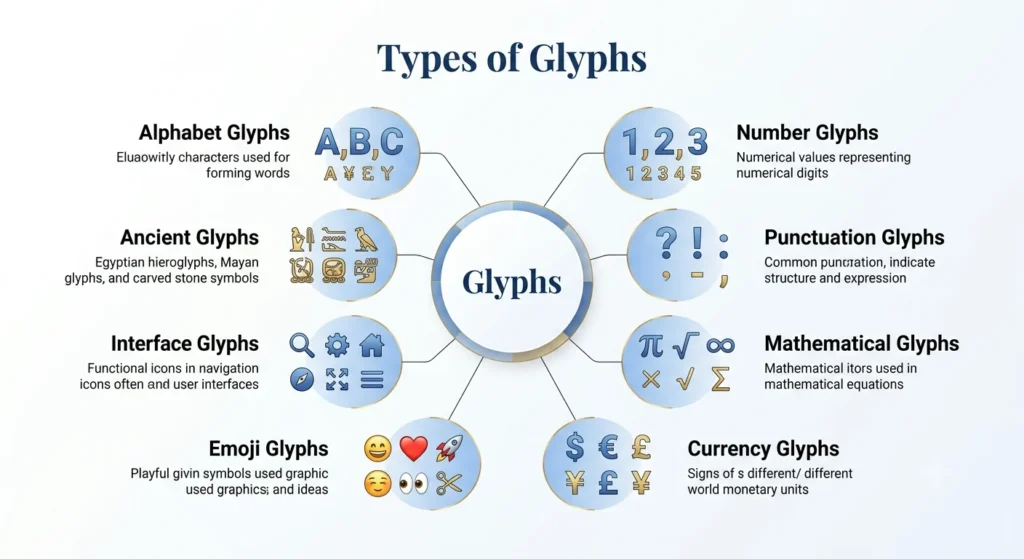
Although many people think glyphs are only ancient symbols, they actually appear in almost every form of modern communication. From the letters you read on this page to the icons on your smartphone, glyphs help transform information into recognizable visual forms.
Different glyphs serve different purposes, but they all have one thing in common—they communicate meaning through appearance.
Let’s explore the main types of glyphs you encounter every day.
1. Alphabet Glyphs
Alphabet glyphs are the visual forms of letters used in writing systems around the world.
For example:
- A
- B
- C
- X
- Z
Although these letters represent specific characters, their appearance changes depending on the font or handwriting style.
For example, the character A can appear as:
- A
- 𝐀
- 𝑨
- 𝒜
- 𝔄
Each version is a different glyph representing the same character.
Where You’ll See Alphabet Glyphs
- Books
- Websites
- Newspapers
- Mobile apps
- Logos
- Road signs
- School textbooks
2. Number Glyphs
Numbers also have glyphs.
Examples include:
- 0
- 1
- 2
- 3
- 4
- 5
- 6
- 7
- 8
- 9
Different fonts display these numbers differently while preserving their meaning.
For example, the number 4 looks different in many typefaces, but it still represents the same number.
3. Punctuation Glyphs
Punctuation marks are small glyphs that organize written language and improve readability.
Examples include:
- .
- ,
- !
- ?
- :
- ;
- “
- ‘
- ()
- []
Without punctuation glyphs, written communication would become much harder to understand.
4. Mathematical Glyphs
Mathematics relies heavily on glyphs because symbols communicate complex ideas quickly and accurately.
Common mathematical glyphs include:
| Glyph | Meaning |
|---|---|
| + | Addition |
| − | Subtraction |
| × | Multiplication |
| ÷ | Division |
| = | Equals |
| ≠ | Not Equal |
| ≤ | Less Than or Equal To |
| ≥ | Greater Than or Equal To |
| π | Pi |
| √ | Square Root |
| ∑ | Summation |
| ∞ | Infinity |
| % | Percentage |
Instead of writing long explanations, mathematicians use these glyphs to express concepts instantly.
Glyph Meaning in Maths
In mathematics, a glyph is a visual symbol that represents a mathematical operation, value, equation, or relationship. Symbols such as π, √, and ∞ are mathematical glyphs because they convey meaning through a standardized visual form.
5. Currency Glyphs
Currency symbols help identify different forms of money around the world.
Examples include:
- $
- €
- £
- ¥
- ₹
- ₩
These glyphs allow readers to recognize currencies immediately without reading lengthy text.
6. Emoji Glyphs
Emojis are among the most familiar glyphs in modern communication.
Examples include:
❤️ 😊 😂 👍 🎉 🚀 🌍 📚 💡 ⚠️
Although they look like pictures, emojis are digital characters displayed as glyphs by your device’s font system.
Interestingly, the same emoji can appear slightly different on Android, iPhone, Windows, and other platforms because each platform uses its own glyph design.
7. Icon Glyphs
Many apps and websites use glyph-based icons to help users navigate quickly.
Examples include:
🔍 Search
🏠 Home
⚙️ Settings
🗑️ Delete
🔒 Lock
📤 Share
📥 Download
❤️ Favorite
Because these glyphs communicate visually, users can understand their purpose even without reading text.
8. Ancient Glyphs
Long before modern alphabets existed, civilizations communicated using carved glyphs.
Ancient glyphs represented:
- Sounds
- Words
- Objects
- People
- Places
- Animals
- Religious beliefs
- Historical events
Famous examples include:
- Egyptian hieroglyphs
- Mayan glyphs
- Early Chinese characters
- Aztec glyphs
These writing systems preserved history, religion, science, trade, and culture for thousands of years.
Mensch Meaning Explained: Why It’s One of the Best Compliments
Glyph Examples
The easiest way to understand glyphs is to look at examples from everyday life.
| Glyph | Represents | Common Use |
|---|---|---|
| A | Letter | Writing |
| 8 | Number | Mathematics |
| @ | At sign | Email addresses |
| # | Hashtag or number sign | Social media |
| © | Copyright | Legal notices |
| ® | Registered trademark | Branding |
| ™ | Trademark | Business |
| π | Pi | Mathematics |
| √ | Square root | Mathematics |
| ∞ | Infinity | Mathematics |
| ❤️ | Love | Messaging |
| 😊 | Happiness | Social media |
| ⚠️ | Warning | Safety signs |
| ♻️ | Recycling | Environmental symbols |
| 🎵 | Music | Media apps |
Quick Fact: Even if you’ve never heard the word glyph, you’ve probably seen thousands of them today alone.
What Is a Glyph in Typography?
Typography is where the word glyph has its most precise technical meaning.
In typography, a glyph is the visual design used to display a character within a typeface or font.
Think about the letter A.
Although it represents one character, it can appear in countless visual styles depending on the font.
For example:
- Arial → A
- Times New Roman → A
- Georgia → A
- Garamond → A
Each appearance is a different glyph.
Why Typography Uses Glyphs
Professional fonts contain far more than just 26 letters.
A modern font may include:
- Uppercase letters
- Lowercase letters
- Numbers
- Punctuation
- Mathematical symbols
- Currency symbols
- Accented characters
- Arrows
- Ligatures
- Multilingual characters
Many professional fonts contain thousands of glyphs to support different languages and writing systems.
Expert Insight: A typeface defines the overall design style, while a font is the digital file that contains the glyphs used to display characters in that style.
What Is a Glyph in Fonts?
A font is a collection of glyphs designed to work together visually.
Each glyph represents a specific character, symbol, or punctuation mark within that font.
For example, one font may include glyphs for:
- English
- French
- Spanish
- German
- Greek
- Arabic
- Cyrillic
- Mathematical notation
- Currency symbols
- Technical symbols
Modern font technologies such as OpenType and TrueType support thousands of glyphs, alternate character forms, ligatures, and multilingual writing systems.
Glyph Meaning in Computer Science
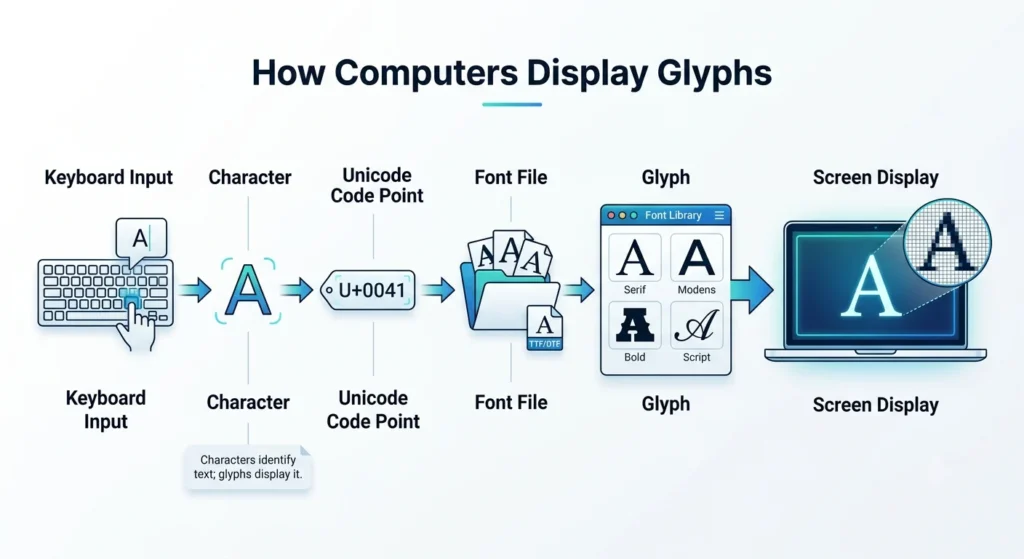
In computing, a glyph is the visual image displayed on your screen when a character is rendered by a font.
Here’s what happens when you press a key:
- You press a key on your keyboard.
- The computer identifies the character.
- The operating system reads its code point.
- The selected font finds the correct glyph.
- The glyph is displayed on your screen.
This entire process happens in milliseconds every time you type a message, open a webpage, or edit a document.
Why Computers Need Glyphs
Without glyphs:
- Text couldn’t appear on your screen.
- Websites couldn’t display readable content.
- Apps couldn’t show icons correctly.
- Multiple languages couldn’t be rendered accurately.
That’s why operating systems and software rely on standards like Unicode together with fonts that provide the necessary glyphs.
Glyph Meaning in Computer
In everyday computer use, a glyph is simply the visible symbol that represents a character on your screen.
Examples include:
- Letters
- Numbers
- Keyboard symbols
- Emojis
- Menu icons
- Mathematical signs
Every time your computer displays text, it is rendering glyphs from a font.
Glyph Interface Meaning
If you’ve searched for Glyph Interface, you were probably looking for the feature found on Nothing smartphones.
The Glyph Interface is a unique LED lighting system built into the back of compatible Nothing phones. Instead of using only sounds or vibrations, the phone communicates through customizable light patterns.
The Glyph Interface can show:
- Incoming calls
- Notifications
- Charging progress
- Timers
- Music synchronization
- App alerts
Although it shares the same word, the Glyph Interface is a product name inspired by the idea of visual communication rather than a traditional writing glyph.
Common Misconception: The Nothing Phone’s Glyph Interface is not a writing glyph. It’s a branded visual notification system that uses light patterns to communicate information.
Why Glyphs Matter in Everyday Life
You don’t need to be a designer, programmer, or historian to benefit from understanding glyphs.
Every day, glyphs help you:
- Read books and articles
- Send text messages
- Use emojis
- Navigate apps
- Interpret road signs
- Solve math problems
- Recognize logos
- Read prices
- Understand warning symbols
- Use software efficiently
From ancient carvings to modern smartphones, glyphs remain one of humanity’s most effective ways to communicate visually.
WDYM Meaning 📱 | Text, Chat & Slang Definition
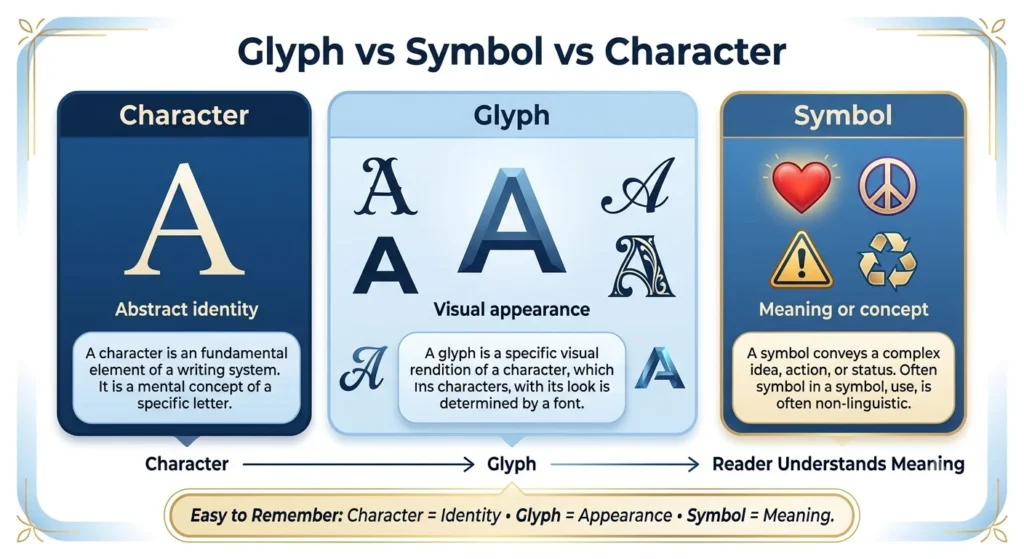
Glyph vs Symbol: What’s the Difference?
Many people use the words glyph and symbol interchangeably, but they don’t mean exactly the same thing.
A glyph is the visual shape used to display a character or sign.
A symbol is the idea, meaning, or concept that the visual shape represents.
For example:
- ❤️ is the glyph you see.
- Love or affection is the symbolic meaning it conveys.
Likewise:
- + is the glyph.
- Addition is the mathematical concept it symbolizes.
Understanding this distinction helps explain why the same symbol can appear in different visual styles while keeping the same meaning.
Glyph vs Symbol Comparison
| Glyph | Symbol |
|---|---|
| The visible shape of a character or sign | The meaning represented by that shape |
| Focuses on appearance | Focuses on meaning |
| Used in fonts, typography, and digital displays | Used in communication, language, mathematics, religion, and culture |
| Can represent letters, numbers, punctuation, icons, or emojis | Represents ideas, actions, emotions, or concepts |
Quick Tip:
Glyph = What you see
Symbol = What it means
Glyph vs Character
This is one of the most commonly misunderstood concepts.
A character is an abstract unit of writing, such as the letter A.
A glyph is the way that character is displayed.
For example, these are all different glyphs of the same character:
- A
- 𝐀
- 𝑨
- 𝒜
- 𝔄
The identity of the character never changes—only its appearance does.
Comparison Table
| Character | Glyph |
|---|---|
| Abstract text element | Visual representation |
| Stored digitally | Displayed visually |
| Independent of style | Changes with fonts and formatting |
| Usually one identity | May have multiple visual forms |
Expert Insight:
Modern operating systems store characters internally, then use fonts to render the correct glyphs on your screen.
Glyph vs Icon
Glyphs and icons often look similar, especially in mobile apps and websites, but they serve slightly different purposes.
A glyph is generally the visual form of a character or sign.
An icon is a graphic designed to represent an action, object, feature, or concept.
Examples of icons include:
- 🔍 Search
- 🏠 Home
- ⚙️ Settings
- 🗑️ Delete
- 📤 Share
Many software icons are intentionally designed as simple glyphs because they remain clear even at small sizes.
Comparison
| Glyph | Icon |
|---|---|
| Represents a character or visual sign | Represents an action or object |
| Common in writing systems and fonts | Common in apps, software, and websites |
| Often tied to text rendering | Often used for navigation or controls |
Glyph vs Hieroglyph
People often associate glyphs with ancient Egypt because of hieroglyphs, but the two terms are not identical.
A hieroglyph is a specific type of glyph used in the ancient Egyptian writing system.
That means:
- Every hieroglyph is a glyph.
- Not every glyph is a hieroglyph.
Examples:
| Example | Glyph? | Hieroglyph? |
|---|---|---|
| Letter A | ✅ | ❌ |
| Emoji 😊 | ✅ | ❌ |
| π | ✅ | ❌ |
| Egyptian owl symbol | ✅ | ✅ |
Think of glyph as the broad category and hieroglyph as one specific member of that category.
Glyph vs Emoji
Emojis are among the newest and most recognizable forms of glyphs.
An emoji is a standardized digital character used to represent emotions, people, objects, places, or activities.
The visual image of that emoji is the glyph displayed by your device.
For example, 😊 may look slightly different on Android, iPhone, Windows, or other platforms because each platform provides its own glyph design.
Comparison
| Glyph | Emoji |
|---|---|
| Broad term covering visual representations | A specific category of digital characters |
| Includes letters, numbers, punctuation, and symbols | Mainly expresses emotions, objects, and activities |
| Used in many fields | Mainly used in digital communication |
Glyph vs Sigil
The words glyph and sigil are sometimes confused, especially in fantasy games, mythology, and fictional stories.
A glyph communicates language, sounds, or information.
A sigil is usually a symbolic design associated with rituals, spirituality, magic, or fictional worlds.
For example:
- A magical rune in a fantasy game may be called a sigil.
- The letters used in the game’s dialogue are glyphs.
Comparison
| Glyph | Sigil |
|---|---|
| Used in writing and communication | Used in mystical or symbolic traditions |
| Represents characters or ideas | Represents intentions, rituals, or magical concepts |
| Practical and linguistic | Ceremonial or fictional |
Glyph Synonyms
The best synonym depends on the context.
Common alternatives include:
- Character
- Symbol
- Sign
- Mark
- Figure
- Emblem
- Pictograph
- Ideogram
- Graphic character
- Visual mark
However, in typography and computer science, glyph has a specific technical meaning that most synonyms cannot fully replace.
Glyph Meaning for Kids
A glyph is a picture, letter, number, or symbol that helps people understand something.
For example:
- 😊 means someone is happy.
- ❤️ can show love.
- A is a letter.
- ★ is a star symbol.
These are all glyphs because they visually communicate information.
Easy Definition for Kids:
A glyph is a shape or picture that tells you something without needing a long explanation.
Common Misconceptions About Glyphs
Many beginners misunderstand what glyphs are. Here are a few common myths:
Myth 1: Glyphs only exist in ancient writing.
Reality: Modern fonts, websites, apps, emojis, and mathematical notation all use glyphs.
Myth 2: Every symbol is automatically a glyph.
Reality: A glyph refers to the visual form. The symbol refers to the meaning.
Myth 3: A character has only one glyph.
Reality: The same character can have many glyphs depending on the font, language, or stylistic variation.
Myth 4: Glyphs are only letters.
Reality: Glyphs also include numbers, punctuation, mathematical symbols, currency signs, icons, and emojis.
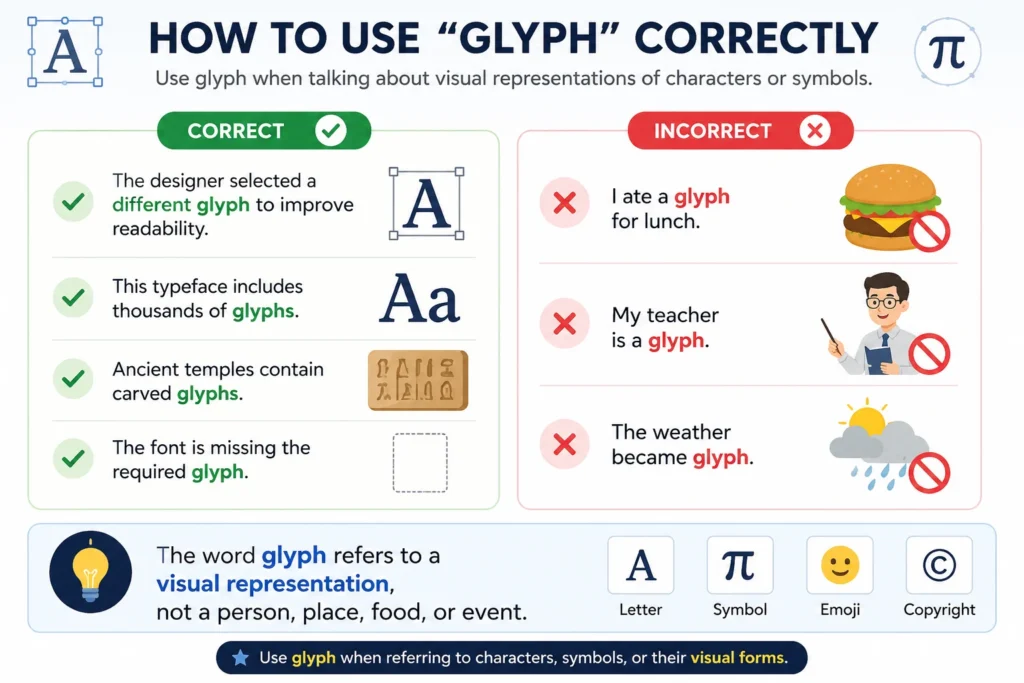
How to Use “Glyph” Correctly
Here are examples of natural usage:
Correct
✔ “The designer selected a different glyph to improve readability.”
✔ “This typeface includes thousands of glyphs.”
✔ “Ancient temples contain carved glyphs.”
✔ “The font is missing the required glyph.”
Incorrect
✘ “I ate a glyph for lunch.”
✘ “My teacher is a glyph.”
✘ “The weather became glyph.”
The word glyph refers to a visual representation, not a person, place, food, or event.
Glyph in a Sentence
Here are examples across different contexts:
- “The font contains more than 3,000 glyphs.”
- “Archaeologists discovered stone glyphs dating back centuries.”
- “The designer adjusted the glyph spacing for better readability.”
- “Unicode assigns characters, while fonts display glyphs.”
- “The textbook explains how mathematical glyphs simplify equations.”
Why Understanding Glyphs Is Useful
Knowing what a glyph is helps you understand:
- How fonts work.
- Why text looks different across devices.
- How computers display characters.
- How writing systems evolved.
- Why emojis can vary between platforms.
- How designers create readable interfaces.
- How ancient civilizations recorded information.
Whether you’re a student, designer, developer, writer, or simply curious, understanding glyphs makes digital and written communication much easier to appreciate.
Frequently Asked Questions
What is the definition of a glyph?
A glyph is the visual form of a letter, number, punctuation mark, symbol, or character. It is the shape you see on a page or screen rather than the abstract character it represents.
What does glyph mean in English?
In English, glyph refers to a visual mark or symbol used to represent language, numbers, ideas, or information. The term is widely used in typography, computing, design, archaeology, and digital communication.
What is a glyph in simple words?
Simply put, a glyph is how a letter, number, or symbol looks.
For example, the letter A, the number 5, and the emoji 😊 are all displayed as glyphs.
What is an example of a glyph?
Common examples include:
- A
- 8
- @
- π
- √
- ∞
- ❤️
- ©
- ™
Each one is a visual representation used to communicate information.
What is another word for glyph?
Depending on the context, similar words include:
- Symbol
- Character
- Sign
- Mark
- Figure
- Pictograph
- Ideogram
- Emblem
However, glyph has a more precise technical meaning in typography and computing.
What is the difference between a glyph and a symbol?
A glyph is the visual appearance of a character or sign, while a symbol is the idea or meaning that the visual form represents.
What is the difference between a glyph and a character?
A character is an abstract unit of writing.
A glyph is the visual representation used to display that character.
One character can have many different glyphs depending on the font or writing style.
What is a glyph in typography?
In typography, a glyph is the individual visual design used to display a character within a font or typeface.
What is a glyph in fonts?
A font is a collection of glyphs designed in a consistent visual style. Professional fonts often contain thousands of glyphs supporting multiple languages, symbols, and writing systems.
What is a glyph in computer science?
In computing, a glyph is the visual image displayed on the screen when software renders a digital character using a font.
What is a glyph in maths?
In mathematics, glyphs are visual symbols representing operations or concepts, such as:
-
- −
- ×
- ÷
- π
- √
- ∞
- ∑
These symbols simplify mathematical communication.
What is the Glyph Interface?
The Glyph Interface is the LED notification system used on compatible Nothing smartphones. It uses customizable light patterns to display notifications, charging status, timers, and other alerts.
What does “No Glyph” mean?
“No Glyph” usually means the required visual representation cannot be displayed because the selected font does not contain that glyph.
What is a .notdef glyph?
A .notdef glyph is a placeholder shown when a font does not include the glyph needed for a particular character. It often appears as an empty square or box.
How do you pronounce glyph?
Glyph is pronounced:
/ɡlɪf/
It rhymes with cliff.
Are emojis glyphs?
Yes. Emojis are digital characters displayed as glyphs. Their appearance may vary between devices because different platforms use different glyph designs.
Are icons glyphs?
Some icons are implemented as glyphs, particularly in icon fonts. However, not every icon is technically considered a glyph.
Where are glyphs used?
Glyphs appear in:
- Books
- Websites
- Mobile apps
- Fonts
- User interfaces
- Mathematics
- Road signs
- Maps
- Software
- Ancient writing systems
- Digital communication
Why are glyphs important?
Glyphs allow humans and computers to display information visually. Without glyphs, written language, mathematical notation, user interfaces, and digital communication would not function as we know them.
Glossary
Character: An abstract letter, number, or symbol.
Glyph: The visible form used to display a character.
Typeface: The overall visual design of a family of characters.
Font: A digital file containing glyphs in a specific style and size.
Unicode: An international standard that assigns unique code points to characters from many writing systems.
Ligature: A single glyph that combines two or more characters into one connected design.
Icon: A graphic representing an object, feature, or action.
Emoji: A standardized digital character displayed as a glyph.
Key Takeaways
- A glyph is the visual appearance of a character or symbol.
- Glyphs include letters, numbers, punctuation, mathematical symbols, emojis, icons, and ancient carvings.
- One character can have multiple glyphs depending on the font or style.
- Glyphs are essential in typography, computing, mathematics, design, and written communication.
- Understanding glyphs helps explain how text, fonts, and digital interfaces work.
Conclusion
Glyphs have shaped human communication for thousands of years, from ancient carvings etched into stone to the digital text and icons we interact with every day. Although most people use glyphs constantly without realizing it, they are fundamental to how we read, write, design, and communicate.
Whether you’re exploring typography, studying history, learning graphic design, developing software, or simply curious about language, understanding glyphs gives you a deeper appreciation of how information is represented visually.
The next time you type a message, read a book, use an emoji, or recognize a familiar icon, you’ll know you’re interacting with glyphs—the visual building blocks of communication.

Ethan Cole is a content writer at Meanovia who explains internet slang, texting abbreviations, and social media language in a simple and reader-friendly way._)