
Have you ever heard someone call a movie, comedian, or person irreverent and wondered whether it was meant as a compliment or an insult? You’re not alone.
In short, irreverent describes someone or something that deliberately shows little respect for people, traditions, beliefs, or institutions that are usually treated with seriousness or reverence. However, its meaning isn’t always negative. In many cases, irreverent is used to praise bold humor, fearless creativity, sharp satire, and the confidence to challenge conventional thinking, while in others it can imply disrespect or offensiveness, depending on the context.
Whether you’ve encountered the word in books, movies, news articles, social media, or everyday conversations, understanding its true meaning helps you interpret it correctly. This guide explains the irreverent meaning, pronunciation, origin, synonyms, antonyms, examples, and exactly how to use irreverent naturally and confidently in real-life English without confusing it with rude, offensive, or disrespectful.
🤔 What Does Irreverent Mean?
Have you ever watched a comedian make fun of politics, religion, celebrities, or social traditions and heard someone describe the performance as “irreverent”?
Or maybe you noticed Netflix describing a TV show as having an irreverent sense of humor and wondered what that actually means.
You’re not alone.
Every month, thousands of people search for:
- irreverent meaning
- what does irreverent mean
- define irreverent
- irreverent definition
- irreverent humor meaning
- irreverence meaning
- what is irreverent
because the word appears everywhere—from comedy specials and movie reviews to books, podcasts, journalism, and everyday conversations.
The good news is that understanding irreverent is much easier than it first appears.
In this complete guide, you’ll learn its meaning in simple English, pronunciation, origin, examples, synonyms, antonyms, common mistakes, and exactly when it’s appropriate to use the word naturally.
Whether you’re a student, writer, English learner, or simply curious about vocabulary, this guide will answer every common question about irreverent in one place.
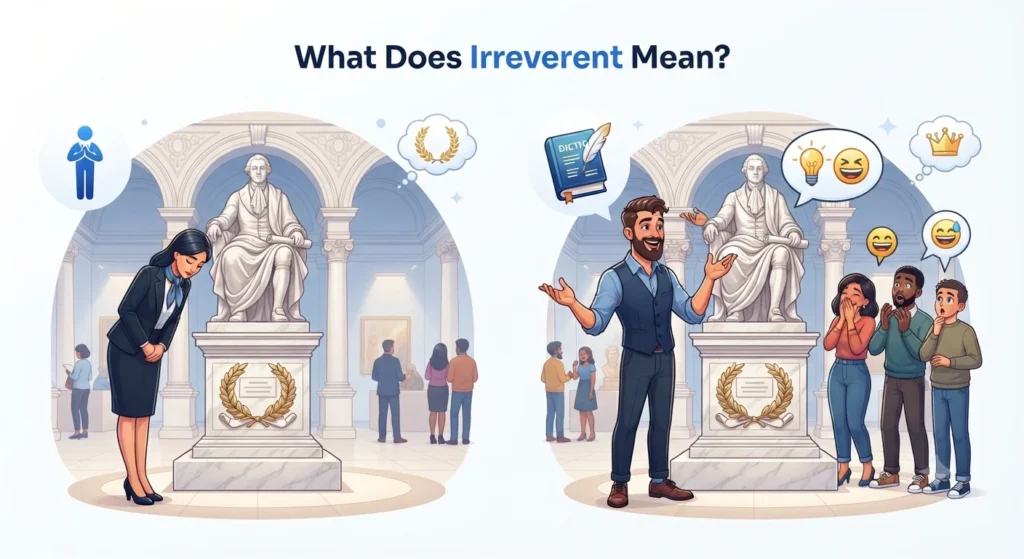
📖 Irreverent Meaning in Simple English
The simplest way to understand irreverent is this:
Someone who is irreverent doesn’t treat certain people, ideas, traditions, or institutions with the serious respect that others usually expect.
Instead, they may use:
- humor
- satire
- clever jokes
- playful criticism
- bold opinions
- unconventional thinking
to express themselves.
Being irreverent doesn’t automatically mean being rude.
In many situations, it simply means looking at serious topics from a fresh, humorous, or unconventional perspective.
Simple Definition
Irreverent = Respecting ideas less formally than expected, often with humor or wit.
📚 Irreverent Definition
The definition of irreverent is:
An adjective describing a person, comment, action, style, or piece of writing that shows little respect toward something generally considered important, traditional, or sacred.
The word is commonly used to describe:
- humor
- comedy
- television shows
- movies
- books
- journalism
- advertising
- speeches
- personalities
- social media content
💡 What Does It Mean to Be Irreverent?
Many people mistakenly believe irreverent simply means “disrespectful.”
That’s only part of the story.
Someone who is irreverent usually:
✔ questions traditions
✔ challenges authority
✔ jokes about serious topics
✔ enjoys satire
✔ thinks independently
✔ isn’t afraid to express unusual opinions
The key difference is intent.
An irreverent person often wants to entertain, encourage discussion, or challenge assumptions—not deliberately insult others.
🚦How to Recognize Irreverent Behavior
One reason people misunderstand this word is because irreverence can look very different depending on the situation.
Ask yourself these questions:
- Is the person making light of a serious topic?
- Are they using humor instead of direct criticism?
- Are they challenging authority or traditions?
- Is the goal to entertain, provoke thought, or simply shock?
- Could different audiences react differently?
If the answer to several of these questions is yes, the behavior is probably irreverent.
Example
A comedian joking about politicians during a stand-up show is often considered irreverent, while someone insulting another person without humor is usually just disrespectful.
🎙️ How to Pronounce Irreverent
Pronunciation
ih-REV-er-uhnt
IPA
/ɪˈrɛvərənt/
Syllables
Ir • rev • er • ent
Stress the second syllable (REV).
🔤 Part of Speech
Irreverent is an adjective.
It describes:
- a person
- humor
- behavior
- writing
- speech
- personality
- attitude
- style
- comedy
- movies
🧩 Word Forms
| Word | Part of Speech | Meaning |
|---|---|---|
| Irreverent | Adjective | Showing less respect than expected |
| Irreverently | Adverb | In an irreverent way |
| Irreverence | Noun | The quality of being irreverent |
| Reverent | Adjective | Showing deep respect |
| Reverence | Noun | Deep admiration or respect |
🌍 Origin and Etymology
The word irreverent has been part of the English language for more than 500 years.
It comes from the Latin word irreverentem, meaning “without respect” or “not showing reverence.”
From Latin, it passed through Middle French before entering English during the fifteenth century.
Originally, it was used almost exclusively in religious writing to describe behavior that showed insufficient respect toward sacred beliefs or religious traditions.
Over time, the meaning broadened.
Today, irreverent commonly appears in discussions about:
- comedy
- journalism
- politics
- entertainment
- literature
- advertising
- podcasts
- social media
- popular culture
📅 Evolution of the Word
1400s
Used mainly in religious texts.
1700s
Appeared in literature and philosophy.
Early 1900s
Became associated with satire and journalism.
Modern English
Frequently used to describe comedy, creative writing, films, television, podcasts, stand-up comedians, and people with bold personalities.
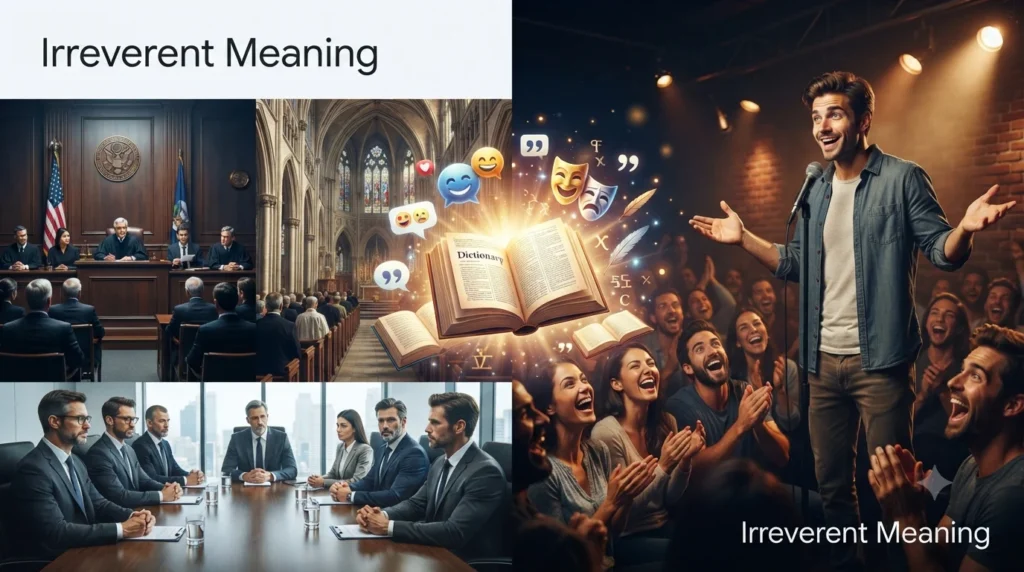
⭐ Why Is “Irreverent” So Popular Today?
Modern audiences generally appreciate creativity and authenticity.
Instead of always accepting traditions without question, many comedians, writers, filmmakers, and content creators use irreverent humor to explore serious topics from fresh perspectives.
That’s why you’ll often see irreverent in reviews of:
- Netflix shows
- Stand-up comedy specials
- Satirical news programs
- Podcasts
- Novels
- YouTube creators
- Advertising campaigns
Reviewers often use the word as a compliment because it suggests originality, confidence, and clever storytelling rather than ordinary humor.
Duly Noted Meaning Explained in Simple Words 📝 |
📌 Quick Facts About “Irreverent”
| Question | Answer |
|---|---|
| Meaning | Showing less respect than expected, often humorously |
| Pronunciation | ih-REV-er-uhnt |
| Part of Speech | Adjective |
| Noun Form | Irreverence |
| Adverb | Irreverently |
| Opposite | Reverent |
| Common Contexts | Comedy, movies, books, journalism, social media |
| Positive or Negative? | Depends entirely on context |
🌍 Irreverent Meaning in Different Contexts
The meaning of irreverent stays the same at its core—showing less respect than expected for something serious—but the way people interpret it changes depending on the context.
In some situations, irreverence is praised as creative and witty. In others, it may be seen as inappropriate or offensive. Understanding these differences will help you use the word accurately in conversations, writing, and professional settings.
🎭 Irreverent Humor Meaning
One of the most searched questions is “What is irreverent humor?”
Irreverent humor is a style of comedy that playfully challenges people, traditions, beliefs, or institutions that are normally treated with seriousness. Rather than avoiding sensitive topics, it uses wit, exaggeration, satire, or irony to encourage laughter and discussion.
Unlike insults, irreverent humor often aims to make people think while entertaining them.
Common Topics in Irreverent Humor
- Politics
- Religion
- History
- Social customs
- Pop culture
- Celebrities
- Business
- Technology
- Everyday life
Examples of Irreverent Humor
✔ A comedian joking about politicians.
✔ A sitcom making fun of office culture.
✔ A parody video about famous historical events.
✔ A satirical newspaper cartoon.
Example: The comedian’s irreverent humor challenged political stereotypes without attacking individuals personally.
🎬 Irreverent Comedy Meaning
Irreverent comedy is comedy that ignores traditional limits and uses bold, unexpected humor to question authority, social rules, or popular opinions.
This style often combines:
- Satire
- Irony
- Clever dialogue
- Self-awareness
- Unexpected twists
- Social commentary
Many award-winning comedians and television writers are known for their irreverent style because it feels fresh, fearless, and memorable.

🎥 Irreverent Movie Meaning
When critics describe a movie as irreverent, they usually mean it doesn’t take traditional heroes, institutions, or serious subjects too seriously.
Instead, the film may:
- Break storytelling rules
- Make fun of familiar clichés
- Challenge authority figures
- Mix serious themes with comedy
- Surprise viewers with unconventional humor
Example
The movie’s irreverent take on superhero culture made it one of the year’s most talked-about films.
📺 What Does “Irreverent” Mean on Netflix?
If you’ve seen “irreverent” in a Netflix description, it usually tells viewers what kind of humor or storytelling to expect.
On Netflix, irreverent often describes shows or movies that feature:
- Edgy comedy
- Bold dialogue
- Satirical characters
- Unexpected jokes
- Creative storytelling
- Unconventional perspectives
It doesn’t necessarily mean offensive content—it usually means the story challenges expectations in a humorous or original way.
📰 Irreverent Meaning in Journalism
In journalism, an irreverent style refers to writing that questions authority, traditions, or current events through wit and satire instead of formal language.
Many opinion writers and columnists use irreverence to make complicated topics easier to understand and more engaging for readers.
Example
The columnist’s irreverent articles encouraged readers to think differently about politics.
📖 Irreverent Meaning in Literature
Authors often use an irreverent tone to create memorable characters or challenge accepted beliefs.
An irreverent narrator may:
- Question traditions.
- Ignore social expectations.
- Use witty observations.
- Make readers reconsider familiar ideas.
This writing style is especially common in satire, dark comedy, and modern fiction.
💼 Irreverent Meaning in the Workplace
In professional settings, being irreverent can have both advantages and disadvantages.
Positive
- Encourages innovation.
- Challenges outdated practices.
- Makes meetings more engaging.
- Inspires creative thinking.
Negative
- May appear disrespectful.
- Can upset formal workplaces.
- Risks misunderstanding.
- May seem unprofessional if poorly timed.
Example
Her irreverent approach encouraged fresh ideas, although some senior managers preferred a more traditional style.
🎓 Irreverent Meaning in Education
Teachers sometimes describe students as irreverent when they question accepted ideas with humor or creative thinking.
For example:
His irreverent questions challenged the class to think more critically.
In educational settings, irreverence is often appreciated when it encourages respectful discussion rather than disruption.
⛪ Irreverent Meaning in Religion
Historically, irreverent was most commonly used in religious contexts.
It referred to behavior showing insufficient respect toward:
- Sacred places
- Religious ceremonies
- Holy books
- Spiritual beliefs
- Worship traditions
Because these subjects are deeply meaningful to many people, irreverence may be viewed as offensive depending on the audience and cultural setting.
📱 Irreverent Meaning on Social Media
Today, many viral creators build their popularity through an irreverent style.
Examples include:
- Satirical memes
- Funny reaction videos
- Parody accounts
- Bold commentary
- Creative storytelling
- Playful criticism of trends
This approach often attracts younger audiences because it feels authentic and unexpected.
😊 Is Irreverent Positive or Negative?
This is one of the most common questions people ask.
The answer is:
It depends on the context.
Irreverence is not automatically good or bad.
It depends on:
- who is speaking,
- what they are talking about,
- the audience,
- and the intention behind the words.
When Irreverent Is Positive
People often use irreverent as a compliment when describing someone who is:
- Creative
- Original
- Fearless
- Witty
- Entertaining
- Independent
- Thought-provoking
Example:
The author’s irreverent writing style attracted millions of readers.
When Irreverent Is Negative
Others use it negatively when someone appears:
- Offensive
- Insensitive
- Mocking
- Inappropriate
- Needlessly disrespectful
Example:
Some viewers considered the jokes irreverent because they targeted sensitive cultural traditions.
🚦When Should You Use the Word “Irreverent”?
Use irreverent when describing someone or something that challenges serious topics through humor, creativity, or unconventional thinking.
It’s commonly used for:
✔ comedians
✔ writers
✔ journalists
✔ filmmakers
✔ podcasts
✔ advertisements
✔ speeches
✔ books
✔ television shows
✔ social media creators
Avoid using it when simple words like rude, impolite, or offensive describe the situation more accurately.
Bonafide Meaning: The True Meaning Behind This Trusted Word
⚖️ Irreverent vs. Disrespectful
Many people think these words are interchangeable, but they’re not.
| Irreverent | Disrespectful |
|---|---|
| Often playful | Usually rude |
| May be humorous | Rarely humorous |
| Can challenge ideas creatively | Usually ignores courtesy |
| Sometimes complimentary | Almost always negative |
| Often associated with satire | Usually associated with poor manners |
Example
Irreverent
The comedian challenged political traditions through clever jokes.
Disrespectful
The student interrupted the teacher repeatedly.
😄 Irreverent vs. Sarcastic
| Irreverent | Sarcastic |
|---|---|
| Questions respected ideas | Uses irony in speech |
| Describes attitude | Describes communication style |
| Often playful | Often sharp |
| Can include satire | May simply criticize |
🎭 Irreverent vs. Satirical
These two terms are closely related but not identical.
| Irreverent | Satirical |
|---|---|
| Challenges seriousness | Uses humor to criticize society |
| Doesn’t always have a message | Usually has a clear purpose |
| May simply entertain | Often aims to inspire change |
Many satirical works are irreverent, but not every irreverent joke is satire.
🔥 Irreverent vs. Offensive
This distinction is especially important.
| Irreverent | Offensive |
|---|---|
| Often playful | Intentionally or unintentionally hurtful |
| Can encourage discussion | Usually causes discomfort |
| Humor is common | Humor may not be present |
| Context matters | Usually viewed negatively |
Someone can be irreverent without being offensive.
🧠 Why Do People Misunderstand “Irreverent”?
Many people confuse irreverence with rudeness because both involve challenging expectations.
However, intent is the key difference.
An irreverent person often wants to:
- entertain,
- encourage critical thinking,
- question traditions,
- or introduce a fresh perspective.
A disrespectful person is more likely to ignore courtesy or deliberately offend others.
That’s why understanding the context is essential before deciding whether irreverence is appropriate.

💬 Real-Life Examples of Irreverent
At Work
“His irreverent presentation challenged old business practices without insulting anyone.”
In School
“The student’s irreverent question sparked a thoughtful classroom discussion.”
Movie Review
“Critics praised the film’s irreverent sense of humor and original storytelling.”
Social Media
“Her irreverent videos became popular because they challenged internet trends in a funny way.”
Family Conversation
“His irreverent jokes made everyone laugh, although his grandparents weren’t impressed.”
Book Review
“The novel’s irreverent narrator gave readers a fresh perspective on history.”
🔄 Irreverent Synonyms
If you’re looking for another word for irreverent, the right synonym depends on the context. Some words emphasize humor, while others focus on boldness or disrespect.
| Synonym | Meaning | Best Used For |
|---|---|---|
| Satirical | Uses humor to criticize | Writing, comedy |
| Witty | Clever and funny | Humor |
| Cheeky | Playfully disrespectful | Informal speech |
| Defiant | Challenges authority | Personality |
| Rebellious | Opposes rules or traditions | Behavior |
| Audacious | Fearlessly bold | Positive descriptions |
| Flippant | Doesn’t take serious matters seriously | Negative contexts |
| Insolent | Rudely disrespectful | Formal writing |
| Mocking | Making fun of someone or something | Humor |
| Provocative | Intended to challenge opinions | Journalism |
| Bold | Confident and unconventional | General |
| Unconventional | Different from tradition | Creative work |
| Maverick | Independent thinker | Leadership |
| Iconoclastic | Challenges accepted beliefs | Academic writing |
| Nonconformist | Rejects social norms | Lifestyle |
Which synonym should you use?
- Satirical → when humor criticizes society.
- Cheeky → for playful jokes.
- Defiant → when someone openly resists authority.
- Witty → when the focus is clever humor.
- Irreverent → when humor or behavior challenges something treated seriously.
⬅️ Antonyms of Irreverent
The opposite of irreverent is showing respect, admiration, or seriousness.
- Reverent
- Respectful
- Polite
- Courteous
- Humble
- Considerate
- Deferential
- Obedient
- Formal
- Respectable
🧩 Common Word Combinations (Collocations)
Native English speakers frequently pair irreverent with these words:
- irreverent humor
- irreverent comedy
- irreverent joke
- irreverent attitude
- irreverent tone
- irreverent personality
- irreverent behavior
- irreverent speech
- irreverent style
- irreverent writer
- irreverent journalist
- irreverent podcast
- irreverent movie
- irreverent TV show
- irreverent advertising
- irreverent campaign
- irreverent commentary
- irreverent storytelling
- irreverent social media content
- irreverent point of view
These combinations make your writing sound natural and fluent.
📝 Irreverent Meaning Examples (Real-Life Sentences)
Here are practical examples that show how the word is used in everyday English.
- The comedian’s irreverent humor made everyone laugh.
- Her irreverent attitude challenged office traditions.
- The movie has an irreverent tone from beginning to end.
- His irreverent jokes divided the audience.
- The novel features an irreverent narrator.
- Critics praised the show’s irreverent comedy.
- The magazine is known for its irreverent political cartoons.
- His irreverent personality attracts loyal fans.
- The advertisement used irreverent humor to stand out.
- She spoke irreverently about outdated customs.
- His irreverence surprised the older audience.
- The writer’s irreverent style appealed to younger readers.
- The podcast takes an irreverent look at current events.
- Their campaign used an irreverent brand voice.
- His irreverent remarks sparked debate.
- The documentary has an unexpectedly irreverent approach.
- Her irreverent comments encouraged discussion.
- The speaker mixed facts with irreverent wit.
- The television series is admired for its irreverent storytelling.
- The journalist wrote in an irreverent but thoughtful style.
- His irreverent behavior was funny to some but inappropriate to others.
- The actor often plays irreverent characters.
- Their social media account has an irreverent sense of humor.
- The cartoon offers an irreverent take on history.
- The author became famous for his irreverent observations.

✅ How to Use “Irreverent” Correctly
Use irreverent when describing:
- A comedian making bold jokes.
- A movie challenging traditional storytelling.
- A writer questioning authority.
- A podcast using satire.
- A brand with a playful personality.
- Someone who isn’t afraid to challenge accepted ideas.
Avoid using irreverent when:
- You simply mean rude.
- Someone is intentionally insulting others.
- There is no humor, creativity, or challenge to convention.
⚠️ Common Mistakes
Mistake #1: Thinking irreverent always means rude.
Correct: Someone can be irreverent without being impolite.
Mistake #2: Using it only in religious contexts.
Although the word began in religious writing, today it’s widely used in comedy, entertainment, journalism, literature, and marketing.
Mistake #3: Confusing irreverent with sarcastic.
Sarcasm is a speaking style.
Irreverence is an attitude or approach.
Mistake #4: Confusing irreverent with offensive.
Many irreverent jokes are playful rather than hurtful.
Mistake #5: Misspelling the word.
Common incorrect spellings include:
- irreverant
- irrevernt
- irrevent
- irreverend
- irrevrent
- irriverent
Correct spelling:
Irreverent
🌟 Tips for Using “Irreverent” Naturally
To sound like a fluent English speaker:
✔ Pair it with nouns like humor, tone, style, attitude, writer, movie, podcast, or comedy.
✔ Think about the audience. A joke that feels irreverent to one group may feel perfectly acceptable to another.
✔ Remember that context determines whether irreverence is viewed as clever or inappropriate.
❓Frequently Asked Questions
What does irreverent mean in simple words?
It means showing less respect than expected, often through humor, wit, or unconventional ideas.
Is irreverent a positive or negative word?
It depends on the context. It can describe creative humor or behavior, but it may also suggest disrespect.
Does irreverent mean disrespectful?
Not exactly. Irreverent often includes humor or satire, while disrespectful usually implies intentional rudeness.
What is irreverent humor?
Humor that playfully challenges serious topics, traditions, or authority.
What is an example of irreverent?
A comedian making jokes about politics during a stand-up show.
Is irreverent slang?
No. It is a standard English adjective.
What part of speech is irreverent?
It is an adjective.
How do you pronounce irreverent?
ih-REV-er-uhnt
IPA: /ɪˈrɛvərənt/
What is the noun form of irreverent?
Irreverence.
What is the adverb form?
Irreverently.
Can a person be irreverent?
Yes. An irreverent person often questions traditions or authority in a witty or unconventional way.
Is irreverent the same as rebellious?
No. A rebellious person resists authority, while an irreverent person often uses humor or wit to challenge it.
🏁 Conlusion
The irreverent meaning goes beyond simply being disrespectful. It describes a style of humor, communication, or behavior that challenges serious ideas with confidence, wit, and originality. Depending on the setting, irreverence can entertain, inspire discussion, or encourage people to question long-held assumptions.
Whether you’re reading a book review, watching a comedy special, exploring a Netflix series, or improving your English vocabulary, understanding the word irreverent helps you recognize the difference between playful boldness and genuine disrespect. By focusing on context, you’ll know exactly when and how to use this versatile adjective with confidence.

Kinza ✨ is a content writer at Meanovia, specializing in slang, texting meanings, and internet phrases. She simplifies modern digital language for easy understanding and daily use 💬🔥