Goofy usually means silly, weird, playful, awkward, or funny—but online, the word can mean completely different things depending on the tone, context, and who says it. One person might use it affectionately, another sarcastically, and someone else as a straight-up insult.
That confusion is exactly why so many people search for its meaning.
You’ll hear “goofy” everywhere now: TikTok comments, gaming chats, memes, sports culture, relationship slang, and everyday conversations. Phrases like “lowkey goofy,” “goofy mood,” or “kill goofy” spread online constantly, yet their meaning changes depending on the situation and the energy behind them.
And that’s what makes the word so interesting.
Sometimes “goofy” describes someone fun, lovable, and unserious in a good way. Other times, it can mean awkward, immature, strange, annoying, or disrespectful slang in certain communities. Add in Disney’s Goofy character, goofy stance in skateboarding, Gen Z humor, and internet meme culture, and the word suddenly becomes much more layered than it first appears.
Whether someone called you goofy, you saw the term online, or you’re trying to understand what it means in a specific context, this guide explains the complete goofy meaning clearly—from slang and relationships to sports, memes, street culture, and modern internet usage.
What Does Goofy Mean?
Goofy means silly, playful, awkward, or foolish in a light-hearted way in most everyday contexts. In Gen Z slang, it often means acting weird or unserious. In relationships, it means comfortably playful. In skateboarding and snowboarding, it is a technical stance term (right foot forward). In street/hood slang, “goofy” can mean weak, soft, or unserious — sometimes used as a mild insult. Context and tone determine everything.
Full Definition of Goofy
Goofy is primarily an adjective in English. It describes someone or something that is silly, playful, awkward, or mildly foolish — typically in a way that is harmless and light-hearted rather than deeply offensive.
| Source | Definition |
|---|---|
| Merriam-Webster | Being crazy, ridiculous, or mildly ludicrous; silly |
| Oxford English Dictionary | Foolish or harmlessly eccentric |
| Cambridge Dictionary | Silly in a harmless way; slightly ridiculous but in an amusing way |
| Urban Dictionary (top definition) | Used to describe someone acting weird, unserious, or out of pocket — often in a Gen Z or street context where it signals weakness or silliness depending on tone |
Goofy can function as:
- An adjective: “He has a goofy smile.” / “That was a goofy thing to do.”
- A label or insult (slang): “You’re goofy, bro.”
- A technical term in skateboarding: “I ride goofy.”
- A personality descriptor: “She has a goofy personality.”
Origin & History of Goofy — Including 1920s Meaning
The word goofy has a longer history than most people realize. Its roots trace back to early American slang:
| Era | Meaning & Usage |
|---|---|
| Early 1900s | “Goofy” derived from “goof” — which meant a foolish, stupid, or simple-minded person. A “goof” was not a compliment. |
| 1920s (Goofy meaning 1920) | In the 1920s, goofy meant genuinely foolish or simple-minded — closer to calling someone dumb or mildly intellectually limited. It was often mildly insulting, not playful. |
| 1932 | Disney introduced the character Goofy — a clumsy, cheerful, well-meaning dog character. This single pop-culture moment began softening the word’s tone significantly. |
| 1950s–1980s | Goofy became mainstream American slang for silly or harmlessly eccentric — no longer primarily an insult. |
| 1990s–2000s | The word entered sports vocabulary (“goofy stance”) and remained a standard casual adjective in American English. |
| 2010s–Present | Gen Z and social media revived goofy with new layers — playful, ironic, street-slang, and relationship contexts all coexist simultaneously. |
The goof root likely comes from the British dialectal word goff — meaning a foolish person — which itself may trace back to the Old French goffe (awkward, stupid). So the word has European roots that found their fullest expression in American slang.
Goofy Meaning in Gen Z Slang
Gen Z has given the word goofy a rich set of layered meanings that older definitions don’t fully capture. In Gen Z speech and online culture — particularly on TikTok, Instagram, Snapchat, Discord, and gaming chats — goofy means several distinct things:
1. Acting Silly or Weird (Affectionate)
When a Gen Z person calls a friend goofy, they often mean: you’re being weird in a funny, harmless way. This usage is affectionate and usually comes with a laughing emoji or skull emoji to signal humor.
“Why are you like this 💀 you’re so goofy bro”
“She literally tripped over nothing — so goofy omg”
2. Unserious or Not Taking Things Seriously
In more critical usage, goofy in Gen Z slang signals that someone is not being taken seriously — they are seen as clownish, immature, or out of touch with the situation.
“He pulled up in that outfit? Bro is goofy.”
“Stop being goofy and handle your business.”
3. Lowkey Goofy Meaning
Lowkey goofy means subtly or quietly silly — someone who seems normal at first but has a goofy side that comes out gradually. “Lowkey” adds the dimension of being not obvious about it.
“She’s lowkey goofy when you get to know her — she makes the weirdest jokes.”
4. Goofy Mode / Goofy Mood Meaning (in Gen Z)
Goofy mode or goofy mood in Gen Z refers to being in a state where you are especially silly, random, and uninhibited — not your “serious self.” It is seen as a fun, chaotic energy state that friends recognize and enjoy.
“It’s midnight and we’re all in goofy mode rn 😭”
“Sorry for those texts — I was in a goofy mood last night.”
5. Game Goofy Meaning
In gaming culture, game goofy or being goofy in a game means playing in a non-serious, chaotic, or funny way — not trying to win, just doing random or silly things for entertainment. It’s the gaming equivalent of “not sweating it.”
“We were just being game goofy all night — no tryhard energy.”
Goofy Meaning in the Hood / Street Slang
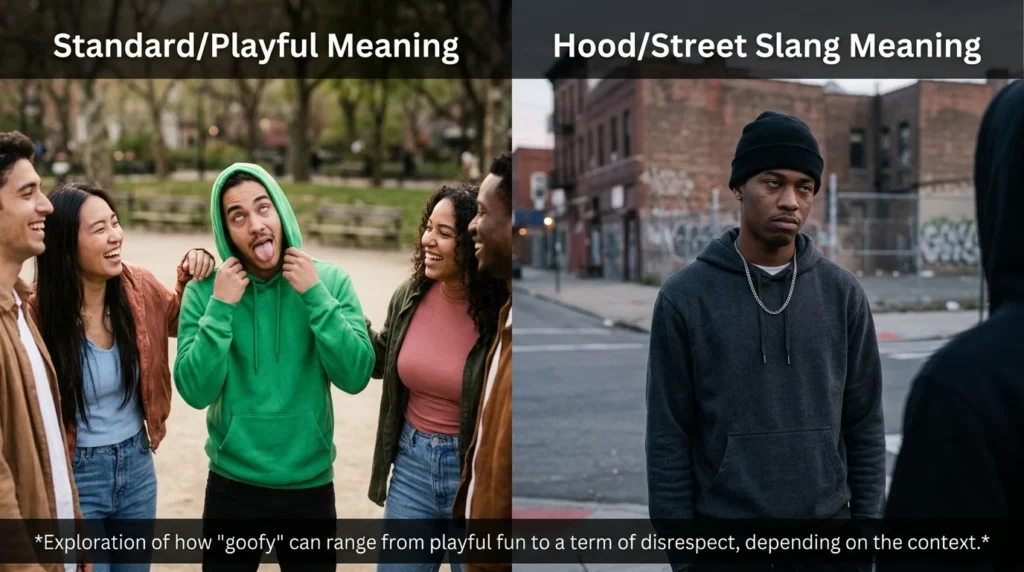
In urban and street slang — particularly in Black American vernacular and hip-hop culture — “goofy” has a notably different and stronger edge than in standard Gen Z usage. Understanding this distinction matters because the same word can land very differently depending on the community and delivery.
In street/hood slang, calling someone goofy typically means:
- Weak or soft — someone who lacks toughness, backbone, or street credibility
- Untrustworthy or fake — someone who acts a certain way but cannot be relied on
- Clownish in a disrespectful way — not funny-clownish, but embarrassing-clownish
- Out of pocket — doing something socially inappropriate or disrespectful for the situation
Important distinction: In the hood/street context, “you’re goofy” is rarely playful. It is often a real criticism — dismissing someone as weak, unserious, or not worth respecting. This is very different from a friend calling you goofy while laughing. Tone, relationship, and setting are everything.
“He snitched on his boy? That’s goofy behavior.” (Meaning: disloyal, weak, disrespectful)
“Don’t even pay attention to him — he’s goofy.” (Meaning: not worthy of being taken seriously)
“Stop being goofy out here — you’re embarrassing yourself.” (Meaning: stop acting foolish in a way that damages your reputation)
What Does “TYSM” Mean? — Full Meaning, Usage & Examples
Kill Goofy Meaning
“Kill goofy” is a phrase that appears in hip-hop, rap lyrics, and street culture. It does not mean literal violence. It is an expression meaning: stop acting weak, soft, or unserious — eliminate the goofy energy. It is a call to toughen up, be more serious, or stop embarrassing yourself.
In rap culture and lyrics, “kill goofy” or “kill the goofy” means leaving behind a weak or soft persona and stepping into a harder, more serious identity. It is about shedding immaturity or weakness.
“Time to kill goofy — no more playing around.” (Meaning: stop the weak behavior, get serious)
Context note: “Kill goofy” appears frequently in rap lyrics and social media captions where “goofy” is being used in the street-slang sense (meaning weak or soft), not the playful sense. If someone uses this phrase, they are signaling seriousness and a rejection of perceived weakness — it is not literally about the Disney character or playful silliness.
Goofy Meaning in a Relationship
In the context of relationships — romantic partnerships, close friendships, or family bonds — being goofy carries an almost entirely positive meaning. In fact, being called goofy by a partner is usually one of the most affectionate things they can say.
In relationships, goofy means:
- Emotionally safe — you are comfortable enough to be silly without fear of judgment
- Playful and fun — you bring lightness and humor to the relationship
- Authentic — you do not put on a performance or try to be cool around this person
- Lovably imperfect — your quirks are seen as endearing, not embarrassing
“I love how goofy you are with me — I can just be myself around you.”
“He’s so serious at work but completely goofy at home. I love that side of him.”
“Our relationship is built on being goofy together — we laugh at everything.”
Goofy Love Meaning
Goofy love refers to a type of affection characterized by playfulness, silly inside jokes, nonsense conversations, and the kind of comfortable humor that only develops between people who truly know each other. It is the opposite of performative or serious love — it is love expressed through laughter, teasing, and uninhibited silliness. Many couples and close friends describe their bond using exactly this phrase.
Goofy Person Meaning in a Relationship
When a romantic partner calls you “their goofy person,” it means you are their source of lightness — the person who can make them laugh even on hard days, who brings joy through silliness, and who makes being together genuinely fun rather than just comfortable. This is widely regarded as one of the most valuable qualities in a long-term partner.
Goofy Girl Meaning
The phrase goofy girl has a specific cultural meaning that goes beyond just “a silly female.” In modern usage — particularly online — a goofy girl refers to:

- A girl who is naturally silly, spontaneous, and doesn’t take herself too seriously
- Someone who embraces awkwardness rather than hiding it
- A person whose humor is genuine and uninhibited, not calculated for social approval
- Someone who makes weird faces, tells random jokes, and laughs at herself without shame
The “goofy girl” aesthetic has become genuinely popular in Gen Z and millennial circles as a reaction against the pressure to be polished and performative. Being a goofy girl is increasingly seen as an aspirational quality — authentic, confident, and fun — rather than a social flaw.
“She’s such a goofy girl and I love it — she never takes herself too seriously.”
“The funniest people I know are all goofy girls who just don’t care what anyone thinks.”
In relationship contexts, many people specifically say they want a “goofy girl” as a partner — meaning someone who will match their silly energy and make everyday moments feel light and joyful.
What Does “TBH” Mean? — Full Meaning, Usage & Examples
Is Goofy an Insult or a Compliment?
The honest answer: it depends entirely on who says it, how they say it, and the relationship between the people involved. Goofy sits in the rare category of words that genuinely function as both compliment and insult without changing their spelling.
When Goofy IS a Compliment
- Said by a close friend while laughing
- Said by a romantic partner affectionately
- Said with a warm tone about playful behavior
- Said in the context of describing someone’s lovable quirks
- Said about yourself: “I’m so goofy sometimes” = self-aware and comfortable
When Goofy IS an Insult
- Said in street/hood slang to mean weak or soft
- Said with a dismissive or contemptuous tone
- Said to mock someone’s outfit, behavior, or choices
- Said in a serious confrontation to diminish someone
- Said about someone’s appearance in a mocking way
Is Goofy a Bad Word?
No — goofy is not a profanity or an inherently offensive word. It is not a slur. It is a standard English adjective that can carry negative weight depending purely on context and delivery. In most everyday situations, goofy is either neutral or mildly positive. It only becomes an insult through tone, context, or street-slang usage where it means weak or fake.
Is Goofy Positive or Negative?
Statistically speaking, goofy is used positively or neutrally far more often than negatively. Most appearances of the word in casual speech, social media, and relationships carry affectionate or humorous intent. The negative usage — particularly in street slang — is more specific, more intense, and context-dependent. When in doubt about which usage you are dealing with, look at tone, emoji, and relationship context.
Is Being Called Goofy an Insult?
Not usually. Most of the time, being called goofy means someone finds you pleasantly silly or amusingly awkward. If someone calls you goofy while laughing or smiling, it is almost certainly affectionate. If it is said flatly, dismissively, or in a street context, it may carry more edge. The delivery tells you everything the word itself does not.
Goofy Meaning in Sports — Skateboarding & Snowboarding
In skateboarding, snowboarding, surfing, and wakeboarding, the word goofy has zero connection to silliness. It is a purely technical term describing foot positioning on the board.
| Stance | Meaning | Lead Foot | Most Common? |
|---|---|---|---|
| Goofy stance | Riding with right foot forward | Right foot | Less common (~40% of riders) |
| Regular stance | Riding with left foot forward | Left foot | More common (~60% of riders) |
Goofy Meaning in Skateboarding
In skateboarding, a goofy stance means your right foot is at the front of the board (near the nose) and your left foot is at the back (near the tail). Tricks, turns, and grinds are all learned and executed relative to your stance. A goofy skater who learns tricks in their natural stance will find those same tricks feel completely different if they attempt them in the opposite direction (called “switch” — skating in your unnatural stance).
Goofy Meaning Snowboard / Goofy Meaning in Snowboarding
In snowboarding, goofy stance means exactly the same thing as in skateboarding — right foot forward on the board, facing the mountain to the right. Most snowboarders determine their natural stance by how they naturally slide on a slippery floor: whichever foot goes forward instinctively is your lead foot. Right foot first = goofy; left foot first = regular.
Riding Goofy Meaning
“Riding goofy” means riding your skateboard, snowboard, surfboard, or wakeboard with your right foot leading. It is not a comment on skill level, personality, or silliness — it is simply a description of your natural riding stance.
Half Pipe Stance Goofy Meaning
In halfpipe skateboarding or snowboarding, goofy stance affects which direction feels natural when entering and exiting the pipe. Goofy riders typically feel more natural approaching the pipe’s right wall with their right foot forward. This is purely technical and has no bearing on skill or ability.
Is Goofy or Regular More Common?
Regular stance (left foot forward) is statistically more common — roughly 60% of riders. Goofy (right foot forward) makes up about 40%. Neither is better or worse; it simply reflects which side of the body is naturally dominant for that individual in a board sport context. Interestingly, foot dominance in board sports does not always match handedness — many right-handed people ride goofy, and vice versa.
Goofy Mood, Goofy Smile & Goofy Face Meaning
Goofy Mood Meaning / Silly Goofy Mood Meaning
A goofy mood describes a mental state in which someone is feeling particularly silly, random, playful, and uninhibited. When someone says they are “in a goofy mood,” they mean they are not their serious self — they feel light, a little chaotic, and inclined to make jokes, act strange, or just enjoy being ridiculous without caring what people think. A “silly goofy mood” intensifies this, adding an extra layer of randomness and energy.
“I’m in such a goofy mood today — don’t expect serious answers from me.”
“We were all in this silly goofy mood at 2 AM and everything was hilarious.”
Goofy Smile Meaning
A goofy smile is a wide, slightly awkward, uninhibited grin — the kind that is too big to be polished, sometimes lopsided, and completely genuine. A goofy smile is not the controlled smile of a photo shoot; it is the face-splitting, eye-crinkling, uncontrollable smile that happens when someone is genuinely happy or amused. It is almost universally described as endearing — people love a goofy smile because it signals authentic, unfiltered joy.
“He has the goofiest smile and it makes everyone around him smile too.”
Goofy Face Meaning
A goofy face is any deliberately exaggerated, silly, or ridiculous facial expression — crossed eyes, puffed cheeks, weird mouth shapes, exaggerated surprise. Making goofy faces is a sign of comfort, playfulness, and a willingness to look ridiculous for the sake of humor. In relationships, making goofy faces with a partner is often a marker of deep comfort and affection.
Goofy vs Funny — What Is the Difference?
These two words overlap but are not the same. Understanding the difference helps you use each correctly:
| Quality | Goofy | Funny |
|---|---|---|
| Source of humor | Awkwardness, silliness, being unintentionally or playfully ridiculous | Wit, timing, clever observations, jokes |
| Intentionality | Often unintentional or naturally occurring | Usually deliberate — crafted for a laugh |
| Sophistication | Simple, physical, childlike in its playfulness | Can range from simple to highly sophisticated |
| How it reads in a person | “They’re so silly and lovable” | “They have great comic timing and intelligence” |
| Can coexist? | Yes — a person can be both goofy AND funny. These are not mutually exclusive. | |
A comedian who crafts tight joke structures and nails timing is funny. Someone who trips over nothing, makes a ridiculous face, and laughs at themselves immediately is goofy. The best people are often both — and “goofy funny” is a specific type of humor: physical, unself-conscious, and warmly ridiculous.
Goofy Personality & Goofy Person Meaning
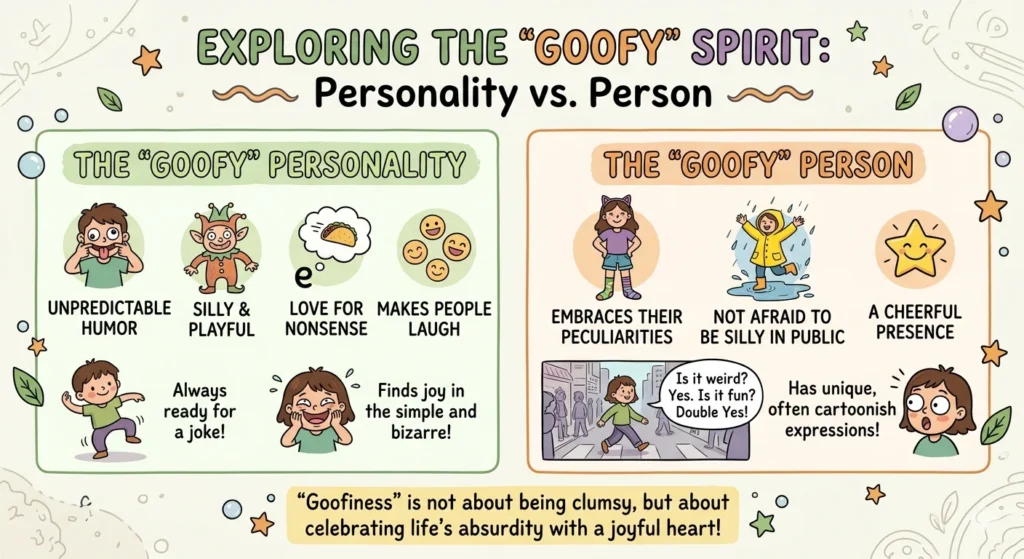
A goofy personality is a personality type characterized by spontaneity, playfulness, comfort with awkwardness, and a tendency to bring lightness to situations. People with genuinely goofy personalities tend to:
- Make others laugh without really trying
- Not take themselves too seriously
- Feel comfortable being silly in public
- Use humor naturally as a way of connecting with people
- Find the absurdity in everyday situations
- Bounce back from embarrassing moments quickly
A goofy person is not someone who lacks intelligence or depth — in fact, some of the most emotionally intelligent and self-aware people have distinctly goofy personalities. The goofiness comes from a comfortable, secure sense of self rather than insecurity or immaturity.
Stay Goofy Meaning
“Stay goofy” is an encouragement phrase meaning: keep being your silly, authentic, playful self — don’t let the world’s seriousness pressure you into becoming someone stiff and performative. It is a compliment disguised as advice. When someone tells you to “stay goofy,” they are saying your silliness is a gift, not a flaw.
Super Goofy Meaning
Super goofy is an intensified version — someone who is especially and memorably silly. It can also refer to the Disney character Super Goofy (Goofy’s superhero alter ego in the comics), but in everyday speech it simply means: extremely, delightfully goofy.
Goofy Meaning in Different Languages
| Language | Equivalent / Translation | Notes |
|---|---|---|
| Hindi | Pagla sa / Pagal / Mazakiya / Bewakoof | Depends on tone: mazakiya (funny/playful) for positive; bewakoof (foolish) for negative |
| Spanish / Español | Tonto (foolish), Payaso (clown/silly), Gracioso (funny/playful) | Gracioso captures the affectionate version best |
| French | Rigolo (playful/funny), Idiot (harsh/foolish), Loufoque (zany/eccentric) | Loufoque captures the quirky-goofy vibe well |
| Farsi / Persian | Ahmaq / Sholoogh / Baazi-gar | Sholoogh (lively/boisterous) or baazi-gar (playful) for positive contexts |
| Tagalog | Loko-loko (silly/crazy), Kulit (playfully annoying), Nakakatawa (funny) | Kulit is the closest to the affectionate goofy in Filipino culture |
| Chinese (Mandarin) | 傻乎乎 (shǎhūhū) — silly/dopey; 搞笑 (gǎoxiào) — funny/humorous | 傻乎乎 captures the goofy-silly meaning; 搞笑 is used when the humor is intentional |
| German | Albern (silly), Trottelig (dopey/clumsy), Witzig (funny) | Albern is the closest direct equivalent |
| Japanese | おかしい (okashii — funny/strange) or ふざけた (fuzaketa — joking/playful) | Context determines which fits |
Goofy in Sentences — 25 Examples Across All Contexts
Everyday / Casual Use
“He always does the most goofy things when he’s nervous.”
“That outfit is a little goofy, not gonna lie — but I respect the commitment.”
“We spent the whole night being goofy and I have not laughed that hard in months.”
Gen Z / Slang Context
“Why you dancing like that 💀 you’re so goofy bro”
“That reply was goofy — did you even read the room?”
“Lowkey goofy for thinking that was a good idea.”
“It’s midnight and we’re fully in goofy mode rn — no thoughts.”
Street / Hood Context
“He really pulled that move? Goofy behavior.”
“I don’t deal with goofy people — life’s too short.”
“Time to kill goofy and start moving different.”
Relationship Context
“I love that she’s goofy with me — she lets her guard down completely.”
“He brings out my goofy side and I am so here for it.”
“Our relationship is built on goofy humor — we quote dumb things to each other all day.”
“She has the goofiest laugh and it’s genuinely my favorite sound.”
Sports Context
“I ride goofy — right foot forward, always have.”
“Check your stance first: are you goofy or regular?”
“Most of my friends skate regular but I’ve always been goofy.”
Goofy Girl / Personality
“She is such a goofy girl — you will love her energy.”
“I want someone who is goofy and doesn’t take every moment too seriously.”
“His goofy personality is what makes him the best person to have at any gathering.”
How to Use Goofy Correctly
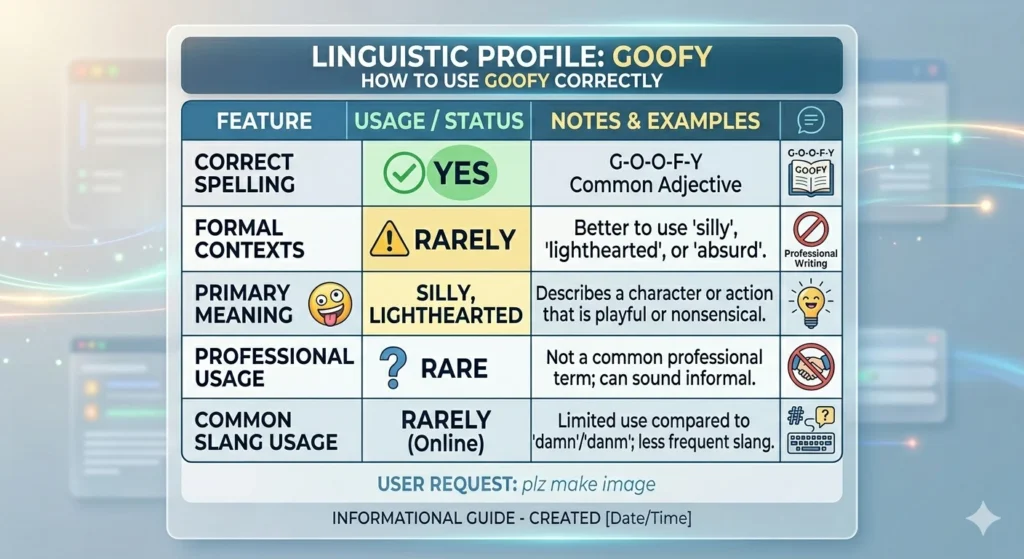
DO Use Goofy When…
- Describing playful, silly, harmless behavior among friends
- Complimenting someone’s lovable, uninhibited personality
- Describing your own behavior with self-aware humor
- Using the technical sports term (skateboarding/snowboarding stance)
- Describing a mood, smile, or energy that is light and silly
DON’T Use Goofy When…
- In professional or formal writing (emails, reports, presentations)
- When speaking to someone who might be sensitive to being called foolish
- Without considering your tone — flat delivery can make it insulting
- Confusing street-slang meaning with playful meaning in mixed company
- As a substitute for genuinely addressing a serious problem
The golden rule for goofy: If you would smile while saying it and the other person would smile back — it is a compliment. If you would say it flatly to dismiss someone — it is an insult. The word has not changed; the delivery and relationship have.
Full FAQ — Every Goofy Question Answered
What does goofy mean?
Goofy means silly, playful, awkward, or mildly foolish in a light-hearted way. Depending on context, it can mean: comfortably silly (in relationships), weird and unserious (Gen Z slang), weak or soft (street/hood slang), or right-foot-forward (sports). Context and tone determine which meaning applies.
Is goofy an insult?
Not inherently — but it can be. When said affectionately by a friend or partner, it is usually a compliment. When said in street/hood slang to describe someone as weak, fake, or disloyal, it is an insult. In Gen Z slang, it falls somewhere in between depending on tone and relationship. The word itself is neutral; the delivery makes it positive or negative.
Does goofy mean cute?
Not exactly, but the two are related. In relationship and affectionate contexts, being called goofy often implies that your silliness is endearing and lovable — which is adjacent to cute. Someone with a goofy smile or goofy personality is frequently described as cute precisely because their goofiness is attractive in an authentic, unpolished way. So goofy doesn’t mean cute, but it often produces the same effect.
What does it mean if someone calls you goofy?
It depends on who said it and how. From a friend while laughing: you’re being amusingly silly — probably a positive. From a romantic interest: you’re comfortably playful with them — definitely a positive. Said flatly or dismissively: you’re being unserious or acting foolish — mildly negative. Said in a street context: you may be seen as weak or fake — negative. Read the tone and the relationship first.
What does goofy mean in Gen Z?
In Gen Z slang, goofy most commonly means: acting silly or weird in a funny way (affectionate), being unserious or out of pocket (mild criticism), or being in a chaotic/silly energy state (goofy mode/mood). Gen Z uses it frequently with the skull emoji (💀) to signal humor, or with a dismissive tone to signal that someone is not worth taking seriously.
What does goofy mean in the hood?
In street and hood slang, goofy means weak, soft, untrustworthy, or disrespectful in behavior. It is used to dismiss someone who is seen as lacking credibility, loyalty, or toughness. In this context, being called goofy is a genuine insult — not playful at all.
What does kill goofy mean?
“Kill goofy” means eliminate or leave behind weakness, softness, and unserious behavior. It appears in hip-hop and street culture as a call to step up, get serious, and stop acting in ways that are seen as weak or embarrassing. It is not literal — it is about shedding a soft or unserious persona.
What does goofy mean in a relationship?
In relationships, goofy is almost always a compliment. It means someone is playful, emotionally relaxed, and comfortable being their silly, authentic self. A goofy partner is valued for bringing lightness, humor, and joy to the relationship. When a partner calls you goofy, they are usually saying they love your uninhibited, genuine side.
What does goofy girl mean?
A goofy girl is a woman or girl who is naturally silly, spontaneous, and unafraid of being awkward or ridiculous. She makes faces, tells random jokes, laughs at herself, and brings playful energy to everything. In modern culture, being a goofy girl is increasingly seen as aspirational — a marker of authenticity and confident self-expression rather than something to be embarrassed by.
What does goofy stance mean?
In skateboarding, snowboarding, surfing, and wakeboarding, goofy stance means riding with your right foot forward on the board. It is a technical term with no connection to the slang meaning. The opposite is regular stance (left foot forward). About 40% of board sport riders are goofy.
Is goofy a bad word?
No — goofy is not a profanity, slur, or inherently offensive word. It is a standard English adjective. Its potential negativity comes entirely from context, tone, and the relationship between speaker and listener. In most everyday contexts, it is neutral to positive.
Is being goofy a good thing?
Usually, yes. Being goofy indicates that you are comfortable with yourself, not overly concerned with others’ judgments, and capable of bringing joy and lightness to your relationships. Studies on relationship satisfaction consistently show that couples who laugh together stay together — and goofy, playful humor is one of the main ways that laughter happens. The main exception is in street/professional contexts where being goofy can signal weakness or unprofessionalism.
What does goofy mood mean?
A goofy mood means a state of feeling particularly silly, playful, and uninhibited — not your serious self. When someone says they’re in a goofy mood, expect random jokes, weird behavior, and a generally light and chaotic energy. It is almost always a positive state described with affection.
What does goofy mean in the 1920s?
In the 1920s, goofy meant genuinely foolish or simple-minded — closer to calling someone dumb or mildly intellectually limited. It was more of an insult than a playful descriptor. The word comes from “goof,” which in the 1920s meant a stupid or foolish person. Disney’s character Goofy (introduced in 1932) began softening the word’s connotations significantly over the following decades.
Conclusion
The word goofy is one of English’s most versatile and context-sensitive words. It can be a warm compliment from a partner, a playful tease from a friend, a Gen Z signal of unserious behavior, a street-culture dismissal of weakness, or a purely technical sports term — all without changing a single letter.
What determines which meaning you are dealing with is always the same thing: who is saying it, how they are saying it, and what their relationship is to the person they are describing. Master those three variables and you will never misread “goofy” again.
Whether you embrace your goofy side, ride goofy on a skateboard, or just want to decode what someone meant when they called you goofy — you now have everything you need. Stay goofy. 😄

Lucas Hayes is a content writer at Meanovia, specializing in slang, texting meanings, and internet phrases. He creates simple, clear, and engaging explanations of modern digital language 💬✨