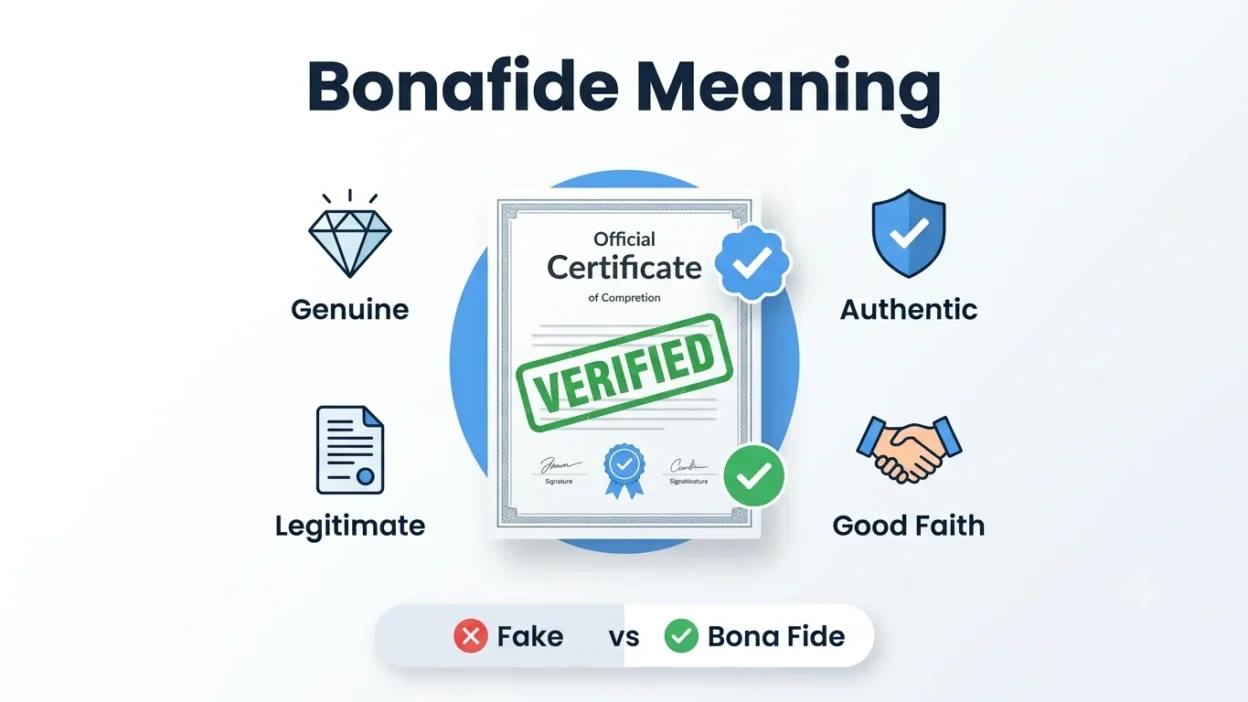
Have you seen the word “bonafide” in a job posting, legal document, business agreement, school form, or online conversation and wondered what it really means—or whether it’s even spelled correctly? Bonafide is a very common spelling, but the standard and widely accepted form is “bona fide.” Originally borrowed from Latin, bona fide literally means “in good faith” and, in modern English, describes someone or something that is genuine, authentic, legitimate, real, or honest.
Whether you’re talking about a bona fide customer, bona fide offer, bona fide mistake, or bona fide business, the expression emphasizes trustworthiness, sincerity, and authenticity rather than deception. Because of its broad use in law, business, education, employment, journalism, and everyday English, the exact meaning depends on the context, but it always conveys the idea of being the real thing.
In simple terms, bonafide (more accurately written as bona fide) means genuine, authentic, or legitimate. For example, a bona fide customer is a real customer, a bona fide company is a legitimate business, and a bona fide reason is a valid and honest reason. The phrase is widely used to reassure people that someone or something is real, trustworthy, and acting in good faith, making it one of the most important expressions for describing authenticity in both formal and everyday communication.
If you’ve come across bonafide or bona fide and weren’t sure what it means, this guide explains the correct spelling, pronunciation, Latin origin, definition, legal and everyday usage, synonyms, antonyms, real-life examples, common mistakes, and how to use the term naturally and confidently in any context.
What Does Bonafide Mean?
The bonafide meaning is genuine, authentic, legitimate, or real. It refers to someone or something that is honest, officially recognized, and worthy of trust.
In simple words, if something is bonafide, it is not fake, false, or misleading.
The word is widely used in:
- Education
- Law
- Business
- Government documents
- Banking
- Employment
- Immigration
- Professional communication
- Everyday English
Although the exact meaning can vary slightly depending on the context, the central idea always remains the same:
A bonafide person or thing is genuine and can be trusted.
Simple Definition
If you’re looking for the easiest explanation:
Bonafide means real, genuine, authentic, and officially accepted.
Examples
- A bonafide student is officially enrolled in a school or university.
- A bonafide certificate proves that a person genuinely belongs to an institution.
- A bonafide offer is made honestly and sincerely.
- A bonafide business operates legally and legitimately.
How Do You Pronounce Bonafide?
One of the most common questions people ask is how to pronounce bonafide correctly.
Pronunciation
BOH-nuh-FYDE
IPA (American English)
/ˌboʊ.nə ˈfaɪd/
IPA (British English)
/ˌbəʊ.nə ˈfaɪd/
Easy Pronunciation Trick
Break the word into three simple sounds:
BOH + nuh + FYDE
Say it slowly a few times, then naturally speed it up.
Is It “Bonafide” or “Bona Fide”?
This is one of the biggest points of confusion.
Here’s the short answer:
- Bona fide (two words) is the traditional and preferred spelling in formal English, legal writing, and many dictionaries.
- Bonafide (one word) is a modern variant that is widely recognized and commonly used in general writing and online content.
If you’re writing an academic paper, legal document, or formal report, bona fide is usually the better choice.
If you’re writing a blog post or using the common search term “bonafide meaning,” readers will still understand the one-word form because it is widely used online.
| Form | Where You’ll Commonly See It |
|---|---|
| Bona fide | Dictionaries, legal writing, academic English, formal documents |
| Bonafide | Blogs, websites, journalism, online searches, everyday writing |
Quick Tip: If you’re unsure which version to use, choose bona fide in formal writing and use the spelling that best matches your audience elsewhere.
Why Is This Word So Common Today?
You may not notice it, but bonafide appears in many everyday situations.
For example, you might need a bonafide certificate when applying for:
- A scholarship
- A passport
- A student visa
- An internship
- A government scheme
- A bank loan
- A travel concession
Similarly, businesses use the term when referring to bonafide customers, bonafide offers, or bonafide transactions, while legal professionals often use it to describe actions taken in good faith.
Understanding this one word can help you read official documents more confidently and communicate more precisely in both professional and everyday English.
Origin and History of the Word “Bona Fide”
Every word has a story, and bona fide is no exception. Understanding where it comes from not only helps you remember its meaning but also explains why it remains one of the most trusted expressions in legal, educational, and professional English.
The phrase bona fide comes from Latin, where:
- bona means good
- fide means faith
Together, the phrase literally translates to:
“In good faith.”
Originally, it was used to describe actions performed honestly, sincerely, and without any intention to deceive. Over time, English adopted the phrase, and today it is widely used to describe people, documents, businesses, certificates, agreements, and claims that are genuine and trustworthy.
A Brief Timeline
| Period | How the Meaning Evolved |
|---|---|
| Ancient Rome | Bona fide meant “in good faith” and referred to honest intentions. |
| 16th Century | The phrase entered English legal and commercial writing. |
| 18th–19th Centuries | It became common in contracts, trade, and official documents. |
| Today | It is widely used in law, education, business, government, and everyday English to describe authenticity and legitimacy. |
Although the phrase has existed for centuries, its meaning has remained remarkably consistent: honesty, authenticity, and legitimacy.
Why Do So Many People Spell It Incorrectly?
If you’ve ever typed bonified, bonafied, bonifide, or bonefide, you’re not alone.
These misspellings are extremely common because the word is pronounced as one smooth phrase, making it easy to guess the spelling instead of remembering its Latin origin.
Common Incorrect Spellings
- ❌ Bonified
- ❌ Bonafied
- ❌ Bonifide
- ❌ Bonefide
- ❌ Bonofide
Correct Spellings
- ✅ Bona fide (traditional and preferred)
- ✅ Bonafide (modern one-word variant commonly seen online)
Memory Tip: Think of “good faith” rather than trying to sound out the word. Remembering its Latin meaning makes the correct spelling much easier to recall.
Why Is “Bona Fide” Different from Similar Words?
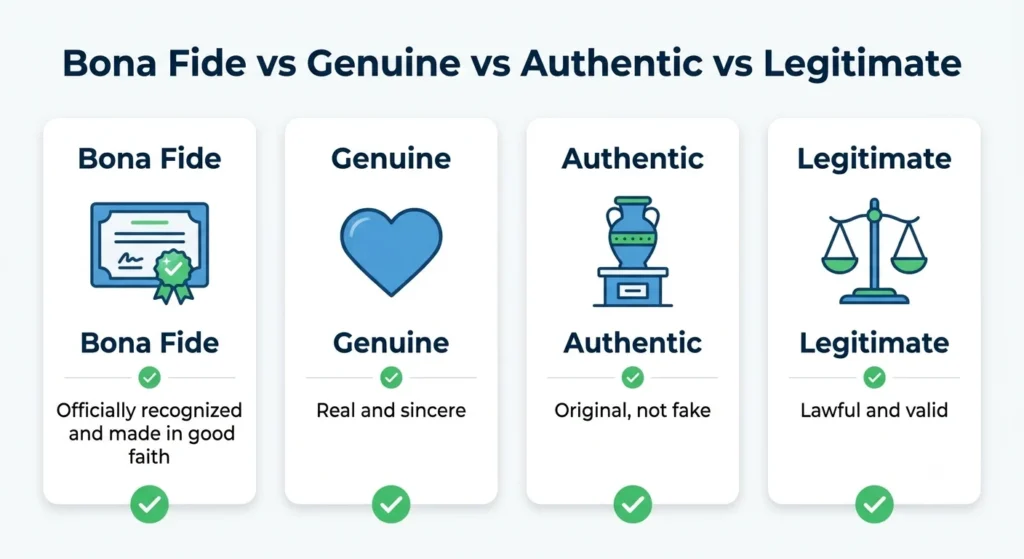
Many learners assume bona fide, genuine, authentic, and legitimate all mean exactly the same thing. While they overlap, each word highlights a different idea.
| Word | What It Emphasizes | Example |
|---|---|---|
| Bona fide | Good faith, legitimacy, honesty | A bona fide purchaser bought the property without knowing about any dispute. |
| Genuine | Real and sincere | She gave a genuine apology. |
| Authentic | Original and not fake | The museum displayed an authentic artifact. |
| Legitimate | Lawful or officially valid | He has a legitimate business license. |
Choosing the right word makes your writing more precise and professional.
Where Will You See the Word “Bona Fide”?
One reason this expression is so useful is that it appears in many real-life situations. Once you recognize it, you’ll start noticing it in official documents and everyday communication.
In Education
Schools, colleges, and universities issue bona fide certificates to confirm that a student is officially enrolled.
In Law
Lawyers and courts use the phrase to describe actions taken honestly and without fraud, such as a bona fide purchaser or a bona fide belief.
In Business
Companies refer to bona fide customers, bona fide offers, and bona fide transactions to show that dealings are genuine and legitimate.
In Government and Public Services
You may encounter the term when applying for:
- Passports
- Student visas
- Scholarships
- Educational loans
- Travel concessions
- Internship programs
- Identity verification
- Government benefits
In each case, the idea is the same: proving that a person, document, or claim is real, valid, and trustworthy.
Did You Know?
💡 Although bona fide is a Latin phrase that is hundreds of years old, it is still widely used in modern English. Lawyers, universities, government departments, employers, and businesses continue to rely on it because there is no single English word that captures all of its meanings—genuine, legitimate, and made in good faith—at the same time.
Remember This
If you’re ever unsure about the meaning of bona fide, remember this simple rule:
If something is bona fide, it is genuine, authentic, officially recognized, and made in good faith.
Whether you’re talking about a student, certificate, business, contract, offer, or person, the phrase always conveys trust, honesty, and legitimacy.
What Does Subordinate Mean? Easy Definition with Work
Bona Fide Meaning in Law
In legal English, bona fide refers to actions, agreements, or transactions carried out honestly and without fraud, deception, or hidden intentions.
The phrase is especially important because many legal rights depend on whether someone acted in good faith.
For example, a bona fide purchaser is someone who buys property honestly, pays a fair price, and has no knowledge of another person’s legal claim over it.
Common Legal Expressions
- Bona fide purchaser
- Bona fide transaction
- Bona fide dispute
- Bona fide belief
- Bona fide intention
- Bona fide offer
- Bona fide mistake
- Bona fide requirement
Examples
- The court ruled that she was a bona fide purchaser.
- Both parties entered the agreement in bona fide.
- The company made a bona fide effort to resolve the dispute before going to court.
Remember
In legal writing, bona fide doesn’t simply mean “real.” It also suggests honesty, fairness, and the absence of fraud.
Bona Fide Certificate Meaning
A bona fide certificate is an official document issued by an educational institution, employer, or organization confirming that a person genuinely belongs to that institution.
Think of it as official proof of your status.
Educational institutions commonly issue bona fide certificates to verify that a student is currently enrolled.
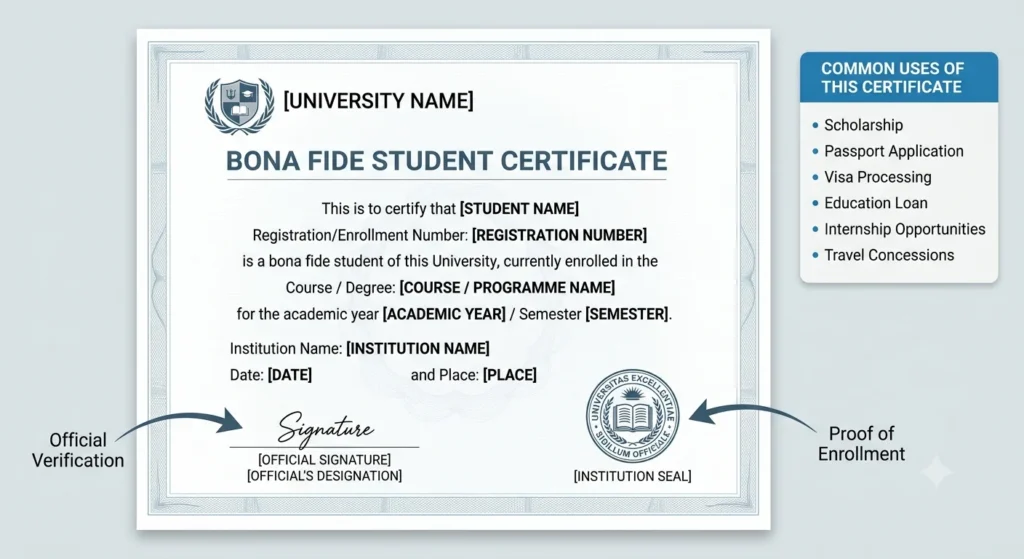
A Bona Fide Certificate May Be Required For:
- Scholarship applications
- Student visas
- Passport applications
- Education loans
- Internship programs
- Hostel admission
- Government schemes
- Railway or travel concessions
- Competitive examinations
- Identity verification
Information Usually Included
A bona fide certificate generally contains:
- Student’s full name
- Roll or registration number
- Course or class
- Institution name
- Enrollment status
- Academic session
- Date of issue
- Official signature
- Institution seal
Example
“The university issued a bona fide certificate confirming that Ayesha is enrolled in the Bachelor of Computer Science program.”
Quick Tip
A bona fide certificate does not replace your degree or transcript. Instead, it confirms your current affiliation with the institution.
Bona Fide Student Meaning
A bona fide student is someone who is officially admitted and actively enrolled in a recognized educational institution.
The term is used by schools, colleges, universities, scholarship providers, and government organizations to distinguish officially registered students from applicants or former students.
Examples
- Only bona fide students may apply for the scholarship.
- The university provides travel concessions to bona fide students.
- Applicants must prove they are bona fide students before receiving financial assistance.
In Simple Words
A bona fide student is a student whose enrollment has been officially verified.
Bona Fide Meaning in School
Schools frequently use the term when confirming that a child is genuinely studying at the institution.
For example, a school may issue a bona fide certificate stating:
- the student’s name,
- current grade,
- admission number,
- academic year,
- and confirmation that the student is actively enrolled.
Parents often need this document when applying for scholarships, educational competitions, fee concessions, or government programs.
Bona Fide Meaning in Business
In business, bona fide refers to people, companies, offers, and transactions that are legitimate, authentic, and carried out honestly.
Using the term helps distinguish genuine commercial activities from fraudulent or misleading ones.
Common Business Uses
- Bona fide customer
- Bona fide supplier
- Bona fide employer
- Bona fide employee
- Bona fide transaction
- Bona fide offer
- Bona fide business
- Bona fide inquiry
Examples
- The company accepted only bona fide suppliers after completing its verification process.
- We received a bona fide purchase order from an international client.
- Investors prefer bona fide businesses with transparent financial records.
- The manager confirmed that the inquiry was bona fide before sharing confidential information.
Malice Meaning: The Dark Intention Hidden in One Word
Bona Fide Person Meaning
When bona fide describes a person, it means the individual is genuine, trustworthy, authentic, and legitimately qualified.
It does not simply mean that someone is “nice.” Instead, it emphasizes that the person’s identity, qualifications, or reputation are real and credible.
Examples
- She is a bona fide scientist whose research has been published internationally.
- He’s a bona fide entrepreneur with over ten years of business experience.
- They hired a bona fide cybersecurity expert to investigate the incident.
- She’s a bona fide leader respected throughout the organization.
Bona Fide Member Meaning
A bona fide member is someone whose membership has been officially accepted and verified by an organization, club, association, or society.
Examples
- Only bona fide members are allowed to vote during the annual meeting.
- Conference discounts are available to bona fide members of the association.
- The organization verified that he was a bona fide member before granting access.
Real-Life Examples of Bona Fide
Here are a few natural examples that show how the term is used in different situations.
Education
- The college asked me to submit a bona fide certificate for my scholarship application.
- She has been a bona fide student since 2023.
Business
- The company works only with bona fide suppliers.
- We received a bona fide inquiry from a potential customer.
Law
- The judge recognized him as a bona fide purchaser.
- Both parties entered into the agreement in good faith.
Everyday English
- She’s a bona fide expert in digital marketing.
- That museum displays bona fide historical artifacts.
- His achievements make him a bona fide sports legend.
In Short
No matter where you encounter the phrase—whether in law, education, business, employment, or daily conversation—bona fide always points to the same core idea:
Something that is genuine, authentic, officially recognized, and made in good faith.
Bona Fide vs. Similar Words: What’s the Difference?
Although bona fide is often translated as genuine, authentic, or legitimate, these words are not always interchangeable. Understanding the differences helps you choose the most accurate word in different situations.
Bona Fide vs. Genuine
Both words suggest that something is real, but they emphasize different ideas.
| Bona Fide | Genuine |
|---|---|
| Highlights legitimacy, official recognition, or good faith | Highlights sincerity or realness |
| Common in legal, business, and educational contexts | Common in everyday conversations |
Examples
- The university issued a bona fide certificate.
- She gave a genuine apology after realizing her mistake.
Quick Rule: Use bona fide when legitimacy matters. Use genuine when sincerity matters.
Bona Fide vs. Authentic
These words overlap, but authentic usually focuses on originality.
| Bona Fide | Authentic |
|---|---|
| Genuine and officially recognized | Original and not fake |
Examples
- He is a bona fide member of the association.
- The museum displayed an authentic Roman coin.
Bona Fide vs. Legitimate
These two words are very close in meaning, but there is a subtle difference.
| Bona Fide | Legitimate |
|---|---|
| Stresses honesty and good faith | Stresses legality or validity |
Examples
- The buyer acted as a bona fide purchaser.
- She has a legitimate claim to the property.
Bona Fide vs. Valid
A document may be valid because it meets legal requirements, while bona fide emphasizes that it is genuine and issued honestly.
Example
- This passport is valid until 2032.
- This is a bona fide passport issued by the government.
Common Synonyms of Bona Fide
The best synonym depends on the context, but these words often have similar meanings.
| Synonym | Best Used When |
|---|---|
| Genuine | Something is real or sincere |
| Authentic | Something is original |
| Legitimate | Something is lawful or officially accepted |
| Valid | Something meets legal or official requirements |
| Official | Something is authorized |
| Verified | Something has been confirmed |
| Certified | Something has been formally approved |
| Trustworthy | A person or source is reliable |
| Credible | Information or a person can be believed |
| Real | The opposite of fake |
| Honest | A person’s actions are truthful |
| Lawful | Something follows the law |
| Recognized | Officially accepted |
| Reliable | Someone or something can be depended upon |
| Original | Not copied or fake |
Antonyms of Bona Fide
The opposite of bona fide describes something false, dishonest, or unofficial.
- Fake
- False
- Fraudulent
- Counterfeit
- Bogus
- Illegal
- Invalid
- Deceptive
- Dishonest
- Unofficial
- Fabricated
- Sham
- Misleading
- Illegitimate
- Artificial
How to Use “Bona Fide” Correctly
The easiest way to remember the correct usage is to ask yourself one question:
“Am I describing something that is genuine, officially recognized, or made honestly?”
If the answer is yes, bona fide is probably the right choice.
Correct Examples
✔ She is a bona fide doctor.
✔ The university issued a bona fide certificate.
✔ They made a bona fide offer to purchase the property.
✔ He is a bona fide member of the organization.
✔ The company serves only bona fide customers.
When NOT to Use “Bona Fide”
Even though bona fide is versatile, it should not be used as a replacement for every positive adjective.
Incorrect
❌ The weather is bona fide.
❌ She sings bona fide.
❌ This pizza is bona fide.
Better Alternatives
✔ The weather is pleasant.
✔ She sings beautifully.
✔ This pizza is delicious.
Remember: Bona fide describes legitimacy or authenticity—not quality, taste, or manner.
Common Spelling Mistakes
Because of its pronunciation, many people spell the word incorrectly.
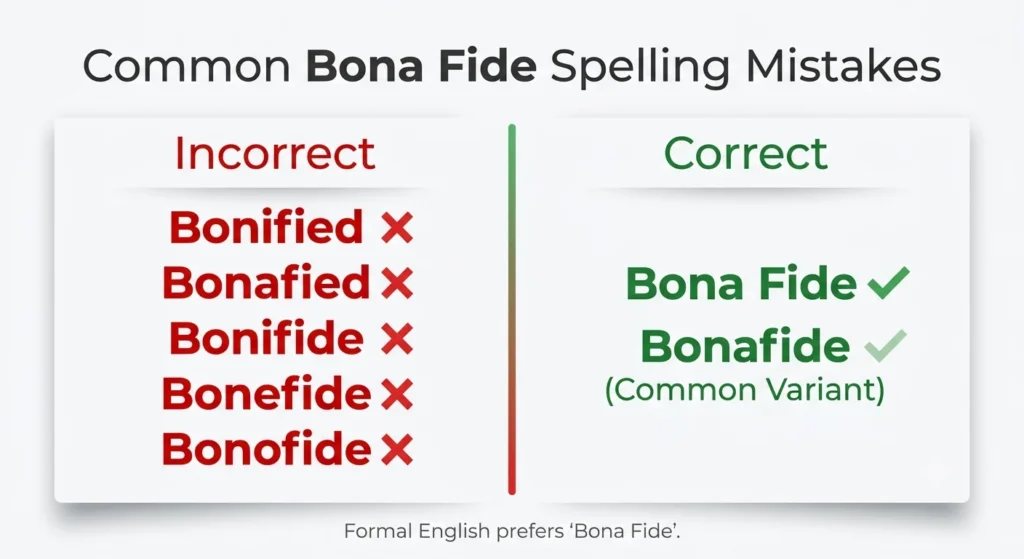
| ❌ Incorrect | ✅ Correct |
|---|---|
| Bonified | Bona fide |
| Bonafied | Bona fide |
| Bonifide | Bona fide |
| Bonefide | Bona fide |
| Bonofide | Bona fide |
You’ll also see bonafide written as one word online. While it is commonly recognized, bona fide remains the preferred spelling in formal English.
Common Mistakes to Avoid
Mistake 1: Confusing It with “Qualified”
Someone can be qualified but not necessarily bona fide if their credentials are not genuine.
Example:
✔ She is a bona fide architect with a valid professional license.
Mistake 2: Thinking It Means Only “Real”
The phrase also carries the idea of good faith, honesty, and legitimacy—not just realness.
Mistake 3: Using It Too Casually
Expressions like “He’s a bona fide pizza lover” are understood in informal English, but in formal writing it’s better to reserve bona fide for situations involving authenticity, official recognition, or credibility.
Grammar Note
Bona fide is most commonly used as an adjective.
Examples:
- A bona fide student
- A bona fide agreement
- A bona fide certificate
- A bona fide customer
- A bona fide business
It can also appear in established legal expressions such as:
- Bona fide purchaser
- Bona fide belief
- Bona fide transaction
- Bona fide intention
Word Family
Knowing related expressions helps you understand the phrase in different contexts.
| Expression | Meaning |
|---|---|
| Bona fide | Genuine; in good faith |
| Bona fides | A person’s qualifications, experience, or credentials |
| Bona fide purchaser | A buyer who purchases honestly without knowing about another legal claim |
| Bona fide offer | A sincere and genuine offer |
| Bona fide belief | An honest belief based on available information |
Example
“The interviewer was impressed by her bona fides, including years of experience and professional certifications.”
Remember This
Whenever you see bona fide, think of these four ideas:
- Genuine
- Authentic
- Legitimate
- Made in good faith
If those ideas fit the context, you’re almost certainly using the phrase correctly.
Quick Knowledge Check
Which sentence uses bona fide correctly?
A. The weather is bona fide today.
B. She submitted a bona fide certificate with her scholarship application.
C. He bona fide runs every morning.
✅ Correct Answer: B
Why? Because bona fide describes an official, genuine document—not an action or the weather.
FAQs
1. What does bona fide mean?
Bona fide means genuine, authentic, legitimate, or made in good faith. It describes a person, document, offer, business, or claim that is real, trustworthy, and officially recognized. The phrase comes from Latin, where bona fide literally means “in good faith.”
2. What is the meaning of bona fide in simple words?
In simple words, bona fide means real and not fake. It is used for people, documents, businesses, or actions that are genuine, honest, and officially accepted.
3. What does it mean to be bona fide?
To be bona fide means to be authentic, trustworthy, and legitimate. For example, a bona fide professional has genuine qualifications and experience, while a bona fide customer is a real customer rather than a fake or fraudulent one.
4. What is a bona fide student?
A bona fide student is someone who is officially admitted and currently enrolled in a recognized school, college, or university. Educational institutions often issue a bona fide certificate to verify a student’s enrollment status.
5. What is a bona fide certificate?
A bona fide certificate is an official document that confirms a person’s genuine association with an institution. Schools and universities commonly issue it to prove that a student is currently enrolled, while employers may issue similar letters to verify employment.
6. What does bona fide mean in law?
In legal contexts, bona fide means acting honestly, fairly, and in good faith without fraud or deception. Common legal terms include bona fide purchaser, bona fide belief, and bona fide transaction.
7. Is it “bonafide” or “bona fide”?
The traditional and preferred spelling is bona fide (two words). Bonafide (one word) is widely used online and in everyday writing, but bona fide is generally preferred in formal English, legal documents, and many dictionaries.
8. Is bona fide one word or two?
Traditionally, it is written as two words: bona fide. Although bonafide appears as a single word in some modern usage, bona fide remains the standard spelling in formal contexts.
9. How do you pronounce bona fide?
Bona fide is commonly pronounced:
BOH-nuh-FYDE
American IPA: /ˌboʊ.nə ˈfaɪd/
British IPA: /ˌbəʊ.nə ˈfaɪd/
10. What is another word for bona fide?
Depending on the context, common synonyms include:
- Genuine
- Authentic
- Legitimate
- Valid
- Official
- Verified
- Certified
- Trustworthy
- Credible
- Real
Each synonym has a slightly different nuance, so choose the one that best matches your sentence.
11. Can bona fide describe a person?
Yes. A bona fide person is someone who is genuine, trustworthy, authentic, or legitimately qualified.
Example: She’s a bona fide researcher with years of published work.
12. Is bona fide a formal word?
Yes. Bona fide is considered a formal expression and is commonly used in legal, educational, business, and government communication. It can also appear in everyday English when you want to emphasize authenticity or legitimacy.
13. What is the origin of the phrase bona fide?
The phrase comes from Latin, where bona means “good” and fide means “faith.” Together, bona fide translates to “in good faith.”
14. Is “bonified” the correct spelling?
No. Bonified is a common misspelling and is not the correct form in this context.
The correct spelling is:
- Bona fide (preferred)
- Bonafide (common modern variant)
15. Can bona fide describe a document?
Yes. Official documents such as certificates, contracts, identity records, and letters may be described as bona fide if they are genuine, valid, and officially recognized.
16. What is a bona fide purchaser?
A bona fide purchaser is someone who buys property honestly, pays a fair value, and has no knowledge of another person’s legal claim or ownership dispute. This is an important concept in property and contract law.
17. Is bona fide used only in legal English?
No. Although it is common in law, bona fide is also widely used in education, business, government, employment, and everyday English whenever you want to describe something genuine or officially recognized.
18. How can I remember the meaning of bona fide?
An easy way to remember it is:
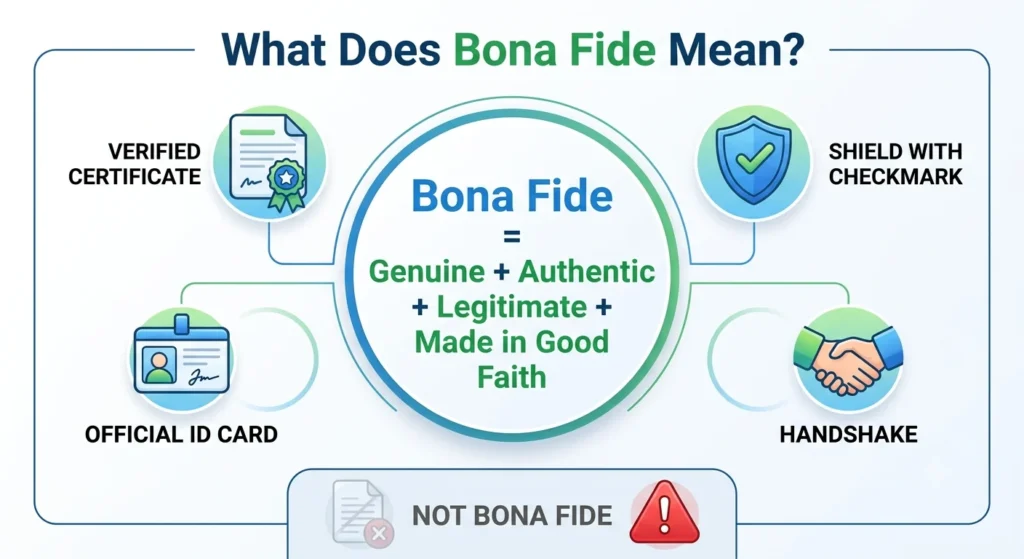
Bona fide = Good Faith = Genuine = Legitimate
If something is bona fide, it is real, trustworthy, and not fake.
19. Can I use bona fide in everyday conversation?
Yes. While the phrase is formal, it is often used in everyday speech to emphasize that someone or something is unquestionably genuine.
Example: She’s a bona fide expert in renewable energy.
20. Why is bona fide still widely used today?
Bona fide remains popular because it clearly expresses the ideas of authenticity, legitimacy, and good faith in a way that few single English words can. That’s why it continues to appear in legal documents, business communication, educational institutions, and government records around the world.
Key Takeaways
Before you leave, here’s a quick summary of everything you’ve learned about bona fide.
At a Glance
- Meaning: Genuine, authentic, legitimate, or made in good faith.
- Origin: From the Latin phrase bona fide, meaning “in good faith.”
- Preferred Spelling: Bona fide (two words) is the standard spelling in formal English, while bonafide (one word) is a common modern variant often seen online.
- Pronunciation: BOH-nuh-FYDE
- Common Uses: Law, education, business, employment, government documents, and everyday English.
- Common Examples: Bona fide student, bona fide certificate, bona fide purchaser, bona fide offer, bona fide business, and bona fide member.
- Core Idea: If something is bona fide, it is genuine, officially recognized, trustworthy, and not fake.
Quick Memory Trick
If you ever forget the meaning of bona fide, remember this simple formula:
Bona Fide = Good Faith = Genuine + Authentic + Legitimate + Trustworthy
This one sentence captures the essence of the phrase and makes it easier to remember whenever you encounter it in reading or writing.
When Should You Use “Bona Fide”?
Use bona fide whenever you want to emphasize that a person, document, offer, organization, or action is real, officially recognized, and made honestly.
It is especially appropriate in:
- Academic and educational writing
- Business communication
- Legal documents
- Government forms
- Employment verification
- Professional emails
- Formal reports
Using the phrase correctly makes your communication more precise and professional.
Conclusion
The phrase bona fide has remained relevant for centuries because it expresses an idea that every language values—honesty, authenticity, and trust. Whether you’re reading a legal agreement, applying for a scholarship, verifying your student status, or describing a genuine professional, understanding this expression helps you communicate with greater confidence and accuracy.
Although many people search for bonafide meaning, the traditional spelling bona fide remains the preferred choice in formal English. Knowing both forms—and understanding when each is commonly used—allows you to recognize the phrase wherever you encounter it and use it naturally in your own writing.
Rather than thinking of bona fide as just another vocabulary word, remember it as a practical expression you’ll see throughout everyday life—in schools, universities, businesses, banks, government offices, contracts, employment letters, and official documents. The more you notice it in real contexts, the easier it becomes to understand and use correctly.
The next time you come across the phrase bona fide, you’ll know that it represents far more than simply “real.” It carries the ideas of good faith, legitimacy, credibility, and authenticity—qualities that make communication clearer and more trustworthy.

Ryan Blake is a content writer at Meanovia, focused on slang, texting meanings, and internet phrases. He simplifies modern online language into easy, clear, and engaging explanations 💬✨