Ever seen the word “diabolical” in a book, movie, comment, or conversation and wondered whether it simply means “evil”? In most contexts, diabolical describes something extremely evil, wicked, or devilish, often suggesting behavior or plans that are deliberately cruel or fiendishly clever.
For example, “a diabolical plan” can describe a particularly wicked and carefully devised scheme. The word also has an important informal meaning: extremely bad, shocking, or outrageous, especially in British English.
So if someone says, “The service was diabolical,” they usually mean it was terrible—not literally connected to the Devil. The word ultimately traces through Latin and Greek to diabolos, meaning “slanderer.” This guide explains the diabolical meaning, pronunciation, origin, synonyms, examples, and differences between diabolical, evil, wicked, sinister, and demonic, so you can understand and use the word naturally.
What Does Diabolical Mean?
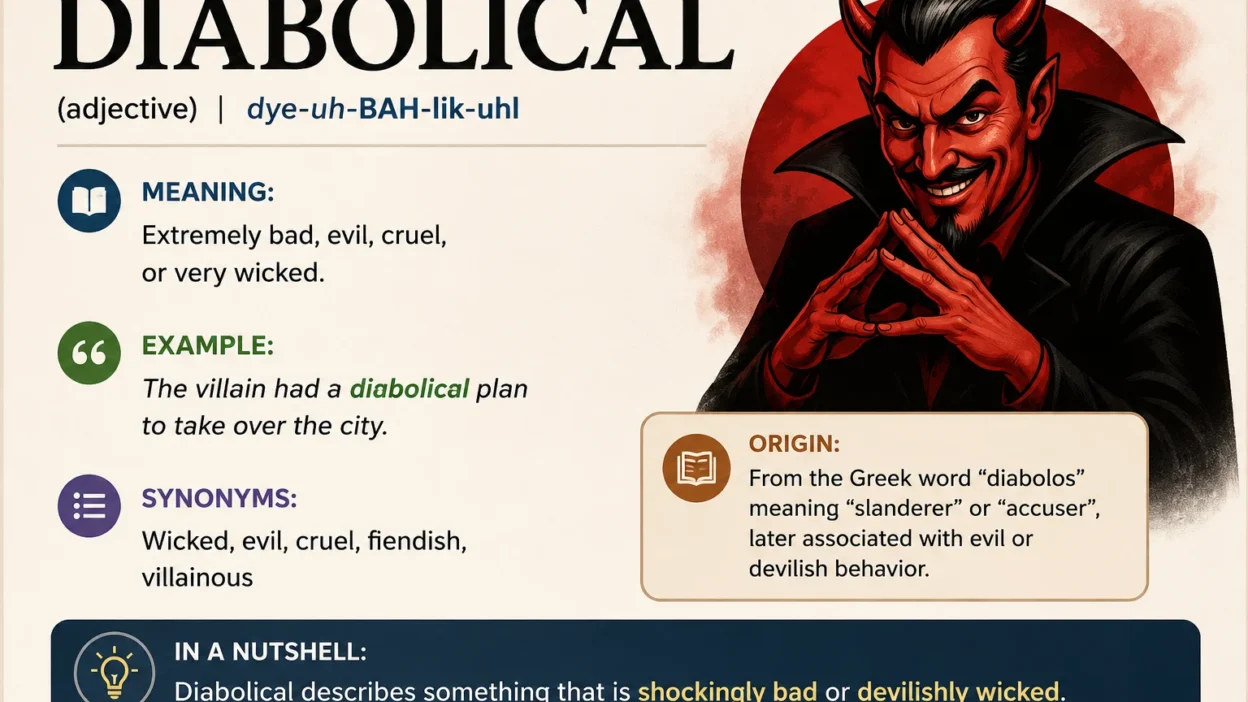
Diabolical is an adjective used for something that is extremely wicked, evil, cruel, or devilish. It is a strong word, so it usually describes behavior or situations that go far beyond something simply annoying, unpleasant, or unfair.
For example:
“The villain devised a diabolical plan.”
This means the villain created an extremely wicked or malicious plan.
However, diabolical does not always mean literally evil. In informal English, particularly British English, it can also describe something that is extremely bad, unpleasant, or outrageous.
“The weather was diabolical all weekend.”
Here, the speaker is not saying the weather was evil. They mean it was terrible.
Simple definition
Diabolical = extremely evil or wicked; sometimes extremely bad or shocking.
The context tells you which meaning is intended.
Is Diabolical Positive or Negative?
Diabolical is normally negative.
When used seriously, it suggests evil, cruelty, maliciousness, or devilish behavior. It is much stronger than simply saying something is “bad.”
For example:
- Bad: “He made a poor decision.”
- Cruel: “He made a cruel decision.”
- Diabolical: “He created a diabolical plan to deliberately harm innocent people.”
That said, people often use diabolical humorously in everyday conversation or online.
“You ate the last cookie and blamed the dog? That’s diabolical.”
In this situation, the speaker is exaggerating. They probably mean sneaky, mischievous, or hilariously ruthless, not genuinely evil.

Does Diabolical Mean Evil or Extremely Bad?
It can mean either, depending on context.
The traditional sense is closely connected with evil, wickedness, and the Devil. But another established use, especially in British English, is extremely bad or dreadful.
| Phrase | Meaning |
|---|---|
| “A diabolical scheme” | An extremely wicked or malicious scheme |
| “Diabolical weather” | Extremely bad weather |
| “His performance was diabolical” | His performance was extremely poor |
This distinction is important because a person searching for the diabolical meaning in English may encounter both definitions in dictionaries.
Does Diabolical Imply Intention?
Often, yes—especially when diabolical describes a person’s actions, plans, or schemes.
The word frequently suggests that someone has knowingly or deliberately done something wicked or harmful.
For example:
“The criminal created a diabolical scheme to deceive the victims.”
The word works especially well because the wrongdoing is intentional.
But intention is not an absolute requirement in every use of the word. If someone says:
“The conditions inside the building were diabolical,”
they simply mean the conditions were extremely bad.
Useful rule:
When describing evil behavior, diabolical often suggests deliberate wickedness; when describing conditions or experiences, it can simply mean extremely bad.
Diabolical Pronunciation and Part of Speech
Part of speech: Adjective
Pronunciation: die-uh-BOL-i-kəl
| Variant | IPA |
|---|---|
| UK | /ˌdaɪ.əˈbɒl.ɪ.kəl/ |
| US | /ˌdaɪ.əˈbɑː.lɪ.kəl/ |
Related forms:
- Diabolic: having the qualities of a devil; extremely evil.
- Diabolical: extremely evil, wicked, or, in some contexts, extremely bad.
- Diabolically: in a diabolical manner.
Diabolical Meaning in Chat, Slang, Gen Z, and TikTok
If you see diabolical in a text message, TikTok comment, meme, or group chat, it may have a more playful meaning.

There is not a completely separate Gen Z definition of the word. Instead, younger internet users often use the traditional word in an exaggerated or ironic way.
In online slang-like usage, diabolical can suggest:
- extremely sneaky
- ruthlessly clever
- mischievous
- hilariously cruel
- outrageous
- unexpectedly ruthless
For example:
“He waited until everyone had submitted their answers before revealing the correct one. Diabolical.”
The speaker is probably praising the person’s cleverness while joking that the behavior was evil.
Common Online Phrases Explained
What Does “That’s Diabolical” Mean?
“That’s diabolical” usually means:
“That is extremely wicked, sneaky, ruthless, outrageous, or bad.”
The tone determines whether it is serious or humorous.
| Context | Example |
|---|---|
| Serious | “They deliberately targeted innocent people. That’s diabolical.” |
| Playful | “You changed the Wi-Fi password while everyone was watching the movie? That’s diabolical.” |
What Does “That Was Diabolical” Mean?
“That was diabolical” means something was exceptionally wicked, ruthless, sneaky, shocking, or cleverly mischievous.
“You pretended to lose the game and then won at the last second. That was diabolical!”
Here, the phrase is playful rather than a literal accusation of evil.
What Does “Being Diabolical” Mean?
Being diabolical means behaving in an extremely wicked, cruel, sneaky, or devilish way.
In casual internet language, it can also mean acting mischievously or executing an impressively ruthless idea.
Is Diabolical Slang?
No, diabolical is not originally a slang word.
It is a standard English adjective with a long history. However, people can use it informally, humorously, or ironically, especially in social media conversations.
That is why searches for diabolical meaning slang, diabolical meaning slang TikTok, and diabolical meaning Gen Z may produce informal interpretations.
The simplest way to understand it:
Standard word + informal internet usage.
The online context may make the word sound playful, but its underlying meaning remains connected to wickedness, devilishness, or extreme badness.
Diabolical Meaning in Other Contexts
Diabolical Meaning in Farsi
The best Farsi translation depends on the context.
Common equivalents include:
| Farsi Word | Transliteration | Meaning |
|---|---|---|
| شیطانی | sheytâni | devilish, evil, or associated with the Devil |
| اهریمنی | ahrimani | demonic or fiendish |

For example:
A diabolical plan → یک نقشه شیطانی
This conveys the idea of an evil or devilish plan.
However, if diabolical means “extremely bad” (as in “diabolical weather”), a literal Devil-related translation may not sound natural in Farsi. In such cases, a contextual translation such as وحشتناک (vahšatnâk) meaning “terrible” or افتضاح (eftezâh) meaning “atrocious” may be more appropriate. Translation should always follow the sentence’s intended meaning.
Diabolical Meaning in the Bible
The word diabolical has a strong connection to the concept of the Devil through its linguistic history.
Its origin can be traced through Late Latin diabolicus to Greek diabolos, associated with an accuser or slanderer and later strongly connected with the Devil.
In a biblical discussion, diabolical generally means:
devilish, evil, demonic, or associated with the Devil.
Important clarification: The exact word diabolical does not appear in all Bible translations. Different translations use different terms:
| Bible Translation | Likely Wording |
|---|---|
| King James Version (KJV) | “devilish,” “satanic” |
| New International Version (NIV) | “evil,” “demonic” |
| English Standard Version (ESV) | “evil,” “devilish” |
| New Living Translation (NLT) | “evil,” “wicked” |
So if you encounter a search for diabolical meaning in the Bible, the safest interpretation is devilish or extremely evil, while checking the specific translation for the exact biblical wording.
Diabolical Meaning in Maths
Diabolical has no standard technical mathematical meaning.
If someone says:
“That was a diabolical maths problem.”
they are using the ordinary adjective to mean the problem was extremely difficult, tricky, frustrating, or cleverly challenging.
For example:
“The final question on the exam was diabolical.”
This does not create a special mathematical definition. It simply expresses that the question was exceptionally difficult.
Diabolical Meaning in The Boys
If you searched for diabolical meaning in The Boys, you may be referring to The Boys Presents: Diabolical, an animated anthology series set in the world of The Boys.
Official source: The series was created by Simon Racioppa and executive produced by Eric Kripke, Seth Rogen, and Evan Goldberg. It premiered on Amazon Prime Video on March 4, 2022, as a spin-off anthology within The Boys franchise. The title Diabolical intentionally evokes themes of darkness, wickedness, outrageousness, extremity, and devilishness—all of which align with the tone of the franchise.
It is therefore important not to treat Diabolical in this search as a special slang definition. It is the title of a specific animated series.
Synonyms for Diabolical (With Differences)
The best synonym depends on which sense of diabolical you mean.
| Synonym | Meaning | Difference from “Diabolical” |
|---|---|---|
| Evil | Morally wrong or wicked | Broader and more common. Learn more about evil → |
| Wicked | Evil or morally bad | Can also be playful. Learn more about wicked → |
| Devilish | Like or associated with the Devil | Very close to diabolical |
| Fiendish | Extremely cruel or wicked | Often emphasizes cruelty or cleverness |
| Sinister | Suggesting danger or evil | Often implies a threatening feeling. Learn more about sinister → |
| Malicious | Intending to cause harm | Strong focus on harmful intent. Learn more about malicious → |
| Cruel | Causing suffering | Focuses on treatment of others |
| Demonic | Like a demon | Strong supernatural association |
| Hellish | Extremely unpleasant or infernal | Often describes terrible conditions |
| Atrocious | Extremely bad or unacceptable | Often means terrible rather than devilish. Learn more about slang vs formal → |
Diabolical vs. Evil
Evil is the broader word.
“The character is evil.”
simply tells us the character is morally bad.
“The character created a diabolical scheme.”
adds a stronger sense of extreme, deliberate, devilish wickedness.
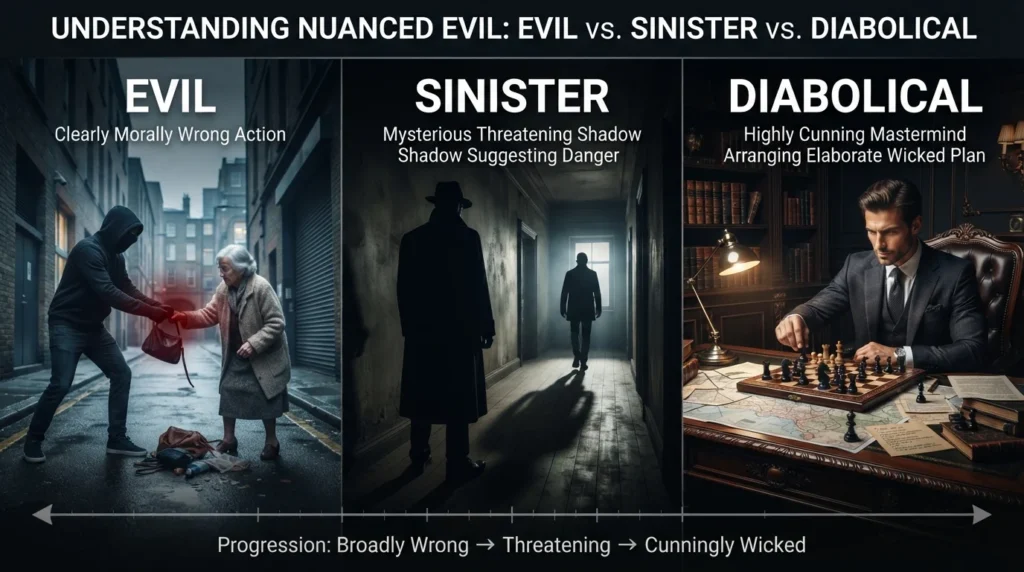
Diabolical vs. Sinister
Sinister often describes something that seems threatening, suspicious, or evil.
Diabolical usually carries a stronger sense of actual wickedness or extreme badness.
“There was something sinister about the room.”
“The criminal devised a diabolical plan.”
Examples of Diabolical in Sentences
Here are natural examples across different contexts:
| Sentence | Context |
|---|---|
| The villain revealed his diabolical plan. | Serious / Evil |
| The criminals carried out a diabolical scheme. | Serious / Evil |
| That was a diabolical trick to play on your friends. | Playful / Sneaky |
| The weather was absolutely diabolical. | British / Extremely bad |
| His performance in the match was diabolical. | British / Extremely poor |
| She came up with a diabolical way to win the competition. | Playful / Ruthlessly clever |
| The story’s antagonist has diabolical intentions. | Serious / Evil |
| “You hid my phone again? That’s diabolical!” | Playful / Mischievous |
| The final maths problem was diabolical. | Extremely difficult |
| The prank was diabolical, but everyone eventually laughed. | Playful / Ruthless |
These examples show why context matters. The same adjective can describe genuine wickedness, terrible conditions, or playful mischief.
What Does “Diabolical Person” Mean?
A diabolical person is someone described as extremely wicked, cruel, malicious, or devilish.
For example:
“The detective described the suspect as a diabolical criminal.”
In casual speech, however, the phrase can be exaggerated:
“You ate my dessert after promising you wouldn’t? You’re diabolical!”
The first example is serious; the second is humorous.
Common Mistakes With Diabolical
| Mistake | Correction |
|---|---|
| Treating it as a synonym for every kind of “bad” | Diabolical is a strong word. It normally suggests extreme wickedness or, in another established use, extreme badness. |
| Assuming it always means “clever” | A diabolical plan may be clever, but cleverness alone does not define the word. The core idea is devilish or extreme wickedness. |
| Calling it only slang | It is a standard English adjective. Modern internet users may use it casually, but the word itself is not new slang. |
| Assuming it can only describe people | It can describe: people, plans, schemes, actions, behavior, conditions, performances, situations, and experiences. |
| Ignoring British usage | In British English, diabolical can mean extremely bad or dreadful, so a sentence such as “The service was diabolical” can be perfectly natural. |
| Confusing British and American usage | In British English, diabolical is frequently used to mean “extremely bad.” In American English, this usage is less common; Americans typically reserve it for genuine wickedness or use it playfully. Always consider the speaker’s origin and context. |
Frequently Asked Questions
What does diabolical mean?
Diabolical means extremely evil, wicked, cruel, or devilish. It can also mean extremely bad or dreadful, especially in British English.
Is diabolical positive or negative?
It is normally negative. In casual speech, however, it can be used humorously to describe something sneaky, ruthless, or mischievous.
What does “that’s diabolical” mean?
It usually means “that is extremely wicked, ruthless, sneaky, outrageous, or bad.” The exact meaning depends on the situation and tone.
What does diabolical mean in Gen Z?
It does not have a completely separate Gen Z definition. Online, it is often used humorously for something ruthless, sneaky, clever, outrageous, or mischievous.
Is diabolical slang?
No. Diabolical is a standard English adjective, although it is frequently used informally online.
What does diabolical person mean?
A diabolical person is someone considered extremely wicked, cruel, malicious, or devilish.
What are synonyms for diabolical?
Common synonyms include evil, wicked, devilish, fiendish, demonic, sinister, malicious, cruel, and hellish. The best choice depends on the context.
What is the difference between diabolical and evil?
Evil is a broad term for serious moral wrongness. Diabolical is more intense and often suggests something devilish, extremely wicked, or shockingly bad.
What does diabolical mean in Farsi?
Depending on context, diabolical can be translated as شیطانی (sheytâni) or اهریمنی (ahrimani). If the word means “extremely bad,” a contextual translation like وحشتناک (vahšatnâk) or افتضاح (eftezâh) may be more appropriate.
What does diabolical mean in maths?
It has no standard mathematical definition. In a maths context, it usually means something is extremely difficult, tricky, or frustrating.
What does diabolical mean in the Bible?
In a biblical context, diabolical generally means devilish, demonic, or extremely evil. The exact wording varies between Bible translations.
What does diabolical mean in The Boys?
It may refer to The Boys Presents: Diabolical, an animated anthology series associated with The Boys. In its title, the word evokes something dark, extreme, wicked, and outrageous.
Final Takeaway
The simplest diabolical meaning is extremely evil, wicked, cruel, or devilish. It is a strong adjective, so it usually describes something much more serious than an ordinary mistake or inconvenience.
But context matters. In British English, diabolical can also mean extremely bad or dreadful. In texts, TikTok comments, memes, and Gen Z conversations, “that’s diabolical” is often used humorously for something sneaky, ruthless, outrageous, or mischievous.
One simple question to ask yourself:
Is the speaker talking about evil—or simply something extremely bad or outrageously sneaky?
That context will usually reveal exactly what diabolical means.

Nora Ellison is a digital language writer specializing in emoji meanings, internet slang, symbols, and online communication, creating clear, accurate, and reader-friendly content.