
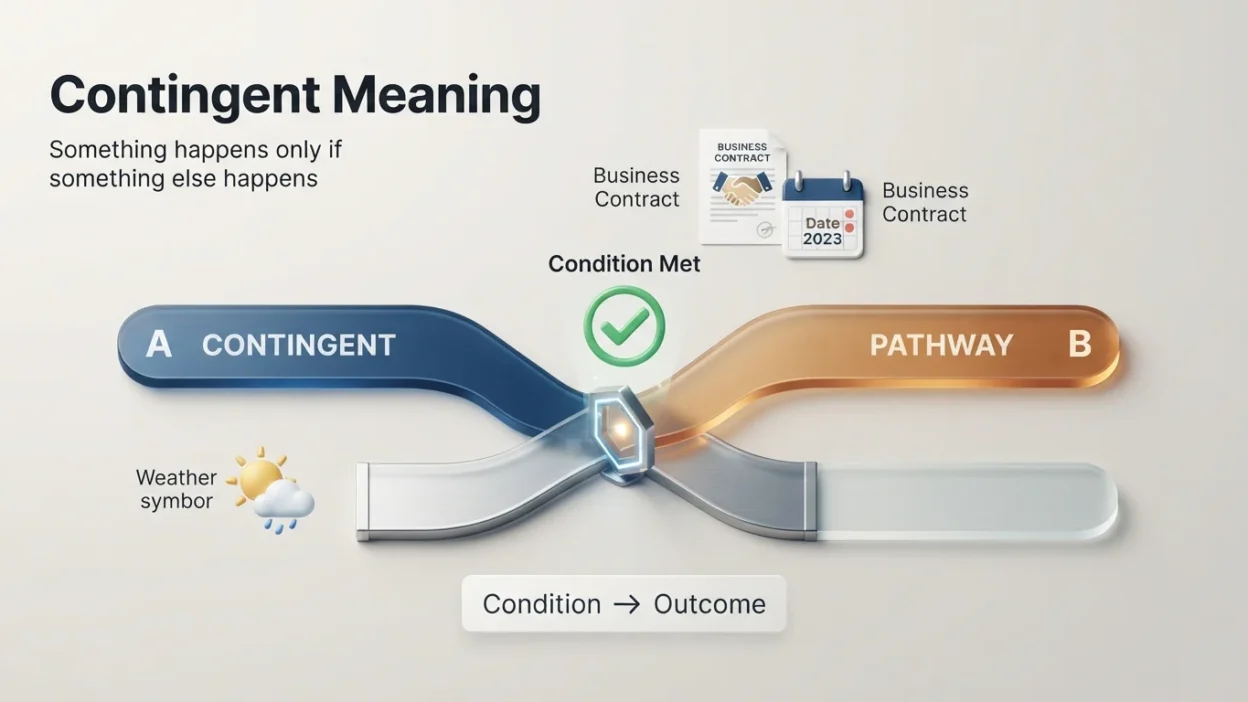
What does “contingent” mean? Most commonly, contingent means dependent on something else or subject to a particular condition. When you see the phrase “contingent on” or “contingent upon,” it means that something will happen only if a certain condition is met. For example, “The deal is contingent on approval” means the deal depends on receiving approval.
The word can also describe something that is possible but not certain or subject to circumstances that may change. As a noun, “contingent” has a different meaning: it refers to a group of people representing an organization or country, or part of a military force, as in “a diplomatic contingent.” Understanding the context is therefore essential.
This guide explains the meaning of contingent, its adjective and noun forms, common phrases such as contingent on/upon, synonyms, and clear examples to help you use the word correctly.
What Does Contingent Mean?
Contingent usually means dependent on something else happening first. In simple English, when an outcome is contingent on a condition, the outcome is not guaranteed because it depends on what happens next.
For example:
“Our trip is contingent on the weather.”
This means the trip will happen only if the weather is suitable.
The word is most often used as an adjective, especially in phrases such as:
- contingent on something
- contingent upon something
- contingent on approval
- contingent on meeting certain conditions
- contingent offer
- contingent plan
Simple meaning
Contingent = dependent on a condition or future event.
Think of it as:
Condition → Outcome
If the condition happens, the outcome may happen. If the condition does not happen, the outcome may change, be delayed, or not happen at all.
Pronunciation
Contingent is pronounced approximately:
kuhn-TIN-juhnt
The stress falls on the second syllable.
What Does It Mean to Be Contingent?
To be contingent means to depend on something that is not completely certain or has not yet been decided.
For example:
“Your admission is contingent upon submitting the required documents.”
In other words, admission depends on submitting those documents.
Another example:
“The event is contingent on receiving enough funding.”
The event is not guaranteed. Whether it takes place depends on the funding being available.
This distinction is important: contingent does not simply mean “possible.” It usually emphasizes a relationship of dependence between one thing and another.
Contingent Meaning in Different Contexts
The meaning of contingent becomes clearer when you see how it works in different situations.

1. Contingent Meaning in Business
In business, contingent describes something that depends on a specific condition, approval, result, or future event.
You may see it in employment offers, bonuses, contracts, payments, agreements, and business plans.
Examples:
- “The bonus is contingent on achieving the annual sales target.”
- “The merger is contingent upon regulatory approval.”
- “The payment is contingent on successful delivery.”
- “The position is contingent on completion of the training program.”
So, if an employer says a bonus is contingent on performance, the bonus is not automatic. The employee must satisfy the stated condition.
2. Contingent Meaning in Law
In legal language, contingent often describes a right, obligation, claim, agreement, or outcome that depends on a future event or condition.
For example:
“The agreement is contingent upon government approval.”
This means the agreement depends on that approval.
Legal documents may also use phrases such as contingent claim, contingent liability, or contingent interest.
Because legal consequences can depend on the exact wording of a document, “contingent” in a legal context should always be interpreted within the complete clause or agreement.
3. Contingent Meaning on a House
If you see a property listed as having a contingent offer, it generally means the seller has accepted an offer, but the sale still depends on one or more conditions being satisfied.
A common example is:
“The buyer’s offer is contingent on the sale of their current home.”
The buyer may need to sell their existing property before completing the new purchase.
Other contingencies in real estate can relate to financing, inspections, appraisals, or other agreed conditions.
Important: Real-estate terminology can vary by market and listing service, so “contingent” does not always mean exactly the same thing as “pending.”
4. Contingent Meaning in Insurance
In insurance, contingent can describe something that depends on a particular event or circumstance.
For example, a benefit may be payable only if a specified event occurs and the policy’s conditions are satisfied.
A contingent beneficiary, for instance, is someone designated to receive benefits if the primary beneficiary cannot receive them under the applicable policy terms.
In simple terms:
Contingent in insurance = dependent on a specified event or condition.
5. Contingent Meaning in the Workplace
At work, contingent can describe something that depends on a condition.
For example:
“Your promotion is contingent upon completing the certification.”
It can also appear in the phrase contingent worker.
A contingent worker is generally someone engaged under a non-permanent or alternative work arrangement, such as certain temporary, contract, or freelance roles. The exact employment classification depends on the organization and applicable law.
6. Contingent Meaning in the Army or Military
As a noun, contingent can refer to a group or detachment of people, especially troops, representing or contributing to a larger force.
For example:
“A military contingent was sent to support the operation.”
Here, contingent does not mean conditional. It refers to a group.
This is one of the most important differences to remember because the word has two major grammatical uses.
7. Contingent in Everyday English
Although it sounds somewhat formal, contingent can be used in ordinary conversation when you want to explain that one thing depends on another.
For example:
“Our picnic is contingent on the weather.”
A simpler everyday alternative would be:
“Our picnic depends on the weather.”
So contingent is perfectly correct in everyday English, but depends on often sounds more natural in casual conversation.
Contingent as an Adjective vs. Noun
One reason this word can be confusing is that contingent has more than one meaning.
| Form | Meaning | Example |
|---|---|---|
| Adjective | Dependent on a condition | “The offer is contingent on approval.” |
| Adjective | Possible but uncertain | “The outcome is contingent.” |
| Noun | A representative group | “A military contingent arrived.” |
| Noun | Something dependent on an event | “The contingent remains uncertain.” |
The adjective is especially common in phrases involving conditions and dependencies, while the noun often refers to a group of people.
What Is a Contingent Example?
A simple example of contingent is:
“The job offer is contingent on passing the interview.”
This means the person gets the job only if the required condition is satisfied.
Here are more examples:
- “The concert is contingent on receiving the necessary permit.”
- “The payment is contingent upon completion of the project.”
- “Our vacation plans are contingent on everyone’s availability.”
- “The loan approval is contingent on meeting the lender’s requirements.”
- “The purchase is contingent on a satisfactory inspection.”
- “The promotion is contingent upon strong performance.”
- “The team’s participation is contingent on final approval.”
- “The event is contingent on favorable weather.”
In a conversation
Person 1: “Are you going to the beach tomorrow?”
Person 2: “It’s contingent on the weather.”
Meaning: The person will go if the weather is suitable.
Contingent vs. Conditional vs. Dependent
These words are closely related, but they are not always interchangeable.
| Word | Main idea | Example |
|---|---|---|
| Contingent | Dependent on a condition or future event | “The offer is contingent on approval.” |
| Conditional | Subject to a particular condition | “The approval is conditional on payment.” |
| Dependent | Relying on something else | “The result is dependent on demand.” |
| Provisional | Temporary and subject to confirmation | “They issued provisional approval.” |

Contingent vs. conditional
Conditional is broader and very common in everyday English.
Contingent often emphasizes that something depends on a future circumstance or event.
For many situations, the two can overlap:
“The offer is conditional on approval.”
“The offer is contingent on approval.”
Both communicate a similar idea.
Contingent vs. dependent
Dependent simply means relying on something else.
Contingent can sound more formal and often highlights an uncertain future condition.
Contingent vs. provisional
Provisional means temporary or not yet final.
Something can be provisional without being contingent, and something can be contingent without being provisional.
What Are Synonyms for Contingent?
Depending on the context, useful synonyms include:
- Conditional
- Dependent
- Subject to
- Possible
- Uncertain
- Probable
- Chance
- Provisional
However, these words are not perfect replacements in every sentence.
For example:
“The payment is contingent on delivery.”
The closest alternatives are:
“The payment is conditional on delivery.”
or
“The payment is dependent on delivery.”
But replacing contingent with “possible” would change the meaning.
For the noun meaning of contingent, suitable alternatives may include:
- Group
- Delegation
- Detachment
- Representatives
- Team
The correct synonym depends on which meaning of contingent is being used.
What Does Contingency Mean?
Contingency is the noun related to the adjective contingent.
A contingency is a possible future event or circumstance that may affect what happens next.
For example:
“We need a contingency plan in case the flight is canceled.”
A contingency plan is a backup plan prepared for a possible problem or unexpected situation.
Contingent vs. contingency
- Contingent = dependent on a condition
- Contingency = a possible future event or circumstance, especially one that may require preparation
Example:
“The project is contingent on funding.”
Here, funding is the condition.
“The team created a contingency plan.”
Here, the plan prepares for a possible future situation.
Common Phrases With Contingent
You may encounter contingent in several common expressions:
Contingent on
“The trip is contingent on the weather.”
Contingent upon
“The contract is contingent upon final approval.”
Upon is more formal than on, but both can express the same basic relationship.
Contingent offer
An offer that depends on one or more conditions being satisfied.
Contingent worker
A worker engaged under a non-permanent or alternative employment arrangement.
Contingent liability
A potential financial obligation whose outcome depends on a future event.
Contingent beneficiary
A person designated to receive a benefit if the primary beneficiary cannot receive it under the applicable terms.
Contingency plan
A backup plan designed for a possible future event or problem.
Common Mistakes When Using Contingent
Mistake 1: Thinking it means guaranteed
Incorrect idea:
“The bonus is contingent, so I will definitely receive it.”
Not necessarily.
If a bonus is contingent on meeting a target, you receive it only if the condition is satisfied.
Mistake 2: Assuming it always means conditional
Usually, yes, when contingent is an adjective. But the noun contingent can mean a group of people.
“A large contingent attended the conference.”
Here, it means a representative group—not a condition.
Mistake 3: Using “contingent” when “provisional” is intended
A provisional decision is temporary or pending confirmation. A contingent decision depends on a specified condition.
Mistake 4: Ignoring the preposition
The most common patterns are:
- contingent on
- contingent upon
For example:
“The decision is contingent on further review.”
Is Contingent a Positive or Negative Word?
Contingent is neutral.
It does not automatically indicate something good or bad. It simply explains that an outcome depends on a condition or circumstance.
For example:
“The promotion is contingent on excellent performance.”
That may be positive.
But:
“The project is contingent on receiving additional funding.”
That may create uncertainty.
The surrounding context determines whether the situation is favorable or unfavorable.
Word Origin and History of Contingent
Contingent ultimately comes from Latin contingere, associated with ideas such as touching, reaching, happening, or falling to one’s lot. It entered English through French and Medieval Latin forms.
The word has a long history in English, with recorded uses dating back to the 14th–15th centuries.
Over time, its meanings developed around ideas of dependence, possibility, chance, and events that are not necessary or certain.
This history helps explain why modern English uses contingent in several related ways. The word can describe something dependent on circumstances, something uncertain or possible, or—when used as a noun—a group representing a larger organization or force.
Frequently Asked Questions About Contingent
What does contingent mean in simple words?
Contingent means dependent on something else. If an outcome is contingent on a condition, that outcome depends on whether the condition is satisfied.
What does it mean to be contingent?
To be contingent means that something depends on a particular condition, event, or circumstance and is therefore not completely guaranteed.
What is a simple example of contingent?
“The trip is contingent on the weather” means the trip will happen only if the weather is suitable.
What are the best synonyms for contingent?
Depending on context, synonyms include conditional, dependent, subject to, possible, and uncertain. For the noun meaning, group, delegation, or detachment may be appropriate.
What is the difference between contingent and conditional?
Both can mean that something depends on a condition. Conditional is more general, while contingent often emphasizes dependence on a future or uncertain circumstance.
What is contingency?
A contingency is a possible future event or circumstance that may affect what happens. A contingency plan is a backup plan for such a situation.
What does contingent mean in business?
In business, it means an agreement, payment, benefit, position, or outcome depends on a particular condition, approval, or result.
What does contingent mean on a house?
A contingent offer generally means a property offer has been accepted subject to one or more conditions being satisfied, such as financing, inspection, appraisal, or another agreed requirement.
What does contingent mean in law?
In legal contexts, contingent generally means that a right, obligation, claim, or outcome depends on a future event or condition.
What does contingent mean in the army?
As a noun, a contingent can mean a group or detachment of troops that forms part of a larger military force.
Can contingent be used in casual conversation?
Yes. For example, “Our plans are contingent on the weather.” However, depends on may sound more natural in very informal conversation.
Final Takeaway
The simplest way to remember contingent meaning is:
Contingent = dependent on a condition, event, or circumstance.
When you read “contingent on” or “contingent upon,” think “this depends on that.”
For example:
“The offer is contingent on approval.”
The offer depends on approval.
Remember that contingent can also be a noun, where it means a representative group or detachment, such as a military contingent. And contingency refers to a possible future event or circumstance, often one that requires preparation.
Once you understand these two main uses, you can recognize contingent confidently in business documents, contracts, real-estate listings, insurance language, workplace communication, news reports, and everyday English.

Lucas Hayes is a content writer at Meanovia, specializing in slang, texting meanings, and internet phrases. He creates simple, clear, and engaging explanations of modern digital language 💬✨