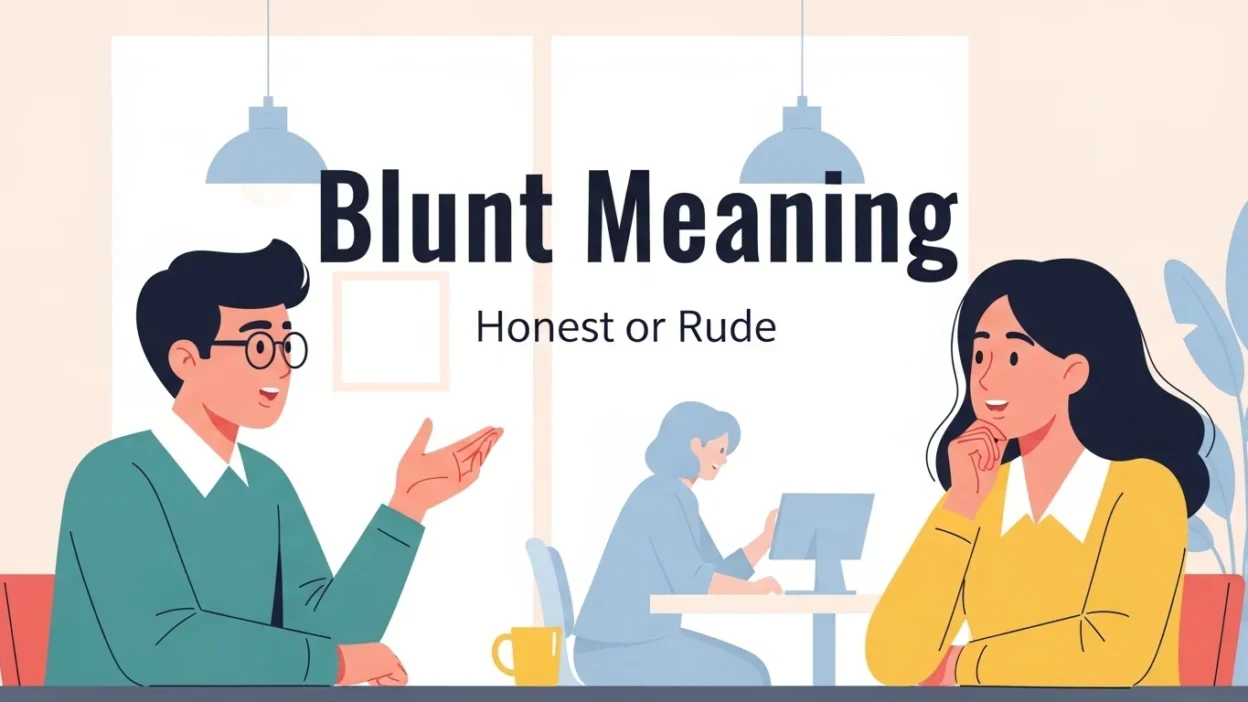
Is being “blunt” a sign of honesty—or just another way of being rude? That’s exactly why this word often causes confusion. Blunt (pronounced BLUHNT) is a versatile English word whose meaning depends on the context. Most commonly, it describes someone who speaks honestly, directly, and without sugarcoating their words, even if the truth sounds harsh or hurts someone’s feelings.
Because of this, being blunt can be seen as either a compliment or a criticism, depending on the situation and how the message is delivered. The word can also describe a knife or object that is no longer sharp, the verb “to blunt,” meaning to weaken or reduce something’s impact, and, in slang, a cigar or cigar wrap filled with cannabis.
Although these meanings seem unrelated, they all share the idea of removing sharpness—whether from speech, an object’s edge, or the force of an action.
In simple terms, blunt can describe a person’s communication style, a dull object, an action, or a slang term. You’ll often encounter the word in everyday conversations, workplace feedback, relationships, books, social media, and text messages, where understanding the context is essential.
This guide explains every major meaning of blunt, its pronunciation, origin, examples, synonyms, antonyms, and how to recognize when being blunt is appreciated as honesty and when it may be considered impolite or insensitive.
What Does Blunt Mean?
The word blunt has several meanings, and the correct one depends on the context.
In everyday English, blunt most often describes someone who speaks honestly and directly without softening their words.
When talking about physical objects, blunt means not sharp or having a dull edge, such as a blunt knife or a blunt pencil.
In medicine, blunt describes injuries caused by force that does not pierce the skin, as in blunt trauma.
In slang, a blunt refers to a cigar or blunt wrap that has been hollowed out and filled with cannabis.
Although these meanings seem different, they all share one common idea: something that lacks a sharp edge or softening layer—whether that’s a knife, a comment, or a medical injury.
Blunt Meaning at a Glance
| Context | Meaning | Example |
|---|---|---|
| Personality | Honest and direct communication | She’s blunt but fair. |
| Conversation | Speaking without sugarcoating | I’ll be blunt with you. |
| Relationship | Open and straightforward communication | My partner is very blunt. |
| Medical | Non-sharp or non-penetrating | The patient suffered blunt trauma. |
| Objects | Not sharp | The knife has become blunt. |
| Slang | A cannabis-filled cigar wrap | They rolled a blunt. |
How Do You Pronounce “Blunt”?
Pronunciation: BLUNT
IPA: /blʌnt/
It rhymes with:
- hunt
- front
- stunt
Word Forms
| Word | Part of Speech | Meaning |
|---|---|---|
| Blunt | Adjective | Direct, straightforward, or not sharp |
| Bluntly | Adverb | In a direct or straightforward way |
| Bluntness | Noun | The quality of being blunt |
| Blunter | Comparative | More direct |
| Bluntest | Superlative | Most direct |
Dictionary Meaning of Blunt
Most major English dictionaries describe blunt in very similar ways.
In simple terms, the word means speaking honestly without trying to make difficult truths sound gentler.
It can also describe something that is dull rather than sharp.
Modern dictionaries additionally recognize the slang meaning of blunt as a cannabis-filled cigar wrapper.
Although the exact wording varies from one dictionary to another, the central idea remains the same:
Blunt means direct, straightforward, and lacking unnecessary softness.
Is Blunt Positive or Negative?
One of the biggest misconceptions about this word is that it’s always negative.
In reality, blunt is a neutral adjective.
Whether it sounds positive or negative depends on:
- the speaker’s tone,
- the relationship,
- the timing,
- and the situation.
For example:
✅ Positive
“She was blunt, but her advice helped me improve.”
Here, bluntness is appreciated because it provides honest and useful feedback.
❌ Negative
“He was so blunt that everyone in the meeting felt embarrassed.”
In this case, the same directness became hurtful because it lacked sensitivity.
This is why people often confuse bluntness with rudeness, even though they are not the same thing.
Why Do People Misunderstand the Word “Blunt”?
The confusion usually comes from focusing only on what someone says instead of how they say it.
Imagine these two comments:
Person A
“Your report needs more evidence before we publish it.”
Person B
“This report is terrible.”
Both comments are direct.
Only one is respectful.
That’s the key difference.
A blunt person focuses on honesty and clarity.
A rude person focuses little—or not enough—on the listener’s feelings.
In other words:
Honesty tells the truth. Bluntness tells the truth directly. Rudeness tells the truth disrespectfully.
Understanding this simple distinction will help you recognize when someone is genuinely trying to help—and when they’re simply being unkind.
Why This Word Matters Today
As communication increasingly happens through texts, emails, social media, and online meetings, it’s easier than ever for messages to sound blunter than intended. Without facial expressions or tone of voice, even short replies like “No,” “That’s incorrect,” or “I disagree” can feel harsher than they would in a face-to-face conversation.
Learning what blunt really means can help you:
- communicate more effectively,
- understand feedback without taking it personally,
- avoid sounding unintentionally harsh,
- improve workplace communication,
- and build healthier personal relationships.
Whether you’re reading a novel, chatting online, watching interviews, or having a difficult conversation, understanding the different meanings of blunt will help you interpret the speaker’s intention more accurately.


What Does Blunt Mean in a Person?
When describing a person, blunt means they communicate in a direct, honest, and straightforward way without hiding their opinions behind polite or indirect language.
A blunt person usually says exactly what they think. Instead of trying to avoid uncomfortable conversations, they prefer honesty—even when the truth is difficult to hear.
For example, imagine asking your friend whether your new haircut suits you.
A polite response might be:
“It’s different. Maybe it’ll grow on me.”
A blunt response could be:
“I don’t think it suits you.”
Both answers may express the same opinion, but the blunt response removes the softening words and delivers the message more directly.
Many people appreciate blunt individuals because they know they’re receiving genuine opinions rather than vague or misleading compliments. However, others may find the same communication style too direct, especially in emotional situations.
A Blunt Person Often:
- Speaks honestly without sugarcoating.
- Values clarity over diplomacy.
- Gives straightforward feedback.
- Says what they mean.
- Prefers solving problems rather than avoiding them.
- May unintentionally hurt feelings if they ignore tone.
Being blunt doesn’t automatically make someone insensitive. It simply means they communicate differently from people who naturally soften their words.
Is Being Blunt a Good or Bad Personality Trait?
One of the most common questions people ask is:
“Is being blunt a good thing?”
The answer is it depends on how the honesty is delivered.
Bluntness itself isn’t good or bad. It’s a communication style, and like any communication style, it can be effective in some situations and inappropriate in others.
Advantages of Being Blunt
✅ Builds trust through honesty.
✅ Reduces misunderstandings.
✅ Saves time.
✅ Makes expectations clear.
✅ Encourages transparency.
For example, a manager who gives direct feedback may help employees improve faster because everyone understands exactly what needs to change.
Disadvantages of Being Blunt
❌ Can unintentionally hurt feelings.
❌ May sound insensitive.
❌ Can create conflict if empathy is missing.
❌ May be misunderstood in text messages or emails.
Blunt communication works best when honesty is balanced with respect and emotional awareness.
Does Blunt Mean Rude?
No. Blunt does not automatically mean rude.
This is probably the biggest misunderstanding about the word.
A blunt person speaks directly.
A rude person speaks disrespectfully.
The difference lies in how the message is delivered.
For example:
Blunt but Respectful
“I think this report needs stronger evidence before we publish it.”
The speaker is honest while remaining professional.
Rude
“This report is awful. Did you even try?”
Here, the criticism becomes personal and disrespectful.
In other words:
- Blunt = Direct.
- Rude = Disrespectful.
A person can be blunt without being rude, and someone can be polite while still giving honest feedback.
Blunt vs Honest vs Direct vs Harsh vs Rude
Many learners confuse these words because they all relate to communication. However, each has a different meaning.
| Word | Meaning | Positive or Negative? |
|---|---|---|
| Honest | Tells the truth sincerely. | Usually Positive |
| Direct | Clear and straightforward. | Neutral |
| Blunt | Honest without softening the message. | Neutral (depends on context) |
| Harsh | Very severe or unpleasant in tone. | Usually Negative |
| Rude | Disrespectful or offensive. | Negative |
Quick Example
Honest:
“I think this could be improved.”
Direct:
“This section needs more examples.”
Blunt:
“This article isn’t ready to publish.”
Harsh:
“This article is a mess.”
Rude:
“Did you even know what you were doing?”
Notice how the level of respect changes even though all five statements express criticism.


5
Blunt Communication Meaning
Blunt communication means expressing thoughts openly, honestly, and directly without unnecessary exaggeration or vague language.
People who communicate bluntly usually:
- say exactly what they think,
- avoid hints,
- prefer clarity,
- value honesty over politeness.
In workplaces, blunt communication can improve efficiency because expectations are clear.
However, effective communicators know that clarity works best when combined with empathy.
The goal is not simply to be blunt—it’s to be understood.
What Does “To Be Blunt” Mean?
The phrase “to be blunt” is commonly used before someone shares an honest opinion.
It prepares the listener for direct feedback.
Examples
“To be blunt, I don’t think this plan will succeed.”
“To be blunt, you deserve better.”
“To be blunt, we need to improve customer service.”
Using this phrase signals that the speaker intends to be straightforward rather than impolite.
🤔 Real Irreverent Meaning in English 💬 | 2025
What Does “I’ll Be Blunt” Mean?
When someone says,
“I’ll be blunt,”
they’re warning the listener that they’re about to express a completely honest opinion.
Examples:
“I’ll be blunt—I don’t think accepting that offer is a good idea.”
“I’ll be blunt—you need more practice before the interview.”
This expression often appears in business meetings, interviews, coaching sessions, and everyday conversations.
What Does “Let Me Be Blunt” Mean?
“Let me be blunt” has a similar meaning.
It politely asks the listener to expect a direct answer.
Example:
“Let me be blunt. If we don’t change our strategy, we’ll lose customers.”
Instead of sounding aggressive, the phrase prepares people for honest communication.
Can You Be Blunt and Kind at the Same Time?
Absolutely.
One of the biggest myths is that people must choose between kindness and honesty.
In reality, the strongest communicators combine both.
Example 1
❌
“That’s a terrible presentation.”
Example 2
✅
“I think your ideas are strong, but adding more evidence would make your presentation much more convincing.”
Both comments are honest.
Only the second one is likely to encourage improvement.
Blunt Meaning in a Relationship
In relationships, being blunt means communicating openly instead of hiding thoughts or emotions.
Healthy bluntness can:
- improve trust,
- reduce misunderstandings,
- encourage honest conversations.
However, constant bluntness without empathy can make a partner feel criticized or unappreciated.
For example:
Instead of saying:
“You never listen.”
A healthier blunt approach would be:
“I don’t feel heard during our conversations.”
The second statement remains honest while focusing on feelings rather than blame.
Signs Someone Is Naturally Blunt
Not everyone who speaks directly is trying to offend.
People with a blunt communication style often:
- Answer questions immediately.
- Avoid small talk.
- Prefer facts over assumptions.
- Give honest feedback without being asked.
- Dislike passive-aggressive communication.
- Appreciate clear expectations.
- Respect people who are equally honest.
These traits don’t automatically make someone rude—they simply reflect a preference for straightforward communication.


Origin and History of the Word “Blunt”
The word blunt has been part of the English language for more than 700 years. It first appeared in Middle English during the 13th century, where it described objects that were dull or not sharp, such as knives, swords, or tools.
Over time, the meaning expanded beyond physical objects. By the 18th and 19th centuries, English speakers began using blunt to describe people who spoke in a direct, straightforward way—almost as if their words had no polished edge.
Today, the word has several widely recognized meanings depending on the situation:
| Time Period | Meaning |
|---|---|
| 1200s | Not sharp or dull |
| 1700s–1800s | Direct and straightforward speech |
| 1980s | Cannabis slang becomes popular |
| Today | Communication, medicine, objects, and slang |
Although the meanings have evolved, the central idea remains the same: something that lacks a sharp or softened edge.
Why Is It Called a “Blunt”?
Many people wonder why a cannabis cigar is called a blunt.
The slang meaning became popular in the United States during the 1980s, when people began emptying inexpensive cigars and replacing the tobacco with cannabis.
One well-known cigar brand sold products called “Blunts.” Over time, the brand name became a generic slang term for this style of smoking.
Today, the word is commonly used in music, movies, and internet culture.


Blunt Meaning in Slang
In modern slang, a blunt is a cigar or cigar wrap that has been hollowed out and filled with cannabis instead of tobacco.
This meaning is completely different from the communication-related meaning of blunt.
Example
“They rolled a blunt before listening to music.”
Here, blunt refers to the smoking product—not someone’s personality.
Because the same word has two very different meanings, always pay attention to the surrounding context.
Duly Noted Meaning Explained in Simple Words 📝 | 2025
What Does “Smoke a Blunt” Mean?
The phrase “smoke a blunt” simply means to smoke a blunt after it has been prepared.
You’ll often hear this expression in:
- Hip-hop lyrics
- Movies
- TV shows
- Social media
- Informal conversations
Example:
“They planned to smoke a blunt after dinner.”
This usage belongs to informal slang and isn’t appropriate in formal or professional communication.
What Does “Roll a Blunt” Mean?
Roll a blunt means preparing a blunt by filling a cigar wrapper or blunt wrap with cannabis and rolling it into shape.
Example:
“He knows how to roll a blunt.”
Like many slang expressions, this phrase is common in entertainment and online discussions but uncommon in formal writing.
What Does “Pearled a Blunt” Mean?
A pearled blunt is a blunt that has been rolled evenly, smoothly, and neatly.
Among people who use cannabis slang, saying someone “pearled the blunt” is a compliment because it suggests the blunt was rolled with skill and care.
Example:
“That blunt is perfectly rolled—you really pearled it.”
This meaning is limited to cannabis culture and is unlikely to appear in everyday English outside that context.
What Does “Drop the Blunt” Mean?
The phrase “drop the blunt” can have more than one meaning.
Literal Meaning
It simply means someone accidentally dropped the blunt they were holding.
Example:
“Be careful—you almost dropped the blunt.”
Internet Slang
On social media, “drop the blunt” or “I dropped the blunt” is sometimes used humorously to react to something shocking, confusing, or unexpected.
For example:
“Wait…what did I just read? I must’ve dropped the blunt.”
In this context, it’s a humorous expression rather than a literal statement.
What Is a Blunt Rotation?
A blunt rotation is an informal slang term describing the practice of passing the same blunt from one person to another within a group.
Example:
“Everyone joined the blunt rotation.”
This expression is commonly found in cannabis-related conversations and internet slang.
Blunt vs Joint vs Spliff
These terms are often confused because they all refer to smoking products, but they are not the same.
| Term | Wrapper | Contents |
|---|---|---|
| Blunt | Cigar or blunt wrap | Cannabis |
| Joint | Rolling paper | Cannabis |
| Spliff | Rolling paper | Cannabis mixed with tobacco (common in some regions) |
Knowing the difference helps you understand conversations more accurately, especially in music, movies, and online discussions.
Common Slang Expressions Using “Blunt”
You may come across these phrases online:
| Expression | Meaning |
|---|---|
| Roll a blunt | Prepare a blunt for smoking |
| Smoke a blunt | Use a blunt |
| Pass the blunt | Hand it to another person |
| Pearled blunt | A perfectly rolled blunt |
| Blunt rotation | Passing one blunt around a group |
| Need a blunt | Informal slang expressing a desire to smoke |
These expressions belong to informal slang and should be understood in context.
Important Context Tip
The word blunt has multiple meanings, and context determines which one is intended.
For example:
Personality
“She’s very blunt.”
Meaning: She speaks honestly and directly.
Object
“This knife is blunt.”
Meaning: The knife is not sharp.
Medical
“The patient suffered blunt trauma.”
Meaning: The injury was caused by impact rather than a sharp object.
Slang
“They rolled a blunt.”
Meaning: A cannabis-filled cigar wrap.
Looking at the surrounding words is the easiest way to identify the correct meaning.
Tips for Giving Blunt Feedback Professionally
- Focus on the work, not the person.
- Explain why something needs improvement.
- Offer practical suggestions.
- Stay respectful.
- Choose an appropriate time and place.
Constructive bluntness builds stronger teams than criticism without solutions.


5
Blunt Meaning in Medical Terms
In medicine, blunt has a completely different meaning from its communication or slang uses.
It refers to force or injuries that do not cut or pierce the body.
Medical professionals commonly use terms such as:
- Blunt trauma
- Blunt force
- Blunt injury
These injuries are caused by impact rather than sharp objects.
What Is Blunt Trauma?
Blunt trauma is an injury caused by a strong impact that does not penetrate the skin.
Common causes include:
- Falls.
- Car accidents.
- Sports injuries.
- Physical collisions.
Examples of blunt trauma include bruises, fractures, and internal injuries caused by force.
What Does Blunt Force Mean?
Blunt force describes impact from a non-sharp object.
Examples include being struck by:
- a baseball bat,
- a wall during an accident,
- a heavy object,
- or another solid surface.
Unlike cuts from knives or glass, blunt force injuries are caused by impact rather than penetration.
What Does Blunt Taste Mean?
The phrase blunt taste refers to a reduced or weakened sense of taste.
A person experiencing blunt taste may notice that food seems less flavorful than usual.
Possible reasons include:
- temporary illness,
- certain medications,
- aging,
- nasal congestion,
- or other medical conditions.
If changes in taste persist, it’s appropriate to seek medical advice.
What Is Blunt Affect?
Blunt affect is a medical and psychological term describing reduced emotional expression.
A person with blunt affect may:
- show limited facial expressions,
- speak with a flat tone,
- appear emotionally unresponsive,
even though they still experience emotions internally.
This term is used in clinical settings and should not be confused with someone having a blunt personality.
How to Be Blunt Without Being Rude
Many people want to communicate honestly without damaging relationships.
The good news is that you can be both direct and respectful.
1. Focus on the Problem, Not the Person
❌ “You’re careless.”
✅ “There are a few mistakes that need correcting.”
2. Give Specific Feedback
Instead of saying:
“This isn’t good.”
Try:
“Adding more examples would make this section much stronger.”
Specific advice is easier to understand and more helpful.
3. Choose the Right Time
Honest feedback is easier to accept when people aren’t already stressed or upset.
Private conversations are often better than public criticism.
4. Speak Calmly
A calm tone makes even direct feedback easier to hear.
Remember:
People react to how you say something just as much as what you say.
5. Offer a Solution
Helpful bluntness points toward improvement.
Example:
“The report needs more recent sources. Adding two or three studies would strengthen your argument.”
This approach encourages growth instead of discouragement.
Real-Life Examples of “Blunt”
Everyday Conversation
Friend:
“Be honest. How was my speech?”
Friend:
“I’ll be blunt. You spoke too quickly, but your ideas were excellent.”
Workplace
Manager:
“I’m going to be blunt. This proposal isn’t ready for the client yet.”
Relationship
Partner:
“I’m being blunt because I want us to communicate better, not because I’m angry.”
Medical
Doctor:
“The X-ray shows a blunt force injury rather than a cut.”
Social Media
Comment:
“She’s blunt, but at least she’s honest.”
Blunt Meaning Synonyms
Depending on the context, these words have similar meanings:
| Synonym | Best Used When |
|---|---|
| Direct | Clear communication |
| Honest | Truthfulness |
| Frank | Open discussion |
| Candid | Honest opinions |
| Forthright | Professional honesty |
| Straightforward | Simple, clear communication |
| Plainspoken | Easy-to-understand speech |
| Explicit | Extremely clear explanation |
Although these words overlap, blunt often implies less effort to soften the message.
Antonyms of Blunt
Words opposite in meaning include:
| Antonym | Meaning |
|---|---|
| Tactful | Sensitive to feelings |
| Diplomatic | Careful and polite |
| Gentle | Soft in communication |
| Considerate | Thoughtful toward others |
| Polite | Respectful and courteous |
| Indirect | Not openly stated |
Common Mistakes People Make
❌ Mistake 1
Blunt always means rude.
✅ Reality:
Bluntness is about directness. Rudeness is about disrespect.
❌ Mistake 2
Blunt and honest mean exactly the same thing.
✅ Reality:
Honesty describes telling the truth.
Bluntness describes how the truth is delivered.
❌ Mistake 3
A blunt person doesn’t care about feelings.
✅ Reality:
Many blunt people care deeply about others but naturally communicate more directly.
❌ Mistake 4
Blunt only refers to personality.
✅ Reality:
The word also describes objects, medical terms, and cannabis slang.
Quick Summary
| Context | Meaning |
|---|---|
| Person | Honest and direct |
| Relationship | Open communication |
| Texting | Straightforward message |
| Workplace | Clear feedback |
| Medical | Non-penetrating injury |
| Slang | Cannabis-filled cigar wrap |
FAQs
1. What does blunt mean in a person?
A blunt person speaks honestly and directly without trying to soften their words. Some people appreciate this openness, while others may find it too straightforward depending on the situation.
2. Does blunt mean rude?
No. Blunt and rude are not the same. A blunt person tells the truth directly, whereas a rude person speaks disrespectfully. Tone, timing, and word choice make the difference.
3. Is being blunt a bad thing?
Not necessarily. Being blunt can improve honesty and reduce misunderstandings when it’s balanced with empathy. However, constant bluntness without considering other people’s feelings may damage relationships.
4. What is the difference between blunt and honest?
Honest means telling the truth. Blunt means telling the truth in a direct, unfiltered way that may sound harsh if not expressed thoughtfully.
5. What does “to be blunt” mean?
The phrase “to be blunt” means to speak very honestly and directly, usually before giving an opinion that may be difficult to hear.
6. What does “I’ll be blunt” mean?
When someone says “I’ll be blunt,” they’re signaling that they’re about to express a frank opinion without sugarcoating it.
7. What does blunt mean in texting?
In texting, blunt usually describes a message that feels short, direct, or emotionally neutral. Because text lacks facial expressions and tone, messages can sometimes sound blunter than intended.
8. What does blunt mean in a relationship?
In relationships, bluntness refers to open, straightforward communication. It can strengthen trust when paired with kindness, but may cause hurt feelings if delivered without empathy.
9. What is blunt communication?
Blunt communication means expressing thoughts clearly and honestly without unnecessary indirectness. Effective blunt communication focuses on clarity while still showing respect.
10. What is a blunt in slang?
In slang, a blunt is a cigar or blunt wrap that has been hollowed out and filled with cannabis. This meaning is completely different from the communication-related meaning of the word.
11. What does “roll a blunt” mean?
It refers to preparing a blunt by filling a cigar wrapper or blunt wrap with cannabis and rolling it into shape.
12. What does “smoke a blunt” mean?
It means to smoke a prepared blunt. This expression is common in informal conversations, music, and internet slang.
13. What does “pearled a blunt” mean?
A pearled blunt is one that has been rolled neatly and evenly. In cannabis slang, it’s considered a compliment for a well-rolled blunt.
14. What does “drop the blunt” mean?
Literally, it means someone dropped the blunt they were holding. Online, it can also be used humorously to react to something shocking or confusing.
15. What does blunt mean in medical terms?
In medicine, blunt refers to force or injuries that do not pierce the skin, such as blunt trauma or blunt force injuries.
16. What does blunt taste mean?
Blunt taste means a reduced or weakened sense of taste. It may occur because of illness, medication, or other medical conditions.
17. What is blunt affect?
Blunt affect is a clinical term for reduced outward emotional expression. It does not necessarily mean the person lacks emotions.
18. Is blunt a negative word?
No. Blunt is generally a neutral word. Whether it’s perceived positively or negatively depends on the context and how the message is delivered.
19. What are some synonyms for blunt?
Common synonyms include:
- Direct
- Frank
- Candid
- Forthright
- Straightforward
- Plainspoken
Each has a slightly different nuance, so choose the one that best fits your context.
20. Can you be blunt and kind?
Yes. The most effective communicators combine honesty with empathy. You can deliver clear feedback while remaining respectful and considerate.
Key Takeaways
- Blunt most commonly means speaking in a direct and honest way.
- A blunt person values clarity over sugarcoating.
- Being blunt does not automatically mean being rude.
- The word also describes objects that are not sharp, certain medical injuries, and a slang term for a cannabis-filled cigar wrap.
- Understanding the context is the easiest way to identify the correct meaning.
Conclusion
The word blunt has several meanings, but they all share one central idea: a lack of unnecessary softness or sharpness. In everyday conversation, a blunt person speaks openly and honestly, often choosing clarity over diplomacy. Depending on the tone and situation, that honesty may be appreciated as refreshing or perceived as insensitive.
Outside communication, blunt can describe a dull object, a type of non-penetrating medical injury, or a cannabis-related slang term. Understanding the context is essential because the same word can mean very different things.
Whether you encounter blunt in a conversation, a workplace discussion, a medical report, or online slang, you can now recognize its meaning with confidence and use it appropriately.

Ethan Cole is a content writer at Meanovia who explains internet slang, texting abbreviations, and social media language in a simple and reader-friendly way._)