

Have you ever heard someone describe a person as earnest and wondered whether it means serious, sincere, honest, or something entirely different? You’re not alone.
In short, earnest means sincere, serious, honest, and genuinely committed to what you say, believe, or do. It describes a person whose words, actions, or intentions are heartfelt rather than fake, careless, or meant as a joke.
You’ll often see earnest in books, job interviews, business communication, speeches, and everyday conversations, making it an important English word to understand and use correctly.
Whether you’re improving your vocabulary, preparing for an exam, writing professionally, or simply curious about its meaning, this guide explains the earnest meaning, pronunciation, origin, synonyms, antonyms, example sentences, common phrases, and exactly how to use earnest naturally and confidently in real-life English.
Why Does the Word “Earnest” Matter?
In everyday life, people often use words like serious, honest, or nice to describe someone. However, earnest carries a deeper meaning.
A serious person may simply focus on a task.
An honest person tells the truth.
But an earnest person combines sincerity, seriousness, and genuine effort.
For example:
Someone saying:
“I want to help you.”
is different from someone who listens carefully, takes action, and makes a real effort.
The second person is being earnest.
This is why the word appears frequently in:
- professional communication,
- education,
- literature,
- relationships,
- speeches,
- interviews,
- personal development,
- and meaningful conversations.
What Is the Meaning of Earnest?
The word earnest means showing real sincerity, strong intention, and genuine commitment.
It describes something that is:
- heartfelt,
- authentic,
- purposeful,
- honest,
- serious in intention,
- and deeply meaningful.
Simple Earnest Definition
Earnest (adjective):
Showing sincere and serious feelings, intentions, or efforts.
Earnest Meaning in Simple Words
If someone is earnest, they are not pretending.
They genuinely care.
They truly believe what they say.
They put real effort into what they do.
Easy Example:
Imagine two students preparing for an exam.
Student A studies only because their parents force them.
Student B studies because they truly want to learn and improve.
Student B shows an earnest attitude.

What Does It Mean If Someone Is Earnest?
If someone is earnest, it means they are a person who:
- speaks honestly,
- takes responsibilities seriously,
- keeps promises,
- shows genuine emotions,
- puts effort into important things,
- and acts with integrity.
An earnest person usually does not try to impress others with fake behavior. Their sincerity naturally appears through their actions.
Example:
“Sarah is an earnest person who always gives her best effort.”
Meaning:
Sarah is sincere, responsible, and genuinely committed.
What Is the Meaning of Being Earnest?
Being earnest means approaching something with complete sincerity and genuine intention.
It means you are not:
- pretending,
- joking,
- acting for attention,
- or doing something without care.
Instead, you are fully committed.
Example:
“He is earnest about improving his communication skills.”
Meaning:
He truly wants to improve and is seriously working toward that goal.
Earnest Meaning: Quick Facts
| Category | Information |
|---|---|
| Word | Earnest |
| Part of Speech | Adjective |
| Pronunciation | UR-nist |
| Meaning | Sincere, genuine, serious |
| Tone | Positive |
| Used For | People, feelings, efforts, conversations, intentions |
| Opposite | Insincere, fake, careless |
Earnest Pronunciation
Many learners recognize the spelling but are unsure how to pronounce earnest.
Pronunciation:
UR-nist
IPA:
American English: /ˈɝː.nɪst/
British English: /ˈɜː.nɪst/
The word sounds similar to the name Ernest, but the meanings are different.
Earnest Part of Speech
The most common use of earnest is as an adjective.
It describes a person, action, feeling, or situation.
Examples:
- earnest person
- earnest effort
- earnest apology
- earnest request
- earnest conversation
- earnest desire
Word Family of Earnest
Understanding related words helps you use English more naturally.
| Word | Type | Meaning | Example |
|---|---|---|---|
| Earnest | Adjective | Sincere and serious | She made an earnest promise. |
| Earnestly | Adverb | In a sincere way | He listened earnestly. |
| Earnestness | Noun | The quality of sincerity | Her earnestness was obvious. |
Earnest Meaning Through a Real-Life Example
Imagine a friend says:
“I will always support you.”
There are two possibilities.
One person says it casually and forgets later.
Another person says it sincerely, checks on you, helps you during difficult times, and proves their words through actions.
The second person is earnest.
This is the heart of the word:
Earnest is when your actions match your words.
Is Earnest a Compliment?
Yes.
Calling someone earnest is usually a positive compliment.
It suggests that they are:
✅ sincere
✅ trustworthy
✅ responsible
✅ genuine
✅ thoughtful
✅ dedicated
Example:
“The teacher appreciated his earnest effort.”
This means the teacher valued his genuine dedication.
Earnest vs Serious: The Important Difference
Many people think earnest simply means serious, but there is a difference.
Serious:
Means someone is focused or not joking.
Example:
“The doctor was serious during the operation.”
Earnest:
Means someone is serious because they genuinely care.
Example:
“The doctor showed earnest concern for the patient.”
Earnest = seriousness + sincerity + genuine intention
Why People Search for Earnest Meaning
People usually search for this word because they see it in a sentence and want to understand the deeper meaning.
Common questions include:
- What does earnest mean?
- What is the meaning of being earnest?
- Is earnest a compliment?
- What is an earnest person?
- What does in earnest mean?
- Is earnest the same as honest?
- What is the Bible meaning of earnest?
- How do you use earnest in a sentence?
This guide answers all of these questions with examples and practical explanations.
How Native Speakers Understand “Earnest”
Native English speakers usually connect earnest with authenticity.
When someone is described as earnest, people often imagine someone who:
- truly cares,
- speaks from the heart,
- works sincerely,
- avoids pretending,
- and takes meaningful things seriously.
It is a word about character, not just behavior.
The Origin and History of the Word “Earnest”
The word earnest is a powerful example of how language preserves human values over centuries.
The modern meaning of earnest—being sincere, serious, and genuine—comes from the Old English word eornost, which carried meanings connected with:
- seriousness,
- sincerity,
- determination,
- zeal,
- and strong intention.
Originally, the word was used to describe someone who approached important matters with seriousness and commitment.
Over time, the spelling changed from eornost to earnest, but the central idea remained the same:
A person who truly means something and acts with genuine purpose.
Earnest Etymology: Where Does the Word Come From?
The history of earnest shows that the concept of sincerity has always been valued in human communication.
Old English Period
The word eornost referred to seriousness and sincere purpose.
Middle English Period
The spelling gradually developed into earnest.
Modern English
Today, earnest describes:
- sincere people,
- meaningful efforts,
- honest emotions,
- serious intentions,
- and genuine commitments.
Although English has changed dramatically, this word has remained popular because sincerity is a timeless quality.
Why Has “Earnest” Survived for Hundreds of Years?
Many old English words disappear because they describe outdated objects or situations.
However, earnest survived because it describes something universal:
human intention.
Every generation values people who are:
- trustworthy,
- sincere,
- responsible,
- and genuine.
Whether in friendships, workplaces, education, or leadership, sincerity never becomes outdated.
5G UC Mean: Why Carriers Use This Term Now
Earnest Meaning in the Bible
The meaning of earnest in the Bible requires understanding historical language because older English Bible translations sometimes use words differently from modern conversation.
In Biblical contexts, earnest can refer to:
- sincere devotion,
- wholehearted commitment,
- deep faith,
- assurance,
- or a pledge/guarantee.
The exact meaning depends on the verse and translation.
Earnest in the Bible: Spiritual Meaning
When used to describe faith or devotion, earnest suggests:
- a sincere heart,
- genuine dedication,
- serious commitment,
- and deep spiritual intention.
Example concept:
A person who prays earnestly is someone who prays with genuine faith and complete sincerity.
What Does “Earnestly” Mean in the Bible?
The word earnestly means doing something with deep sincerity and strong intention.
Examples of Biblical-style usage:
- seeking earnestly,
- praying earnestly,
- desiring earnestly,
- working earnestly.
It suggests that the person is not acting casually but with full devotion.

Earnest Meaning in Hebrew
The English word earnest does not directly come from Hebrew.
However, several Hebrew concepts express similar ideas, including:
- sincerity,
- faithfulness,
- wholeheartedness,
- truth,
- commitment.
The closest ideas are related to having a genuine heart and remaining faithful to one’s purpose.
So while earnest is an English word, the concept behind it appears across many cultures and languages.
Earnest Meaning in Urdu
The meaning of earnest in Urdu includes:
- مخلص (Mukhlis)
- سنجیدہ (Sanjeeda)
- خلوص والا
- دل سے کیا ہوا
- سچی نیت والا
Example:
He made an earnest effort.
Urdu:
اس نے خلوص اور سنجیدگی سے کوشش کی۔
Meaning:
He made a sincere and serious effort.
Earnest Meaning in Hindi
Common Hindi meanings include:
- ईमानदार (Imaandaar)
- गंभीर (Gambhir)
- सच्चा (Saccha)
- निष्ठावान (Nishthavan)
- दिल से किया हुआ
Example:
She made an earnest attempt.
Hindi:
उसने पूरी ईमानदारी और लगन से प्रयास किया।
Earnest Meaning in Arabic
Common Arabic equivalents include:
- مُخلص (Mukhlis)
- صادق (Sadiq)
- جادّ (Jadd)
- بإخلاص (Bi-Ikhlas)
These words express:
- sincerity,
- honesty,
- seriousness,
- genuine intention.
Earnest Meaning in Farsi (Persian)
In Farsi, similar meanings include:
- مخلص (Mokhles)
- صادق (Sadegh)
- جدی (Jeddi)
- بااخلاص (Ba-ekhlas)
Meaning:
Someone who is earnest is:
- sincere,
- serious,
- genuine,
- and committed.
Earnest Meaning in Bengali
In Bengali, earnest can be expressed as:
- আন্তরিক (Antorik)
- sincere,
- genuine,
- serious-minded.
Example:
He made an earnest request.
Meaning:
তিনি আন্তরিকভাবে অনুরোধ করেছিলেন।
Earnest Meaning in Tamil
Common Tamil meanings:
- உண்மையான (Unmaiyana)
- நேர்மையான (Nermaiyana)
- அக்கறையுள்ள (Akkaraiyulla)
It describes someone who acts with genuine care and sincerity.
Earnest Meaning in Marathi
Marathi meanings include:
- प्रामाणिक
- मनापासून
- गंभीर
- sincere
Example:
त्याने मनापासून प्रयत्न केला.
Meaning:
He made an earnest effort.
Earnest Meaning in Malayalam
Malayalam meanings include:
- ആത്മാർത്ഥമായ
- സത്യസന്ധമായ
- ഗൗരവമുള്ള
It represents genuine intention and sincere effort.
Earnest Meaning in Gujarati
Gujarati meanings include:
- નિષ્ઠાવાન
- સાચો
- દિલથી કરેલું
- ગંભીર
Example:
An earnest effort:
દિલથી કરેલો પ્રયાસ
Earnest Meaning in Indonesian (Artinya)
For Indonesian speakers:
Earnest artinya:
- sungguh-sungguh
- tulus
- serius
- bersungguh-sungguh
It describes someone who truly means what they say.
Earnest Meaning in English (Dictionary Style)
A simple dictionary-style definition:
Earnest: showing sincere and intense conviction; seriously intending to do something.
Examples:
- an earnest student
- an earnest promise
- an earnest conversation
- an earnest effort
Earnest as a Name Meaning
Many people search:
“Earnest meaning name”
The name usually appears as Ernest.
The name Ernest comes from the same historical root as the word earnest.
It is traditionally associated with:
- honesty,
- seriousness,
- reliability,
- determination,
- sincerity.
Prompt Meaning: What It Really Means in Writing & AI
Ernest vs Earnest: What Is the Difference?
This is one of the most common confusion points.
Although they sound almost identical, they are different.
Earnest
Type: Adjective
Meaning:
Sincere, genuine, serious.
Example:
“She gave an earnest apology.”
Meaning:
Her apology was truly sincere.
Ernest
Type: Proper noun (name)
Meaning:
A person’s name.
Example:
“Ernest Hemingway was a famous writer.”
Easy Trick to Remember
Think:
Earnest = Emotion
Ernest = Name
If you are describing someone’s attitude, effort, or feelings → use earnest.
If you are talking about a person named Ernest → use Ernest.
The Importance of Being Earnest Meaning
One of the most famous uses of this word appears in Oscar Wilde’s comedy:
The Importance of Being Earnest
Published in 1895, this play uses a clever wordplay between:
- earnest (meaning sincere)
- Ernest (a person’s name)
The title explores ideas such as:
- honesty,
- identity,
- social expectations,
- appearance versus reality.
Oscar Wilde humorously questions whether society values true sincerity or simply the appearance of being respectable.
Symbolism in The Importance of Being Earnest
The word earnest symbolizes:
- authenticity,
- truth,
- moral character,
- genuine identity.
The play suggests that being truly sincere is more complicated than simply appearing respectable.
This is why the title remains famous in English literature.
How to Use “Earnest” Correctly
Understanding the definition of earnest is only the first step. The real power of this word comes from knowing where and how to use it naturally.
Native English speakers usually use earnest when they want to describe something that feels:
- genuine,
- meaningful,
- sincere,
- deeply intentional,
- and not casual or fake.
The word can describe:
- a person,
- an effort,
- an apology,
- a conversation,
- a request,
- an expression,
- a promise,
- a desire,
- or a commitment.

Earnest Person Meaning
An earnest person is someone who genuinely means what they say and takes important things seriously.
They usually show:
✅ honesty
✅ dedication
✅ responsibility
✅ emotional sincerity
✅ strong values
An earnest person does not simply make promises—they try to prove their intentions through actions.
Example:
“Maria is an earnest person who always tries to help others.”
Meaning:
Maria is sincere, caring, and genuinely committed.
What Is an Earnest Tone?
An earnest tone means a way of speaking that sounds sincere, serious, and heartfelt.
Someone using an earnest tone is usually expressing something important.
It may show:
- concern,
- honesty,
- respect,
- passion,
- or deep emotion.
Examples:
“The teacher spoke in an earnest tone about the importance of education.”
Meaning:
The teacher spoke with genuine seriousness and care.
Earnest Expression Meaning
An earnest expression refers to a facial expression that shows sincere feelings.
It may include:
- serious eyes,
- thoughtful appearance,
- honest emotions,
- genuine concern.
Example:
“His earnest expression showed that he truly cared.”
Earnest Eyes Meaning
The phrase earnest eyes describes eyes that appear:
- sincere,
- honest,
- emotional,
- and trustworthy.
Writers often use this phrase in literature to show that a character has genuine feelings.
Example:
“She looked at him with earnest eyes, hoping he would understand.”
Earnest Heart Meaning
An earnest heart means having sincere intentions and genuine feelings.
It describes someone who acts with kindness, honesty, and true purpose.
Example:
“He helped the community with an earnest heart.”
Meaning:
He helped because he truly cared.
Earnest Effort Meaning
One of the most common phrases is earnest effort.
An earnest effort means:
A genuine attempt made with dedication and sincere intention.
It does not mean someone must succeed.
It means they truly tried.
Examples:
“She made an earnest effort to improve her writing.”
“The student’s earnest effort was recognized by the teacher.”
Earnest Attempt Meaning
An earnest attempt is a serious and sincere try.
Example:
“He made an earnest attempt to solve the problem.”
Meaning:
He honestly tried his best.
Earnest Apology Meaning
An earnest apology is not just saying sorry—it shows true regret and responsibility.
A genuine apology usually includes:
- admitting the mistake,
- understanding the other person’s feelings,
- accepting responsibility,
- trying not to repeat the mistake.
Example:
“Her earnest apology repaired their friendship.”
Earnest Request Meaning
An earnest request means a serious and sincere request.
It usually shows that the person truly needs help, support, or consideration.
Example:
“He made an earnest request for another chance.”
Meaning:
His request was genuine and important.
Earnest Conversation Meaning
An earnest conversation is a meaningful discussion where people speak honestly.
It often happens when discussing:
- relationships,
- future plans,
- personal problems,
- important decisions.
Example:
“They had an earnest conversation about their future.”
Meaning:
They had a serious and sincere discussion.
Earnest Love Meaning
Earnest love means deep, genuine affection that comes from sincere feelings.
It is love that is:
- loyal,
- meaningful,
- caring,
- and not superficial.
Example:
“Her earnest love for her family was clear.”
Earnest Desire Meaning
An earnest desire means a strong and sincere wish.
Example:
“He has an earnest desire to become a better person.”
Meaning:
He truly wants to improve.
Earnest Commitment Meaning
An earnest commitment means a promise or dedication that someone genuinely intends to follow.
Example:
“The company showed an earnest commitment to customer satisfaction.”
“In Earnest” Meaning
The phrase in earnest is one of the most common expressions using this word.
It means:
- seriously,
- genuinely,
- with full effort,
- with real commitment.
Examples of “In Earnest”
Example 1:
“She started studying in earnest before the final exam.”
Meaning:
She began studying seriously and with complete focus.
Example 2:
“The project began in earnest after the approval.”
Meaning:
The project moved into its serious working stage.
Example 3:
“He started exercising in earnest after his health checkup.”
Meaning:
He began exercising seriously.
Begin in Earnest Meaning
To begin in earnest means to start something seriously after preparation or delay.
Example:
“The campaign began in earnest after the announcement.”
Meaning:
The campaign officially started with serious activity.
Start in Earnest Meaning
Similar to “begin in earnest.”
It means starting something with:
- full attention,
- dedication,
- and genuine effort.
Example:
“The team started working in earnest on the new project.”
Started in Earnest Meaning
This phrase means something has moved from planning into serious action.
Example:
“Construction started in earnest after receiving permission.”
Began in Earnest Meaning
It means something truly started and became active.
Example:
“The discussion began in earnest when everyone shared their opinions.”
Dead Earnest Meaning
The phrase dead earnest means:
completely serious and absolutely sincere.
The word “dead” adds emphasis.
Example:
“I am dead earnest about my decision.”
Meaning:
I am completely serious.
Too Earnest Meaning
Being too earnest means someone is extremely serious or sincere, sometimes more than a situation requires.
It is not always an insult, but it can suggest someone lacks humor or flexibility.
Example:
“His speech was inspiring, but some people thought he was too earnest.”
Very Earnest Meaning
If someone is described as very earnest, it means they are extremely sincere and committed.
Example:
“She is a very earnest student who always works hard.”
Earnest in a Sentence
Here are natural examples:
Simple Sentences
- He is an earnest person.
- She gave an earnest reply.
- His apology was earnest.
- They made an earnest effort.
- I believe her intentions are earnest.
Intermediate Sentences
- The student showed earnest dedication toward learning.
- Her earnest request convinced the manager.
- His earnest expression showed his true feelings.
- They had an earnest conversation about their future.
Advanced Sentences
- The author’s earnest portrayal of human emotions made the novel memorable.
- Her earnest commitment to social work inspired many people.
- The leader delivered an earnest speech about creating positive change.
Earnest Meaning in Professional Communication
The word earnest works especially well in professional settings because it communicates sincerity and responsibility.
In Job Interviews
Example:
“I have an earnest desire to contribute to your organization.”
Meaning:
I genuinely want to make a valuable contribution.
In Workplace Emails
Example:
“Thank you for your earnest support during this project.”
Meaning:
Thank you for your sincere and meaningful help.
In Business Writing
Example:
“The company made an earnest effort to improve customer experience.”
Meaning:
The company genuinely tried to improve.
Earnest Meaning in Relationships
In relationships, being earnest means communicating with honesty and genuine care.
An earnest partner:
- listens sincerely,
- respects feelings,
- keeps promises,
- communicates openly.
Example:
“Their earnest conversation helped them understand each other better.”
Earnest Meaning in School and Learning
Teachers often value earnest students because they show genuine interest.
An earnest student:
- asks questions,
- works consistently,
- wants to understand,
- accepts feedback.
Example:
“Her earnest approach to learning helped her succeed.”
Earnest Meaning in Leadership
Earnest leaders create trust because their words and actions match.
They do not simply make impressive statements—they demonstrate commitment.
Example:
“The leader’s earnest dedication inspired the entire team.”
Quick Usage Formula
Remember:
Earnest + Person = sincere character
Example:
earnest person
Earnest + Action = genuine effort
Example:
earnest attempt
Earnest + Communication = heartfelt expression
Example:
earnest apology
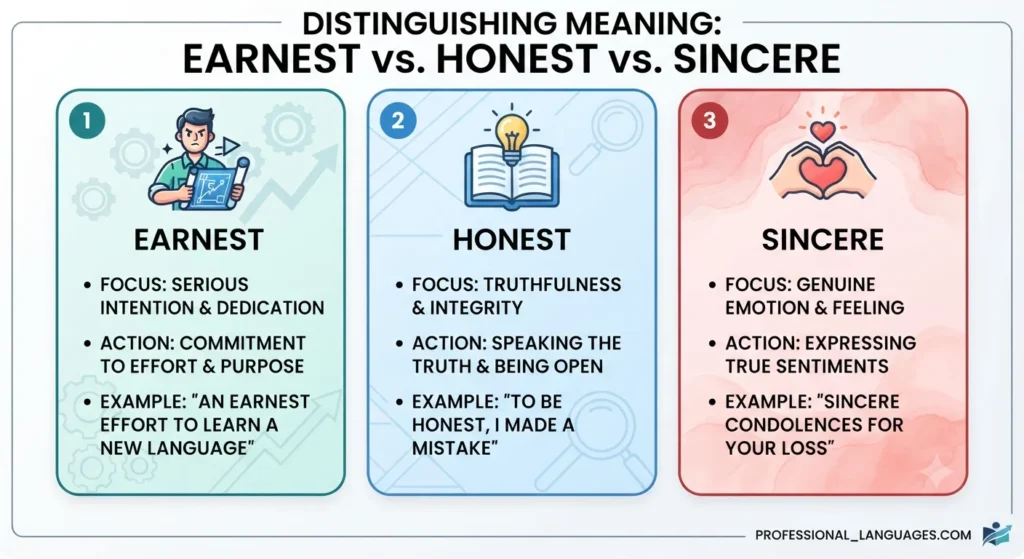
Earnest vs Honest: What Is the Difference?
Many English learners confuse earnest and honest because both words describe positive qualities.
However, they focus on different things.
Honest Meaning
Honest means:
- truthful,
- not lying,
- not hiding facts,
- fair and trustworthy.
Example:
“She was honest about her mistake.”
Meaning:
She told the truth.
Earnest Meaning
Earnest means:
- sincere,
- genuine,
- deeply committed,
- serious in intention.
Example:
“She made an earnest effort to fix her mistake.”
Meaning:
She genuinely tried to make things better.
Simple Difference:
Honest = truth in words
Earnest = sincerity behind words and actions
A person can be honest without being earnest.
Example:
Someone may honestly say:
“I cannot help you.”
But an earnest person will usually show genuine care and intention.
Earnest vs Sincere
These two words are very close and are often used interchangeably.
Sincere Meaning
Sincere means:
Real and genuine in feelings or intentions.
Example:
“He gave a sincere thank-you.”
Earnest Meaning
Earnest means:
Sincere with an added sense of seriousness and commitment.
Example:
“He made an earnest promise.”
Difference:
| Sincere | Earnest |
|---|---|
| Focuses on genuine feelings | Focuses on genuine purpose |
| Often used for emotions | Often used for effort and commitment |
| Means “truly felt” | Means “truly intended” |
Earnest vs Genuine
These words overlap but are not identical.
Genuine
Means:
- real,
- authentic,
- not fake.
Examples:
- genuine smile
- genuine kindness
- genuine interest
Earnest
Means:
- sincere,
- serious,
- purposeful.
Examples:
- earnest effort
- earnest request
- earnest conversation
Easy Way to Remember:
Genuine = real
Earnest = real + serious intention
Earnest vs Serious
This is another common confusion.
Serious Meaning
Serious means:
- not joking,
- important,
- focused.
Example:
“This is a serious problem.”
Earnest Meaning
Earnest means:
- serious because you genuinely care.
Example:
“She gave an earnest explanation.”
Difference:
A serious person may simply be focused.
An earnest person shows sincere commitment.
Earnest vs Eager
These words describe different emotions.
Eager
Means:
- excited,
- enthusiastic,
- wanting something strongly.
Example:
“The child was eager to open the gift.”
Earnest
Means:
- sincere,
- committed,
- genuine.
Example:
“The student made an earnest effort to improve.”
Remember:
Eager = excitement
Earnest = sincerity
Earnest vs Devoted
Devoted Meaning
Devoted means:
- loyal,
- dedicated,
- strongly committed.
Example:
“She is a devoted mother.”
Earnest Meaning
Earnest emphasizes:
- sincerity,
- genuine intention,
- heartfelt effort.
Example:
“She gave an earnest response.”
Complete Earnest Synonyms
The best synonym depends on the situation.
For People:
- sincere
- genuine
- honest
- trustworthy
- authentic
- wholehearted
For Efforts:
- dedicated
- committed
- determined
- diligent
- serious
- wholehearted
For Feelings:
- heartfelt
- deep
- genuine
- sincere
- emotional
For Communication:
- honest
- direct
- truthful
- sincere
- meaningful
50+ Synonyms for Earnest
Here is a complete vocabulary list:
- sincere
- genuine
- heartfelt
- honest
- serious
- devoted
- committed
- dedicated
- wholehearted
- authentic
- truthful
- passionate
- determined
- purposeful
- meaningful
- faithful
- loyal
- reliable
- responsible
- thoughtful
- caring
- sincere-minded
- intent
- resolute
- focused
- diligent
- hardworking
- motivated
- enthusiastic
- intense
- profound
- deep
- serious-minded
- conscientious
- zealous
- ardent
- real
- true
- legitimate
- authentic
- unfeigned
- heartfelt
- solemn
- devoted
- sincere-hearted
- purposeful
- committed
- focused
- dedicated
- genuine-hearted
Earnest Antonyms
Opposite words help understand the meaning better.
Common antonyms include:
- insincere
- fake
- dishonest
- careless
- casual
- superficial
- halfhearted
- indifferent
- playful
- unserious
- pretending
- artificial
- unreliable
Example:
Earnest:
“She made an earnest effort.”
Meaning:
She truly tried.
Opposite:
“She made a halfhearted effort.”
Meaning:
She did not try seriously.
Earnest Personality Meaning
An earnest personality describes someone who naturally approaches life with sincerity and purpose.
Such people often have these qualities:
1. They Mean What They Say
Their words usually match their actions.
Example:
They do not make empty promises.
2. They Care Deeply
They invest real emotions into relationships and responsibilities.
3. They Take Responsibility
They accept mistakes and try to improve.
4. They Work With Purpose
They do not just complete tasks—they care about doing them well.
5. They Are Trustworthy
People feel comfortable relying on them.
Is Being Earnest Always Positive?
Usually, yes.
Being earnest is generally considered a good quality.
However, sometimes someone can be overly earnest.
An overly earnest person may:
- take everything too seriously,
- struggle with humor,
- worry too much about being perfect.
Balance is important.
A person can be sincere while still being relaxed and flexible.
Common Mistakes When Using Earnest
Mistake 1: Thinking Earnest Means Only Serious
❌ Incorrect:
“Earnest only means serious.”
✅ Correct:
Earnest means:
serious + sincere + genuine intention
Mistake 2: Confusing Earnest With Ernest
Incorrect:
“Ernest effort”
Correct:
“Earnest effort”
Remember:
- Ernest = name
- Earnest = quality
Mistake 3: Using Earnest for Objects
Usually, earnest describes:
- people,
- feelings,
- actions,
- communication.
Wrong:
❌ “This book is earnest.”
Better:
✅ “The author’s message is earnest.”
Mistake 4: Using Earnest for Funny Things
Earnest is connected with sincerity.
Wrong:
❌ “That joke was earnest.”
Better:
✅ “That joke was funny.”
Mistake 5: Confusing Earnest With Eager
Wrong:
“She is earnest to receive the gift.”
Better:
“She is eager to receive the gift.”
Because eager means excited.
Grammar Guide: Earnest Word Forms
Earnest (Adjective)
Used to describe something sincere.
Examples:
- earnest person
- earnest effort
- earnest request
Sentence:
“He gave an earnest answer.”
Earnestly (Adverb)
Describes how something is done.
Examples:
“She earnestly apologized.”
“They earnestly worked toward success.”
Earnestness (Noun)
The quality of being sincere.
Examples:
“His earnestness impressed everyone.”
How to Use Earnest in Writing
The word works best when you want to show:
- emotional depth,
- genuine effort,
- meaningful intention.
Strong writing examples:
“Her earnest dedication transformed the project.”
“The speech carried an earnest message of hope.”
“His earnest desire to help others inspired the community.”
Frequently Asked Questions About Earnest Meaning
1. What is the meaning of earnest?
Earnest means sincere, genuine, and serious in intention.
It describes someone who truly means what they say or makes a real effort to do something.
Example:
“She made an earnest attempt to complete the project.”
2. What does earnest mean in simple words?
In simple words, earnest means you truly care and genuinely mean it.
Example:
An earnest apology is one where someone is truly sorry, not just saying sorry because they have to.
3. What does it mean if someone is earnest?
If someone is earnest, they are:
- sincere,
- trustworthy,
- committed,
- honest in intention,
- and serious about important matters.
Example:
“He is earnest about his career goals.”
Meaning:
He genuinely wants to achieve them.
4. What is the meaning of being earnest?
Being earnest means acting with genuine intention and sincerity.
It means:
- doing something wholeheartedly,
- speaking honestly,
- and showing real commitment.
5. Is earnest a compliment?
Yes.
Calling someone earnest is usually a compliment.
It means they are:
- genuine,
- responsible,
- sincere,
- caring,
- and dependable.
6. Does earnest mean honest?
Not exactly.
Honest means telling the truth.
Earnest means showing sincere intention.
Example:
A person can be honest by admitting a mistake.
They are earnest when they genuinely want to correct it.
7. What is the difference between earnest and sincere?
Both words mean genuine.
The difference:
- Sincere focuses on true feelings.
- Earnest focuses on true feelings plus serious commitment.
Example:
A sincere thank-you shows gratitude.
An earnest promise shows genuine intention to follow through.
8. What is the synonym of earnest?
Common synonyms include:
- sincere,
- genuine,
- heartfelt,
- devoted,
- committed,
- wholehearted,
- authentic,
- serious,
- dedicated.
9. What is the opposite of earnest?
Common opposites include:
- fake,
- insincere,
- careless,
- superficial,
- halfhearted,
- dishonest,
- unserious.
10. What does “in earnest” mean?
In earnest means seriously, genuinely, and with full commitment.
Example:
“She started preparing in earnest.”
Meaning:
She started preparing seriously.
11. What does “begin in earnest” mean?
It means to start something seriously after preparation or delay.
Example:
“The project began in earnest after approval.”
12. What does “start in earnest” mean?
It means beginning something with real effort and dedication.
Example:
“The team started working in earnest.”
13. What does “dead earnest” mean?
Dead earnest means completely serious and absolutely sincere.
Example:
“I am dead earnest about my decision.”
14. What does “too earnest” mean?
Too earnest means someone is extremely serious or sincere, sometimes more than necessary.
Example:
“His speech was inspiring but slightly too earnest.”
15. What is an earnest person?
An earnest person is someone who:
- means what they say,
- works sincerely,
- values honesty,
- and takes responsibilities seriously.
16. What is an earnest tone?
An earnest tone is a sincere and serious way of speaking.
It shows:
- honesty,
- care,
- importance,
- or deep emotion.
Example:
“The speaker used an earnest tone while discussing the issue.”
17. What is an earnest effort?
An earnest effort means a genuine attempt made with dedication.
Example:
“She made an earnest effort to learn English.”
18. What is an earnest apology?
An earnest apology is a sincere apology that shows:
- regret,
- responsibility,
- and a desire to improve.
19. What is earnest meaning in the Bible?
In Biblical contexts, earnest can refer to:
- sincere devotion,
- wholehearted faith,
- deep commitment,
- or a pledge/assurance.
The exact meaning depends on the Bible translation and context.
20. What is Ernest vs Earnest?
Ernest is a name.
Example:
Ernest Hemingway was a famous writer.
Earnest is an adjective.
Example:
She made an earnest effort.
21. Is earnest a slang word?
No.
Earnest is not slang.
It is a standard English word used in:
- formal writing,
- conversations,
- literature,
- professional communication.
22. Can earnest describe emotions?
Yes.
You can describe:
- earnest love,
- earnest hope,
- earnest concern,
- earnest desire,
- earnest gratitude.
23. Can earnest describe a conversation?
Yes.
An earnest conversation is a meaningful discussion where people speak honestly about important topics.
24. What does earnest love mean?
Earnest love means genuine, deep, and sincere love.
It suggests affection based on true care rather than temporary feelings.
25. How do you pronounce earnest?
Pronunciation:
UR-nist
IPA:
- American: /ˈɝː.nɪst/
- British: /ˈɜː.nɪst/
Conclusion
The word earnest describes something deeply valuable: sincerity.
It represents people who truly mean what they say, efforts that come from genuine dedication, and communication that is honest and meaningful.
Whether you see earnest in a book, workplace conversation, interview, or daily life, remember:
Earnest means having genuine intention, sincere feelings, and real commitment behind your words and actions.
Learning words like earnest does more than improve vocabulary—it helps us understand human character, communication, and the qualities that build trust.

Lucas Hayes is a content writer at Meanovia, specializing in slang, texting meanings, and internet phrases. He creates simple, clear, and engaging explanations of modern digital language 💬✨