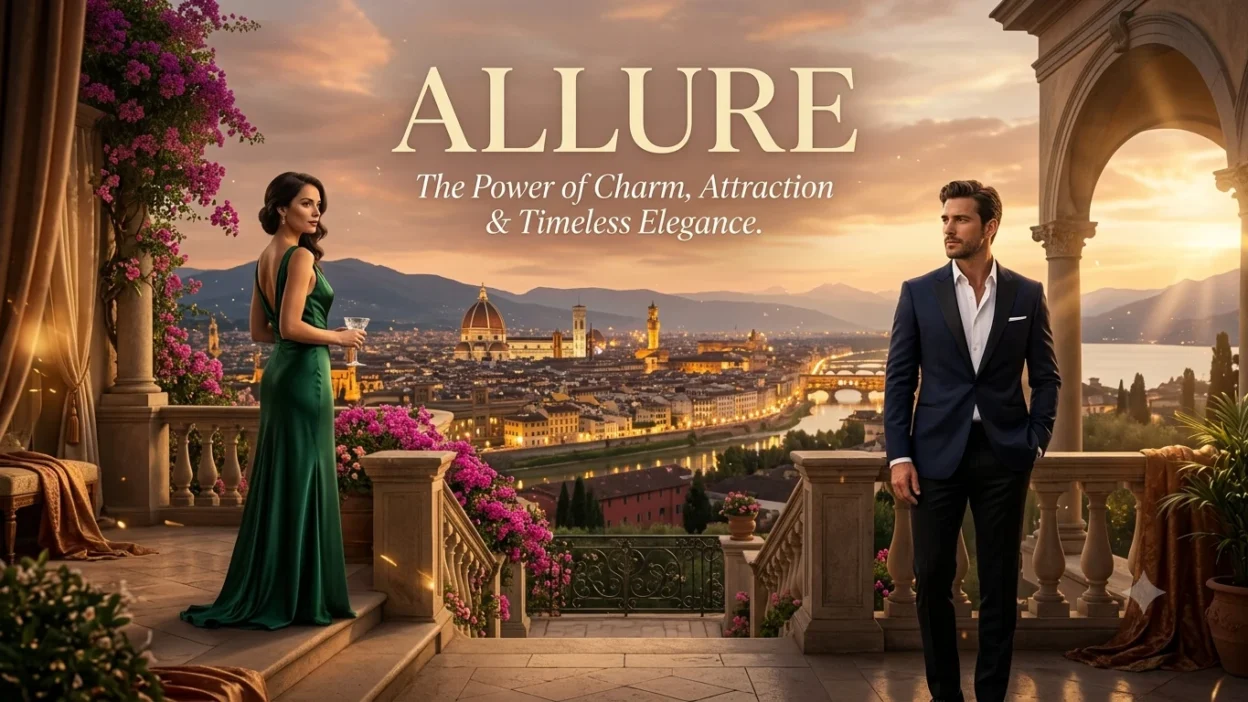
Have you ever heard someone described as having “allure” and wondered whether it simply meant beauty or something much deeper? Allure (pronounced uh-LOOR) is a noun that refers to a powerful, irresistible quality that attracts, fascinates, or captivates people.
Unlike ordinary attractiveness, allure is the unique charm, elegance, mystery, confidence, or appeal that naturally draws others in. Because it can describe people, places, experiences, brands, works of art, and even ideas, the exact meaning of allure depends on the context, but it almost always has a strongly positive meaning.
In simple terms, allure means an irresistible charm or captivating appeal. For example, a person’s allure may come from their confidence and personality rather than their appearance, the allure of an ancient city may lie in its history and culture, and a luxury brand’s allure may come from the prestige and emotions it inspires. The word is widely used in everyday English, literature, fashion, beauty, travel, marketing, and branding to describe anything that leaves a lasting impression and naturally attracts admiration or interest.
If you’ve come across allure and weren’t sure what it means, this guide explains its definition, pronunciation, origin, synonyms, antonyms, real-life examples, and how to recognize and use allure accurately and confidently in any context.
Allure at a Glance
| Feature | Details |
|---|---|
| Word | Allure |
| Pronunciation | uh-LUR |
| IPA | /əˈlʊr/ |
| Part of Speech | Noun & Verb |
| Meaning | A powerful charm, attraction, or fascination |
| Origin | Old French |
| First Recorded Use | Around the 15th century |
| Common Contexts | Fashion, literature, travel, relationships, psychology, business |
| Adjective Form | Alluring |
| Related Noun | Allurement |
| Opposites | Repulsion, aversion, unattractiveness |
| Similar Words | Charm, appeal, fascination, magnetism, charisma |
Key Takeaway:
Allure is more than simple attractiveness. It suggests a deeper, more memorable attraction that often combines beauty, confidence, elegance, mystery, or emotional appeal.
What Does “Allure” Mean?
At its core, allure refers to a special quality that naturally attracts attention or admiration. It is the kind of attraction that goes beyond appearance and creates genuine interest or fascination.
Unlike ordinary attractiveness, allure often carries a sense of elegance, mystery, confidence, or emotional depth. That’s why the word is commonly used to describe not only people but also places, ideas, experiences, works of art, and luxury brands.

Simple Definition
Allure means a powerful charm or appeal that naturally attracts, fascinates, or captivates people.
This attraction may be:
- Physical
- Emotional
- Intellectual
- Artistic
- Cultural
- Romantic
- Spiritual
For example:
- A person’s confidence can be part of their allure.
- A historic city may have timeless allure.
- A luxury watch can possess enduring allure.
- An exciting opportunity may hold great allure.
- The unknown often has a mysterious allure that sparks curiosity.
Dictionary Definition of Allure
Major English dictionaries consistently describe allure as a quality of being powerfully attractive or fascinating, or as the act of attracting or enticing someone.
As a Noun
When used as a noun, allure refers to the attractive quality itself.
Examples:
- Her confidence gave her a quiet allure.
- The island’s natural allure attracts visitors throughout the year.
- The novel’s mysterious allure kept readers turning the pages.
As a Verb
When used as a verb, allure means to attract, entice, or captivate someone.
Examples:
- The mountains allure adventurous travelers.
- The museum’s new exhibition allured thousands of visitors.
- Innovation continues to allure entrepreneurs around the world.
Although the noun form is more common today, both forms are grammatically correct and widely understood.
How to Pronounce “Allure”
One of the most common questions learners ask is, “How do you pronounce allure?”
The correct pronunciation is:
uh-LUR
IPA
/əˈlʊr/
The stress falls on the second syllable, giving the word its smooth and elegant sound.
Easy Pronunciation Tip
Think of it as:
uh + lure
Say the second part a little more strongly than the first.
Common Mispronunciations
❌ AL-lure
❌ uh-LORE
❌ ah-LOOR
✅ uh-LUR
Mastering the pronunciation helps you sound more natural in conversations, presentations, and professional communication.
Why Is “Allure” Such a Popular Word?
Unlike many vocabulary words that appear only in books, allure is widely used across different areas of life because it expresses a type of attraction that simpler words often cannot.
You’ll frequently see it in:
- Fashion magazines describing elegant styles.
- Travel blogs highlighting unforgettable destinations.
- Novels creating mystery and suspense.
- Business articles discussing the appeal of brands.
- Everyday conversations about people, places, or experiences.
For example:
- The allure of Paris continues to inspire travelers.
- The startup’s innovative culture has a strong allure for young professionals.
- The old mansion’s mysterious allure made it unforgettable.
In each case, allure suggests something deeper than ordinary attractiveness—it hints at fascination, emotion, and lasting appeal.
Is Allure a Noun or a Verb?
One reason many English learners get confused is that allure can function as both a noun and a verb. Understanding the difference will help you use the word naturally in conversations, writing, and professional communication.
Allure as a Noun
As a noun, allure refers to the attractive quality itself—the charm, fascination, or appeal that draws people in.
Formula:
Someone or something has allure.
Examples
- Her quiet confidence is part of her allure.
- The village’s timeless allure attracts visitors every year.
- The restaurant’s elegant interior adds to its allure.
- The book’s mysterious allure kept me reading late into the night.
- The mountain’s natural allure makes it a favorite destination for hikers.
Allure as a Verb
As a verb, allure means to attract, entice, or captivate someone.
Although the verb form is correct, it’s less common in everyday conversation than the noun.
Formula:
Something allures someone.
Examples
- The peaceful countryside allures photographers.
- Luxury brands allure customers through exceptional design.
- The promise of adventure allured early explorers.
- Beautiful architecture continues to allure travelers from around the world.
Quick Grammar Guide
| Form | Part of Speech | Example |
|---|---|---|
| Allure | Noun | Her confidence gives her an unforgettable allure. |
| Allure | Verb | The coastline allures thousands of visitors. |
| Alluring | Adjective | She has an alluring smile. |
| Allured | Verb (Past) | They were allured by the opportunity. |
| Allures | Verb (Present) | The city allures artists and writers. |
| Allurement | Noun | The allurement of quick success can be misleading. |
Key Takeaway: While allure works as both a noun and a verb, the noun form is much more common in modern English.
Word Family of Allure
Learning related words helps you expand your vocabulary and understand how the word changes in different situations.
| Word | Part of Speech | Meaning | Example |
|---|---|---|---|
| Allure | Noun | Powerful attraction or charm | The castle’s allure is undeniable. |
| Allure | Verb | To attract or entice | The mountains allure adventurous travelers. |
| Alluring | Adjective | Highly attractive or captivating | She wore an alluring perfume. |
| Allured | Verb | Attracted or enticed | Visitors were allured by the scenery. |
| Allures | Verb | Attracts | The museum allures history lovers. |
| Allurement | Noun | Something that attracts or tempts | Money isn’t the only allurement of the job. |
Origin and Etymology of Allure
Understanding a word’s history often makes its meaning easier to remember.
The word allure comes from the Old French verb aleurer, which originally meant to attract, entice, or lure. It entered the English language around the 15th century, where it was first used to describe the act of drawing someone toward something.
Over time, its meaning gradually evolved.
Instead of focusing mainly on temptation, allure came to describe a broader and more positive kind of attraction—one based on elegance, beauty, mystery, charisma, or emotional appeal.
Today, it’s one of the most expressive English words for describing irresistible attraction in a refined way.
How the Meaning Has Changed Over Time
| Time Period | Meaning |
|---|---|
| 15th Century | To entice, lure, or draw someone in. |
| 17th–18th Century | Attraction mixed with romance, elegance, or temptation. |
| Modern English | A natural charm, fascination, or appeal that attracts people without necessarily implying manipulation. |
This evolution explains why allure now sounds more sophisticated and positive than lure, even though the two words share historical roots.
Why Native English Speakers Love the Word Allure
Native speakers often choose allure because it expresses something that words like attraction or appeal don’t fully capture.
Compare these sentences:
- The city has a lot of attractions. ✅
- The city has a timeless allure. ✅
The second sentence suggests that the city’s appeal is emotional, elegant, and memorable—not just that it has tourist attractions.
Another example:
- She is attractive. ✅
- She has an undeniable allure. ✅
The second sentence implies that her appeal comes from more than appearance. It hints at confidence, personality, elegance, or mystery.
Key Takeaway: Native speakers often use allure when they want to express a deeper, more sophisticated kind of attraction.
When Should You Use Allure?
Use allure when you want to describe attraction that feels natural, memorable, elegant, or emotionally powerful.
It works especially well for:
People
- Her quiet confidence gives her a unique allure.
- His calm personality has an undeniable allure.
Places
- The Swiss Alps have an enduring allure.
- Kyoto’s historic streets possess a timeless allure.
Ideas
- The allure of financial freedom motivates many people.
- The allure of innovation drives entrepreneurs.
Experiences
- The allure of adventure inspires travelers.
- The allure of learning keeps curious minds engaged.
Art and Culture
- Classical music has a timeless allure.
- The painting’s mysterious allure captivated everyone in the gallery.
When Not to Use Allure
One of the easiest ways to sound like a native speaker is knowing when not to use a word.
Although allure is flexible, it doesn’t fit every situation.
Avoid using it for ordinary, everyday objects that don’t naturally inspire fascination or elegance.
Natural Examples ✅
- The ancient temple has a mysterious allure.
- The luxury hotel has undeniable allure.
- The old library possesses timeless allure.
Unnatural Examples ❌
- This spoon has allure.
- My calculator has allure.
- His homework has allure.
- That plastic bucket has allure.
These sound unusual because allure implies a special kind of attraction, not ordinary usefulness.
Native Speaker Tip
If you’re unsure whether to use allure, ask yourself this question:
“Would this person, place, object, or idea naturally inspire fascination, admiration, elegance, or curiosity?”
If the answer is yes, allure is probably the right word.
If not, words like appeal, usefulness, quality, or attractiveness may sound more natural.
Earnest Meaning: What It Really Means in Life & Speech
Common Collocations with Allure
Certain word combinations appear frequently in books, articles, and everyday English. Learning these collocations will help you sound more fluent.
| Common Collocation | Meaning |
|---|---|
| Timeless allure | Beauty or appeal that never fades |
| Enduring allure | Long-lasting attraction |
| Natural allure | Effortless charm |
| Mysterious allure | Fascination created by the unknown |
| Enigmatic allure | Attraction through mystery |
| Feminine allure | Graceful, elegant appeal |
| Sensual allure | Romantic or physical attraction |
| Undeniable allure | Impossible-to-ignore appeal |
| Magnetic allure | Extremely captivating charm |
| Effortless allure | Appeal that feels natural |
| Lasting allure | Attraction that continues over time |
| Visual allure | Strong aesthetic appeal |
Common Sentence Patterns
Native English speakers often use allure in these structures:
- the allure of + noun
- the allure of success
- the allure of luxury
- the allure of adventure
- the allure of the unknown
- have + allure
- She has a natural allure.
- The city has undeniable allure.
- possess + allure
- The old mansion possesses timeless allure.
- allure + someone
- The coastline allures visitors every summer.
Quick Tip: If you’re writing professionally or creatively, these patterns will make your English sound much more natural.
Allure Meaning in Different Contexts
One of the reasons allure is such a rich and expressive English word is that its meaning changes slightly depending on the context. Whether you’re talking about a person’s personality, a luxury brand, a historic city, or even an exciting career opportunity, allure always describes a powerful attraction—but the source of that attraction can be very different.
Understanding these contexts will help you choose the right meaning and use the word naturally.
1. Allure Meaning in Everyday English
In everyday conversations, allure usually refers to a special quality that naturally attracts people. It often describes someone’s personality, confidence, elegance, or the unique appeal of a place or experience.
Examples
- She has an effortless allure that makes everyone feel comfortable.
- The small seaside town has an undeniable allure.
- I can’t explain it, but there’s something about that café’s allure.
Conversation Example
A: Why does everyone love that old bookstore?
B: It has a timeless allure. You feel like you’ve stepped into another world.
Key Takeaway: In daily English, allure often refers to natural charm rather than physical beauty alone.
2. Allure Meaning in Fashion
Fashion professionals frequently use allure to describe elegance, sophistication, confidence, and individuality.
A designer dress isn’t alluring simply because it’s expensive. Its allure comes from how it makes someone feel—confident, graceful, stylish, and memorable.
Luxury brands also rely on allure to create emotional value beyond the product itself.
Examples
- The collection’s minimalist design adds to its timeless allure.
- Her effortless style is part of her signature allure.
- The brand’s allure lies in its craftsmanship and exclusivity.
Key Takeaway: In fashion, allure is about creating a lasting impression through style, confidence, and elegance—not just appearance.

3. Allure Meaning in Literature
Authors often choose allure because it creates stronger imagery than words like attraction or appeal.
In literature, allure may represent:
- mystery
- romance
- temptation
- beauty
- curiosity
- ambition
- danger
- adventure
- freedom
Examples
- The dark forest held an irresistible allure.
- The sea’s endless horizon possessed a mysterious allure.
- The character struggled to resist the allure of power.
Notice that allure adds emotional depth and atmosphere, making descriptions more vivid.
4. Allure Meaning in Psychology
From a psychological perspective, allure is often linked to the qualities that make people or experiences especially compelling.
While physical appearance can contribute, psychologists generally recognize that attraction is influenced by many factors, including:
- confidence
- authenticity
- warmth
- emotional intelligence
- competence
- curiosity
- shared values
- communication style
This helps explain why someone with average looks may still have a powerful allure.
Example
A person who listens attentively, speaks with confidence, and treats others respectfully may be perceived as more alluring than someone who relies only on appearance.
Key Takeaway: Lasting allure often comes from personality and behavior rather than looks alone.
5. Allure Meaning in Marketing and Branding
In marketing, allure refers to the emotional appeal that makes people interested in a product, service, or brand.
Successful companies don’t just sell features—they create a story, an identity, and an experience that customers want to be part of.
For example:
- A luxury watch offers more than accurate timekeeping.
- A premium car represents status and craftsmanship.
- A travel destination promises unforgettable experiences.
This emotional connection is part of their allure.
Examples
- The product’s simplicity is part of its allure.
- The campaign increased the brand’s global allure.
- The hotel’s charm and history add to its allure.
6. Allure Meaning in Relationships
When talking about people, allure often describes a combination of qualities that make someone naturally attractive.
This can include:
- confidence
- kindness
- humor
- intelligence
- emotional maturity
- authenticity
- elegance
- charisma
Unlike physical beauty alone, allure suggests a deeper connection that captures attention over time.
Examples
- Her kindness added to her natural allure.
- His quiet confidence gave him undeniable allure.
- Their shared passion for helping others became part of their mutual allure.
7. Allure Meaning in Travel
Travel writers frequently use allure to describe places that leave a lasting impression.
A destination’s allure may come from:
- breathtaking scenery
- fascinating history
- local culture
- architecture
- cuisine
- peaceful atmosphere
- unique traditions
Examples
- The allure of Kyoto lies in its blend of history and modern life.
- Iceland’s dramatic landscapes have a unique allure.
- The Mediterranean coast continues to attract visitors because of its timeless allure.
8. Allure Meaning in Art and Design
Artists and designers use allure to describe the emotional impact of a creative work.
A painting, sculpture, photograph, or interior design may possess allure because it inspires curiosity, admiration, or wonder.
Examples
- The painting’s mysterious allure captivated every visitor.
- The building’s clean lines contribute to its modern allure.
- The sculpture’s quiet elegance is part of its lasting allure.
5G UC Mean: Why Carriers Use This Term Now
Different Types of Allure
Although allure always refers to attraction, that attraction can take many forms.
Understanding these types helps you interpret the word correctly in different situations.
Physical Allure
Physical allure refers to outward attractiveness enhanced by confidence, posture, style, grooming, or graceful movement.
Example:
Her elegant posture added to her physical allure.
Personal Allure
Personal allure comes from qualities such as confidence, kindness, authenticity, emotional intelligence, and charisma.
Example:
His genuine interest in others gave him a unique personal allure.
Natural Allure
Natural allure describes effortless attractiveness that doesn’t feel forced or artificial.
Example:
The quiet lake has a natural allure that photographers love.
Timeless Allure
Some things remain attractive for generations.
This lasting appeal is known as timeless allure.
Examples:
- Classical architecture has timeless allure.
- Handmade craftsmanship never loses its allure.
Enduring Allure
Similar to timeless allure, enduring allure refers to attraction that remains strong despite changing trends.
Example:
The novel’s enduring allure has inspired readers for decades.
Mysterious Allure
A mysterious allure is created when something isn’t fully understood.
Curiosity itself becomes attractive.
Examples:
- The cave’s mysterious allure fascinated explorers.
- His reserved personality gave him an enigmatic allure.
Enigmatic Allure
Enigmatic allure emphasizes mystery, complexity, and intrigue.
Example:
The detective’s enigmatic allure kept viewers guessing until the final episode.
Feminine Allure
Feminine allure refers to graceful, elegant, confident, or captivating qualities often associated with femininity.
It is not limited to physical appearance.
Example:
Her confidence and compassion contributed to her feminine allure.
Sensual or Sexual Allure
In romantic contexts, sensual allure or sexual allure describes qualities that create romantic or physical attraction.
Unlike the broader meaning of allure, these expressions specifically relate to intimacy and romance.
Example:
The actor’s confidence contributed to his sensual allure on screen.
Dark Allure
Dark allure describes something that is fascinating despite being mysterious, risky, or potentially dangerous.
Examples:
- The abandoned mansion had a dark allure.
- The story explores the dark allure of unchecked ambition.
Mystical Allure
Mystical allure refers to the captivating quality of something connected with spirituality, legends, or the supernatural.
Example:
The ancient temple possessed a mystical allure that drew visitors from around the world.
Allure Meaning in Different Languages
Although allure is an English word, the idea behind it exists in many languages. There isn’t always a perfect one-word translation, so the exact meaning depends on the context. In most cases, it refers to charm, attraction, elegance, fascination, or irresistible appeal.
The table below shows the closest translations.
| Language | Translation | Meaning |
|---|---|---|
| English | Allure | Powerful charm or attraction |
| Urdu (اردو) | کشش، دلکشی، دل فریبی | Charm, attraction, captivating beauty |
| Punjabi (ਪੰਜਾਬੀ) | ਖਿੱਚ, ਆਕਰਸ਼ਣ, ਦਿਲਕਸ਼ੀ | Attraction, captivating appeal |
| Arabic (العربية) | جاذبية، سحر، إغراء | Attraction, charm, fascination |
| Farsi (فارسی) | جذابیت، افسون، کشش | Charm, attraction, enchantment |
| French | Charme, attrait, séduction | Charm, appeal, elegance |
| Italian | Fascino | Fascination, elegance |
| Russian | Очарование, привлекательность | Charm, attractiveness |
| Chinese (简体中文) | 魅力 (Mèilì), 吸引力 (Xīyǐnlì) | Charm, attraction |
| Tagalog | Alindog, Pang-akit | Beauty, charm, attraction |
| Bengali (বাংলা) | আকর্ষণ, মোহ | Attraction, fascination |
| Marathi (मराठी) | आकर्षण, मोहकता | Attraction, charm |
Quick Note: A direct translation may change depending on the sentence. For example, allure in a travel article often means appeal, while in a romantic context it may mean captivating charm or magnetism.
Allure Meaning in English
In modern English, allure refers to a quality that naturally attracts, fascinates, or captivates people. It often suggests something deeper than ordinary attractiveness, combining elegance, confidence, mystery, and emotional appeal.
Simple Definition
Allure is a powerful charm or appeal that naturally draws people toward someone or something.
Example Sentences
- The old castle has an undeniable allure.
- Her confidence adds to her natural allure.
- The allure of learning keeps curious minds engaged.
Key Takeaway: In English, allure is commonly used for people, places, ideas, experiences, brands, works of art, and even opportunities.
Allure Meaning in Urdu (اردو)
Allure کا مطلب صرف خوبصورتی نہیں بلکہ ایسی کشش، دلکشی یا شخصیت بھی ہے جو لوگوں کو اپنی طرف متوجہ کرے۔
عام اردو تراجم:
- کشش
- دلکشی
- دل فریبی
- پرکشش انداز
- جاذبیت
مثال
اس کی پُراعتماد شخصیت میں ایک منفرد کشش تھی۔
پہاڑوں کی قدرتی دلکشی ہر سال ہزاروں سیاحوں کو اپنی طرف کھینچتی ہے۔
اہم بات: ہر جگہ “کشش” بہترین ترجمہ نہیں ہوتا۔ بعض جملوں میں دلکشی یا جاذبیت زیادہ قدرتی محسوس ہوتی ہے۔
Allure Meaning in Farsi (فارسی)
In Persian (Farsi), allure is commonly translated as:
- جذابیت
- افسون
- کشش
These words express charm, attraction, elegance, or enchantment, depending on the context.
Example:
The city’s ancient architecture has a unique allure.
Translation:
معماری باستانی شهر جذابیت خاصی دارد.
Allure Meaning in French
The closest French equivalents include:
- Charme – charm
- Attrait – attraction or appeal
- Séduction – seduction (used in romantic contexts)
French speakers choose different words depending on whether the sentence emphasizes beauty, elegance, or romantic attraction.
Allure Meaning in Chinese
In Chinese, allure is usually translated as:
- 魅力 (Mèilì) – charm or charisma
- 吸引力 (Xīyǐnlì) – attraction or appeal
Example
她有一种独特的魅力。
Meaning:
She has a unique allure.
Allure Meaning in Italian
The Italian word most often used for allure is:
Fascino
It conveys elegance, fascination, and irresistible appeal.
Example
La città ha un fascino senza tempo.
Meaning:
The city has a timeless allure.
Allure Meaning in Russian
The closest Russian translations include:
- Очарование – charm
- Привлекательность – attractiveness
Both words are widely used, depending on the context.
Allure Meaning in Arabic
Common Arabic translations include:
- جاذبية
- سحر
- إغراء
These words may describe attraction, charm, elegance, or fascination.
Allure Meaning in Punjabi
In Punjabi, allure may be expressed as:
- ਖਿੱਚ
- ਆਕਰਸ਼ਣ
- ਦਿਲਕਸ਼ੀ
These words describe a person’s charm or the attractive quality of a place or thing.
Allure Meaning in Tagalog
The most common Tagalog equivalents are:
- Alindog – beauty or charm
- Pang-akit – attraction
These words are often used for both people and places.
Allure Meaning in Bengali
In Bengali, allure is commonly translated as:
- আকর্ষণ
- মোহ
These words express attraction, fascination, or captivating charm.
Allure Meaning in Marathi
The closest Marathi translations include:
- आकर्षण
- मोहकता
Both describe attraction or captivating appeal.
Allure Meaning in the Bible
Many readers search for “allure meaning in the Bible” because the word appears in Hosea 2:14.
In this verse, allure carries the meaning of gently drawing someone back through love, compassion, and reconciliation rather than manipulating or deceiving them.
In other words, the biblical use emphasizes:
- loving invitation
- restoration
- mercy
- reconciliation
- compassionate persuasion
rather than temptation in a negative sense.
Important Note: The meaning comes from the context of the passage, so it is more nuanced than the modern dictionary definition.
Allure Meaning in Running
This search can be confusing because the answer depends on the language.
In English, allure is not a standard running term.
However, in French, the word allure commonly means:
- pace
- speed
- gait
- rhythm of movement
For example, French runners may talk about their allure de course, which means running pace.
This is why you may occasionally see the word in international running guides or training plans.
How Native Speakers Actually Use “Allure”
Learning the meaning is helpful, but understanding how native English speakers naturally use the word is even more important.
The most common patterns include:
- the allure of success
- the allure of travel
- the allure of luxury
- the allure of the unknown
- the allure of fame
- the allure of freedom
- timeless allure
- mysterious allure
- undeniable allure
- natural allure
These expressions appear regularly in books, newspapers, magazines, travel blogs, business articles, and everyday conversations.
Conversation Examples
A: Why do so many people dream of visiting Paris?
B: I think it’s the city’s timeless allure.
A: Why did she accept the new job?
B: The allure of working abroad was too strong to ignore.
A: Why is that old neighborhood so popular?
B: It has a charm, history, and an allure that modern places often lack.
Synonyms of Allure
Although allure is unique, several English words have similar meanings. The best synonym depends on the context.
| Synonym | Meaning | Best Used For |
|---|---|---|
| Charm | Pleasant, attractive quality | People, personalities, places |
| Appeal | General attractiveness | Products, ideas, places |
| Attraction | Something that draws interest | Broad, everyday use |
| Charisma | Powerful personal presence | People and leaders |
| Magnetism | Strong, almost irresistible attraction | Personalities and performers |
| Fascination | Intense interest or curiosity | Ideas, mysteries, hobbies |
| Elegance | Grace and sophistication | Fashion, design, behavior |
| Enchantment | Magical or captivating quality | Stories, nature, fantasy |
| Seduction | Romantic or sensual attraction | Relationships and literature |
| Captivation | Complete attention or admiration | Art, stories, experiences |
Which Synonym Should You Choose?
Use allure when you want to express beauty combined with mystery, elegance, or emotional attraction.
Use appeal when talking about general attractiveness.
Use charm when describing warmth or friendliness.
Use charisma when referring to a person’s ability to influence or inspire others.
Key Takeaway: While these words are related, allure often feels more refined and emotionally powerful.
Antonyms of Allure
The opposite of allure is anything that discourages attraction or interest.
Common antonyms include:
- Repulsion
- Aversion
- Disgust
- Indifference
- Unattractiveness
- Boredom
- Off-putting quality
Examples
- Instead of creating allure, the neglected building created a feeling of repulsion.
- Poor customer service reduced the product’s appeal rather than increasing its allure.

Allure vs. Lure
Although allure and lure are closely related, they are not interchangeable.
| Feature | Allure | Lure |
|---|---|---|
| Meaning | Natural charm or attraction | Deliberately tempting or attracting |
| Tone | Elegant and usually positive | Neutral or sometimes manipulative |
| Common Contexts | Fashion, travel, personality, art | Fishing, advertising, scams, marketing |
| Suggests Mystery? | Often yes | Usually no |
Examples
✅ The island’s natural allure attracts visitors every year.
✅ The advertisement lured customers with huge discounts.
Easy Way to Remember
Allure usually happens naturally.
Lure usually involves intentional temptation.
Allure vs. Charm
These two words are often confused because both describe attraction.
| Allure | Charm |
|---|---|
| More mysterious | More friendly |
| Often elegant | Often warm |
| Creates fascination | Creates affection |
| Deeper emotional appeal | Pleasant personality |
Examples
She has a friendly charm.
She has an elegant allure.
Both are correct—but they create different impressions.
Allure vs. Appeal
Appeal is one of the broadest words for attraction.
Allure is more specific.
| Appeal | Allure |
|---|---|
| General attractiveness | Elegant or fascinating attraction |
| Common in marketing | Common in literature and fashion |
| Practical | Emotional |
| Broad meaning | More expressive |
Example
The phone’s long battery life is part of its appeal.
The luxury brand’s image is part of its allure.
Allure vs. Attraction
Although many dictionaries list attraction as a synonym, they are not exactly the same.
Attraction simply means drawing interest.
Allure suggests that the attraction feels graceful, memorable, or emotionally powerful.
Compare
The museum is an attraction.
The museum has an undeniable allure.
The second sentence paints a richer picture.
Common Collocations with “Allure”
Native speakers frequently combine allure with specific adjectives.
| Phrase | Meaning |
|---|---|
| Timeless allure | Beauty that never fades |
| Enduring allure | Lasting attraction |
| Natural allure | Effortless charm |
| Mysterious allure | Attraction created by mystery |
| Enigmatic allure | Fascination through the unknown |
| Magnetic allure | Extremely captivating charm |
| Feminine allure | Graceful and elegant appeal |
| Sensual allure | Romantic or physical attraction |
| Dark allure | Attractive yet mysterious or risky |
| Undeniable allure | Impossible-to-ignore attraction |
| Visual allure | Strong aesthetic appeal |
| Lasting allure | Attraction that continues over time |
These collocations appear frequently in books, journalism, travel writing, and everyday English.
Common Expressions with “Allure”
One of the most natural sentence patterns is:
the allure of + noun
Examples include:
- the allure of success
- the allure of fame
- the allure of wealth
- the allure of luxury
- the allure of travel
- the allure of freedom
- the allure of nature
- the allure of innovation
- the allure of adventure
- the allure of the unknown
This pattern is extremely common among native English speakers because it expresses emotional attraction in a concise way.

25 Real-Life Example Sentences
Reading examples is one of the best ways to master a new word.
- Her confidence gives her a unique allure.
- The castle’s mysterious allure attracts tourists every year.
- Paris has a timeless allure that inspires artists.
- The mountain village possesses a natural allure.
- His quiet personality has undeniable allure.
- The novel explores the allure of power.
- Adventure has always held great allure for explorers.
- The elegant design adds to the product’s allure.
- The ocean’s endless horizon has a calming allure.
- The museum’s historical allure fascinates visitors.
- Classical music has an enduring allure.
- The old streets have a nostalgic allure.
- Her kindness enhances her natural allure.
- The luxury resort has international allure.
- The island’s tropical beauty creates irresistible allure.
- Innovation continues to allure ambitious entrepreneurs.
- The mysterious painting captivated everyone with its allure.
- The quiet library has an old-world allure.
- The actor’s charisma contributes to his allure.
- The company’s reputation adds to its allure.
- The opportunity allured talented professionals.
- The city’s cultural diversity is part of its allure.
- The antique market has a vintage allure.
- The film’s emotional storytelling is part of its lasting allure.
- The allure of discovering something new never disappears.
Common Mistakes to Avoid
❌ Mistake 1: Thinking Allure Means Only Beauty
Many people believe allure only refers to physical appearance.
✅ Correct:
It can also describe:
- confidence
- personality
- ideas
- travel destinations
- careers
- cultures
- art
- opportunities
❌ Mistake 2: Confusing Allure with Lure
Although related, allure usually suggests natural attraction, while lure often implies deliberate temptation.
❌ Mistake 3: Incorrect Grammar
❌ She is allure.
✅ She has allure.
✅ She possesses remarkable allure.
❌ Mistake 4: Using It for Ordinary Objects
Saying “This calculator has allure” sounds unnatural unless you’re using the word humorously or figuratively.
Instead, reserve allure for things that genuinely inspire fascination, elegance, or admiration.
Frequently Asked QuestionsAbout Allure
1. What does allure mean in simple words?
In simple terms, allure means a special charm or attraction that naturally draws people toward someone or something. It can describe a person’s personality, a beautiful place, an exciting opportunity, or even an idea that captures attention.
Example:
The quiet village has a unique allure that keeps visitors coming back.
2. What is the exact definition of allure?
Allure is a noun and a verb.
- As a noun: A powerful charm, fascination, or appeal.
- As a verb: To attract, captivate, or entice someone.
Examples
Noun:
Her elegance is part of her allure.
Verb:
The peaceful countryside allures travelers seeking relaxation.
3. Is allure a noun or a verb?
It is both.
As a noun
The island’s allure attracts visitors from around the world.
As a verb
The island continues to allure nature lovers.
In modern English, the noun form is used more frequently than the verb.
4. What is the difference between allure and appeal?
Both words describe attraction, but appeal is broader and more general.
Allure usually suggests:
- elegance
- mystery
- fascination
- emotional attraction
Appeal simply means something is attractive or interesting.
Compare
The phone’s affordable price increases its appeal.
The luxury watch’s craftsmanship adds to its allure.
5. What is the difference between allure and charm?
Charm usually refers to warmth, friendliness, or pleasant behavior.
Allure suggests a deeper attraction that may include elegance, mystery, confidence, or sophistication.
Example:
A friendly smile creates charm.
A mysterious personality creates allure.
6. What is the difference between allure and lure?
Although they share a historical connection, their meanings are different.
Allure
- Usually natural
- Elegant
- Positive
- Emotional
Lure
- Often intentional
- Can involve temptation
- Sometimes manipulative
Example
The beach’s natural beauty is its allure.
The advertisement lured customers with unrealistic promises.
7. Is allure always about physical beauty?
No.
This is one of the biggest misconceptions.
Someone can have allure because of:
- confidence
- intelligence
- kindness
- creativity
- leadership
- humor
- authenticity
Likewise, places, books, cultures, careers, and ideas can all have allure.
8. Can places have allure?
Absolutely.
Travel writers often use allure to describe destinations that have lasting emotional appeal.
Examples
- The timeless allure of Rome.
- The mysterious allure of the Sahara Desert.
- The coastal town’s relaxed allure.
9. Can objects have allure?
Yes—but usually only if they inspire admiration, elegance, or fascination.
Natural examples include:
- a luxury watch
- a vintage car
- a handcrafted guitar
- an antique painting
- a beautifully designed home
Ordinary household items are rarely described this way unless used figuratively.
10. Is allure a positive word?
Most of the time, yes.
It usually has a positive meaning connected with admiration, elegance, fascination, or beauty.
However, in certain contexts it can describe something attractive but potentially dangerous.
Examples
- the allure of gambling
- the allure of power
- the allure of forbidden knowledge
In these cases, the attraction exists, but it may lead to harmful choices.
11. How do you pronounce allure?
The correct pronunciation is:
uh-LUR
IPA: /əˈlʊr/
The stress falls on the second syllable.
12. What is the adjective form of allure?
The adjective is alluring.
It describes someone or something that is especially attractive or captivating.
Examples
- an alluring smile
- an alluring destination
- an alluring fragrance
- an alluring opportunity
13. What is the noun form of allure?
The primary noun is allure itself.
Another related noun is allurement, which refers to something that attracts or tempts.
Examples
- The city’s allure never fades.
- Wealth was not the only allurement of the job.
14. What is the past tense of allure?
The past tense is allured.
Examples
- The beautiful scenery allured thousands of tourists.
- Investors were allured by the company’s rapid growth.
15. What are some common collocations with allure?
Native English speakers often use phrases such as:
- timeless allure
- enduring allure
- mysterious allure
- natural allure
- undeniable allure
- magnetic allure
- feminine allure
- dark allure
- sensual allure
- visual allure
- lasting allure
These combinations sound natural because they appear frequently in books, journalism, travel writing, and everyday English.
16. What are the best synonyms for allure?
Some of the closest synonyms include:
- charm
- appeal
- fascination
- charisma
- magnetism
- elegance
- enchantment
- attraction
- captivation
Each has a slightly different shade of meaning, but allure often suggests a deeper, more sophisticated attraction.
17. Can allure describe ideas or opportunities?
Yes.
Many native speakers use allure for abstract concepts.
Examples include:
- the allure of entrepreneurship
- the allure of financial freedom
- the allure of adventure
- the allure of space exploration
- the allure of innovation
- the allure of remote work
18. Is allure commonly used in English today?
Yes.
You’ll regularly encounter it in:
- books
- novels
- newspapers
- magazines
- fashion writing
- travel blogs
- business articles
- marketing
- advertisements
- everyday conversations
Although it’s a more elegant word than appeal, it remains widely understood by native speakers.
Quick Quiz: Test Your Understanding
Choose the correct answer.
1. Which sentence uses allure correctly?
A. The calculator has great allure.
B. The ancient castle has timeless allure.
✅ Answer: B
2. Which word is closest in meaning?
A. Repulsion
B. Charm
✅ Answer: B
3. Is allure only used for people?
A. Yes
B. No
✅ Answer: B
It can describe people, places, ideas, experiences, cultures, brands, and much more.
4. Which sentence is grammatically correct?
A. She is allure.
B. She has natural allure.
✅ Answer: B
5. Which phrase sounds most natural?
A. The allure of adventure.
B. The allure of my calculator.
✅ Answer: A
Conclusion
The beauty of the word allure lies in its depth. It doesn’t simply describe something attractive—it conveys a lasting quality that inspires admiration, curiosity, and emotional connection.
Whether you’re talking about a person’s quiet confidence, the timeless beauty of a city, the excitement of a new opportunity, or the mystery of the unknown, allure is the perfect word when ordinary terms like appeal or attraction don’t fully capture the feeling.
The more you read, write, and speak English, the more you’ll notice how often this elegant word appears—and now you’ll understand exactly how to use it with confidence.

Ethan Cole is a content writer at Meanovia who explains internet slang, texting abbreviations, and social media language in a simple and reader-friendly way._)