
“I’m under the weather” sounds like someone is standing beneath a storm cloud—but that’s not what this strange phrase means at all. If you’ve ever heard someone use it and wondered why weather has anything to do with being sick, you’re not alone.
In short, “under the weather” means feeling ill, unwell, or not quite like yourself, usually because of a minor illness or generally feeling poorly. It’s a common English idiom used as a softer, more conversational way to say “I’m not feeling well,” which is why you’ll hear it in everyday conversations, movies, books, workplaces, and casual messages.
But where did this unusual expression come from, and why did under the weather become associated with illness? This guide explores the meaning, origin, history, pronunciation, real-life examples, synonyms, common mistakes, and natural ways to use “under the weather”, so you can understand not only what the idiom means, but also why English speakers use it.
What Does “Under the Weather” Mean?
“Under the weather” means feeling ill, unwell, or generally not in good health.
It is an informal idiom, so it is especially natural in conversations, texts, messages, and other everyday communication.
Quick definition
Under the weather: feeling sick, unwell, or not completely well.
For example:
“I’m feeling under the weather today, so I’m going to rest.”
Here, the speaker is saying they do not feel well. They are not describing the actual weather.
What Is the Literal Meaning of “Under the Weather”?
The under the weather literal meaning is simply being physically positioned beneath the weather. However, that is not what the idiom means in modern English.
The expression is figurative. When someone says “I am under the weather,” they mean they feel unwell.
So:
- Literal: beneath the weather or conditions above you
- Idiomatic: feeling ill or not completely well
This is why taking the phrase word-for-word can be confusing.
“Under the Weather” Meaning in Simple English
If you want the easiest possible explanation, think of it as:
under the weather = feeling sick / not feeling well
This phrase is commonly used when experiencing:
- A cold
- A mild illness
- Fatigue
- A headache
- General discomfort
- A day when you simply do not feel well
It does not identify a specific illness. It is a general way of saying that your health is not at its best.
“A Little Under the Weather” Meaning
The phrase “a little under the weather” usually softens the statement.
It means someone is feeling somewhat unwell, rather than emphasizing a serious illness.
For example:
“I’m a little under the weather, so I might stay home tonight.”
The word “little” makes the expression sound less severe and more conversational.
Similarly, “a bit under the weather” means approximately the same thing:
“I’ve been a bit under the weather this week.”
“I’m Under the Weather” Meaning
The expression “I’m under the weather” means:
“I’m feeling unwell.”
You can also say:
- I’m feeling under the weather.
- I feel under the weather.
- I’ve been under the weather lately.
- I’m a little under the weather today.
All of these are natural ways to communicate that you are not feeling well.
“I’m feeling under the weather” meaning
“I’m feeling under the weather” means “I’m currently feeling unwell.”
It is one of the most natural forms of the expression.
Where Does the Phrase “Under the Weather” Come From?
The under the weather etymology is commonly connected with seafaring and nautical language, but the exact origin deserves a little caution.
A popular explanation says that sailors who became sick or seasick during rough weather could go below deck, putting themselves literally “under” the harsh weather affecting the ship above.
Another nautical explanation connects the expression with the weather bow, the side of a ship exposed to incoming bad weather.
This maritime explanation is widely reported, but it should not be presented as an absolutely proven origin. Historical evidence shows the phrase was already in use in the 19th century, and an 1835 newspaper example uses “under the weather” in a figurative sense.
That makes the nautical connection plausible and well established in popular etymological explanations, while the precise route by which the modern idiom developed is less certain.
Why Do We Say “Under the Weather”?
So, why do we say under the weather instead of simply saying “sick”?
The expression likely survived because it creates a memorable picture. Something unpleasant is imagined as being above you, while you are beneath it and affected by it.
Over time, the phrase moved beyond its possible maritime associations and became an ordinary English idiom for feeling unwell.
Today, you do not need to know anything about sailing to use it naturally.
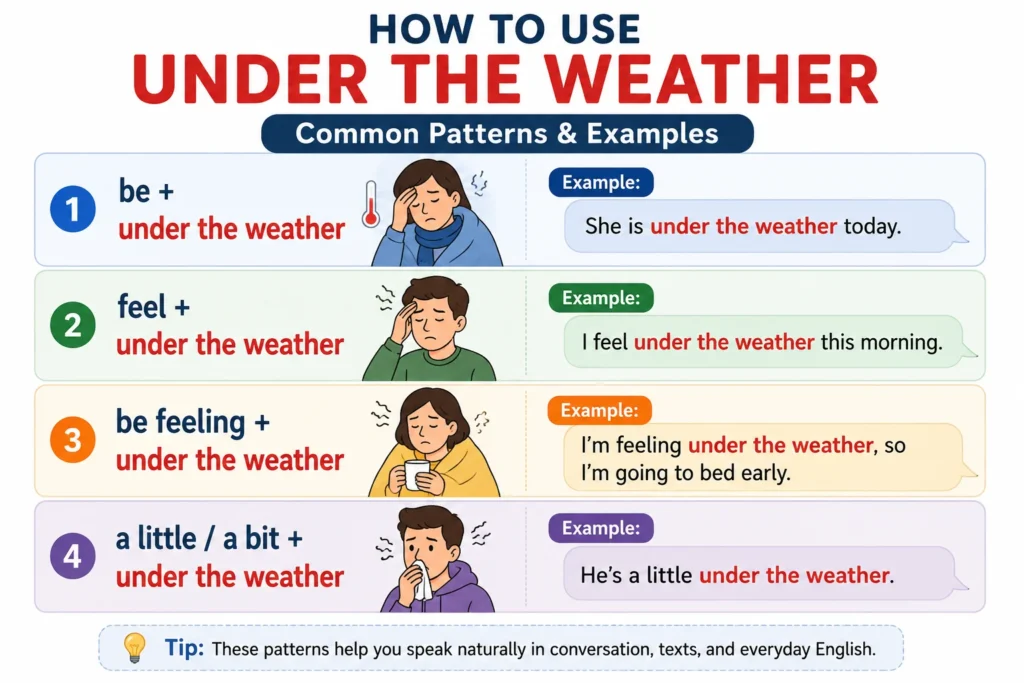
How to Use “Under the Weather”
The most common structures are:
be + under the weather
“She is under the weather today.”
feel + under the weather
“I feel under the weather this morning.”
be feeling + under the weather
“I’m feeling under the weather, so I’m going to bed early.”
a little/a bit + under the weather
“He’s a little under the weather.”
These patterns are useful because they show how the expression actually appears in natural English.
“Under the Weather” Examples in Conversation
Example 1: With a friend
Friend: “Are you coming out tonight?”
You: “I don’t think so. I’m feeling a bit under the weather.”
Example 2: At work
Coworker: “Are you feeling okay?”
You: “Not really. I’ve been under the weather since yesterday.”
Example 3: In a text
“Sorry I didn’t reply earlier. I’ve been under the weather.”
Example 4: Canceling plans
“I woke up under the weather today, so I’m going to take it easy.”
Example 5: Talking about someone else
“Tom looks a little under the weather today.”
Here, “looks under the weather” means Tom appears to be unwell.
“Under the Weather” Meaning in Texting
In texting, under the weather means essentially the same thing: feeling sick or unwell.
It is useful when you want to explain why you are not replying, attending an event, working normally, or making plans without giving detailed information about your health.
For example:
“Can’t make it tonight—I’m under the weather 😷.”
The phrase is not really modern slang. It is a traditional idiom that remains common in everyday digital communication.
Does “Under the Weather” Mean Sick or Sad?
The standard meaning is physically unwell or not feeling well.
It is therefore closer to:
- feeling sick
- feeling unwell
- feeling poorly
- not feeling well
It is not the same as “feeling blue,” which normally refers to sadness or low spirits.
That said, people can sometimes use under the weather loosely when they feel generally off, tired, or poorly. Context matters.
Can “Under the Weather” Mean Tired?
Yes, it can sometimes be used when someone feels generally unwell or not at their best, and tiredness may be part of that feeling.
However, “under the weather” primarily communicates being unwell, rather than simply being tired.
If you only mean lack of sleep, phrases such as “I’m exhausted” or “I’m really tired” are more precise.
Is “Under the Weather” Slang or Formal?
It is best described as an informal idiom, not slang and not formal vocabulary.
You can use it comfortably with:
- Friends
- Family
- Coworkers
- Classmates
- People you know casually
It can also appear in workplace messages, such as:
“I’m feeling under the weather today, so I’ll be working from home.”
The sentence is polite, but the idiom itself is still informal.
How to Reply When Someone Says “I’m Under the Weather”
If someone tells you they are under the weather, a natural response is:
“I’m sorry to hear that. Hope you feel better soon!”
Other friendly replies include:
- “Take care and get some rest.”
- “Hope you’re feeling better soon.”
- “Sorry you’re not feeling well.”
- “Get well soon!”
You do not need a complicated response. A short, caring reply sounds natural.
“Under the Weather” Synonyms and Similar Expressions
Depending on the situation, you can replace the phrase with:
| Expression | Meaning |
|---|---|
| Feeling unwell | Not feeling healthy |
| Feeling sick | Feeling physically ill |
| Not feeling well | General illness or discomfort |
| Feeling off | Not feeling quite right |
| Not feeling myself | Feeling physically or generally different from normal |
| Out of sorts | Feeling uncomfortable, unsettled, or not quite right |
| Sick as a dog | Very sick; more dramatic and informal |
The best choice depends on how strong or casual you want your statement to sound.
Common Mistakes to Avoid
1. Taking it literally
Incorrect interpretation: “Under the weather” means being beneath rain or clouds.
Correct: It is an idiom meaning feeling unwell.
2. Calling it formal English
It is widely understood and polite, but dictionaries classify it as an informal idiom, not formal language.
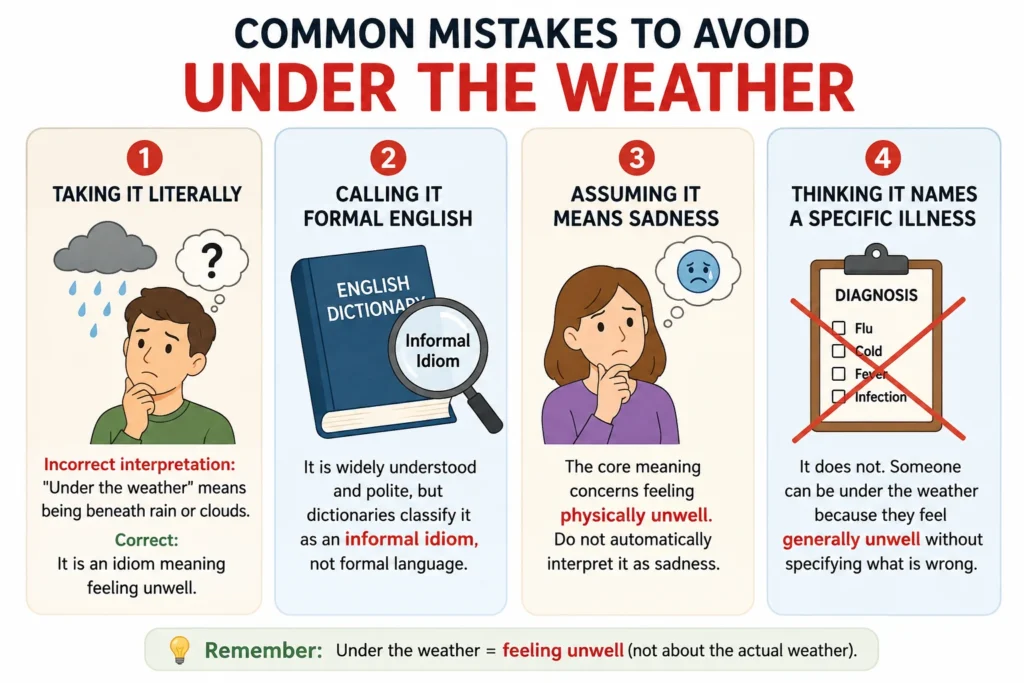
3. Assuming it means sadness
The core meaning concerns feeling physically unwell. Do not automatically interpret it as sadness.
4. Thinking it names a specific illness
It does not. Someone can be under the weather because they feel generally unwell without specifying what is wrong.
Is “I Am Under Weather” Correct?
Usually, the natural expression is:
“I am under the weather.”
The article “the” is part of the established idiom.
So:
❌ I am under weather.
✅ I am under the weather.
Likewise:
❌ I feel under weather.
✅ I feel under the weather.
What Does “Under the Weather Today” Mean?
“Under the weather today” means feeling unwell today.
For example:
“I’m under the weather today, so I’m taking the day off.”
The word “today” simply tells you when the person is feeling unwell.
A Note About Another Dictionary Meaning
There is an additional meaning worth knowing.
However, this is not the meaning most people intend in ordinary modern conversations about being sick. If someone says:
“I’m feeling under the weather,”
the normal interpretation is that they are ill or not feeling well.
Context always determines meaning.
Under the Weather Meaning in Urdu
In Urdu, under the weather can be understood as:
طبیعت خراب ہونا / طبیعت ناساز ہونا / طبیعت ٹھیک نہ ہونا
In simple English, the idea is “not feeling well.”
Frequently Asked Questions
What does “under the weather” mean?
It means feeling ill, unwell, or not completely well. It is a common informal English idiom.
Does “under the weather” mean sick?
Yes. In ordinary modern usage, it generally means feeling sick or unwell.
What does “a little under the weather” mean?
It means feeling somewhat unwell. “A little” softens the expression and makes it sound less severe.
Can I say “I’m under the weather”?
Yes. “I’m under the weather” is a natural and correct English expression.
What does “I’m feeling under the weather” mean?
It means “I’m feeling unwell.” It is one of the most common ways to use the idiom.
Is “under the weather” slang?
No. It is an informal idiom, rather than slang.
What is the opposite of “under the weather”?
There is no single exact opposite, but phrases such as “feeling great,” “feeling well,” or “in good health” communicate the opposite idea.
How do you reply to “I’m under the weather”?
You can say, “I’m sorry to hear that. Hope you feel better soon!”
Where does “under the weather” come from?
The expression is commonly associated with nautical language and rough weather at sea, although the exact etymological path is not completely certain. The phrase is documented in 19th-century usage, including an 1835 example.
Conclusion
The under the weather meaning is simply feeling ill, unwell, or not completely well.
It is an informal English idiom that works naturally in conversations, texts, and everyday workplace messages. You can say “I’m under the weather,” “I feel under the weather,” or “I’m feeling a little under the weather” when you want to explain that you are not feeling well.
The phrase is commonly linked to nautical language and rough weather, although its exact origin is less certain than many simplified explanations suggest. Its documented use goes back at least to the 19th century.
So the next time someone says, “I’m under the weather,” you’ll know they probably aren’t talking about clouds or rain—they’re simply saying they don’t feel well.

Liza is a content writer at Meanovia, focused on slang, texting meanings, and internet phrases. She makes modern online language simple, clear, and easy to understand 💬✨