
A “travesty” isn’t simply something that’s bad—it suggests that something has been so badly distorted, mishandled, or misrepresented that it falls far short of what it should be.
That distinction is why the word often appears in the powerful phrase “a travesty of justice,” describing a situation so unfair or corrupt that it fails to deliver justice at all. But travesty has another important sense too: it can describe a mocking or grossly distorted imitation of a person, work, idea, or tradition.
So if you’ve ever wondered whether travesty means tragedy, injustice, mockery, or simply something terrible, the answer is more nuanced than any one synonym can capture. This guide gives you a clear breakdown of the travesty meaning, definition, origin, examples, synonyms, pronunciation, common phrases, and correct usage, including the subtle differences that will help you use the word accurately.
What Does Travesty Mean?
Travesty is a noun that describes something that distorts, degrades, or badly imitates another thing, often in a way that makes it seem ridiculous or fails to live up to what it should be.
Travesty meaning in simple English
In simple English:
A travesty is a distorted or terrible imitation of something, or a situation so wrong that it makes a mockery of what it should be.
For example:
“The unfair trial was a travesty of justice.”
This means the trial was so seriously unfair that it made a mockery of the idea of justice.
The word can also describe an inferior version of an original:
“The remake was a travesty of the classic film.”
Here, the speaker means the remake was such a poor or distorted version that it failed to represent the original properly.
The two ideas are connected: something has been changed so badly that it no longer represents what it is supposed to be.
What Is an Example of a Travesty?
A simple example would be:
“The competition was a travesty because the judges had already chosen the winner.”
The competition was supposed to be fair, but favoritism destroyed that standard. Calling it a travesty suggests that the event became a mockery of genuine competition.
Other examples include:
- “The adaptation was a travesty of the original novel.”
- “The decision was a travesty of fairness.”
- “The performance turned the serious drama into a comic travesty.”
- “Calling that tiny portion a full meal is a travesty.”
- “The election process was described as a travesty by its critics.”
The last examples also show that travesty can be used humorously. Context determines how serious the criticism is.

Travesty of Justice Meaning
One of the most common expressions is “a travesty of justice.”
A travesty of justice is a legal decision, proceeding, or outcome that is so seriously unfair or flawed that it makes a mockery of justice.
For example:
“The defendant was denied a fair hearing, so the lawyer called the proceedings a travesty of justice.”
The phrase is stronger than simply saying that a court made a mistake. It suggests that the legal process failed in a fundamental way.
What is an example of a travesty of justice?
Imagine a trial in which a defendant is not given a fair opportunity to present important evidence, while the other side receives preferential treatment. If the resulting process seriously undermines fairness, someone could describe it as a travesty of justice.
The phrase is especially common in legal, political, journalistic, and formal contexts.
Travesty vs. Tragedy
Does travesty mean tragedy? No.
Although the words look and sound similar, they describe different ideas.
| Word | Meaning | Example |
|---|---|---|
| Tragedy | A deeply sad, disastrous, or distressing event | “The accident was a tragedy.” |
| Travesty | A distorted, inferior, absurd, or unfair representation | “The unfair trial was a travesty of justice.” |
The easiest way to remember the difference is:
Tragedy = terrible sadness or disaster.
Travesty = terrible distortion or mockery.
A situation can even involve both.
For example:
“The accident was a tragedy, but the investigation that followed was a travesty.”
The accident itself is tragic. The criticism of the investigation concerns how badly or unfairly it was handled.
Travesty Meaning in Literature
In literature, travesty has a more specialized meaning.
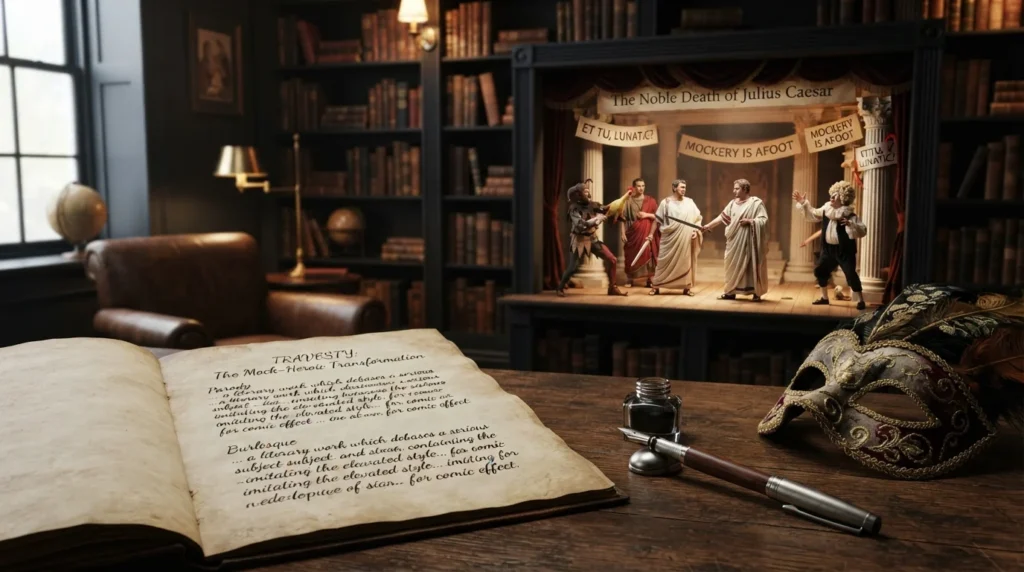
A literary travesty is a comic, burlesque, or deliberately distorted imitation of another serious work or style. The original subject remains recognizable, but it is presented in an exaggerated, absurd, or deliberately inappropriate way.
For example:
“The poem is a humorous travesty of a famous epic.”
The writer is not necessarily attacking the original work. The purpose may be satire, comedy, parody, or artistic experimentation.
This literary sense is important because it helps explain the word’s historical development. Travesty originally had strong associations with disguise and altered representation before developing its broader modern sense.
Travesty Meaning in Everyday Speech
Today, people also use travesty outside literature and law.
You might hear:
“That’s a travesty!”
This means:
“That is outrageously wrong, ridiculous, unfair, or a terrible version of what it should be.”
The tone can be serious:
“They denied the workers a fair hearing. That’s a travesty.”
Or humorous:
“They ran out of chocolate cake? That’s a travesty!”
The second example is deliberately dramatic. Modern speakers sometimes use travesty hyperbolically to make a minor complaint sound funny.
So it is not accurate to say that travesty can never be used casually. It is traditionally a strong word, but context allows humorous and exaggerated uses.
“Such a Travesty” Meaning
“Such a travesty” means such a shocking, absurd, unfair, or distorted example of something that should have been better.
For example:
“They canceled the final performance at the last minute. Such a travesty!”
The phrase expresses strong disappointment or outrage.
It can be serious or humorous depending on the situation.
“Absolute Travesty” Meaning
“Absolute travesty” is an emphatic way of saying that something is an extremely bad, unfair, ridiculous, or distorted example of what it should be.
For example:
“The judges ignored the strongest performance. It was an absolute travesty.”
Here, absolute intensifies the speaker’s criticism.
In casual conversation, it can also be playful:
“They put raisins in the cookies? An absolute travesty!”
Travesty Synonyms
If you’re asking “What is the synonym of travesty?”, the best answer depends on the context.
Common related words include parody, mockery, caricature, burlesque, farce, sham, distortion, misrepresentation, and injustice.
However, these words are not perfect substitutes.
| Word | What it usually emphasizes |
|---|---|
| Parody | Humorous imitation of a recognizable work, person, or style |
| Mockery | Ridicule or making something seem foolish |
| Caricature | Exaggerating distinctive features for comic or critical effect |
| Burlesque | Treating a serious or elevated subject in a deliberately comic way |
| Farce | An absurd situation or comedy built around ridiculous events |
| Sham | Something presented as genuine but actually false or deceptive |
| Distortion | A representation that has been changed or warped |
| Injustice | Unfair treatment or an unfair outcome |
| Travesty | A distorted, debased, or grossly inferior version that makes a mockery of the original or expected standard |
This distinction matters.
For example, a humorous imitation of a famous novel may be a parody. A deliberately exaggerated drawing of a politician may be a caricature. An unfair legal process may be an injustice or, more strongly, a travesty of justice.
Travesty vs. Parody
These words overlap, but they are not identical.
Parody generally emphasizes imitation for humorous or satirical effect.
Travesty emphasizes that the imitation or representation has become distorted, debased, absurd, or grossly inferior.
For example:
“The comedian performed a parody of the politician.”
This simply tells us that the politician was humorously imitated.
But:
“The production was a travesty of the original play.”
This strongly criticizes the production as a distorted or inferior version.

Travesty vs. Mockery
Mockery is broader.
It means ridicule or treatment that makes someone or something appear foolish.
Travesty can involve mockery, but it specifically suggests that something has been distorted or degraded from what it should be.
So:
“His comments were mockery.”
focuses on ridicule.
While:
“The ceremony was a travesty of the original tradition.”
focuses on the ceremony being a distorted or inferior representation.
Travesty Pronunciation
Travesty is commonly pronounced:
TRAV-uh-stee
IPA: /ˈtræv.ə.sti/
The stress is on the first syllable:
TRAV-uh-stee.
The plural is:
travesties
Example:
“The two performances were complete travesties of the original.”
Can Travesty Be a Verb?
Yes.
Travesty can also function as a verb meaning to make a travesty of, parody, or distort something.
Examples:
“The sketch travestied the conventions of political speeches.”
“The adaptation travestied the original story.”
Common forms include:
- travesty — present
- travestied — past
- travestying — present participle
The noun is much more common in everyday modern usage, but the verb is an established English form.
Travesty Origin and Etymology
The word travesty entered English in the seventeenth century.
It came through French travesti, related to the French verb travestir, meaning “to disguise.” The word ultimately traces through Italian travestire to Latin vestire, meaning “to dress” or “to clothe.”
That history gives the modern word an interesting underlying idea: something recognizable is effectively “dressed up” or transformed into a different version of itself.
Merriam-Webster records the first known English use of the noun around 1668, while the verb dates to 1667.
The early literary sense was associated with parody, burlesque, and comic imitation. Over time, travesty developed its broader modern meaning of a distorted or grossly inferior representation and became especially associated with phrases such as “a travesty of justice.”
How to Use Travesty in a Sentence
Here are natural examples in different situations.
Formal
“The lawyer argued that the proceedings were a travesty of justice.”
Literature
“The poem is a comic travesty of the original epic.”
Film and entertainment
“Fans called the remake a travesty of the classic.”
Everyday conversation
“They forgot the main event? What a travesty!”
Online or social media
“Calling that the best performance of the night is a travesty.”
Humorous
“No cheese on the burger? Absolute travesty.”
These examples show that travesty can range from serious criticism to playful exaggeration.
Common Mistakes With Travesty
1. Confusing travesty with tragedy
This is the biggest mistake.
Remember:
tragedy = disastrous or deeply sad event
travesty = distortion, mockery, or grossly inferior representation
2. Assuming travesty always means injustice
Not necessarily.
A travesty of justice is an important phrase, but travesty can also describe a distorted work, imitation, performance, tradition, or representation.
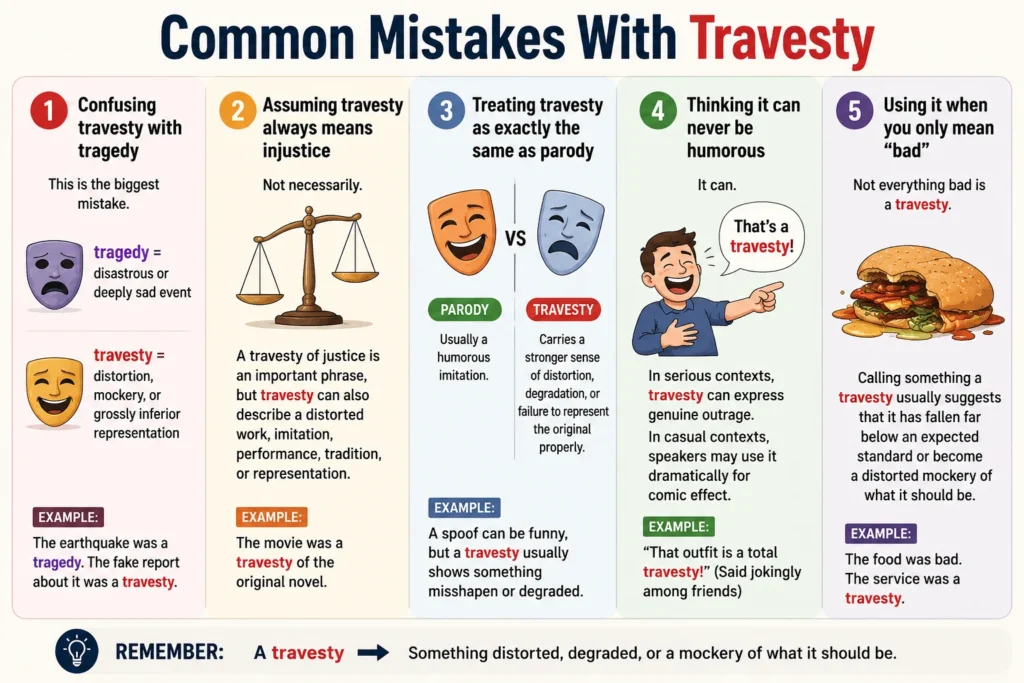
3. Treating travesty as exactly the same as parody
A parody is usually a humorous imitation. A travesty carries a stronger sense of distortion, degradation, or failure to represent the original properly.
4. Thinking it can never be humorous
It can.
In serious contexts, travesty can express genuine outrage. In casual contexts, speakers may use it dramatically for comic effect.
5. Using it when you only mean “bad”
Not everything bad is a travesty.
Calling something a travesty usually suggests that it has fallen far below an expected standard or become a distorted mockery of what it should be.
FAQ: Travesty Meaning
What does travesty mean in simple words?
Travesty means a distorted, inferior, or absurd version of something, or a situation that makes a mockery of what it should be.
What is the synonym of travesty?
Depending on context, useful synonyms include parody, mockery, caricature, burlesque, sham, distortion, and injustice. None is a perfect replacement in every sentence.
Does travesty mean tragedy?
No. A tragedy is a deeply sad or disastrous event. A travesty is a distortion, mockery, or grossly inferior representation.
What is an example of a travesty?
A competition presented as fair but secretly rigged could be called a travesty, because it makes a mockery of genuine competition.
What is an example of a travesty of justice?
A legal proceeding that seriously denies fairness or impartiality could be described as a travesty of justice.
What does “that’s a travesty” mean?
It means “that is outrageously wrong, unfair, ridiculous, or a terrible distortion of what it should be.” The phrase can be serious or humorous depending on context.
Is travesty formal or informal?
Travesty is a standard English word that appears frequently in formal writing, journalism, literature, and legal discussion. However, people also use it informally and humorously.
What does travesty mean in literature?
In literature, a travesty is a comic, burlesque, or deliberately distorted imitation of another serious work or style.
Final Takeaway
Travesty means a distorted, debased, or grossly inferior imitation or representation of something, or a situation that makes a mockery of what it is supposed to be.
The most important distinction is simple:
Tragedy is about terrible events and suffering. Travesty is about distortion, mockery, unfairness, or an inferior imitation.
You’ll most often encounter travesty in phrases such as “a travesty of justice,” “that’s a travesty,” and “a travesty of the original.” Once you understand the difference between those uses, the word becomes much easier to recognize and use naturally.

Nora Ellison is a digital language writer specializing in emoji meanings, internet slang, symbols, and online communication, creating clear, accurate, and reader-friendly content.