
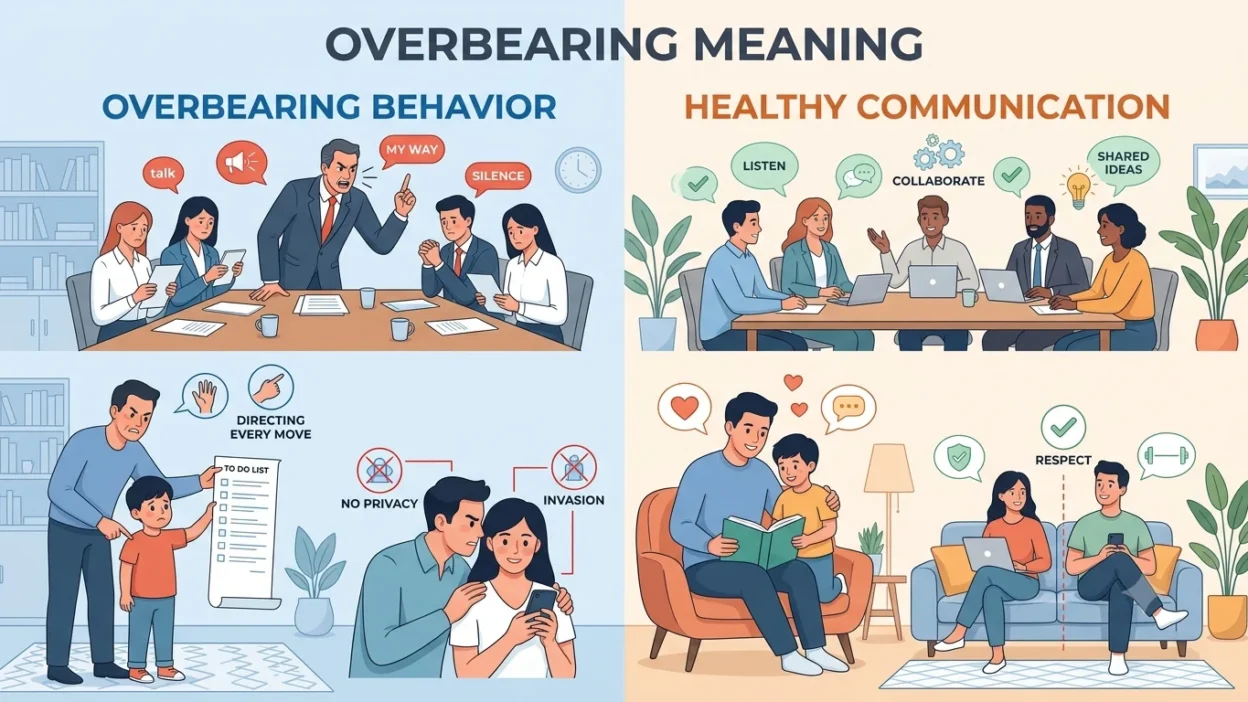
Have you ever wondered whether someone who is protective, caring, or confident can also be overbearing? Or have you heard an overbearing parent, partner, friend, or manager described that way and weren’t sure what it really meant? Overbearing (pronounced oh-ver-BAIR-ing) is an adjective that describes a person, attitude, or behavior that is excessively controlling, domineering, or forceful in a way that limits other people’s independence, choices, or opinions
. Unlike healthy confidence, leadership, or genuine care, overbearing behavior goes beyond offering guidance and instead tries to control how others think, act, or make decisions. Because it often leaves people feeling pressured, ignored, or unable to express themselves freely, the word almost always carries a strongly negative meaning.
In simple terms, overbearing means overly controlling, bossy, or domineering. For example, an overbearing parent may make every decision for their child, an overbearing partner may try to control every aspect of a relationship, an overbearing friend may constantly tell others what they should do, and an overbearing manager may dismiss different opinions instead of encouraging teamwork. Even when someone’s intentions are good, their behavior can still be considered overbearing if it consistently takes away another person’s independence or voice.
If you’ve come across overbearing and weren’t sure what it means, this guide explains its definition, pronunciation, origin, synonyms, antonyms, real-life examples, common phrases, and how to recognize when overbearing is the right word—and when another term may be more appropriate—in everyday English.
What Does Overbearing Mean?
At its core, overbearing describes a person whose behavior is excessively controlling, domineering, or forceful, making others feel as though their opinions, choices, or independence don’t matter. Rather than guiding or supporting people, an overbearing individual often tries to direct conversations, decisions, or situations according to their own preferences.
Unlike someone who is simply confident or assertive, an overbearing person usually crosses healthy boundaries. They may interrupt others, dismiss different viewpoints, insist on being right, or attempt to manage aspects of other people’s lives that should remain personal choices.
In modern English, overbearing is commonly used to describe personality traits, leadership styles, parenting approaches, friendships, and romantic relationships where one person exercises too much control or influence over another.
Simple Definition
Overbearing means being too controlling, bossy, or domineering in a way that overwhelms or limits other people’s freedom, confidence, or independence.
Pronunciation
Word: Overbearing
IPA Pronunciation: /ˌoʊ.vɚˈber.ɪŋ/
Easy Pronunciation: oh-ver-BAIR-ing
Syllables: Over • bear • ing
Part of Speech
| Feature | Details |
|---|---|
| Word | Overbearing |
| Part of Speech | Adjective |
| Tone | Negative |
| Difficulty Level | Intermediate–Advanced English |
| Common Usage | Everyday English, business, psychology, education, relationships |
| Opposite Words | Respectful, considerate, supportive, easygoing |
Definition at a Glance
| Question | Answer |
|---|---|
| What does overbearing mean? | Excessively controlling or domineering. |
| Is it positive or negative? | Almost always negative. |
| Can it describe people? | Yes, most commonly. |
| Can it describe behavior? | Yes. |
| Can it describe leadership? | Yes. |
| Can it describe parents or partners? | Absolutely. |
| Is it slang? | No. It’s a standard English adjective. |
Language Expert Note
One of the biggest misconceptions about the word overbearing is that it simply means bossy. While bossiness is certainly part of its meaning, overbearing carries a stronger emotional impact.
An overbearing person doesn’t just like giving instructions—they often dominate conversations, dismiss opposing views, and make others feel pressured or powerless. That’s why the word frequently appears in discussions about healthy communication, emotional intelligence, leadership, family dynamics, and relationship psychology.
Language experts also distinguish behavior from identity. Instead of permanently labeling someone as “an overbearing person,” it’s often more accurate and constructive to describe specific actions, such as:
✔ “His behavior during the meeting was overbearing.”
rather than
✘ “He is an overbearing person.”
Describing behavior instead of identity provides clearer communication and avoids unfairly defining someone’s entire personality by a single action.
What Does Overbearing Mean in a Person?
When someone asks, “What does overbearing mean in a person?”, they usually want to understand how this behavior appears in real life.
An overbearing person consistently tries to influence, control, or direct other people’s decisions—even when their involvement isn’t needed or requested. They often believe they know what’s best and may unintentionally ignore other people’s independence, opinions, or boundaries.
An overbearing personality may include behaviors such as:
- Always wanting the final say in conversations.
- Giving advice even when nobody asks.
- Interrupting or speaking over others.
- Correcting people unnecessarily.
- Micromanaging small tasks.
- Becoming frustrated when people disagree.
- Making decisions for family members, friends, or coworkers.
- Expecting others to follow their way without discussion.
Although these actions sometimes come from genuine concern or good intentions, their overall effect can make other people feel controlled, undervalued, or emotionally exhausted.
Real-Life Example
Imagine a manager who checks every email before it’s sent, rewrites every report, and refuses to let employees make even simple decisions. Even if the manager wants the best results, most people would describe this leadership style as overbearing because it leaves little room for trust or independence.
The same pattern can appear in families, friendships, classrooms, sports teams, or romantic relationships whenever one person consistently dominates the decisions of others.
Is Overbearing Positive or Negative?
Overbearing is almost always a negative adjective.
It suggests that someone’s desire to lead, help, or protect has gone beyond healthy limits and become controlling, domineering, or oppressive.
For example:
- Assertive: “I think this plan could work well. What do you think?”
- Overbearing: “We’re doing it my way. End of discussion.”
The first example shows confidence combined with respect.
The second removes collaboration and ignores other people’s opinions.
Because of this distinction, the word is commonly used when discussing communication problems, unhealthy relationships, difficult bosses, parenting styles, and interpersonal conflicts.
Does Overbearing Mean Controlling?
Yes—but the two words are not completely identical.
Every overbearing person is controlling to some degree, but overbearing describes a stronger, more excessive form of controlling behavior that often feels intimidating or emotionally exhausting.
| Controlling | Overbearing |
|---|---|
| Wants influence | Demands influence |
| May be subtle | Usually obvious |
| Sometimes protective | Often domineering |
| Can respect boundaries | Frequently ignores boundaries |
| Allows discussion | Often dominates discussions |
| Doesn’t always overwhelm others | Frequently overwhelms others emotionally |
Think of it this way:
- Controlling focuses on wanting control.
- Overbearing focuses on how intensely that control affects other people.
That’s why someone can be controlling without seeming overbearing, but an overbearing person almost always displays controlling behavior.
Quick Expert Tip
Ask yourself this question:
“Does this person’s behavior help others make their own decisions, or does it take those decisions away?”
If someone regularly removes other people’s freedom to choose, interrupts their independence, or insists that only their opinion matters, the behavior is likely overbearing, not simply confident or assertive.
This small distinction is what makes overbearing such a precise and useful word in modern English.
Overbearing Meaning in Different Contexts
The meaning of overbearing stays generally the same across different situations—it always refers to excessively controlling or domineering behavior. However, how that behavior appears can vary depending on the relationship or environment.
Understanding these real-life contexts makes it much easier to recognize when someone is being overbearing and helps you use the word more accurately in conversations and writing.
Overbearing Meaning in Relationships
In a relationship, overbearing describes a partner who tries to control the other person’s choices, emotions, or daily life instead of building a relationship based on trust and mutual respect.
An overbearing partner may believe they’re acting out of love or concern, but their actions often make the other person feel restricted rather than supported.
Signs of an Overbearing Partner
- Wants to know where you are all the time.
- Makes decisions without asking your opinion.
- Frequently checks your phone or social media.
- Tries to control who you spend time with.
- Gets upset when you make independent decisions.
- Expects you to seek approval before doing everyday activities.
- Gives constant criticism instead of encouragement.

Healthy vs. Overbearing Relationship
| Healthy Relationship | Overbearing Relationship |
|---|---|
| Built on trust | Built on control |
| Encourages independence | Limits independence |
| Respects personal boundaries | Frequently crosses boundaries |
| Decisions are shared | One person dominates decisions |
| Open communication | One-sided communication |
Expert Insight: Caring deeply about someone isn’t the same as controlling them. Healthy love gives people the freedom to grow, while overbearing behavior often limits that freedom.
Emotionally Overbearing Meaning
An emotionally overbearing person attempts to control not only what others do but also how they feel. They may constantly interfere, demand reassurance, create feelings of guilt, or become overly involved in emotional decisions.
This behavior isn’t always intentional. Sometimes it comes from anxiety, fear of losing control, or a desire to protect loved ones. However, the emotional impact can still be harmful.
Examples of Emotionally Overbearing Behavior
- Expecting constant emotional reassurance.
- Making someone feel guilty for spending time with others.
- Becoming upset if they aren’t included in every decision.
- Treating another person’s problems as their own to solve.
- Refusing to respect emotional boundaries.
Over time, emotionally overbearing behavior can lead to stress, reduced self-confidence, and emotional exhaustion in relationships.
Overbearing Personality Meaning
An overbearing personality is characterized by a consistent need to direct, influence, or dominate other people. Individuals with this personality style often believe their opinions are superior and may struggle to accept disagreement or alternative viewpoints.
Common Personality Traits
- Highly controlling.
- Strong desire to lead every situation.
- Difficulty accepting criticism.
- Limited patience with different opinions.
- Frequent interruptions during conversations.
- Need to feel in charge.
- Tendency to micromanage others.
It’s important to remember that having one of these traits occasionally does not automatically make someone overbearing. The pattern, frequency, and impact of the behavior matter most.
Mucho Gusto Meaning Secret You’ve Been Saying Wrong
Overbearing Attitude Meaning
An overbearing attitude is a pattern of behaving as though your ideas, decisions, or opinions should always take priority over everyone else’s.
People with an overbearing attitude often:
- Assume they know what’s best.
- Give unsolicited advice repeatedly.
- Dominate conversations.
- Ignore constructive feedback.
- Make decisions without consulting others.
- Expect others to follow instructions without question.
This attitude often creates tension because it leaves little room for collaboration or mutual respect.
Overbearing Parent
An overbearing parent becomes excessively involved in a child’s life, often making decisions that the child should gradually learn to make independently.
Examples include:
- Choosing the child’s hobbies, friends, or career.
- Solving every problem instead of teaching problem-solving skills.
- Monitoring every activity excessively.
- Speaking for the child in social situations.
- Discouraging independent decision-making.
While these actions may come from love and concern, experts generally agree that children also need opportunities to develop confidence, responsibility, and independence.
Overbearing Boss or Manager
In the workplace, an overbearing boss is someone who constantly controls every detail instead of trusting employees to do their jobs.
Common signs include:
- Micromanaging simple tasks.
- Requiring approval for every decision.
- Rejecting new ideas without discussion.
- Constantly monitoring employees.
- Criticizing minor mistakes.
- Rarely recognizing good work.
Example
Instead of saying,
“I trust your judgment—let me know if you need help.”
An overbearing manager might say,
“Don’t send anything until I’ve checked every single word.”
This style of leadership often reduces creativity, lowers morale, and discourages independent thinking.
Overbearing Friend
Friendships should be built on equality and mutual respect. An overbearing friend may unintentionally create an unhealthy dynamic by trying to control plans, opinions, or decisions.
Examples include:
- Always choosing where the group goes.
- Becoming offended when friends make plans without them.
- Giving constant unsolicited advice.
- Trying to influence personal decisions.
- Speaking on behalf of others.
Healthy friendships encourage individuality rather than control.
Can Someone Be Caring but Overbearing?
Yes.
This is one of the most misunderstood aspects of the word overbearing.
Many overbearing people genuinely care about the people around them. Parents want to protect their children. Partners want to keep relationships strong. Managers want projects to succeed.
However, good intentions don’t automatically make controlling behavior healthy.
The difference lies in respect for independence.
A caring person offers support and guidance while respecting another person’s choices.
An overbearing person often replaces support with control, believing they know what’s best regardless of what others want.
Understanding this difference helps explain why someone can be loving, generous, and well-intentioned while still coming across as overbearing.
Did You Know?
Psychologists often distinguish between supportive guidance and controlling behavior. Supportive people encourage others to make informed decisions, while overbearing individuals tend to take control of decisions themselves. Recognizing this distinction can improve communication, strengthen relationships, and help create healthier personal and professional boundaries.
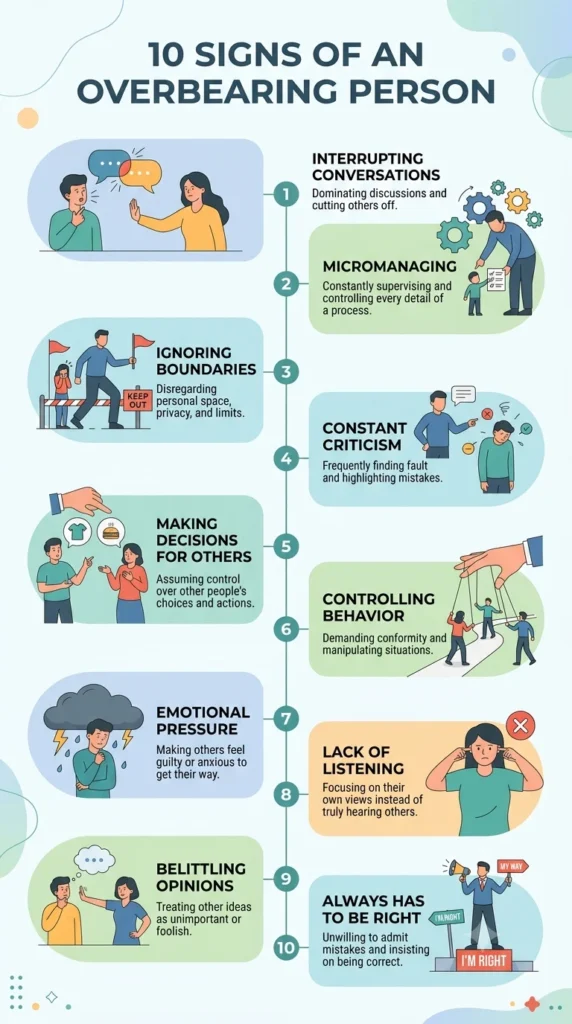
Signs of an Overbearing Person
Sometimes, overbearing behavior isn’t obvious at first. It may begin as helpful advice, strong leadership, or genuine concern. However, when someone consistently ignores boundaries, dominates conversations, or tries to control other people’s choices, their behavior can become overbearing.
Recognizing these signs can help you build healthier relationships, improve communication, and distinguish supportive behavior from unhealthy control.
1. They Always Need to Be in Control
One of the clearest signs of an overbearing person is a constant need to control situations, conversations, or decisions.
They often believe their way is the only correct way and struggle to let others make independent choices.
Example:
Instead of asking,
“What do you think?”
they say,
“This is how we’re doing it.”
2. They Frequently Interrupt Others
Overbearing individuals often dominate conversations without realizing it.
Rather than listening carefully, they interrupt, finish other people’s sentences, or redirect the discussion back to themselves.
Over time, this behavior makes others feel ignored or undervalued.
3. They Ignore Personal Boundaries
Healthy relationships depend on respecting emotional, physical, and personal boundaries.
An overbearing person may:
- Read private messages without permission.
- Give unwanted advice repeatedly.
- Become involved in decisions that don’t concern them.
- Expect constant updates about another person’s life.
Ignoring boundaries often creates frustration and reduces trust.
4. They Micromanage Everything
Whether at home or at work, overbearing people often struggle to trust others.
Instead of allowing people to complete tasks independently, they monitor every detail and correct even minor decisions.
Examples include:
- Rewriting someone else’s work.
- Watching every step of a project.
- Giving excessive instructions.
- Checking progress unnecessarily.
Micromanagement usually lowers confidence rather than improving performance.
5. They Believe They’re Always Right
Confidence is valuable, but overbearing people often take it further by assuming their opinions should always come first.
They may:
- Reject suggestions immediately.
- Dismiss alternative viewpoints.
- Become defensive when challenged.
- Rarely admit mistakes.
This mindset makes healthy discussions difficult.
6. They Make Decisions for Other People
Rather than encouraging independence, an overbearing person often decides what others should do.
This might involve choosing:
- Careers
- Friends
- Hobbies
- Clothes
- Daily schedules
- Financial decisions
Although the intention may be helpful, constantly removing another person’s ability to choose can damage confidence and self-esteem.
7. They Constantly Criticize
Constructive feedback helps people improve.
Overbearing criticism focuses on control instead of growth.
Examples include:
❌ “You never do anything right.”
✔ “Here’s one way this could be improved.”
The difference is respect.
8. They Become Frustrated When Others Disagree
Disagreement is a normal part of healthy communication.
Overbearing people often interpret disagreement as disrespect.
Instead of discussing different viewpoints calmly, they may:
- Raise their voice.
- Repeat their opinion.
- Pressure others to agree.
- Refuse to consider different ideas.
9. They Rarely Ask for Other People’s Opinions
Rather than encouraging collaboration, they assume they already know the best solution.
This behavior often discourages creativity and teamwork.
10. They Try to “Help” Without Being Asked
Sometimes overbearing behavior comes from good intentions.
The person genuinely wants to help.
However, constantly solving other people’s problems without permission can unintentionally communicate:
“I don’t trust you to handle this yourself.”
True support empowers people rather than replacing their independence.
🎭 Travesty Meaning: Definition, Origin
Characteristics of Overbearing Behavior
Although every individual is different, overbearing behavior usually includes several common personality traits.
| Characteristic | Description |
|---|---|
| Controlling | Wants to influence other people’s decisions. |
| Domineering | Uses authority instead of cooperation. |
| Bossy | Frequently tells others what to do. |
| Opinionated | Believes their ideas are usually the best. |
| Critical | Focuses more on mistakes than encouragement. |
| Impatient | Becomes frustrated when others work differently. |
| Micromanaging | Watches unnecessary details instead of trusting people. |
| Boundary-crossing | Has difficulty respecting personal space and independence. |
It’s important to remember that one isolated behavior doesn’t necessarily make someone overbearing. The pattern, frequency, and emotional impact are what matter most.
Why Do People Become Overbearing?
Understanding the cause doesn’t excuse unhealthy behavior, but it can help explain why it happens.
People may become overbearing because of:
- Fear of losing control.
- Anxiety about uncertainty.
- Perfectionism.
- High personal expectations.
- Lack of trust in others.
- Childhood experiences.
- Stress or pressure.
- Leadership roles that encourage excessive control.
In many cases, the person doesn’t realize how their behavior affects others.
Developing self-awareness, emotional intelligence, and active listening skills can help reduce overbearing tendencies over time.
Psychology Insight
Psychologists often describe healthy relationships as a balance between guidance and autonomy.
Supportive people encourage others to think independently while offering advice when needed.
Overbearing people, however, often replace guidance with control.
This difference has a significant emotional impact.
People who regularly experience overbearing behavior may begin to:
- Doubt their own judgment.
- Feel anxious about making decisions.
- Lose confidence.
- Avoid expressing opinions.
- Become emotionally exhausted.
Respecting another person’s independence isn’t a sign of weakness—it’s one of the strongest foundations of healthy communication.
Real-Life Examples of Overbearing Behavior
Workplace
Employee: “I’d like to try a new approach.”
Manager: “No. Follow my instructions exactly.”
The manager’s refusal to consider new ideas makes the leadership style overbearing.
Family
Teenager: “I’d like to choose my own college.”
Parent: “I’ve already decided where you’re going.”
This behavior limits independence, making the parent appear overbearing.
Relationship
Partner: “Please text me every hour and send me your location.”
Occasional concern is normal, but demanding constant updates may become emotionally overbearing if it removes trust and personal freedom.
Friendship
Friend: “I’ll order your food—you always choose the wrong thing.”
Although it may sound harmless, repeatedly making decisions for someone else can create an unhealthy friendship dynamic.
Expert Communication Tip
Not every confident, organized, or protective person is overbearing.
Ask yourself these three questions:
- Do they respect other people’s choices?
- Do they listen as much as they speak?
- Do they encourage independence instead of demanding control?
If the answer is consistently no, the behavior is likely overbearing rather than simply confident or helpful.
Remember: Healthy leadership inspires. Healthy parenting guides. Healthy relationships support. Overbearing behavior controls.
Overbearing vs. Controlling, Assertive, Bossy, Domineering & Overwhelming
Many people use overbearing, controlling, bossy, assertive, domineering, and overwhelming as if they all have the same meaning. While these words are related, they describe different behaviors and carry different emotional tones.
Understanding these differences helps you choose the right word, communicate more accurately, and avoid misunderstanding someone’s personality or intentions.
Overbearing vs. Controlling
One of the most common questions people ask is:
“Does overbearing mean controlling?”
The short answer is yes—but overbearing is usually stronger than controlling.
A controlling person wants to influence or direct another person’s choices. An overbearing person goes a step further by becoming so forceful or domineering that others feel pressured, unheard, or emotionally restricted.
Comparison
| Overbearing | Controlling |
|---|---|
| Excessively controlling | Wants control over situations or people |
| Often ignores personal boundaries | May still respect some boundaries |
| Usually obvious and noticeable | Can sometimes be subtle |
| Frequently dominates conversations | May influence decisions quietly |
| Often creates emotional pressure | Doesn’t always overwhelm others emotionally |
| Strongly negative | Negative, but broader in meaning |
Example
Controlling
“I’d rather you stay home tonight.”
Overbearing
“You’re not going anywhere. I’ve already decided.”
The second example removes the other person’s freedom to choose, making it overbearing rather than simply controlling.
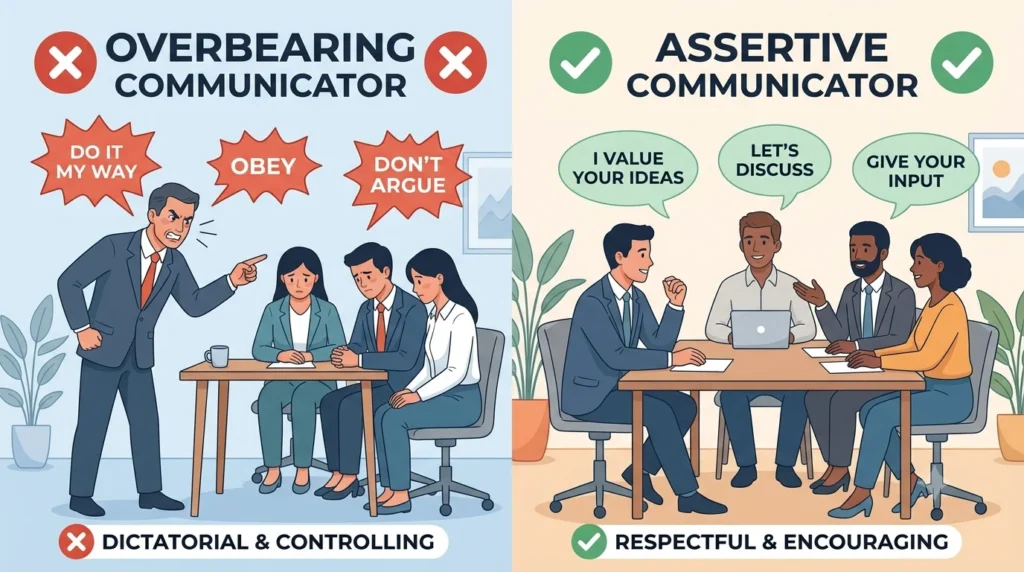
Overbearing vs. Assertive
This is one of the most misunderstood comparisons.
Being assertive is considered a healthy communication skill.
Being overbearing is not.
Assertive people express their opinions confidently while respecting other people’s rights.
Overbearing people often believe their opinions should outweigh everyone else’s.
Comparison
| Assertive | Overbearing |
|---|---|
| Speaks confidently | Speaks forcefully |
| Respects different opinions | Dismisses different opinions |
| Encourages discussion | Dominates discussion |
| Builds cooperation | Demands compliance |
| Listens actively | Interrupts frequently |
| Values teamwork | Wants control |
Example
Assertive
“I recommend this approach because it has worked well before. What are your thoughts?”
Overbearing
“We’re doing it my way. There’s nothing else to discuss.”
The key difference is respect.
Assertiveness respects people’s choices.
Overbearing behavior tries to replace those choices.
Overbearing vs. Bossy
Although these words are similar, bossy is generally more informal and often describes everyday behavior.
Overbearing suggests a deeper pattern of excessive control that can affect relationships, leadership, and emotional well-being.
| Bossy | Overbearing |
|---|---|
| Usually informal | Used in both formal and informal English |
| Often temporary | Often describes an ongoing behavior pattern |
| Gives lots of instructions | Tries to control decisions and independence |
| May be annoying | Can feel emotionally exhausting |
Someone who tells coworkers where to sit might seem bossy.
Someone who controls every conversation, every decision, and refuses to respect boundaries is more accurately described as overbearing.
Overbearing vs. Domineering
These two words are very close in meaning, but there is a subtle difference.
A domineering person enjoys exercising authority and expects obedience.
An overbearing person creates pressure through excessive control, even if they don’t realize they’re doing it.
Comparison
| Domineering | Overbearing |
|---|---|
| Focuses on power and authority | Focuses on excessive control |
| Often intentional | May be intentional or unintentional |
| Commands obedience | Limits independence |
| Strong leadership emphasis | Broader personality description |
Both words have negative meanings, but overbearing is more commonly used in everyday conversations.
Overbearing vs. Overwhelming
This is one of the biggest mistakes English learners make.
These words are not interchangeable.
Overbearing
Describes a person’s behavior.
Overwhelming
Describes a situation, emotion, task, or experience that feels too intense.
| Overbearing | Overwhelming |
|---|---|
| Describes behavior | Describes feelings or situations |
| Means excessively controlling | Means extremely intense |
| Usually refers to people | Usually refers to experiences or emotions |
| Personality-related | Emotion-related |
Correct Examples
✔ “Her overbearing attitude frustrated the entire team.”
✔ “The amount of homework was overwhelming.”
Incorrect Example
❌ “The exam was overbearing.”
The exam wasn’t controlling.
It was overwhelming.
Overbearing vs. Protective
This comparison is especially important because many overbearing people believe they’re simply being protective.
Healthy protection respects another person’s ability to make decisions.
Overbearing behavior often removes that ability.
| Protective | Overbearing |
|---|---|
| Offers guidance | Takes control |
| Encourages independence | Limits independence |
| Respects personal boundaries | Frequently crosses boundaries |
| Gives advice when needed | Gives constant unsolicited advice |
| Builds confidence | Can reduce confidence |
For example:
A protective parent might say,
“Call me when you arrive safely.”
An overbearing parent might say,
“You’re not allowed to go unless I approve every detail.”
The difference isn’t love—it’s control.
Is Overbearing Always Toxic?
Not necessarily.
Someone can occasionally behave in an overbearing way without being a toxic person.
For example, a parent may become overprotective during a stressful period, or a manager may become overly controlling while handling an important project.
However, when overbearing behavior becomes constant, ignores personal boundaries, or repeatedly harms another person’s confidence and independence, it can become part of a toxic relationship or unhealthy environment.
The important question isn’t whether someone has one overbearing moment.
It’s whether the behavior has become a consistent pattern.
Can Overbearing Behavior Change?
Yes.
Overbearing behavior is a learned communication pattern—not a permanent personality label.
People can become less overbearing by developing:
- Self-awareness.
- Active listening skills.
- Emotional intelligence.
- Trust in other people.
- Respect for healthy boundaries.
- Patience during disagreements.
- Better conflict-resolution skills.
Change usually begins when a person recognizes that trying to control others often damages the very relationships they’re trying to protect.
Expert Insight: Confidence vs. Control
One of the biggest misconceptions is believing that strong leadership requires controlling other people.
Research in communication and leadership consistently shows that the most effective leaders, parents, teachers, and partners balance confidence with empathy.
They provide guidance without removing independence.
They lead without dominating.
They influence without controlling.
In other words, true confidence empowers people—overbearing behavior overpowers them.
Quick Summary
If you’re unsure which word fits best, remember this:
- Assertive = Confident and respectful.
- Protective = Caring and supportive.
- Bossy = Likes telling people what to do.
- Controlling = Wants influence over decisions.
- Domineering = Uses authority to dominate.
- Overbearing = Excessively controlling in a way that overwhelms, pressures, or limits others’ independence.
Choosing the correct word helps you communicate more precisely and better understand the differences between healthy guidance and unhealthy control.
Origin and Etymology of “Overbearing”
The word overbearing has been part of the English language since the early 17th century. It combines two older English words:
- Over – meaning above normal, excessive, or beyond limits.
- Bear – from the Old English verb beran, meaning to carry, conduct oneself, endure, or behave.
Originally, overbearing described someone who acted with excessive pride, arrogance, or authority. Over time, its meaning evolved to describe people who try to dominate, control, or overpower others through their behavior rather than physical strength.
Today, the word is commonly used in discussions about communication, leadership, parenting, workplace behavior, emotional intelligence, and healthy relationships.
Timeline at a Glance
| Time Period | Development |
|---|---|
| 1600s | Used to describe arrogant or domineering behavior in English literature. |
| 1800s | Frequently appeared in political speeches and historical writing. |
| 1900s | Became common in discussions about personality, parenting, and leadership. |
| Today | Widely used in everyday English, psychology, business, education, and relationship advice. |
How to Use “Overbearing” Correctly
The word overbearing is almost always used to describe people, attitudes, personalities, leadership styles, or behavior—not objects or situations.
Correct Usage
✔ “Her overbearing attitude discouraged everyone from speaking.”
✔ “The new manager is knowledgeable but sometimes overbearing.”
✔ “His overbearing personality made teamwork difficult.”
✔ “She realized she had been overbearing and apologized.”
✔ “The teacher wasn’t strict, but her overbearing behavior made students nervous.”
Incorrect Usage
❌ “The weather was overbearing.”
✔ Correct: The weather was overwhelming or unbearable.
❌ “That movie was overbearing.”
✔ Correct: The movie was overwhelming, intense, or emotionally powerful.
❌ “The exam felt overbearing.”
✔ Correct: The exam felt overwhelming or difficult.
Expert Tip
A simple way to remember the difference is this:
- Overbearing usually describes how a person behaves.
- Overwhelming usually describes how something feels.
Overbearing in a Sentence (Real-Life Examples)
Here are natural examples showing how native English speakers use overbearing in different situations.
Workplace
- The team struggled because their supervisor was too overbearing.
- An overbearing manager rarely trusts employees to make decisions.
- His overbearing leadership style discouraged creativity.
Relationships
- She ended the relationship because her partner had become emotionally overbearing.
- Loving someone doesn’t mean becoming overbearing.
- Constant jealousy can make a relationship feel overbearing.
Family
- His parents were caring but sometimes overbearing.
- An overbearing father may unintentionally limit a child’s independence.
- Her grandmother offered advice without becoming overbearing.
School
- The coach’s overbearing attitude reduced the team’s confidence.
- Some teachers inspire students, while others become overbearing.
- Good mentors guide rather than control.
Everyday Conversations
- I appreciate your advice, but you’re being a little overbearing.
- Nobody enjoys working with an overbearing coworker.
- Her overbearing behavior made everyone uncomfortable.
- Don’t confuse confidence with being overbearing.
- He finally realized his comments sounded overbearing.
Common Mistakes People Make
Even advanced English learners sometimes misuse overbearing. Here are the most common mistakes and how to avoid them.
Mistake 1: Confusing “Overbearing” with “Overwhelming”
Incorrect: The amount of homework was overbearing.
Correct: The amount of homework was overwhelming.
Why?
Homework cannot control people. It can only feel intense or difficult.
Mistake 2: Using It as a Positive Trait
Some people think overbearing simply means “strong” or “confident.”
That’s incorrect.
A confident leader respects other people’s opinions.
An overbearing leader ignores them.
Mistake 3: Calling Every Strict Person Overbearing
Being strict doesn’t automatically make someone overbearing.
A strict teacher may still:
- Listen carefully.
- Explain expectations.
- Respect students.
- Encourage questions.
Overbearing behavior goes beyond strictness by becoming excessively controlling.
Mistake 4: Confusing Protection with Control
Parents, partners, or friends often care deeply about someone.
The key question is:
Do they support independence—or replace it with control?
Support strengthens people.
Overbearing behavior limits them.
Overbearing Meaning for Kids
For children, overbearing means being too bossy or trying to control other people all the time.
Kid-Friendly Example
Imagine you’re building a tower with your friends.
One child keeps saying:
- “No, use my blocks.”
- “Don’t build it like that.”
- “Only my idea is right.”
That child is being overbearing because they aren’t letting others share ideas or make choices.
A good teammate listens, shares, and lets everyone participate.
Overbearing Meaning in Different Languages
Many learners also search for the meaning of overbearing in their own language. While translations may vary depending on the context, these are common equivalents.
| Language | Translation |
|---|---|
| Hindi | हद से ज़्यादा हावी होने वाला, अत्यधिक नियंत्रित करने वाला |
| Urdu | حد سے زیادہ قابو پانے والا، حکم چلانے والا |
| Bengali | অতিরিক্ত কর্তৃত্বপরায়ণ, নিয়ন্ত্রণকারী |
| Tamil | அதிகமாக ஆதிக்கம் செலுத்தும், கட்டுப்படுத்தும் |
| Chinese | 专横的、盛气凌人的 |
| Tagalog | Masyadong dominante o mapang-control |
Note: Exact translations can vary depending on the sentence and cultural context. The English word overbearing usually emphasizes excessive control, dominance, or disregard for another person’s independence rather than simple confidence.
Usage Tips from English Experts
To use overbearing naturally, keep these tips in mind:
- Use it to describe behavior, not objects.
- Reserve it for situations where someone’s actions feel excessively controlling.
- Avoid using it as a synonym for overwhelming.
- Consider the context—someone may act overbearing in one situation without it defining their entire personality.
- In professional writing, describe specific behaviors rather than labeling a person’s identity. For example, “His comments were overbearing during the meeting” is more precise than “He is an overbearing person.”
Quick Memory Trick
If someone controls people → think “overbearing.”
If something feels too intense → think “overwhelming.”
This simple distinction will help you choose the correct word in everyday English.
How to Deal with an Overbearing Person
Living or working with an overbearing person can be challenging, especially when their behavior affects your confidence, independence, or peace of mind. While you can’t control another person’s actions, you can control how you respond.
Here are practical ways to handle overbearing behavior respectfully and effectively.
1. Set Clear and Healthy Boundaries
Overbearing people often don’t realize they’ve crossed a line. Calmly explain what behavior makes you uncomfortable and what you need instead.
Example:
“I appreciate your advice, but I’d like to make this decision myself.”
Being clear and respectful helps establish expectations without creating unnecessary conflict.
2. Communicate Calmly and Directly
Avoid arguing or becoming defensive. Instead, use “I” statements that focus on your feelings rather than blaming the other person.
For example:
✔ “I feel more confident when I’m able to make my own decisions.”
This approach reduces tension and encourages healthier communication.
3. Stay Consistent
If you set boundaries, stick to them.
Giving mixed signals can make it harder for the other person to understand your expectations.
Consistency helps build mutual respect over time.
4. Avoid Power Struggles
Trying to “win” every disagreement usually makes the situation worse.
Instead of proving who’s right, focus on finding practical solutions and keeping the conversation respectful.
5. Encourage Mutual Respect
Healthy relationships work best when both people feel heard.
Encourage open conversations where everyone has the opportunity to express opinions and make decisions together.
6. Seek Professional Support When Necessary
If overbearing behavior becomes emotionally harmful, manipulative, or abusive, consider speaking with a trusted friend, counselor, therapist, or another qualified professional.
Seeking support isn’t a sign of weakness—it’s a healthy step toward protecting your emotional well-being.
How to Stop Being Overbearing
Many people don’t realize their behavior comes across as overbearing. Fortunately, communication habits can improve with practice and self-awareness.
Here are some ways to become more supportive without being controlling.
Listen More Than You Speak
Give other people enough time to express their thoughts before offering advice.
Ask Before Giving Advice
Instead of assuming someone wants help, ask:
“Would you like my opinion?”
This simple question shows respect for their independence.
Accept Different Opinions
Remember that different doesn’t always mean wrong.
Healthy discussions allow room for multiple perspectives.
Trust Other People’s Decisions
Supporting someone doesn’t require controlling every choice they make.
Learning to trust others strengthens relationships.
Practice Emotional Intelligence
Pay attention to how your words and actions affect those around you.
Empathy, patience, and active listening are key parts of effective communication.
Let Go of Perfection
Many overbearing people become controlling because they believe everything must be done perfectly.
Accepting that people have different working styles often reduces unnecessary conflict.
Synonyms of Overbearing
Depending on the context, these words have similar meanings.
| Synonym | Meaning |
|---|---|
| Domineering | Exercising excessive authority over others. |
| Controlling | Trying to influence or direct another person’s actions. |
| Bossy | Frequently telling people what to do. |
| Authoritarian | Expecting strict obedience. |
| Dictatorial | Exercising absolute control. |
| Pushy | Forcing opinions or ideas on others. |
| High-handed | Acting without considering other people’s wishes. |
| Imperious | Commanding in a proud or arrogant way. |
| Oppressive | Exercising harsh or unfair control. |
| Arrogant | Believing oneself to be superior to others. |
Antonyms of Overbearing
The opposite of overbearing behavior involves respect, empathy, and cooperation.
- Respectful
- Considerate
- Supportive
- Understanding
- Cooperative
- Easygoing
- Open-minded
- Encouraging
- Flexible
- Empathetic
Frequently Asked Questions
What does overbearing mean in simple words?
It means being too controlling, bossy, or dominant in a way that limits another person’s freedom or makes them feel uncomfortable.
What does overbearing mean in a person?
An overbearing person frequently tries to control conversations, decisions, or situations instead of respecting other people’s independence and opinions.
Does overbearing always mean controlling?
Yes, overbearing behavior involves controlling tendencies, but it usually describes a stronger and more excessive form of control.
Is overbearing a positive or negative word?
It’s generally negative because it describes behavior that feels dominating, restrictive, or emotionally exhausting.
Can someone be caring and overbearing at the same time?
Yes. Good intentions don’t always prevent controlling behavior. A person may genuinely care while still becoming overly involved in another person’s choices.
What’s the difference between overbearing and assertive?
Assertive people express their opinions confidently while respecting others. Overbearing people often ignore boundaries and try to dominate discussions or decisions.
What is an overbearing attitude?
An overbearing attitude is a habit of acting as though your opinions or decisions should always take priority over everyone else’s.
Is an overbearing relationship unhealthy?
It can be. When one partner consistently controls the other’s choices or ignores personal boundaries, the relationship may become emotionally unhealthy.
Can overbearing behavior change?
Yes. With self-awareness, empathy, better communication skills, and a willingness to respect boundaries, many people can develop healthier interaction patterns.
Is overbearing the same as toxic?
Not always. A person can occasionally behave in an overbearing way without being toxic. However, persistent overbearing behavior that repeatedly harms or controls others may become part of a toxic relationship.
Conclusion
Overbearing means being excessively controlling, domineering, or bossy in a way that limits another person’s independence, confidence, or ability to make their own choices. Whether you’re describing an overbearing parent, partner, friend, coworker, or leader, the defining characteristic is an unhealthy level of control rather than healthy guidance.
Understanding the meaning of overbearing also helps you distinguish it from related words such as assertive, controlling, bossy, domineering, and overwhelming. While confidence, leadership, and protection can be positive qualities, they become overbearing when they consistently ignore another person’s boundaries, opinions, or freedom.
By recognizing the signs of overbearing behavior and practicing respectful communication, you can build stronger relationships based on trust, empathy, and mutual respect. Whether you searched for “overbearing meaning,” “what does overbearing mean,” “does overbearing mean controlling,” or “what is an overbearing attitude,” you now have a complete understanding of the word, its usage, examples, and practical applications in everyday life

Liza is a content writer at Meanovia, focused on slang, texting meanings, and internet phrases. She makes modern online language simple, clear, and easy to understand 💬✨