

What does “para” actually mean, and why does this short word have so many different definitions? If you’ve seen para in a school assignment, medical term, scientific article, sports event, military discussion, text message, or everyday conversation, you may have noticed that its meaning changes completely depending on the context.
That’s because para is used both as a standalone word and as a prefix, giving it several distinct meanings in English. As a prefix—derived from the Greek word para, meaning “beside,” “alongside,” “beyond,” or “closely related to”—it appears in words such as paragraph, paranormal, paramedic, and paralegal.
In other contexts, para may refer to a paragraph, a paratrooper, Para sports and the Paralympic movement, or have different meanings in medicine, biology, chemistry, texting, slang, and other languages. Understanding the context is the key to identifying the correct meaning.
In simple terms, para does not have one universal definition—its meaning depends entirely on how and where it is used. Knowing the correct meaning helps you avoid confusion in writing, education, healthcare, science, sports, online communication, and everyday English. This guide explains every major meaning of para, its pronunciation, origin, real-life examples, and the most common uses of the word and prefix, so you’ll be able to recognize exactly which definition applies whenever you encounter it.
What Does “Para” Mean?
The meaning of para depends on the context in which it appears.
In modern English, para- is usually a prefix that expresses the idea of beside, alongside, beyond, near, related to, or assisting. Rather than having one fixed definition, it slightly changes its meaning to match the word it joins.
For example:
- Paramedic — a healthcare professional who works alongside physicians to provide emergency medical care.
- Paralegal — a legal professional who assists lawyers with research, documentation, and case preparation.
- Parallel — two lines or objects running side by side without meeting.
- Paranormal — events or experiences considered beyond ordinary scientific explanation.
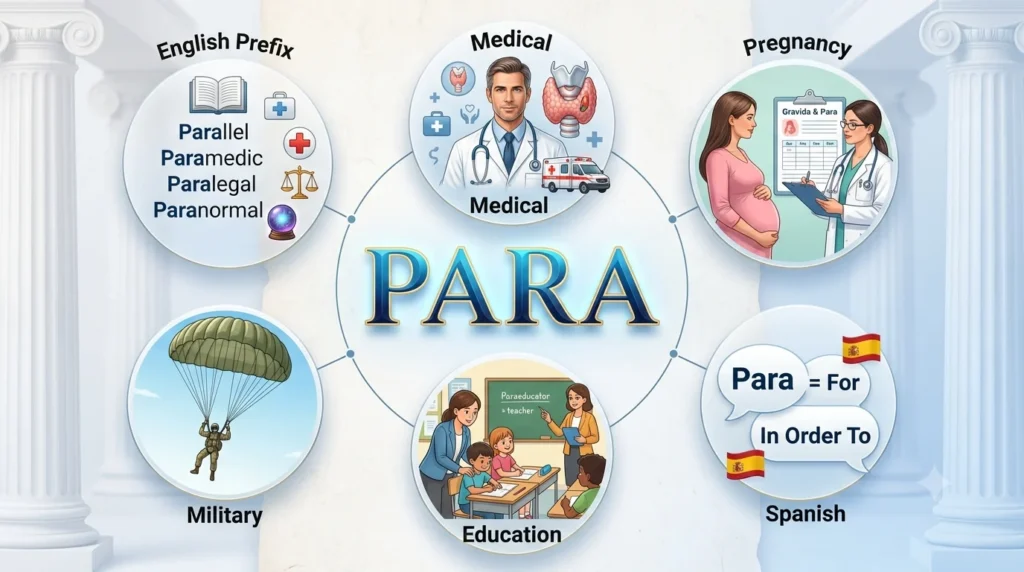
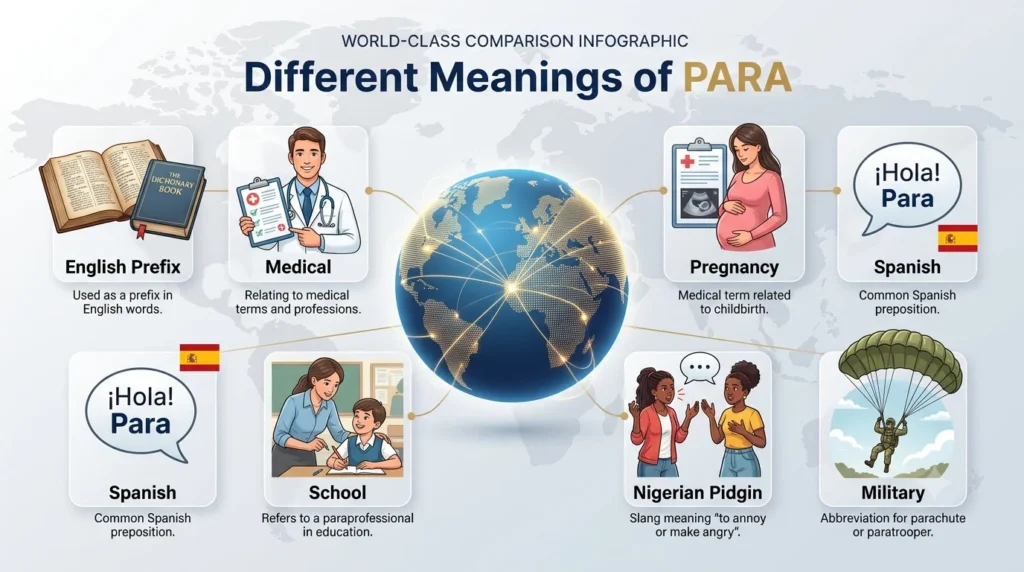
In other contexts, however, para can refer to completely different ideas. In Spanish, it commonly means “for” or “in order to.” In obstetrics, para records the number of pregnancies that reached fetal viability. In education, para is often short for paraeducator, while in military usage it can refer to a paratrooper.
Because of these varied meanings, it is important to understand the surrounding context rather than assuming para always has the same definition.
Origin and Etymology of Para
The history of para stretches back more than two thousand years to Ancient Greece. It comes from the Greek preposition παρά (pará), which carried several closely related meanings, including beside, near, alongside, beyond, contrary to, and in comparison with. Ancient Greek writers used the word in everyday speech as well as philosophy, literature, medicine, and law.
As Greek knowledge spread across Europe, many Greek words—including para—were adopted into Latin, particularly in scholarly, scientific, and medical writing. From Latin, the prefix entered French and eventually Middle English, where it became part of the growing English vocabulary.
Today, para- remains one of the most productive prefixes in English. It appears in hundreds of words across medicine, biology, education, law, psychology, linguistics, science, and everyday language. Although its exact meaning changes from word to word, the central idea of being beside, alongside, beyond, or closely related to something has remained remarkably consistent for centuries.
Evolution of the Word “Para”
| Period | Development |
|---|---|
| Ancient Greek | Pará meant beside, alongside, beyond, near, or contrary to. |
| Classical Latin | Adopted into scholarly, legal, and medical vocabulary. |
| Middle English | Entered English through Latin and French texts. |
| Modern English | Widely used as a productive prefix in medicine, science, education, law, and everyday vocabulary. |
Why Does “Para” Have So Many Meanings?
Many people wonder why para seems to mean different things in different situations.
The reason is that para is not usually a complete English word—it is primarily a prefix. Prefixes modify the meaning of the base word they are attached to rather than carrying a single definition on their own.
For example:
- In parallel, it expresses the idea of being side by side.
- In paramedic, it refers to someone working alongside doctors.
- In paranormal, it means beyond what is considered normal.
- In paralegal, it indicates someone working alongside legal professionals.
Understanding this shared idea makes it much easier to understand unfamiliar words that begin with para-.
What Does the Prefix Para- Mean?
The prefix para- is one of the most common prefixes in English and comes from the ancient Greek word παρά (pará). Its core idea is being beside, alongside, near, beyond, related to, or abnormal compared with something else. The exact meaning changes slightly depending on the word it joins, which is why you’ll see para- used across medicine, science, law, education, and everyday English.
Unlike prefixes that always carry a single meaning, para- is flexible. It adds a relationship to the root word instead of replacing its meaning. Understanding that relationship makes unfamiliar words much easier to decode.
For example:
| Word | Meaning of para- | Overall Meaning |
|---|---|---|
| Parallel | Beside | Running side by side without meeting |
| Paramedic | Alongside | A medical professional who works alongside physicians during emergencies |
| Paralegal | Assisting | A legal professional who supports lawyers |
| Parathyroid | Near | Glands located beside the thyroid gland |
| Paranormal | Beyond | Beyond normal scientific explanation |
| Paraphrase | Alongside | Restating someone’s words in a different way while keeping the original meaning |
Although these words belong to different subjects, they all share the same underlying idea of being beside, beyond, connected to, or assisting something else.
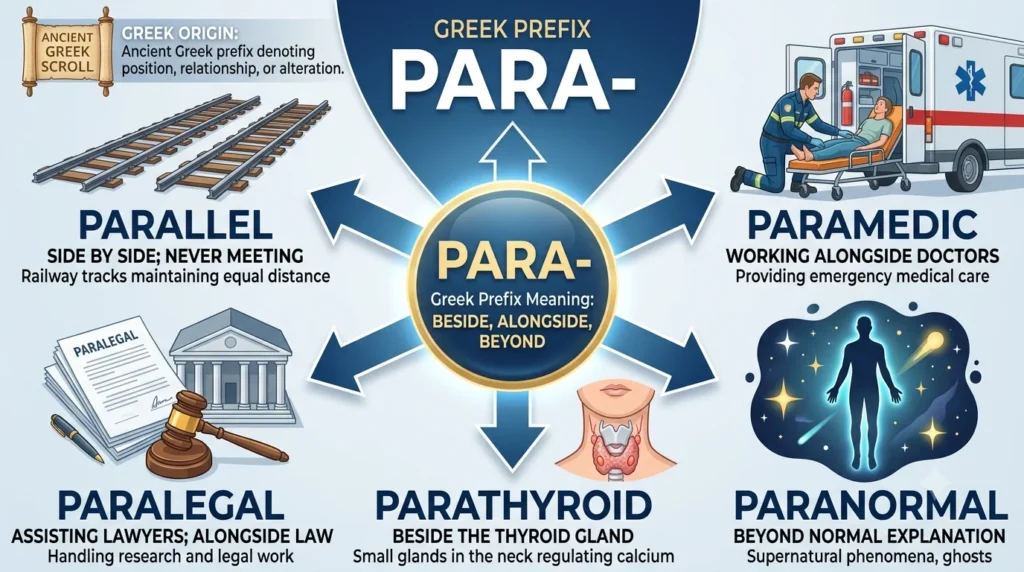
Expert Tip: When you come across an unfamiliar word beginning with para-, try identifying the root word first. Then ask yourself how the idea of beside, alongside, or beyond fits that root. This simple approach often reveals the word’s meaning without needing a dictionary.
Para Meaning in English
In English, para is most commonly used as a prefix, not as a standalone word. It appears in hundreds of words that describe relationships, positions, assistance, or ideas that extend beyond the ordinary.
For example:
- Parallel means two lines remain side by side without crossing.
- Paralegal refers to someone trained to assist lawyers.
- Paramedic describes a healthcare professional who provides emergency medical care before or during transport to a hospital.
- Paranormal refers to events believed to exist beyond normal scientific understanding.
However, para can occasionally appear as a standalone noun in specific contexts.
For example:
- In military English, para is an informal abbreviation for paratrooper.
- In education, people sometimes shorten paraeducator or paraprofessional to simply “para.”
Examples in Everyday English
✔ “The two railway tracks run parallel for several miles.”
✔ “A paramedic reached the accident scene within minutes.”
✔ “The law firm hired an experienced paralegal.”
✔ “She enjoys reading books about paranormal mysteries.”
Notice that para itself is rarely used alone in standard English. Instead, it forms part of larger words whose meanings become clear through context.
Para Meaning in Medical Terms
In medicine, para- usually means beside, near, adjacent to, or abnormal depending on the medical term. It is one of the most frequently used prefixes in medical terminology because many parts of the human body are named according to their position relative to other organs.
Understanding this prefix can make complex medical vocabulary much easier to interpret.
Common Medical Words with Para-
| Medical Term | Meaning |
|---|---|
| Paramedic | A healthcare professional who provides emergency treatment before or during transport to a hospital. |
| Parathyroid | Small glands located beside the thyroid gland that regulate calcium levels. |
| Paraplegia | Paralysis affecting the lower half of the body, usually both legs. |
| Paranasal | Located near the nose or nasal cavity. |
| Paravertebral | Situated beside the spinal column. |
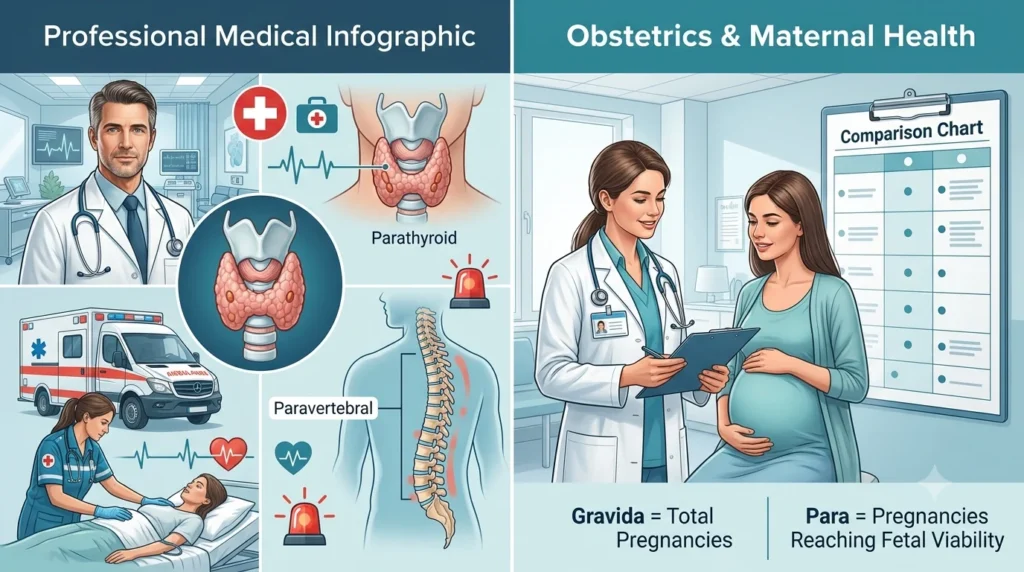
Why Is Para- Used So Often in Medicine?
Medical terminology aims to describe the body as accurately as possible. Prefixes such as para- help indicate the location, relationship, or function of body structures without using lengthy explanations.
For example:
- Parathyroid literally means beside the thyroid.
- Paranasal sinuses are air-filled spaces located around and beside the nose.
- Paravertebral muscles are muscles found next to the spine.
Learning common prefixes like para-, peri-, and endo- can make medical vocabulary much easier to understand, even if you’re not a healthcare professional.
Gravida and Para Meaning (Pregnancy)
One of the most searched meanings of para appears in obstetrics (pregnancy and childbirth).
In pregnancy records, para has a completely different meaning from the Greek prefix. Here, para refers to the number of pregnancies that have reached fetal viability, regardless of whether the babies were born alive or stillborn. The exact definition of fetal viability may vary slightly between healthcare systems.
What Is Gravida?
Gravida (G) represents the total number of times a woman has been pregnant, including the current pregnancy if applicable.
What Is Para (P)?
Para (P) records the number of pregnancies that progressed to the stage of fetal viability, not the number of babies born.
Because twins or triplets can result from a single pregnancy, para counts pregnancies—not babies.
Simple Examples
| Pregnancy History | Gravida | Para |
|---|---|---|
| First pregnancy | G1 | P0 |
| One previous full-term birth | G2 | P1 |
| Two pregnancies, both reached viability | G2 | P2 |
| Three pregnancies, one miscarriage before viability, two births | G3 | P2 |
Understanding “G2P1”
Doctors often write pregnancy history using a shorthand such as:
G2P1
This means:
- Gravida 2 = pregnant twice.
- Para 1 = one pregnancy reached fetal viability.
This notation allows healthcare providers to understand a patient’s pregnancy history quickly and consistently.
Important: In obstetrics, para does not mean “beside” or “beyond.” It is a specialized medical abbreviation used only to record pregnancy outcomes. Always interpret its meaning based on the medical context.
Para Meaning in Spanish
One of the most common searches related to para meaning comes from people learning Spanish. Unlike the English prefix para-, the Spanish word para is a preposition used as a standalone word.
In Spanish, para usually means:
- For
- In order to
- To (indicating a destination or purpose)
- By (a deadline or specific time)
Its exact meaning depends on the sentence, but it almost always expresses purpose, intention, destination, or a goal.
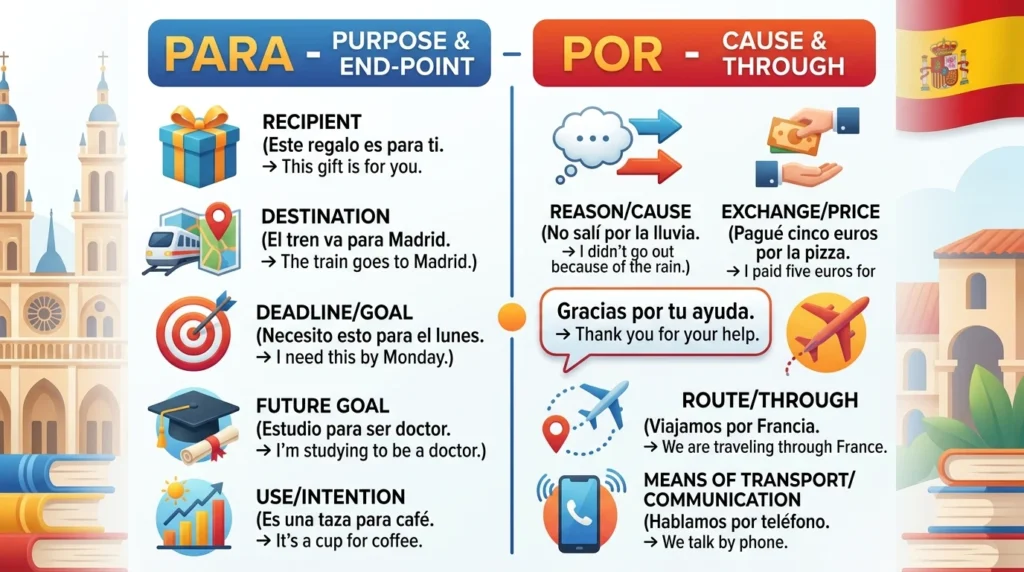
Common Meanings of Para in Spanish
| Spanish | English Meaning | Example |
|---|---|---|
| for | Indicates who something is intended for | Este regalo es para ti. (This gift is for you.) |
| in order to | Expresses purpose | Estudio para aprender. (I study to learn.) |
| to | Indicates a destination | Salimos para Madrid. (We’re leaving for Madrid.) |
| by | Refers to a deadline | Necesito terminarlo para mañana. (I need to finish it by tomorrow.) |
What Does “Para Ti” Mean?
One of the most searched Spanish phrases is para ti.
It simply means:
“For you.”
Examples:
- Este regalo es para ti. → This gift is for you.
- La carta es para ti. → The letter is for you.
What Does “Es Para” Mean?
Another popular search is es para meaning.
The phrase es para translates to:
“It is for…”
Examples:
- Es para mi hermana. → It is for my sister.
- Es para estudiantes nuevos. → It is for new students.
Para vs. Por: What’s the Difference?
Many Spanish learners confuse para and por because both can translate as “for” in English.
A simple way to remember the difference is:
| Para | Por |
|---|---|
| Purpose | Reason |
| Destination | Movement through |
| Goal | Cause |
| Deadline | Exchange |
| Intended recipient | Means or method |
Examples:
- Trabajo para mi familia. (I work for my family.)
- Gracias por tu ayuda. (Thanks for your help.)
A useful memory trick is:
- Para = Purpose
- Por = Reason or Cause
Para Meaning in School
If you’ve heard someone say, “She’s a para at our school,” they aren’t referring to the Greek prefix.
In education, para is short for paraeducator or paraprofessional.
A paraeducator is a trained school employee who works alongside licensed teachers to support students inside and outside the classroom.
Depending on the school or district, this role may also be called:
- Paraprofessional
- Instructional aide
- Teacher’s aide
- Classroom assistant
- Learning support assistant
Although the job titles differ, the goal is similar—helping teachers provide effective instruction and giving students additional support.
What Does a School Para Do?
A paraeducator may:
- Support students during classroom lessons.
- Help children with reading, writing, and math activities.
- Assist students with disabilities.
- Prepare classroom materials.
- Supervise small-group learning.
- Encourage positive classroom behavior.
- Provide one-on-one academic support.
Many schools rely on paraeducators to create an inclusive learning environment where every student receives the help they need.
What Is a SPED Para?
Another common search is SPED para meaning.
SPED stands for Special Education.
A SPED para is a paraprofessional who works specifically with students who have disabilities or individualized education programs (IEPs). They assist certified special education teachers by providing academic, behavioral, and personal support tailored to each student’s needs.
Although paraeducators play a vital role in education, they work under the guidance and supervision of licensed teachers rather than replacing them.
Para Meaning in Nigerian Pidgin
Another meaning of para appears in Nigerian Pidgin English, where it has become a popular slang expression.
In Nigerian Pidgin, para generally means:
- Angry
- Upset
- Annoyed
- Irritated
- Losing your temper
For example:
Why you dey para?
This translates roughly to:
Why are you so angry?
Another example:
No para because of small matter.
Meaning:
Don’t get angry over something small.
This meaning is completely different from the English prefix para- or the Spanish word para. It developed independently through everyday spoken language.
Whenever you see para in Nigerian conversations, songs, or social media posts, the surrounding context usually makes it clear that it refers to someone’s mood rather than the Greek-derived prefix.
Para Meaning in Slang and Military
In standard English, para is not commonly used as a slang word on its own. However, in certain communities and professions, it has developed specialized meanings.
Military Meaning
In several countries, particularly the United Kingdom and other Commonwealth nations, para is an informal abbreviation for paratrooper—a soldier trained to enter combat by parachuting from an aircraft.
For example:
- The paras were deployed before dawn.
- He served as a para for several years.
The abbreviation is widely understood in military contexts but is less common in everyday conversation.
Informal Slang Usage
Outside the military, para is occasionally used as a shortened form of words such as:
- Paramedic
- Paraprofessional
- Paraeducator
For example:
- She’s been a para at the elementary school for five years.
- The para responded quickly to the emergency.
Because these shortened forms depend heavily on context, they may not be understood by everyone. In formal writing, it’s usually better to use the complete word.
Quick Summary of the Different Meanings of Para
| Context | Meaning |
|---|---|
| English Prefix | Beside, alongside, beyond, near, related to |
| Spanish | For, in order to, to, by |
| Medical | Beside, near, adjacent to (depending on the term) |
| Pregnancy (OB) | Number of pregnancies that reached fetal viability |
| School | Short for paraeducator or paraprofessional |
| Nigerian Pidgin | Angry, upset, annoyed |
| Military | Informal abbreviation for paratrooper |
One word can have several meanings, but the surrounding context usually makes the intended definition clear. Whether you’re reading a medical report, studying Spanish, discussing education, or encountering military terminology, understanding the context is the key to interpreting para correctly.
Para vs. Peri: What’s the Difference?
Because para- and peri- are both Greek prefixes, many people assume they mean the same thing. In reality, they describe different relationships.
- Para- generally means beside, alongside, near, beyond, or related to.
- Peri- means around, surrounding, or enclosing.
Understanding this difference makes it much easier to interpret unfamiliar scientific and medical terms.
| Prefix | Meaning | Example | Explanation |
|---|---|---|---|
| Para- | Beside, alongside, beyond | Parathyroid | Glands located beside the thyroid gland |
| Peri- | Around, surrounding | Pericardium | The membrane surrounding the heart |
| Para- | Alongside | Paramedic | A medical professional working alongside doctors |
| Peri- | Around | Perinatal | The period around childbirth |
Easy Memory Trick
A simple way to remember the difference is:
- Para = Beside
- Peri = Around
Whenever you encounter these prefixes, identifying the root word first can help you understand the complete meaning.
Molested Meaning: A Simple, Respectful Definition Guide
Common English Words That Begin with Para-
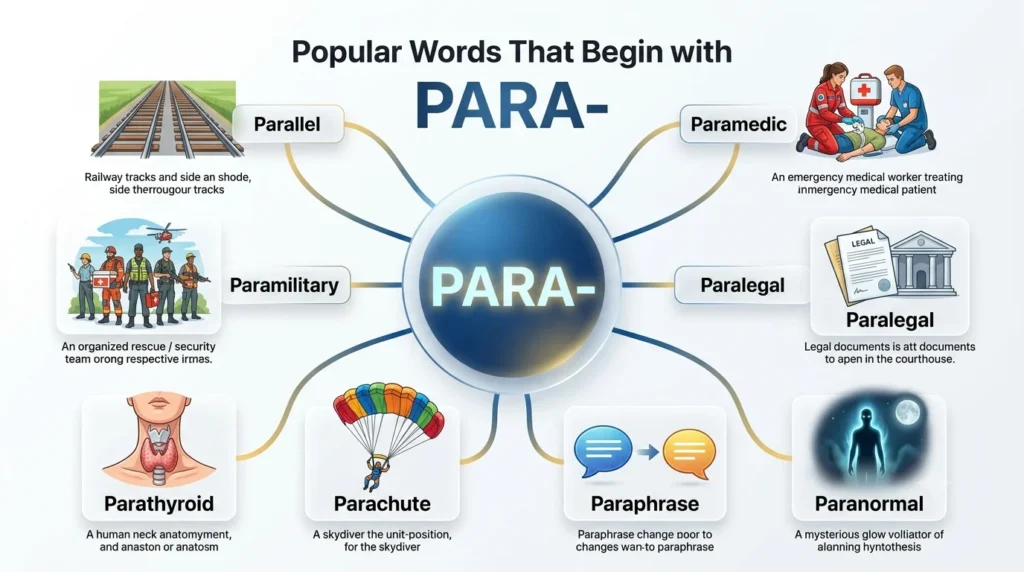
The prefix para- appears in hundreds of English words. Although their meanings vary, they all share the idea of being beside, alongside, related to, or beyond something.
Here are some of the most common examples.
| Word | Meaning |
|---|---|
| Parallel | Side by side without meeting |
| Paranormal | Beyond normal scientific explanation |
| Paralegal | A legal professional who assists lawyers |
| Paramedic | An emergency healthcare professional |
| Parathyroid | Glands beside the thyroid |
| Paraphrase | Expressing the same idea using different words |
| Parachute | A device used to slow descent from the air |
| Paramilitary | Organized similarly to a military force but not part of the official armed forces |
| Parapsychology | The study of paranormal phenomena |
| Paravertebral | Located beside the spine |
Learning these examples can help you recognize the meaning of unfamiliar words that start with para-.
Examples of Para in Real-Life Conversations
Seeing a word in context is often the easiest way to understand it. Here are examples from different situations.
Everyday English
Person A: What does parallel mean?
Person B: It describes two lines that stay side by side without crossing.
Medical
Nurse: The paramedic stabilized the patient before arriving at the hospital.
Doctor: That early treatment made a significant difference.
Pregnancy
Patient: My chart says G3P2. What does that mean?
Doctor: It means you’ve been pregnant three times, and two of those pregnancies reached fetal viability.
School
Parent: Who helps my child during reading sessions?
Teacher: Our paraeducator provides additional classroom support every day.
Spanish
Friend: What does “para ti” mean?
Teacher: It simply means “for you.”
Nigerian Pidgin
Friend: Why you dey para today?
Reply: Traffic made me late for work.
Meaning:
Why are you so upset today?
Military
Reporter: The paras completed the operation successfully.
Meaning:
The paratroopers completed the mission successfully.
These examples show why context matters. The same word can represent different ideas depending on where and how it is used.
Reluctant Meaning: The Tiny Detail Everyone Misses
How to Use Para Correctly
Since para has multiple meanings, the best way to use it correctly is to match it with the right context.
✔ Do
- Use para- as a prefix when forming established English words.
- Consider the subject before deciding what para means.
- Remember that medical, educational, Spanish, and pregnancy-related uses are different.
- Use complete terms such as paramedic, paralegal, or paranormal in formal writing.
✘ Don’t
- Assume para has the same meaning in every language.
- Confuse the English prefix with the Spanish preposition.
- Mix up para- and peri- in medical terminology.
- Use para as a standalone English word unless the context clearly supports it (such as military or educational settings).
Common Mistakes People Make
Because para has several meanings, misunderstandings are common. Here are the mistakes people make most often.
Mistake 1: Assuming There Is Only One Meaning
Many people think para always means “beside.”
In reality, its meaning depends entirely on context.
For example:
- In paranormal, it means beyond.
- In paralegal, it means assisting or working alongside.
- In Spanish, para means for or in order to.
Mistake 2: Confusing Para with Peri
These prefixes are related but not interchangeable.
✔ Parathyroid = beside the thyroid.
✔ Pericardium = around the heart.
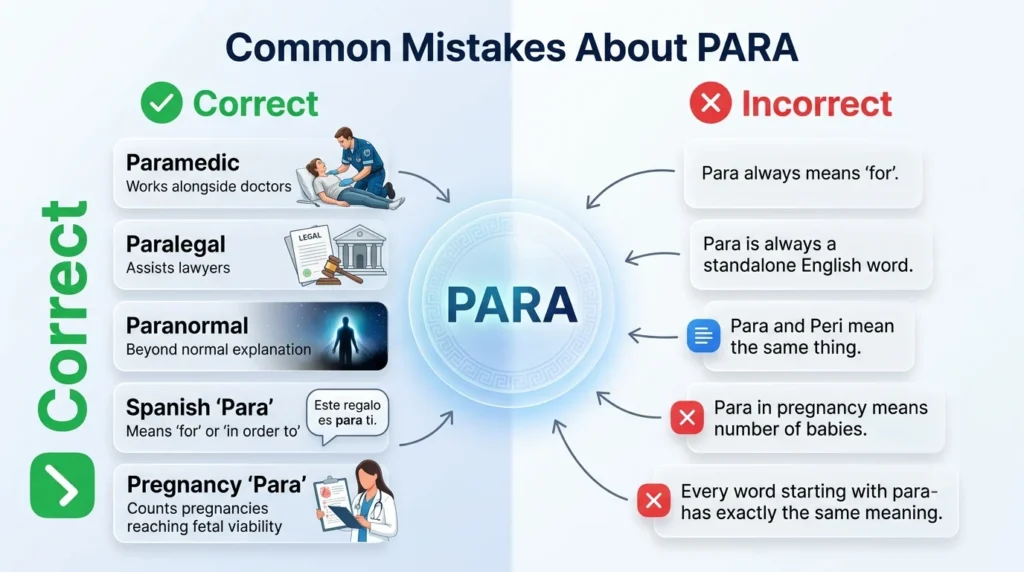
Mistake 3: Thinking Para Is Always a Prefix
Although it’s usually a prefix in English, para can also be:
- A Spanish preposition.
- A pregnancy abbreviation in obstetrics.
- Short for paraeducator.
- Military shorthand for paratrooper.
- Nigerian Pidgin slang meaning angry or upset.
Always look at the sentence before deciding what the word means.
Mistake 4: Confusing Gravida with Para
These medical terms are related but measure different things.
- Gravida counts the total number of pregnancies.
- Para counts pregnancies that reached fetal viability.
Healthcare professionals use both together to summarize pregnancy history accurately.
Key Takeaways
Before moving to the FAQs, here’s a quick recap.
- Para- is a Greek-derived prefix meaning beside, alongside, near, beyond, or related to, depending on the word.
- In English, it most commonly appears as a prefix rather than a standalone word.
- In medicine, it often describes location or relationship.
- In obstetrics, para records pregnancies that reached fetal viability.
- In Spanish, para usually means for, to, or in order to.
- In education, para often refers to a paraeducator or paraprofessional.
- In Nigerian Pidgin, para means angry or upset.
- In military contexts, para can be short for paratrooper.
Understanding the context is the simplest and most reliable way to determine the correct meaning of para.
Frequently Asked Questions
1. What is the meaning of para?
The meaning of para depends on the context. In English, it is usually a Greek-derived prefix meaning beside, alongside, near, beyond, or related to. In Spanish, para means “for” or “in order to.” In medicine, education, and pregnancy, it has specialized meanings.
2. What does the prefix para- mean?
The prefix para- comes from the Ancient Greek word παρά (pará). It commonly means beside, alongside, near, beyond, or related to. You’ll find it in words such as paramedic, paralegal, parallel, and paranormal.
3. What does para mean in medical terms?
In medical terminology, para- often means beside, near, or adjacent to. For example, the parathyroid glands are located beside the thyroid gland, while paravertebral muscles are positioned next to the spine. The exact meaning depends on the medical term.
4. What does para mean in pregnancy?
In obstetrics, para records the number of pregnancies that reached fetal viability, regardless of whether the baby was born alive or stillborn. It is commonly used with gravida to summarize a patient’s pregnancy history.
5. What is the difference between gravida and para?
Gravida counts the total number of pregnancies, including the current pregnancy. Para counts the number of pregnancies that progressed to fetal viability. Because twins are considered one pregnancy, para counts pregnancies—not babies.
6. What does para mean in Spanish?
In Spanish, para is a preposition that usually means for, to, by, or in order to. It expresses purpose, destination, or a deadline.
Example:
- Este regalo es para ti.
- This gift is for you.
7. What does “para ti” mean?
The Spanish phrase para ti simply means “for you.”
Example:
Esta carta es para ti.
This letter is for you.
8. What is a paraeducator or school para?
A paraeducator, often called a paraprofessional, is a trained education professional who works alongside licensed teachers to support students with instruction, classroom activities, and learning needs.
9. What is a SPED para?
A SPED para is a special education paraprofessional who assists students with disabilities under the supervision of a certified special education teacher. Their responsibilities vary depending on students’ individual learning plans.
10. What does para mean in Nigerian Pidgin?
In Nigerian Pidgin English, para is slang for being angry, upset, annoyed, or irritated.
Example:
Why you dey para?
Meaning:
Why are you angry?
11. Is para a word or a prefix?
Both. In English, para- is primarily used as a prefix, while in certain contexts, para can also function as a standalone word—for example, in Spanish, as military shorthand for paratrooper, or as an abbreviation for paraeducator.
12. What does para mean in paranormal?
In the word paranormal, the prefix para- means beyond or outside what is considered normal. Therefore, paranormal refers to events or experiences believed to exist beyond ordinary scientific explanation.
13. What does para mean in paramedic?
In paramedic, the prefix suggests working alongside medical professionals. A paramedic is a trained emergency healthcare provider who delivers immediate treatment before and during transport to a hospital.
14. What does para mean in paralegal?
In paralegal, para- indicates someone who works alongside lawyers. A paralegal assists with legal research, document preparation, case management, and administrative tasks but is not a licensed attorney.
15. What is the difference between para and peri?
Although both are Greek prefixes, they have different meanings.
- Para- = beside, alongside, near, or beyond.
- Peri- = around or surrounding.
For example:
- Parathyroid = beside the thyroid.
- Pericardium = the membrane surrounding the heart.
Conclusion
The meaning of para isn’t limited to a single definition—it changes with the context in which it’s used. In English, para- is a Greek-derived prefix that often means beside, alongside, near, beyond, or related to, giving rise to words like parallel, paramedic, paralegal, and paranormal. In other contexts, para can refer to a pregnancy record in obstetrics, a paraeducator in schools, the Spanish preposition meaning “for” or “in order to,” or even a slang term in Nigerian Pidgin.
The easiest way to understand para is to look at the sentence or subject it appears in. Once you recognize the context, its meaning becomes much clearer. Whether you’re expanding your English vocabulary, studying medical terminology, learning Spanish, or simply satisfying your curiosity, understanding para will help you interpret many everyday words with greater confidence.
Now that you know the different meanings of para, you’ll be able to recognize and use it accurately wherever you encounter it.

Ethan Cole is a content writer at Meanovia who explains internet slang, texting abbreviations, and social media language in a simple and reader-friendly way._)