
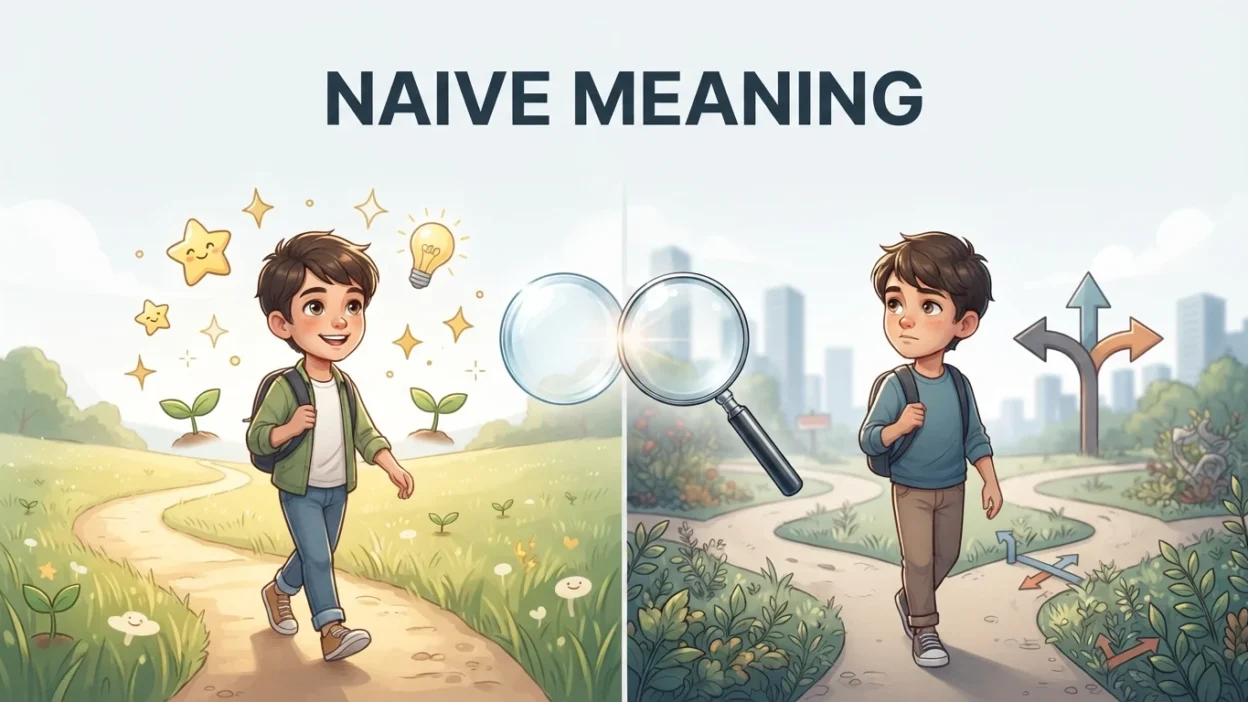
Have you ever trusted someone too quickly, believed a claim without questioning it, or expected a situation to be easier than it really was? The word naive describes this kind of lack of experience or practical understanding. In simple terms, naive means lacking experience, knowledge, or good judgment, especially when someone trusts people too easily or has an unrealistic view of a situation.
For example, “She was naive to believe the stranger’s promise” means she trusted the stranger because she did not recognize the possibility of being deceived. However, naive does not always mean foolish or gullible. It can also suggest innocence or a lack of worldly experience, depending on the context.
The word can describe a person, belief, assumption, idea, or approach. It may sound gentle when it highlights innocence, but it can sound critical when it suggests poor judgment or unrealistic expectations. Unlike innocent, which often relates to purity or lack of wrongdoing, naive focuses more on inexperience and limited understanding.
In this guide, you’ll learn the naive meaning, pronunciation, examples, synonyms, antonyms, origin, and how to use naive correctly in everyday English, school writing, professional communication, and different social situations.
What Does Naive Mean?
Naive is an adjective used to describe someone or something that shows a lack of experience, knowledge, sophistication, or practical judgment.
A naive person may trust people too easily, misunderstand a complicated situation, or make an unrealistic assumption because they have not experienced enough to recognize the possible problems.
For example:
- “I was naive to think the job would be easy.”
- “She was naive to believe everything the stranger told her.”
- “That is a naive assumption because it ignores several risks.”
The word can describe a person, belief, question, expectation, assumption, approach, or behavior.
Most importantly, naive does not automatically mean unintelligent. Someone can be very intelligent but still be naive about a subject they have never experienced.
Naive Meaning in Simple English
In simple English, naive means not having enough experience or knowledge to understand how complicated a situation can be.
A naive person may:
- Trust others very easily.
- Expect people to be completely honest.
- Have little real-world experience.
- Make assumptions without considering hidden problems.
- Believe something because they have not learned otherwise.
For example:
“He was naive to think everyone would keep their promises.”
This means he did not have enough experience to realize that some people might not keep their promises.
Is Naive a Positive or Negative Word?
The meaning of naive can be positive, neutral, or negative, depending on context and tone.
It can describe innocent or open-minded behavior:
“Her naive optimism was refreshing.”
It can also criticize unrealistic thinking:
“That is a naive plan because it ignores the cost.”
When used about a person, naive can sound judgmental, especially if the speaker means that the person should know better. Context therefore matters.
Naive Pronunciation and Spelling
Naive is commonly pronounced “nye-EVE” and can be written naive or naïve.
Both spellings are accepted in English. The version with the diaeresis, naïve, reflects the French spelling, while naive is very common in modern English.
Related forms include:
- Naively — in a naive way.
- Naivety — the quality of being naive.
- Naiveté — another spelling of naivety, influenced by French.
Example:
“She naively assumed that the offer was completely safe.”
Origin and Etymology of Naive
The word naive came into English through French naïf and naïve, which are connected to the Latin nativus, meaning “native” or “natural.”
The original idea was associated with being natural, simple, or unaffected. Over time, English developed the modern sense of someone who lacks worldly experience or practical knowledge.
Today, naive can describe both a person’s outlook and an idea or approach that fails to recognize important complications.
Naive Meaning in Urdu
The naive meaning in Urdu depends on the exact context.
Common explanations include:
- سادہ لوح — someone who is too trusting or unsophisticated.
- بھولا بھالا — innocent or simple in nature.
- نا تجربہ کار — inexperienced.
- سادہ — simple, when the context supports that meaning.
For example:
“He was naive enough to trust the stranger.”
This could be understood as saying that he was سادہ لوح or بھولا بھالا enough to trust the stranger.
There is no single Urdu word that perfectly replaces naive in every sentence. The intended meaning—innocence, inexperience, or excessive trust—determines the best translation.
Naive Meaning in Farsi
The naive meaning in Farsi can also change according to context.
Common equivalents include:
- سادهلوح — overly trusting or unsophisticated.
- بیتجربه — inexperienced.
- معصوم — innocent, when innocence is the intended meaning.
For example, someone who has little experience with the real world may be described as بیتجربه, while someone who trusts people too easily may be described as سادهلوح.
Naive vs. Innocent
Naive and innocent are related, but they are not exact synonyms.
Innocent often means free from guilt, wrongdoing, or harmful intentions. It can also describe someone who has little experience with unpleasant aspects of life.
Naive focuses more strongly on lack of experience, knowledge, or judgment.
Compare:
- “The child was innocent and had done nothing wrong.”
- “The child was naive to believe every promise.”
The first sentence concerns innocence. The second emphasizes limited experience and trust.
Naive vs. Gullible
Naive and gullible are often confused.
Naive suggests a lack of experience or practical understanding.
Gullible specifically means easily tricked or deceived.
For example:
“She was naive about investing.”
This means she lacked experience or knowledge about investing.
“She was gullible enough to believe the fake investment message.”
This specifically suggests that someone successfully deceived her.
A person can be naive without being gullible, and a gullible person may be gullible in one situation without being inexperienced in everything else.
Naive vs. Inexperienced
Inexperienced is usually more neutral than naive.
If someone has never managed a business, you can say:
“She is inexperienced in business management.”
Calling her naive adds another idea: she may have unrealistic expectations or misunderstand how complicated the situation is.
So, inexperienced simply describes a lack of experience, while naive can suggest that the lack of experience affects someone’s judgment.
Naive vs. Ignorant
Ignorant generally means lacking knowledge about a particular subject. It can sometimes sound insulting.
Naive usually suggests limited experience or an overly simple understanding rather than simply having no information.
For example:
“He was ignorant of the tax rules.”
This means he did not know the rules.
“He was naive to assume taxes would not affect the cost.”
This suggests that his assumption was unrealistic because he lacked practical understanding.
Naive Meaning in Texting
In texting, naive usually has the same basic meaning as in standard English, but the tone can become more casual or playful.
Example:
“You actually believed that story? You’re so naive 😂”
Between friends, this may be teasing rather than seriously insulting.
Another example:
“I was naive to think everything would go according to plan.”
Here, the speaker is using naive to describe their own lack of experience.
Naive Meaning on Social Media
On social media, people may use naive in captions, comments, posts, and discussions to describe innocence, unrealistic expectations, or trusting behavior.
Example:
“I was young and naive back then.”
Or:
“Naive but hopeful.”
The word can be used seriously, humorously, or self-deprecatingly. The surrounding words and tone determine the meaning.
What Is Naive Behavior?
Naive behavior is behavior that shows limited experience, unrealistic trust, or a failure to recognize possible complications.
Examples include:
- Giving personal information to a stranger without checking who they are.
- Believing every online claim immediately.
- Assuming every business deal is risk-free.
- Expecting everyone to behave honestly.
- Thinking a difficult task will require almost no preparation.
Naive behavior does not necessarily mean a person is foolish. It may simply show that they have not encountered that type of situation before.
Naive Meaning in Academic and Professional Writing
In academic and professional contexts, naive can be used more precisely.
For example:
“The researchers selected participants who were naive to the purpose of the experiment.”
Here, naive means the participants did not already know the purpose, which could help prevent certain forms of bias.
The word can also describe an assumption or approach:
“The proposal takes a naive view of the problem.”
This means the proposal may overlook important complexities.
In professional communication, it is usually better to explain why an assumption is naive rather than using the word as a personal criticism.
Naive Meaning in Biology
In biology, naive can have a specialized technical meaning.
For example, a naive immune cell generally refers to a cell that has not previously encountered the specific antigen associated with its later immune response.
This is completely different from calling a person naive in everyday conversation.
So when you see naive meaning in biology, remember that the word is describing a state of prior exposure or activation, not intelligence.
Immunologically Naive Meaning
Immunologically naive describes an immune cell that has not yet encountered its specific antigen.
In this context, naive essentially means not previously exposed or activated in the relevant immune response.
The phrase is technical and should not be interpreted as meaning “innocent” or “easily fooled.”
Drug-Naive, Opioid-Naive, and Opiate-Naive Meaning
In medical and clinical contexts, drug-naive can describe someone who has not previously received or been exposed to a particular drug or treatment.
Similarly, opioid-naive generally refers to someone without previous opioid exposure or tolerance, while opiate-naive is used in contexts involving opiates.
You may also encounter narcotic-naive in older or broader terminology.
These are specialized medical uses. Here, naive does not mean gullible, childish, or unintelligent. It refers to lack of previous exposure.
Treatment-Naive and Medication-Naive Meaning
Treatment-naive generally describes a person who has not previously received a particular treatment.
Medication-naive can similarly describe someone without previous experience or exposure to a particular medication.
For example:
“The study included treatment-naive patients.”
The phrase describes previous treatment history rather than personality.
Because these terms can appear in medical contexts, they should be interpreted according to the surrounding clinical information.
Sexually Naive Meaning
Sexually naive generally describes someone who has little or no sexual experience or limited knowledge about sexual matters.
The phrase does not automatically mean that the person is unintelligent. It describes a particular area of experience or knowledge.
For example:
“He was sexually naive and had many questions about relationships.”
The exact meaning depends on the context, so it is better not to assume anything beyond what the phrase actually communicates.
Young and Naive Meaning
The phrase young and naive usually describes someone who is young and has limited life experience.
For example:
“When I was young and naive, I believed success would happen overnight.”
The phrase often suggests that experience has changed the person’s understanding over time.
It does not necessarily mean the person was unintelligent. It usually emphasizes what they had not yet learned.
Being Naive Meaning
Being naive means having an outlook or behavior that shows limited experience, practical knowledge, or awareness of how complicated a situation can be.
For example:
“Being naive about business made him underestimate the risks.”
Being naive is not necessarily permanent. People often become more experienced and aware after learning from mistakes or encountering new situations.
Neti Meaning: What Does Neti Mean in Yoga? Definition & Uses
Not Naive Meaning
Not naive generally means being experienced, realistic, cautious, or aware of possible complications.
For example:
“She is not naive about online scams.”
This means she understands that scams exist and knows to be careful.
Someone can also be experienced in one area but naive in another. Experience is usually context-specific.
Naive Meaning Examples
Here are several natural examples:
- “I was naive to believe the offer was completely free.”
- “She is young and naive, but she learns quickly.”
- “It was naive of him to trust an unknown seller.”
- “His naive question helped everyone understand the issue.”
- “The plan sounds naive because it ignores the budget.”
- “I used to be naive about how difficult starting a business could be.”
- “Her naive optimism made the situation feel less stressful.”
- “The participants were naive to the study’s purpose.”
- “He was naive about online privacy.”
- “The researcher studied naive immune cells.”
Naive Meaning Synonyms
The best naive meaning synonyms depend on the context:
| Synonym | Best used when you mean |
|---|---|
| Innocent | Free from wrongdoing or inexperienced with certain realities |
| Inexperienced | Lacking practical experience |
| Gullible | Easily tricked or deceived |
| Trusting | Too willing to believe others |
| Unsuspecting | Unaware of possible danger or deception |
| Unsophisticated | Lacking worldly knowledge or refinement |
| Unworldly | Having little knowledge of real-world matters |
| Green | Informally inexperienced |
| Childlike | Innocent, open, or trusting |
| Unseasoned | Lacking experience, especially in a particular activity |
These words overlap with naive, but they are not interchangeable in every sentence.
Is Naive a Rude Word?
Naive is not automatically rude. However, it can sound critical when used directly about someone’s intelligence or judgment.
For example:
“That was a naive assumption.”
This criticizes the assumption.
But:
“You’re naive.”
can feel more personal.
If you want to sound respectful, explain the specific problem:
“That assumption may overlook some practical risks.”
This communicates the same concern more constructively.
Common Mistakes With Naive
Naive does not mean stupid
A person can be intelligent and still be naive about an unfamiliar subject.
Naive does not always mean gullible
Gullible specifically focuses on being easily deceived, while naive can simply mean inexperienced.
Naive is not always negative
It can describe innocence, openness, or hopeful simplicity.
Naive is not slang
It is a standard English adjective used in everyday, academic, professional, scientific, and literary contexts.
Context changes the meaning
A naive person, naive assumption, naive participant, and naive immune cell can all involve different shades of meaning.
ISTG Meaning: What Does ISTG Mean in Text & Social Media?
FAQs About Naive
What is naive in a person?
A naive person lacks experience, practical knowledge, or judgment in a particular situation and may therefore trust others too easily or expect things to be simpler than they are.
What is the synonym of naive?
Common synonyms include innocent, inexperienced, trusting, gullible, unsophisticated, unsuspecting, and unworldly, although each has a slightly different meaning.
What is naive behavior?
Naive behavior shows limited experience or unrealistic trust, such as believing an unknown person’s claims without checking them.
Is naive a rude word?
It can be, depending on tone. It may sound harmless when describing innocence but critical when used to judge someone’s decisions.
What does naive mean in texting?
In texting, naive usually means innocent, inexperienced, or too trusting. Friends may use it playfully or teasingly.
What does naive mean in English?
Naive means lacking experience, knowledge, sophistication, or practical judgment, often with a sense of innocence or excessive trust.
What does naive mean in Urdu?
Depending on context, naive can mean سادہ لوح, بھولا بھالا, or نا تجربہ کار.
What does naive mean in Farsi?
Depending on context, naive can be expressed as سادهلوح, بیتجربه, or another term that conveys innocence or lack of experience.
What does sexually naive mean?
It generally describes someone with little or no sexual experience or limited knowledge about sexual matters.
What does naive mean in biology?
In biology, naive can describe a cell or organism that has not previously encountered a particular stimulus or condition. In immunology, it commonly refers to immune cells that have not yet encountered their specific antigen.
What does treatment-naive mean?
Treatment-naive generally means that a person has not previously received a particular treatment.
What does opioid-naive mean?
Opioid-naive generally describes someone without previous opioid exposure or tolerance in a medical context.
What does not naive mean?
Not naive usually means experienced, realistic, cautious, or aware of possible complications.
Final Takeaway
The naive meaning is broader than simply “too trusting.” In everyday English, it usually describes a person, belief, expectation, or behavior that shows limited experience, knowledge, or practical judgment.
It can suggest innocence or openness, but it can also describe an unrealistic assumption. In specialist contexts, such as biology, immunology, medicine, drug-naive, treatment-naive, and medication-naive, the word can have a more technical meaning related to previous exposure or experience.
The easiest way to remember it is:
Naive = lacking experience or practical knowledge, often in a way that leads to innocence, simple assumptions, or excessive trust.
Once you understand the context, you can use naive naturally in conversation, texting, academic writing, professional communication, and specialized English.

Nora Ellison is a digital language writer specializing in emoji meanings, internet slang, symbols, and online communication, creating clear, accurate, and reader-friendly content.