
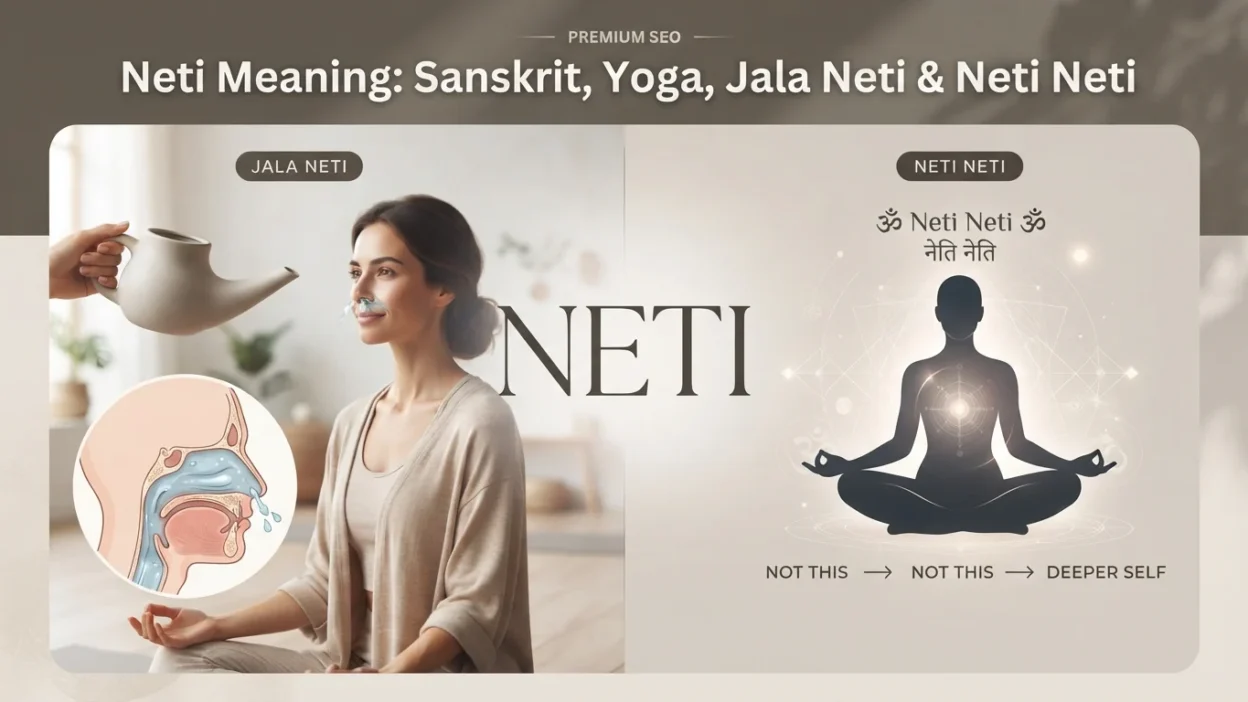
Have you heard the word Neti and wondered what it means? In the context of yoga, Neti is a traditional nasal-cleansing practice used to clean the nasal passages. The best-known form is Jala Neti, which uses water, while another traditional form is Sutra Neti, which uses a thread or thin tube.
The word can become confusing because “neti-neti” is a separate Sanskrit expression used in Indian philosophy. It is commonly translated as “not this, not this” or “neither this nor that” and is associated particularly with Jnana Yoga and Advaita Vedanta.
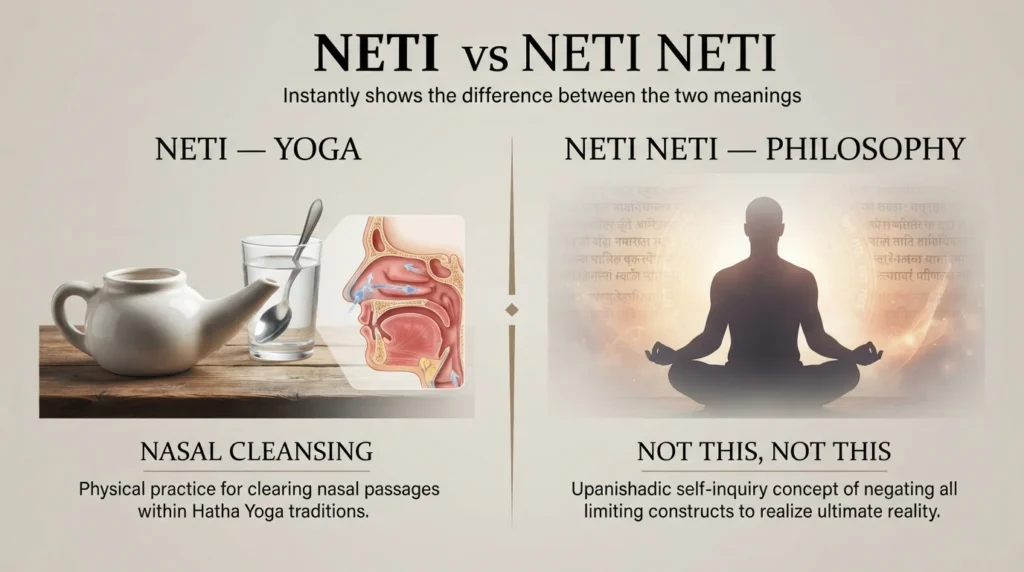
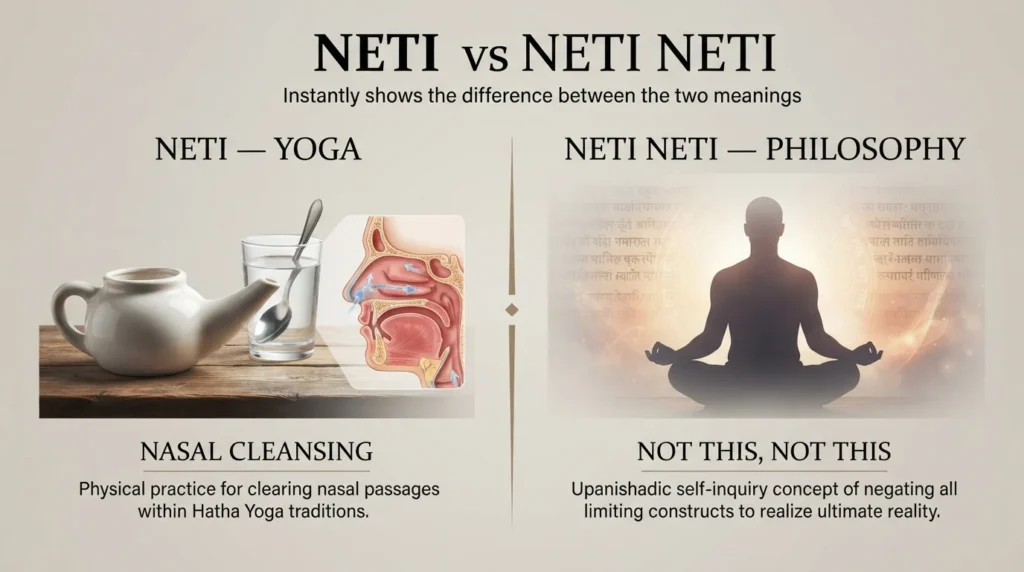
So, the Neti meaning depends on the context. In yoga, Neti usually refers to a nasal-cleansing technique; in the phrase “neti-neti,” it refers to a philosophical method of negation. Understanding this distinction helps prevent two different uses of the word from being mixed together.
In this guide, you’ll learn the Neti meaning, its Sanskrit background, what Neti means in yoga, the difference between Jala Neti and Sutra Neti, what neti-neti means, and how the term is used in different contexts.
What Does Neti Mean?
Neti is a traditional yogic cleansing practice associated with cleansing the nasal passages. Two commonly described forms are jala neti, which uses water, and sutra neti, which uses a thread or similar material.

However, neti neti has a different meaning. In Sanskrit philosophy, it is commonly translated as “not this, not this” and is associated with Upanishadic and Vedantic inquiry.
So:
- Neti = a yogic nasal-cleansing practice
- Jala neti = water-based neti
- Sutra neti = thread-based traditional neti
- Neti neti = “not this, not this”
Neti Meaning in English
The simplest neti meaning in English is a traditional nasal-cleansing practice in yoga.
The word commonly appears when people discuss traditional Hatha yoga cleansing practices, nasal hygiene, or a neti pot. In the most familiar modern form, jala neti uses a saline solution to rinse the nasal passages.
But there is an important distinction. If you encountered neti neti, the word is being used in a philosophical context rather than referring to nasal cleansing.
For example:
“She learned jala neti in her yoga class.”
Here, neti refers to nasal cleansing.
But:
“The teacher explained neti neti as ‘not this, not this.’”
Here, neti neti refers to philosophical inquiry.
Context is therefore the easiest way to identify the intended meaning.
Neti Meaning in Sanskrit
When people search for neti meaning in Sanskrit, they may actually be asking about two different uses.
In yoga, neti is the name of a traditional cleansing practice. In philosophical Sanskrit, neti neti is an expression generally understood as a negating formula meaning “not this, not this” or “not this, not that.” The phrase is associated with the Upanishads, particularly the Brihadaranyaka Upanishad.
The philosophical expression is commonly explained as a form of inquiry: rather than defining ultimate reality through a limited description, it points away from things that can be identified as objects or concepts.
That is why searching simply for “neti” can produce apparently unrelated results. Neti in yoga and neti neti in Vedanta belong to different contexts.
What Is Neti in Yoga?
In yoga, neti is traditionally described as a cleansing practice for the nasal passages. It is included among the cleansing practices known as shatkarma or shatkriya in Hatha yoga traditions.
The two commonly discussed forms are:
- Jala Neti — water-based nasal cleansing
- Sutra Neti — a traditional thread-based technique
Jala neti is the form most people are likely to encounter today because of the popularity of the neti pot and modern nasal irrigation.
Sutra neti is considerably more specialized. Traditional descriptions involve passing a thread or similar material through the nasal passage, so it should not be treated as a simple DIY technique.
What Are the Two Types of Neti?
The commonly described two types of neti are Jala Neti and Sutra Neti.
| Type | Meaning | Basic idea |
|---|---|---|
| Jala Neti | Water neti | Uses saline water to rinse the nasal passages |
| Sutra Neti | Thread neti | Uses a thread or similar material in a traditional cleansing technique |
The terms themselves are helpful: jala means water, while sutra means thread.
What Is Jala Neti?

Jala neti is the water-based form of neti. It is traditionally performed with a saline solution and is commonly associated with a neti pot.
During nasal irrigation, the saline solution passes through the nasal passages and exits through the other nostril. Modern nasal irrigation is also used outside traditional yoga for symptoms such as nasal congestion and irritation.
If you searched for jala neti meaning or jal neti meaning, these terms generally refer to the same water-based practice.
The spelling jal neti is common in English searches, while jala neti more closely reflects the Sanskrit-derived form used in many yoga resources.
What Is a Neti Pot?
A neti pot is a small container designed to deliver saline solution through the nasal passages. It is commonly associated with jala neti.
A neti pot is not the same thing as the broader concept of neti. Think of it this way:
Neti = the practice
Jala neti = the water-based form
Neti pot = one tool used for that form
That simple distinction can prevent a lot of confusion.
Neti Benefits: What Are They?
Searches for neti benefits usually refer to the possible benefits of nasal cleansing or nasal irrigation.
When properly performed, saline nasal irrigation can help wash away mucus, allergens, and other irritants from the nasal passages. It may provide relief from congestion for some people.
Traditional yoga sources may describe neti in broader terms, including its role in preparing for breathing practices. However, traditional claims should not automatically be treated as medically proven outcomes.
A useful way to understand the benefits is:
- It can help rinse the nasal passages.
- Saline irrigation may loosen and remove mucus.
- It may help some people with nasal congestion.
- It can be used as part of some traditional yoga practices.
- It may make nasal breathing feel clearer for some users.
Avoid claims that neti cures every sinus problem, permanently prevents disease, improves eyesight, or guarantees spiritual benefits. Such statements go beyond what a responsible meaning article needs to claim.
Inshallah Meaning: “God Willing” and When to Say It
Jala Neti Safety
Safety is an essential part of explaining jala neti.
The most important point is water quality. Nasal irrigation should not be performed with untreated tap water. Guidance on nasal irrigation recommends using distilled or sterile water, or appropriately boiled and cooled water, because contaminated water can introduce harmful organisms into the nasal passages.
The equipment should also be cleaned and maintained properly.
If nasal irrigation causes significant pain, bleeding, worsening symptoms, or other unusual reactions, stop using it and seek appropriate medical advice.
This is especially important because a search for neti benefits should not leave readers with the impression that a traditional practice is automatically risk-free.
What Is Sutra Neti?
Sutra neti is the traditional thread-based form of neti.
Unlike jala neti, it does not use a neti pot and saline water as its defining feature. Traditional descriptions involve guiding a thread or similar flexible material through the nasal passage.
Because this technique involves sensitive tissue, it should not be improvised from an online article. People interested in learning it should seek appropriate instruction from a qualified teacher experienced with the practice.
For most readers searching for neti meaning, simply knowing that sutra neti is the thread-based form is enough.
What Does Neti Neti Mean?
Neti neti is different from the nasal-cleansing practice.
The neti neti meaning is commonly given as “not this, not this,” “not this, not that,” or “neither this nor that.” It is a Sanskrit expression associated with the Upanishadic philosophical tradition.
The expression is particularly associated with the Brihadaranyaka Upanishad. In its philosophical context, neti neti is connected with inquiry into the nature of the Self and ultimate reality.
The basic idea can be simplified like this:
If something can be observed, named, or treated as an object of thought, the neti neti approach asks whether that thing can truly be identified as the ultimate Self.
So the phrase works through negation and discrimination rather than through a simple positive definition.
Neti Neti Meaning in English
The most familiar neti neti meaning in English is:
“Not this, not this.”
You may also see:
- “Not this, not that”
- “Neither this nor that”
- “Not so, not so”
These are different English renderings used to communicate the general philosophical sense of the Sanskrit expression.
Neti Neti Meaning in Hindi
For readers searching for neti neti meaning in Hindi, the phrase is commonly explained as:
“यह नहीं, यह नहीं” or “न यह, न वह”.
The underlying idea remains the same: a process of understanding through negation rather than attaching the ultimate Self to a limited object, quality, or description.
Neti Neti Meditation
Neti neti meditation refers to contemplative use of this philosophical approach.
Rather than simply repeating “neti neti” as a conventional mantra, practitioners may use the idea as a form of self-inquiry. A thought, emotion, physical sensation, or temporary identity can be observed and questioned rather than automatically treated as the complete Self.
For example:
“I am experiencing this thought, but is this thought the whole of who I am?”
The purpose is not to deny that thoughts, feelings, or the body exist. Instead, the traditional inquiry asks what can legitimately be identified as the deeper Self.
Modern teachers explain this practice in different ways, so it is better to describe neti neti as a philosophical method of inquiry rather than claim that there is one universally prescribed meditation routine.
Neti Meaning vs. Neti Neti Meaning
This is the most important distinction on the page:
| Search term | Meaning | Context |
|---|---|---|
| Neti | Traditional nasal-cleansing practice | Yoga |
| Neti kriya | Yogic cleansing practice involving neti | Hatha yoga |
| Jala neti | Water-based nasal cleansing | Yoga / nasal irrigation |
| Jal neti | Common spelling variant of jala neti | Yoga |
| Sutra neti | Traditional thread-based neti | Yoga |
| Neti pot | Device commonly used for jala neti | Nasal irrigation |
| Neti neti | “Not this, not this” | Sanskrit philosophy |
| Neti neti meditation | Contemplative self-inquiry using neti neti | Vedanta / meditation |
This comparison is especially useful because someone searching neti meaning may be looking for either the yoga practice or the philosophical phrase.
Is Neti a Slang Word?
The earlier version of this article treated neti meaning slang as though “neti” were a standard online slang word for “nah” or “nope.” That was too strong and should not be presented as the primary definition.
There is no reliable basis for describing that slang interpretation as the standard meaning of neti.
If you saw neti in a specific chat, game, college group, social-media comment, or online community, it could potentially be a username, abbreviation, typo, local expression, or community-specific term. In that situation, the surrounding sentence is necessary to determine the intended meaning.
For general English, yoga, and Sanskrit searches, the established meanings discussed above are much more relevant.
Neti Examples in Context
Yoga example:
“Her yoga teacher introduced the class to jala neti.”
Nasal-irrigation example:
“He researched how to use a neti pot safely.”
Traditional yoga example:
“Neti is described as one of the cleansing practices in Hatha yoga.”
Philosophy example:
“The teacher used neti neti to explain a method of self-inquiry.”
Meditation example:
“Neti neti meditation focuses on questioning temporary identifications.”
These examples show why context matters when translating or defining the word.
ISTG Meaning: What Does ISTG Mean in Text & Social Media?
Common Mistakes About Neti
1. Confusing neti with neti neti
They are not automatically the same term. One commonly refers to a yogic cleansing practice; the repeated phrase has a philosophical meaning.
2. Assuming jala neti means every type of neti
Jala neti specifically identifies the water-based form.
3. Treating sutra neti as a beginner DIY technique
Traditional sutra neti involves the nasal passage and should not be improvised.
4. Using unsafe water
Untreated tap water should not be used for nasal irrigation. Appropriate water safety is essential.
5. Calling neti standard internet slang
A context-specific online use does not establish a universal slang definition.
6. Treating traditional claims as medical facts
Traditional yoga descriptions and modern medical evidence are different types of information and should be presented separately.
Frequently Asked Questions
What does neti mean?
Neti commonly refers to a traditional yogic nasal-cleansing practice. In neti neti, however, it forms part of a Sanskrit philosophical expression meaning “not this, not this.”
What is neti called in English?
In yoga, neti can be described as nasal cleansing or a nasal-cleansing practice. Jala neti is commonly described as saline nasal irrigation.
What are the two types of neti?
The two commonly described forms are jala neti and sutra neti. Jala neti uses water, while sutra neti traditionally uses a thread or similar material.
What is neti meaning in Sanskrit?
In yoga, neti is the name of a traditional cleansing practice. In the phrase neti neti, it is commonly translated as “not this” or “not so,” depending on the translation and context.
What is jala neti?
Jala neti is the water-based form of neti that uses a saline solution to rinse the nasal passages.
What does neti neti mean?
Neti neti is commonly translated as “not this, not this.” It is a Sanskrit philosophical expression associated with Upanishadic and Vedantic inquiry.
Is neti the same as a neti pot?
No. Neti refers to the practice, while a neti pot is a device commonly used for jala neti.
What does nethi mean?
Nethi may appear as a spelling variant or transliteration of neti. The exact intended meaning depends on the context in which it appears.
Final Answer
The meaning of neti depends on context. In yoga, neti is a traditional nasal-cleansing practice, while jala neti is its water-based form and sutra neti is the traditional thread-based form. A neti pot is commonly used for jala neti.
The phrase neti neti is different. It is a Sanskrit philosophical expression commonly translated as “not this, not this” and is associated with Upanishadic and Vedantic self-inquiry.
So if you see neti pot, jala neti, saline, or neti kriya, the topic is probably yoga or nasal cleansing. If you see neti neti, Atman, Brahman, Vedanta, or self-inquiry, the topic is philosophical.
That context-based distinction gives you the clearest neti meaning in English and Sanskrit without confusing two very different uses of the same term.

Lucas Hayes is a content writer at Meanovia, specializing in slang, texting meanings, and internet phrases. He creates simple, clear, and engaging explanations of modern digital language 💬✨