Why is everyone suddenly saying “be chalant” on TikTok? If you’ve seen “chalant” in a comment, text message, meme, or dating conversation and wondered whether it’s a real English word, you’re not alone. Chalant (pronounced SHAH-luhnt) is a nonstandard internet slang term that became popular as the playful opposite of nonchalant.
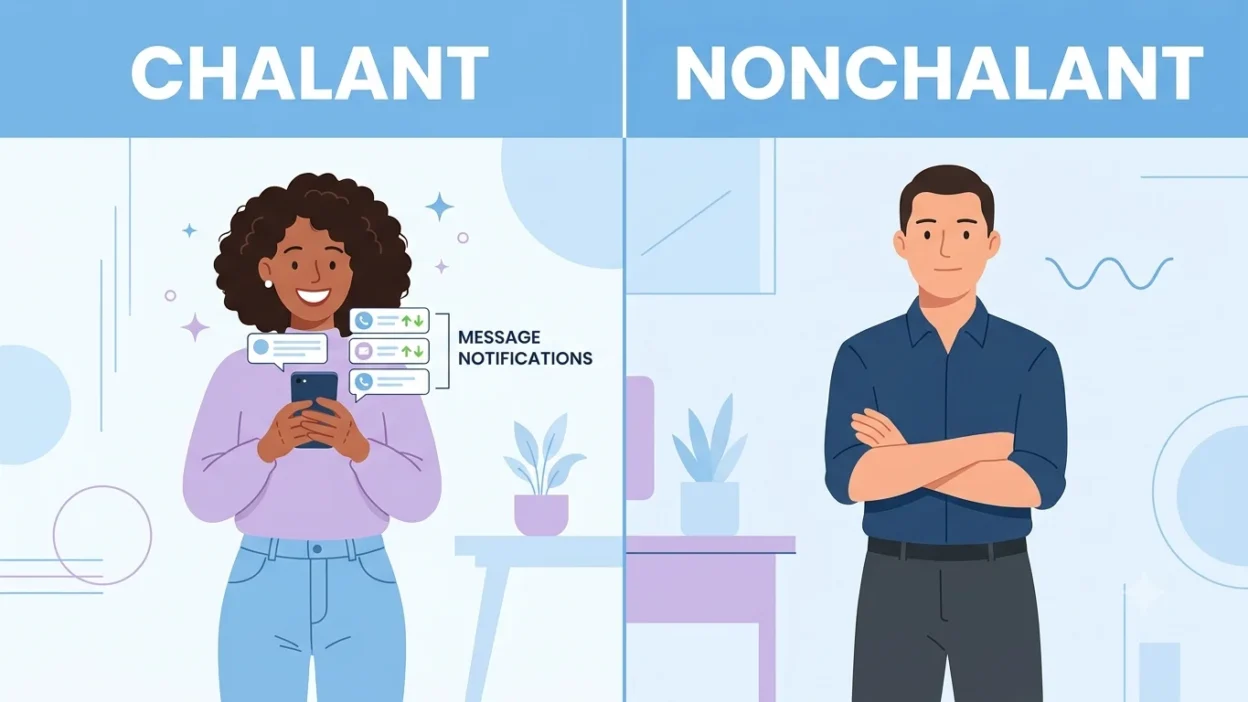
While nonchalant describes someone who appears calm, detached, or emotionally unaffected, chalant is used to describe a person who is openly interested, emotionally expressive, enthusiastic, or genuinely invested in someone or something.
Although many major dictionaries do not recognize chalant as standard English, the word has gone viral across TikTok, Instagram, Snapchat, X, memes, and Gen Z culture, where people use it humorously to encourage authenticity instead of pretending not to care.
In simple terms, chalant means showing genuine interest, excitement, or emotion instead of acting cool, distant, or indifferent. This guide explains its meaning, pronunciation, origin, why it became popular, how it differs from nonchalant, real-life examples, and when it’s appropriate to use chalant in modern online conversations.
💡 Quick Facts About Chalant
| Feature | Details |
|---|---|
| Meaning | Showing interest, concern, or emotional involvement |
| Pronunciation | shuh-LAHNT |
| IPA | /ʃəˈlɑːnt/ |
| Part of Speech | Informal adjective |
| Opposite Of | Nonchalant (informally) |
| Origin | Modern back-formation inspired by nonchalant |
| Common Usage | Social media, texting, memes, casual conversation |
| Formal Writing | Not recommended |
| Popular Among | Gen Z, internet users, online communities |
What Does Chalant Mean?
If someone describes a person as chalant, they usually mean that the person is openly showing interest, concern, excitement, or emotional involvement instead of acting calm or indifferent.
In today’s online conversations, chalant is widely understood as the playful opposite of nonchalant. Rather than pretending not to care, a chalant person openly expresses their feelings, pays attention, or reacts enthusiastically.
Quick Definition
Chalant (informal adjective): Someone who openly cares, pays attention, or shows emotional involvement, often used humorously as the opposite of nonchalant.
Although the word is common in memes and social media, it’s generally considered informal and non-standard, making it better suited for casual conversations than formal writing.
Simple Examples
- “I kept checking my phone all evening—I was definitely chalant.”
- “She’s acting so chalant about the concert tickets.”
- “You’re trying to look cool, but you’re obviously chalant.”
In each example, chalant suggests that someone clearly cares about the situation instead of hiding their emotions.
Chalant Definition
Because chalant developed through modern internet culture, its meaning comes primarily from how people use it rather than from a long history in standard dictionaries.
Chalant Definition (Simple English)
Chalant means:
- Showing interest
- Paying attention
- Caring about something
- Being emotionally invested
- Reacting openly instead of acting indifferent
One-Line Definition
Chalant describes someone who openly shows care, attention, or enthusiasm instead of appearing unconcerned.
Chalant Meaning in English
The closest standard English words include:
- Concerned
- Attentive
- Interested
- Engaged
- Enthusiastic
- Emotionally invested
- Responsive
These words are appropriate in professional or academic writing, whereas chalant is mainly used in informal online communication.
Is Chalant a Real Word?
This is by far one of the most common questions people ask.
Short Answer
Yes—people genuinely use the word chalant. However, it is generally regarded as a non-standard or informal word rather than a fully established standard English adjective.
That’s why you’ll frequently encounter it on:
- TikTok
- X (formerly Twitter)
- Discord
- Text messages
- Group chats
- Meme pages
Yet you probably won’t see it in school textbooks, legal documents, or professional writing.
The key point is that real usage and standard dictionary status are not always the same thing. Many expressions become popular in everyday speech long before they gain widespread recognition in formal reference works.
Does Chalant Exist?
Another popular search is:
Does chalant exist?
The answer depends on what you mean by “exist.”
If you mean…
Do people actually say it?
Yes.
Millions of people have used chalant online over the past several years, especially in memes, captions, and casual conversations.
Is it understood by English speakers?
Again, yes—particularly among people who spend time on social media or follow internet culture.
Is it considered standard English everywhere?
Not generally. It’s best viewed as an informal internet expression that has become widely recognized through usage.
This distinction explains why so many people search for the word in the first place.
Is Chalant in the Dictionary?
People often ask whether chalant appears in dictionaries because they notice it online but can’t always find it in traditional reference books.
The answer isn’t as simple as “yes” or “no.”
Some modern dictionaries and language resources discuss chalant because of its growing popularity and widespread internet use, while others do not list it as a standard headword. Dictionary coverage also changes over time as language evolves.
For that reason, it’s more accurate to say:
Chalant is widely used and widely understood, but it is generally treated as an informal, non-standard expression rather than a fully established dictionary adjective.
This balanced explanation reflects how modern language develops and avoids oversimplifying the issue.
Why Isn’t Chalant a Standard English Word?
At first glance, chalant seems like it should naturally exist.
After all, if we have:
- happy → unhappy
- fair → unfair
- likely → unlikely
Then why not:
- chalant → nonchalant?
The answer lies in the history of the English language.
English borrowed nonchalant directly from French as a complete word. It didn’t first have an English adjective called chalant and then add the prefix non- later.
Because of that, nonchalant entered English on its own, while chalant never became an established standard counterpart.
Centuries later, internet users playfully “recreated” chalant by removing the non- prefix. The joke caught on because it felt logical, memorable, and easy to understand.
Chalant Pronunciation
If you’ve only seen the word written online, you might be unsure how to say it.
IPA
/ʃəˈlɑːnt/
Easy Pronunciation
shuh-LAHNT
The pronunciation mirrors the second half of nonchalant.
Think of it like this:
nonchalant → chalant
Pronunciation Tip
Say the word nonchalant, then simply remove the “non-“ at the beginning. The remaining sound gives you the most common pronunciation of chalant.
Origin of Chalant
To understand chalant, it’s helpful to first understand nonchalant.
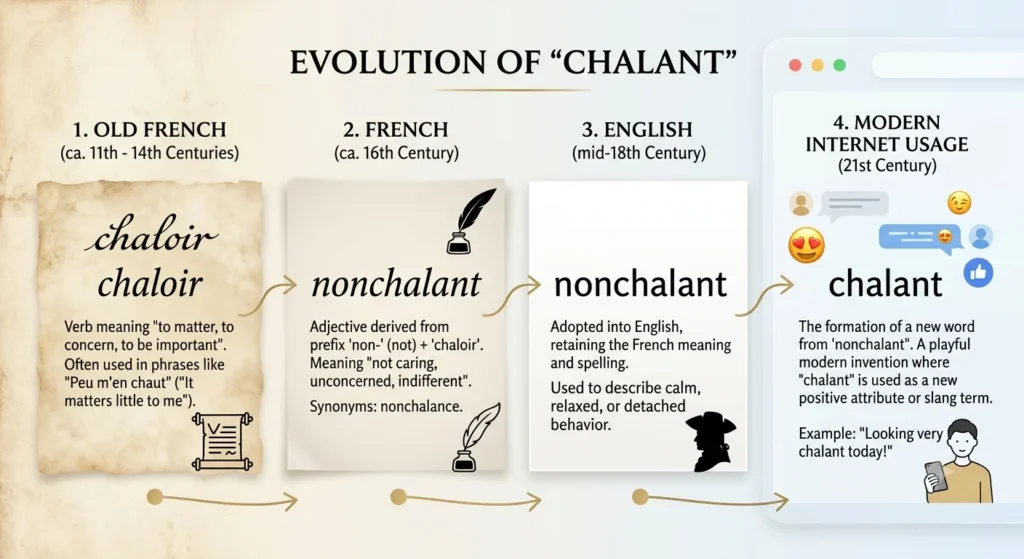
The English word nonchalant comes from French. It ultimately traces back to the Old French verb chaloir, which meant “to concern” or “to matter.” Over time, French developed the adjective nonchalant, meaning someone who appeared unconcerned or emotionally detached.
English later borrowed nonchalant directly from French as a complete word. Because of that, English never developed a standard adjective called chalant first.
Centuries later, internet users noticed that removing the prefix non- from nonchalant produced a word that sounded perfectly logical. They began using chalant humorously to describe someone who obviously does care.
Although chalant is now widely recognized online, it grew through everyday usage rather than traditional dictionary development.
Timeline of the Word
| Period | Development |
|---|---|
| Old French | Chaloir meant “to concern” or “to matter.” |
| French | Nonchalant developed to describe someone unconcerned. |
| English | English borrowed nonchalant directly from French. |
| Internet Era | Online users playfully created chalant as its opposite. |
Why Did Chalant Become So Popular?
The popularity of chalant isn’t an accident. It reflects the way people communicate online today.
Modern social media encourages short, clever, and memorable expressions. Instead of saying:
“I’m emotionally invested.”
People simply write:
“I’m so chalant.”
The word is funny because it feels like it should have existed all along.
That small joke makes it easy to remember, easy to share, and easy to understand.
1. Internet Humor
Social media thrives on playful language.
Words that sound believable—but aren’t traditionally standard—often become viral because they’re unexpected.
Chalant fits that pattern perfectly.
Examples include:
- “Stop acting nonchalant.”
- “You’re way too chalant.”
- “I’m trying to be chill but I’m so chalant.”
These phrases spread naturally through memes, comments, and videos.
2. Gen Z Enjoys Creative Language
Gen Z frequently reshapes language to make conversations more expressive.
Instead of creating entirely new words, they often remix existing ones.
Examples include:
- Delulu
- Situationship
- Unalive
- Rizz
- Chalant
Each became popular because speakers instantly understood the intended meaning.
3. It Solves a Language Gap
English has many words meaning concerned, but none feels like a perfect mirror image of nonchalant.
That’s why chalant resonates with so many people.
It’s short.
It’s memorable.
And everyone immediately understands the contrast.
Why Do People Pretend to Be Nonchalant?
This is one of the most interesting reasons chalant became popular.
Many people don’t actually feel nonchalant—they simply want to appear that way.
Psychologists often describe this as a form of impression management: people try to control how others see them. Acting calm, confident, or unaffected can sometimes feel socially safer than showing excitement or vulnerability.
Think about these situations:
- Waiting for someone to text back.
- Going on a first date.
- Attending a job interview.
- Posting on social media.
- Applying to university.
- Watching exam results.
Most people genuinely care.
But they often try to hide those feelings.
That’s why you’ll hear jokes like:
“Trying to act nonchalant.”
or
“I’m pretending to be nonchalant.”
The humor comes from the obvious mismatch between how someone feels and how they’re trying to appear.
Why “Chalant” Feels So Relatable
One reason the word spread so quickly is that it describes a very common experience.
Many of us have said things like:
- “I don’t care.”
while secretly refreshing our phone every few minutes.
Or:
- “It’s no big deal.”
while feeling nervous inside.
Calling yourself chalant is a playful way of admitting:
“I actually care more than I’m pretending.”
That’s why the word feels authentic to so many internet users.
Chalant vs Nonchalant
Although the two words are closely connected, they describe very different attitudes.
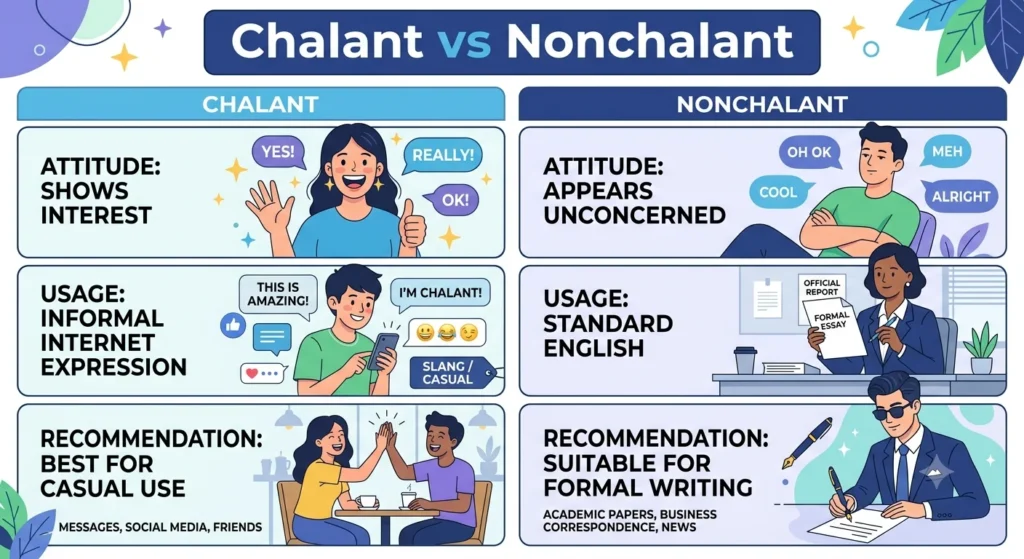
| Chalant | Nonchalant |
|---|---|
| Shows interest | Appears unconcerned |
| Emotionally expressive | Emotionally restrained |
| Informal internet expression | Standard English adjective |
| Popular in memes and texting | Used in everyday formal and informal English |
| Suggests visible enthusiasm | Suggests calm detachment |
Example
Nonchalant
“She stayed nonchalant even after hearing the good news.”
Chalant
“He was obviously chalant—he couldn’t stop smiling.”
Is Chalant Really the Opposite of Nonchalant?
In internet slang, yes.
People commonly use chalant as the opposite of nonchalant.
In formal English, however, better opposites include:
- Concerned
- Interested
- Attentive
- Engaged
- Enthusiastic
- Invested
- Responsive
These are the words you should choose in academic or professional writing.
Can a Word Become Real Through Usage?
Language isn’t fixed—it changes constantly.
Many everyday English words started as slang, informal expressions, or regional terms before becoming widely accepted.
Dictionaries don’t create language; they document how people use it.
If a word is used consistently, understood by a large number of speakers, and continues to spread over time, dictionaries may eventually recognize it more broadly.
Whether chalant will follow that path isn’t certain, but its popularity is a great example of how digital communication influences modern English.
Chalant Meaning in Slang
In modern internet slang, chalant describes someone who openly shows interest, excitement, concern, or emotional involvement. It’s most often used humorously as the opposite of nonchalant, which describes someone who appears calm or unconcerned.
Rather than saying:
“I care too much.”
Many people simply joke:
“I’m so chalant.”
The word has become popular because it’s short, memorable, and instantly communicates that someone is emotionally invested.
Slang Examples
- “He’s way too chalant about the game tonight.”
- “I’m trying to stay cool, but I’m feeling super chalant.”
- “You’re definitely not nonchalant—you’re completely chalant.”
Quick Meaning: In slang, chalant means openly caring, reacting emotionally, or paying obvious attention to something.
HBU Meaning: What It Really Means in Text Messages
Chalant Meaning in Gen Z
Among Gen Z, chalant is a playful way of describing someone who can’t hide their excitement, feelings, or interest.
It’s often used in:
- TikTok comments
- Instagram captions
- Snapchat conversations
- Group chats
- Meme pages
Example
“She keeps checking if he viewed her story. She’s so chalant.”
The humor comes from the fact that the person is trying to appear relaxed while clearly caring.
Popular Gen Z Expressions
- Very chalant
- Super chalant
- Fully chalant
- Extra chalant
- Hyper chalant
These expressions exaggerate emotional involvement for comedic effect.
Chalant Meaning on Instagram
On Instagram, chalant usually appears in captions, comments, and reels to describe someone who is obviously excited, interested, or emotionally invested.
For example:
“Trying to act nonchalant but I’m actually chalant.”
or
“She’s been liking every photo… that’s pretty chalant.”
In most cases, the word is used with humor or light sarcasm rather than as a serious description.
Quick Meaning: On Instagram, chalant means someone is openly showing care, excitement, or emotional interest.
Chalant Meaning in Chat
In texting and online chats, chalant often refers to someone who is clearly paying attention to a conversation or eagerly waiting for a response.
Example Conversation
Friend 1: “Did they text you back?”
Friend 2: “I’ve checked my phone ten times.”
Friend 1: “You’re so chalant.”
The joke is that the person’s actions reveal they care, even if they claim they don’t.
Chalant Texter Meaning
A chalant texter is someone who:
- Replies almost immediately.
- Keeps checking for new messages.
- Shows obvious excitement while texting.
- Is emotionally invested in the conversation.
Chalant Meaning in Relationships
In dating and relationships, chalant usually describes someone who openly expresses affection, excitement, or concern instead of pretending to be emotionally detached.
Examples
- “He’s really chalant whenever she’s around.”
- “She tried to play it cool, but she was obviously chalant.”
Many relationship memes encourage people to stop pretending they don’t care and simply “be chalant.”
Chalant Meaning in English
In everyday English, chalant is best understood as an informal internet expression rather than a standard English adjective.
When people use it, they generally mean:
- Caring
- Interested
- Attentive
- Emotionally invested
- Enthusiastic
For professional or academic writing, these standard English words are better choices than chalant itself.
Chalant Meaning in Hindi
Chalant का कोई आधिकारिक हिन्दी शब्द नहीं है क्योंकि यह मुख्य रूप से इंटरनेट स्लैंग के रूप में इस्तेमाल होता है।
इसके अर्थ को हिन्दी में इस तरह समझा जा सकता है:
- परवाह करने वाला
- ध्यान देने वाला
- रुचि दिखाने वाला
- भावनात्मक रूप से जुड़ा हुआ
- उत्साहित व्यक्ति
उदाहरण
English:
“She’s very chalant about the interview.”
Hindi:
“वह इंटरव्यू को लेकर बहुत परवाह करती है।”
Quick Meaning:
Chalant = परवाह करने वाला, ध्यान देने वाला, या भावनात्मक रूप से जुड़ा हुआ व्यक्ति।
Chalant Meaning in Urdu
اردو میں chalant کا کوئی سرکاری لغوی ترجمہ موجود نہیں کیونکہ یہ بنیادی طور پر ایک جدید انٹرنیٹ سلینگ لفظ ہے۔
عام طور پر اس کا مفہوم یہ ہو سکتا ہے:
- پروا کرنے والا
- توجہ دینے والا
- دلچسپی لینے والا
- جذباتی طور پر وابستہ
- فکر مند
مثال
English:
“He’s very chalant about tomorrow’s match.”
Urdu:
“وہ کل کے میچ کے بارے میں کافی پروا کرتا ہے۔”
Quick Meaning:
Chalant meaning in Urdu: پروا کرنے والا، دلچسپی لینے والا، یا جذباتی طور پر وابستہ شخص۔
Chalant Meaning in Hindi (Instagram & Chat)
People also search for chalant meaning in Hindi Instagram and chalant meaning in chat in Hindi.
In both cases, the meaning is essentially the same.
Instagram Example
“She’s so chalant.”
Hindi Meaning:
“वह अपनी भावनाएँ खुलकर दिखा रही है और साफ़ तौर पर परवाह करती है।”
Chat Example
Friend 1: “उसने रिप्लाई किया?”
Friend 2: “मैं हर दो मिनट में चैट देख रहा हूँ।”
Friend 1: “तू तो पूरा chalant है!”
Chalant Meaning with Example
Seeing a word in context makes it easier to understand.
Example 1
“I’m trying to stay calm, but I’m completely chalant about tomorrow.”
Example 2
“She pretended not to care, but everyone knew she was chalant.”
Example 3
“He’s acting very chalant after getting the interview email.”
Example 4
“The fans were incredibly chalant before the final match.”
What Does “Very Chalant” Mean?
Very chalant means someone is clearly showing strong interest, concern, or excitement.
Example
“He’s very chalant whenever his favorite team plays.”
What Does “Super Chalant” Mean?
Super chalant simply emphasizes an even greater level of emotional involvement.
Example
“I’m super chalant about the concert.”
What Does “Fully Chalant” Mean?
When someone says they’re fully chalant, they mean they’re completely emotionally invested in something.
Example
“I tried acting cool, but I was fully chalant.”
What Does “Hyper Chalant” Mean?
Hyper chalant is an exaggerated, humorous expression meaning someone is extremely excited or emotionally involved.
Example
“He’s hyper chalant every time a new game launches.”
What Does “Chalant AF” Mean?
Adding AF (short for “as f***”) simply intensifies the meaning.
Chalant AF means:
Extremely emotionally invested or obviously excited.
Because AF is informal, it’s best reserved for casual online conversations.
Chalantly Meaning
Some internet users also playfully use chalantly as an adverb.
Meaning
Doing something in a caring, emotionally invested, or enthusiastic way.
Example
“She talked chalantly about the project.”
In formal English, words like enthusiastically or attentively are usually more appropriate.
Leary Meaning: The Origin Story You Didn’t Know
Chalantness Meaning
Chalantness humorously refers to the quality of openly caring or showing emotional involvement.
Example
“His chalantness was obvious during the interview.”
Like chalant, this form is mainly seen in informal online communication.
How to Use Chalant Correctly
Knowing the chalant meaning is one thing, but knowing when to use it is just as important.
Because chalant is an informal internet expression, it’s best used in relaxed conversations where playful language feels natural.
✅ Use “Chalant” In
- Text messages
- Group chats
- Instagram captions
- TikTok videos
- Meme pages
- Reddit discussions
- Casual conversations
- Friendly social media posts
Correct Examples
✔ “I’m so chalant about tomorrow’s results.”
✔ “Stop pretending—you’ve been chalant all week.”
✔ “She’s definitely chalant whenever he posts.”
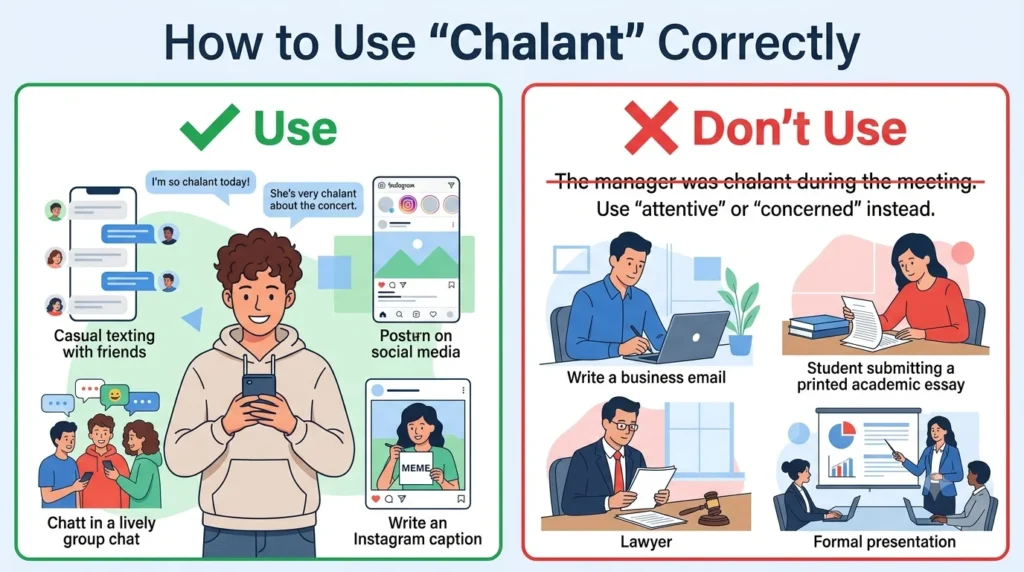
❌ Avoid Using “Chalant” In
- Business emails
- Academic essays
- Legal documents
- Research papers
- Professional presentations
- Job applications
Instead, choose standard English words such as:
- Concerned
- Attentive
- Engaged
- Interested
- Enthusiastic
Common Mistakes to Avoid
1. Assuming “Chalant” Is Standard English
Many people believe chalant is the official opposite of nonchalant.
In reality, it’s generally treated as an informal, non-standard expression, even though it’s widely understood online.
2. Using It in Professional Writing
❌ “The manager was chalant during the meeting.”
✅ “The manager was attentive during the meeting.”
3. Thinking It Was Invented Only by Gen Z
Gen Z helped popularize chalant, but playful uses of the word appeared before it became widespread on today’s social media platforms.
4. Believing Every Word Needs a Perfect Opposite
English doesn’t always work that way.
For example:
- nonchalant → chalant (informal)
- disgruntled → gruntled (rare but attested)
- ruthless → ruth (no standard opposite)
Language develops through history, borrowing, and everyday usage—not always through perfect logical pairs.
Chalant Synonyms
If you’re writing formally, these words usually communicate the idea more clearly than chalant.
| Word | Meaning |
|---|---|
| Concerned | Showing care or worry |
| Attentive | Paying close attention |
| Interested | Showing curiosity |
| Engaged | Actively involved |
| Enthusiastic | Showing excitement |
| Invested | Emotionally involved |
| Caring | Showing concern |
| Focused | Giving full attention |
| Responsive | Reacting thoughtfully |
| Passionate | Showing strong interest |
Opposites of Chalant
Although nonchalant is the most common opposite in internet slang, formal English offers several alternatives.
- Nonchalant
- Indifferent
- Unconcerned
- Detached
- Aloof
- Apathetic
- Uninterested
- Emotionally detached
FAQs
What does chalant mean?
Chalant is an informal word people use online to describe someone who openly cares, pays attention, or shows emotional involvement. It’s commonly used as the playful opposite of nonchalant.
Is chalant a real word?
People genuinely use chalant, especially online. However, it is generally considered non-standard English rather than a fully established standard dictionary adjective.
Is chalant in the dictionary?
Some dictionaries and language references discuss chalant because of its growing popularity, while others do not list it as a standard headword. Coverage can change over time as language evolves.
What is the opposite of nonchalant?
In formal English, good opposites include concerned, attentive, engaged, and interested. In internet slang, many people jokingly use chalant.
Why isn’t chalant a standard English word?
English borrowed nonchalant directly from French as a complete word. Chalant later emerged through playful back-formation and internet usage rather than traditional language development.
What does chalant mean in slang?
In slang, chalant means someone who clearly cares, reacts emotionally, or pays close attention.
What does chalant mean in texting?
In texting, it usually describes someone who is obviously invested in a conversation or eagerly waiting for a reply.
What does chalant mean on Instagram?
On Instagram, chalant often appears in captions and comments to describe someone who openly shows excitement, affection, or concern.
What does chalant mean in Gen Z slang?
For Gen Z, chalant humorously describes someone who is emotionally invested instead of acting cool or unbothered.
Can I use chalant in formal writing?
It’s better not to. Use words like concerned, attentive, engaged, or enthusiastic in professional or academic contexts.
Key Takeaways
- Chalant is an informal internet expression used to describe someone who openly cares or shows emotional involvement.
- It’s commonly understood as the playful opposite of nonchalant.
- The word became popular through memes, texting, and social media.
- While widely recognized online, it is generally treated as non-standard English.
- For formal writing, choose standard alternatives such as concerned, attentive, or engaged.
- Understanding when to use the word is just as important as knowing what it means.
Conclusion
Language is constantly evolving, and chalant is a great example of how online communities influence the way people communicate. Although it isn’t generally treated as standard English, its widespread use in memes, captions, texts, and social media has made its meaning familiar to many English speakers.
Today, saying someone is chalant usually means they’re openly showing care, excitement, or emotional involvement—the opposite of acting nonchalant. Whether you’re reading TikTok comments, scrolling through Instagram, or chatting with friends, understanding this expression helps you follow modern internet conversations more confidently.
The key is using the word in the right context. Chalant works well in casual communication and online culture, while standard English alternatives remain the better choice for formal situations. By understanding both its meaning and its background, you can use—or recognize—the word naturally and appropriately.

Kinza ✨ is a content writer at Meanovia, specializing in slang, texting meanings, and internet phrases. She simplifies modern digital language for easy understanding and daily use 💬🔥