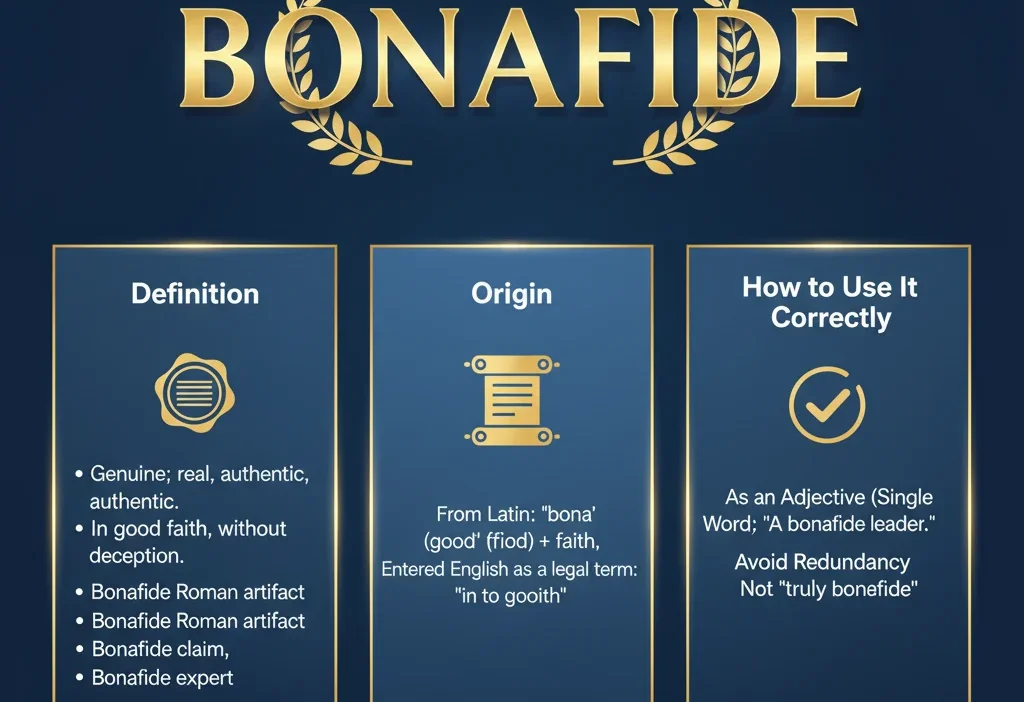
Bonafide means genuine, authentic, or real, often used to describe a person, document, or claim that is legitimate and trustworthy.
The term bonafide is frequently used in legal, professional, and everyday contexts, prompting people to search for its meaning
It comes from Latin, meaning “in good faith”, and implies honesty, authenticity, and legitimacy. For example, a bonafide document is officially recognized, while a bonafide person is sincere and trustworthy.
Understanding the meaning of bonafide helps readers and speakers communicate legitimacy, authenticity, and credibility clearly. Using the term correctly allows you to emphasize honesty, reliability, and realness, whether in business, legal matters, personal introductions, or written communication, ensuring that your statements or references are taken seriously.
💡 What Does Bonafide Mean?
Bonafide means genuine, real, or made in good faith.
It’s often used to describe something authentic, legitimate, or trustworthy — such as a bonafide student, bonafide document, or bonafide agreement.
It is not slang but a formal term used in business, education, and law.
📜 Origin and Popularity
The word “bonafide” originates from Latin, where “bona fides” literally means “good faith.”
It entered English vocabulary in the 16th century and became common in legal and official communication, where “acting in good faith” signifies honesty or authenticity.
Timeline Snapshot:
- 1500s: Derived from Latin bona fides (good faith).
- 1800s: Widely used in contracts and legal documentation.
- Modern era: Common in schools, companies, and identity verification (e.g., “bonafide student certificate”).
Over time, bonafide has become a popular adjective to describe people or things that are legit, trustworthy, or credible.
🌍 Bonafide Meaning in Different Contexts
| Context | Meaning of Bonafide | Example Usage |
| Business / Legal | Genuine, legitimate, in good faith | “He made a bonafide offer to buy the company.” |
| Education | Official or authentic proof of status | “She received a bonafide certificate from her university.” |
| Everyday Conversation | Real or genuine person | “He’s a bonafide expert in his field.” |
| Social Media / Pop Culture | Authentic, original, or true | “She’s a bonafide trendsetter!” |
Let’s explore these a bit deeper 👇
🏢 In Business and Law
In professional or legal contexts, bonafide means done with honest intent.
Example: “A bonafide contract is one created without fraud or deception.”
🎓 In Education
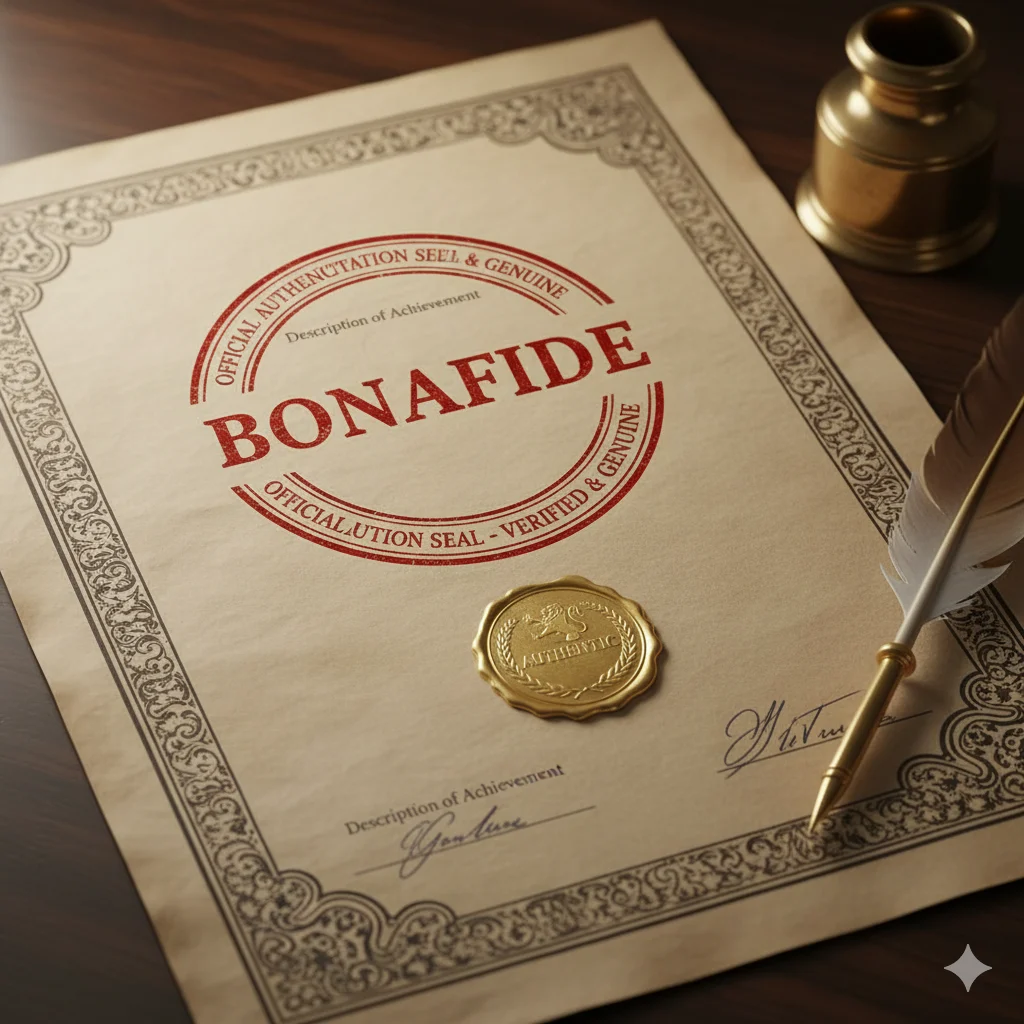
Schools and colleges often issue bonafide certificates to confirm a student’s authentic enrollment or status.
Example: “You’ll need a bonafide student certificate to apply for the internship.”
💬 In Everyday Speech
Used casually, bonafide emphasizes realness or credibility.
Example: “She’s a bonafide artist — her work speaks for itself.”
💬 Examples of Bonafide in Sentences
Here are some real-world examples to help you understand usage better:
Formal examples:
“The company verified his bonafide credentials before hiring him.”
“This is a bonafide partnership based on mutual trust.”
Casual examples:
Friend 1: Is he really an engineer?
Friend 2: Yep, he’s a bonafide professional.
Academic context:
“Students must submit a bonafide certificate to confirm their enrollment.”
Business context:
“The manager approved the proposal as a bonafide project.”
🔍 Similar or Related Terms
Here are a few related or commonly confused terms:
| Term | Meaning | Usage Example |
| Legitimate | Lawful or valid | “He made a legitimate claim.” |
| Authentic | Real, not fake | “The painting is authentic.” |
| Genuine | True or sincere | “She gave a genuine apology.” |
| Official | Authorized or approved | “He received official documentation.” |
All of these share the essence of bonafide — truth, sincerity, and validity — but may differ slightly in tone or formality.
✅ How to Use “Bonafide” Correctly
Do’s
✅ Use it to describe genuine, verified, or official things.
✅ Apply it in formal contexts — like work, education, or documentation.
✅ Write it as “bonafide” or “bona fide” (both are accepted, but bona fide is traditional).
Don’ts
❌ Don’t use it for casual exaggeration (e.g., “He’s a bonafide pizza lover” is informal).
❌ Don’t confuse it with “benefit” or “bon voyage” — different meanings entirely.
❌ Avoid saying “bonified” — that’s a common spelling mistake.
⚠️ Common Mistakes or Misinterpretations
- Wrong Spelling:
Many people mistakenly write “bonified” instead of “bonafide”.
✅ Correct: Bonafide or Bona fide
❌ Incorrect: Bonified - Wrong Meaning:
Some think bonafide means qualified — but it actually means authentic or genuine. - Context Confusion:
It’s formal, not slang — so it doesn’t belong in memes or casual texting unless used humorously.
❓ FAQ Section
1. What does “bonafide” mean in simple terms?
It means genuine or real — something or someone that is authentic and trustworthy.
2. Is “bonafide” formal or slang?
It’s a formal word used in business, law, and education — not slang or casual text.
3. What’s the difference between “bonafide” and “genuine”?
Both mean “real,” but bonafide is more formal and often used in official or legal contexts.
4. What is a bonafide certificate?
A bonafide certificate is an official document confirming that a person is a legitimate member of an organization or institution.
5. Can I use “bonafide” to describe a person?
Yes. It can describe someone who is authentic, trustworthy, or legitimate — e.g., “She’s a bonafide leader.”
6. Is it “bonafide” or “bona fide”?
Both forms are correct. “Bona fide” (two words) is more traditional, while “bonafide” (one word) is widely accepted in modern English.
🏁 Conclusion
In summary, bonafide means real, genuine, and in good faith — a word rooted in honesty and authenticity. Whether you’re describing a bonafide student, a bonafide offer, or a bonafide document, it reflects trust and truth.
Now that you know the bonafide meaning, you’ll recognize it easily in business, education, and everyday language — and use it confidently wherever authenticity matters.
✨ Keep exploring our site for more word meanings and professional terminology explained simply!

Patrick Gale is a word-meaning expert at Meanovia.com. He explains complex terms, definitions, and language trends with clarity and precision. His goal is to help readers understand the exact meaning behind every word they search.