

Have you ever seen or heard someone say “Bon Voyage” and wondered what it really means, when you should use it, or whether it’s different from simply saying “Have a safe trip”? You’re not alone.
In short, “Bon Voyage” is a French expression that means “have a good journey” or “have a pleasant trip,” and it is used to wish someone safety, happiness, success, and wonderful memories as they travel. Although the phrase originated in France, it is now widely used around the world before vacations, business trips, holidays, cruises, flights, road trips, and other travel adventures.
Whether it’s written in a greeting card, spoken at an airport, included in a farewell message, or shared on WhatsApp, Instagram, Facebook, or other social media, “Bon Voyage” is a warm and thoughtful way to encourage someone before they begin their journey.
This guide explains the Bon Voyage meaning, pronunciation, origin, examples, cultural significance, common mistakes, and exactly when and how to use this timeless travel phrase naturally, confidently, and appropriately in every situation.
What Does Bon Voyage Mean?
At its core, Bon Voyage means:
- Have a good trip.
- Have a safe journey.
- Travel safely.
- Enjoy your travels.
It is a travel-specific farewell that expresses kindness, encouragement, and hope for a pleasant journey.
Unlike a general “Goodbye,” Bon Voyage is only used when someone is about to travel. That’s what makes it unique. Instead of simply ending a conversation, it celebrates the beginning of a new adventure.
Simple Definition
Bon Voyage is a French phrase meaning “Have a good journey” or “Safe travels,” used to wish someone well before they leave on a trip.
Because of its elegant sound and international recognition, many people prefer saying Bon Voyage instead of the more common “Have a safe trip.”
What Does “Bon Voyage” Literally Mean?
The phrase consists of two French words:
| French Word | English Meaning |
|---|---|
| Bon | Good |
| Voyage | Journey, trip, or travel |
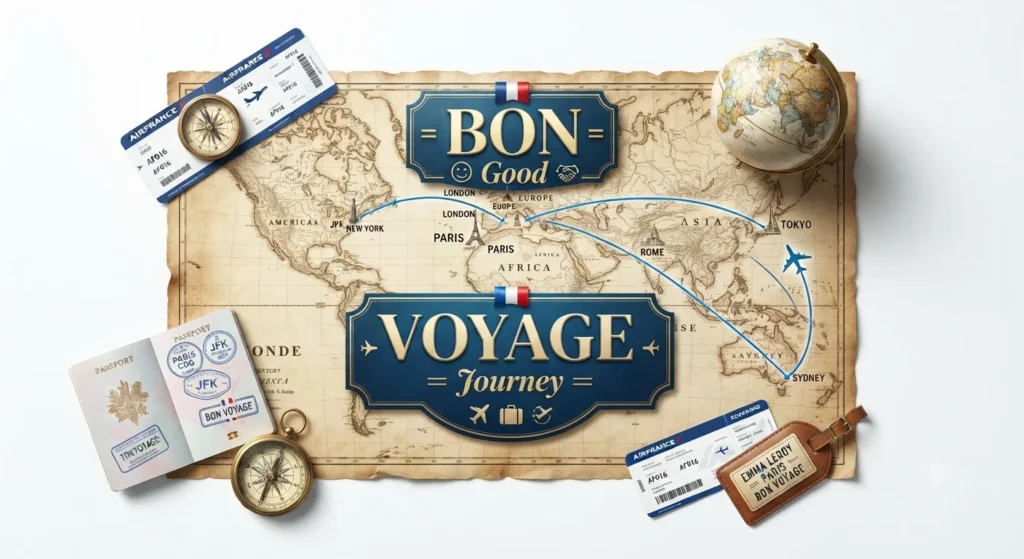
Together, they literally translate to:
Good Journey
However, languages don’t always translate word for word. In natural English, Bon Voyage is understood as:
- Have a good trip.
- Safe travels.
- Enjoy your journey.
- Wishing you a pleasant trip.
This is why you’ll hear the phrase at airports, train stations, cruise terminals, farewell dinners, and travel celebrations around the world.
Bon Voyage Meaning in English
Although Bon Voyage comes from French, it has become a familiar part of modern English.
In everyday conversation, people use it to wish travelers well before they leave. The phrase conveys warmth, encouragement, and excitement for the journey ahead.
Example
Emma: I’m flying to Japan tomorrow.
Sophia: Bon Voyage! Have an unforgettable trip and travel safely.
In English, Bon Voyage often carries the same meaning as:
- Safe travels
- Have a wonderful trip
- Enjoy your vacation
- Wishing you a safe journey
The difference is that Bon Voyage sounds a little more elegant, timeless, and internationally recognized.
How Do You Pronounce Bon Voyage?
Many people know how to spell the phrase but aren’t sure how to say it correctly.
English Pronunciation
Bon Voy-AHZH
IPA (English)
/bɒn vɔɪˈɑːʒ/
Native French Pronunciation
/bɔ̃ vwajaʒ/
Don’t worry if you can’t perfectly imitate the French accent. Most English speakers naturally pronounce it as Bon Voy-AHZH, and that pronunciation is widely accepted and easily understood.
Expert Tip: Clear communication is more important than a perfect French accent. Native English speakers commonly use the English pronunciation in everyday conversations, greeting cards, and travel wishes.
What Language Is Bon Voyage?
Bon Voyage is a French expression that has been adopted into English without changing its original spelling.
Today, it is recognized worldwide and appears in:
- Airport announcements
- Travel agencies
- Greeting cards
- Business emails
- Farewell speeches
- Social media captions
- Travel blogs
- Cruise advertisements
- Tourism campaigns
Its universal appeal is one reason it has remained popular for generations.
The Origin of Bon Voyage
The history of Bon Voyage dates back several centuries to France.
The adjective bon means good, while voyage referred to a journey, particularly a long-distance trip. In earlier times, travel was often difficult, dangerous, and unpredictable. Before loved ones departed, family and friends would wish them Bon Voyage as a sincere hope for a safe journey and successful return.
As trade, exploration, and international travel expanded during the 18th and 19th centuries, English speakers gradually adopted the phrase because it sounded refined, expressive, and culturally sophisticated. Over time, Bon Voyage appeared in literature, travel writing, postcards, films, and eventually modern digital communication.
Today, despite the popularity of phrases like “Safe Travels” and “Have a Great Trip,” Bon Voyage continues to symbolize adventure, optimism, goodwill, and the excitement of discovering new places.
Why Is “Bon Voyage” Still Popular Today?
Even in the age of instant messaging and social media, Bon Voyage remains one of the most widely used travel expressions in the world.
People continue to use it because it:
- Expresses genuine care and positivity.
- Sounds elegant without feeling outdated.
- Works in both personal and professional settings.
- Is instantly recognized across many cultures.
- Fits naturally in travel captions, greeting cards, farewell speeches, and business emails.
- Adds a timeless, international touch that simple phrases like “Have a nice trip” sometimes lack.
Travel Insight: In real life, a short message like “Bon Voyage! Wishing you safe travels and unforgettable memories” often feels warmer and more personal than a plain “Have a safe trip.” That’s one reason the phrase remains popular among travelers, families, and professionals alike.
When Can You Use “Bon Voyage”?
One of the biggest reasons people search for Bon Voyage meaning is because they aren’t sure when it’s actually appropriate to say it.
The simple rule is this:
Say “Bon Voyage” before someone begins a journey.
It doesn’t matter whether the person is traveling for work, education, vacation, or adventure. If they’re leaving for a trip, Bon Voyage is an appropriate, thoughtful, and elegant farewell.
Unlike Goodbye, which can be used in almost any situation, Bon Voyage is travel-specific. It celebrates the beginning of someone’s journey rather than simply ending a conversation.
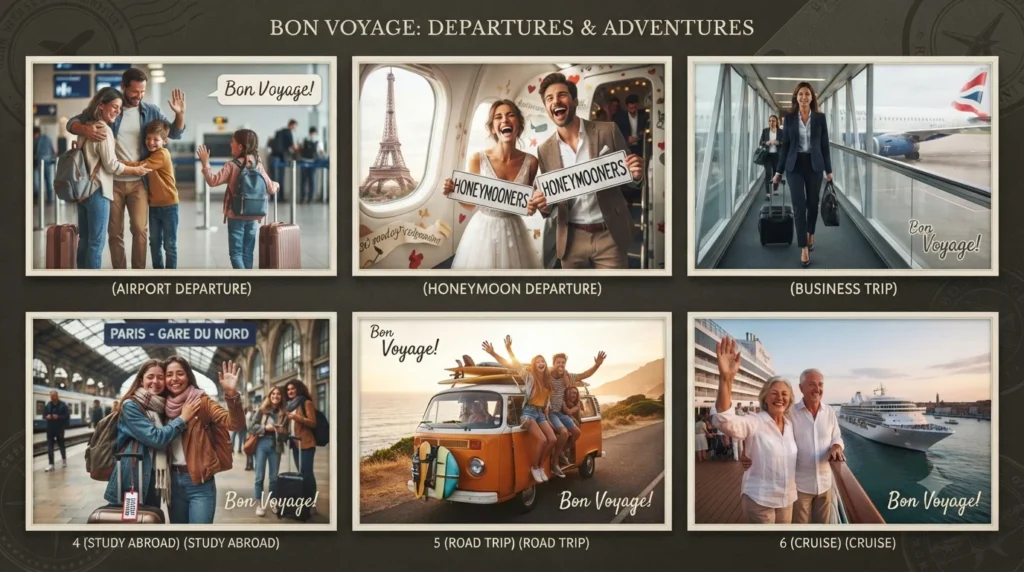
You Can Say “Bon Voyage” Before:
✈️ Domestic flights
🌍 International flights
🚢 Cruises
🚆 Train journeys
🚗 Road trips
🏝️ Vacations
🎓 Studying abroad
💼 Business trips
❤️ Honeymoons
🏕️ Camping adventures
🚴 Cycling tours
🧳 Long holidays
🌎 Backpacking trips
🚢 Sea voyages
Real-Life Examples
Before a Flight
Bon Voyage! Have a safe flight to London.
Before a Honeymoon
Bon Voyage! Wishing you both a lifetime of happiness and unforgettable memories.
Before College Abroad
Bon Voyage! Make the most of this incredible opportunity.
Before a Business Trip
Bon Voyage! We wish you success during your international assignment.
Can You Say “Bon Voyage” for a Flight?
Yes—Absolutely.
This is one of the most searched questions on Google.
Many people think Bon Voyage is only correct for ships because historically the word voyage often referred to long sea travel.
That was true hundreds of years ago.
Modern English is different.
Today, Bon Voyage is perfectly acceptable for:
- Air travel
- Domestic flights
- International flights
- Family vacations
- Business travel
- Student exchange programs
- Holiday trips
Example
Ali: My flight leaves tomorrow morning.
Sara: Bon Voyage! Have a safe flight and enjoy every moment.
This sounds completely natural in modern English.
Expert Insight: In today’s English, most native speakers no longer associate Bon Voyage exclusively with ships. It’s commonly used before flights, making it a stylish alternative to “Safe Travels.”
Is “Bon Voyage” Only for Ships?
No.
This is one of the internet’s biggest misconceptions.
Historically:
✔ Yes, the phrase became popular during the age of sea travel.
Today:
✔ It applies to almost every type of journey.
Modern Usage
| Type of Journey | Bon Voyage Correct? |
|---|---|
| Flight | ✅ Yes |
| Cruise | ✅ Yes |
| Road Trip | ✅ Yes |
| Train | ✅ Yes |
| Vacation | ✅ Yes |
| Business Trip | ✅ Yes |
| Study Abroad | ✅ Yes |
| Pilgrimage | ✅ Yes |
Can We Say “Happy Bon Voyage”?
Another popular Google question is:
Can we say Happy Bon Voyage?
The answer is:
Yes—but it isn’t the most natural expression.
Native English speakers usually prefer:
- Bon Voyage!
- Safe Travels!
- Have a wonderful trip!
- Enjoy your journey!
- Have an amazing vacation!
Instead of
❌ Happy Bon Voyage
Most people naturally write:
✅ Bon Voyage!
or
✅ Wishing you a happy journey.
Is It Correct to Say “Wish You Bon Voyage”?
Yes.
Examples include:
- Wish you Bon Voyage!
- Wishing you Bon Voyage and safe travels.
- We wish you Bon Voyage on your exciting adventure.
- Bon Voyage! May every mile bring happiness.
Can You Say Bon Voyage Before Every Trip?
Almost every trip—yes.
It works naturally for:
- Airport departures
- Family vacations
- International conferences
- Overseas jobs
- School exchange programs
- Weekend getaways
- Cruises
- Religious pilgrimages
However, it sounds unnecessary for very short everyday trips.
For example:
❌ Bon Voyage! See you at the grocery store.
That feels unnatural.
Bon Voyage vs Have a Safe Flight
People often wonder which expression sounds better.
The answer depends on the situation.
| Bon Voyage | Have a Safe Flight |
|---|---|
| Elegant | Direct |
| Works for every journey | Only flights |
| French origin | English |
| Formal & informal | Mostly casual |
| Sounds timeless | Sounds practical |
Which Should You Use?
If someone is boarding a plane:
You can say either:
Bon Voyage!
or
Have a safe flight!
Both are completely correct.
Ramadan Mubarak Meaning: What It Truly Means in Islam
Bon Voyage in Business
Many professionals wonder if Bon Voyage is appropriate in workplace communication.
The answer is:
Yes.
It sounds respectful, polished, and professional.
Example Email
Dear Mr. Ahmed,
On behalf of our entire team, we wish you Bon Voyage as you travel to Singapore for the annual conference.
May your meetings be successful, and we look forward to hearing about your experience.
Kind regards,
ABC Company
Best Business Situations
- International meetings
- Overseas assignments
- Conferences
- Corporate travel
- Diplomatic visits
- Educational exchange
- Company relocation
Bon Voyage in Social Media
One reason Bon Voyage remains popular is social media.
Travel influencers use it because it feels stylish and international.
You’ll often see it on:
- TikTok
- Threads
- X (Twitter)
Popular Captions
✈️ Bon Voyage! Adventure starts today.
🌍 New passport. New memories.
✨ Bon Voyage to the journey I’ve always dreamed of.
🏝️ Life begins where your comfort zone ends.
🧳 Collect moments, not things.
Bon Voyage Meaning in Different Languages
Although Bon Voyage itself is French, people often search for its meaning in their native language.
Bon Voyage Meaning in Urdu
Bon Voyage in Urdu means:
“آپ کا سفر خوشگوار، کامیاب اور محفوظ ہو۔”
Other natural expressions include:
- سفر مبارک
- خوشگوار سفر
- محفوظ سفر کی دعا
Bon Voyage Meaning in Hindi
In Hindi, it means:
“आपकी यात्रा शुभ और सुरक्षित हो।”
Natural alternatives:
- शुभ यात्रा
- आपकी यात्रा मंगलमय हो
Bon Voyage Meaning in Punjabi
A natural Punjabi equivalent is:
“ਤੁਹਾਡਾ ਸਫ਼ਰ ਸੁਖਦਾਇਕ ਤੇ ਸੁਰੱਖਿਅਤ ਹੋਵੇ।”
You can also say:
- ਸੁੱਖੀ ਯਾਤਰਾ
- ਚੰਗਾ ਸਫ਼ਰ ਹੋਵੇ
Bon Voyage Meaning in Arabic
Closest Arabic expression:
رحلة سعيدة
Meaning:
Have a pleasant journey.
Bon Voyage Meaning in Tagalog
Closest translation:
Magandang biyahe
Meaning:
Have a good trip.
Bon Voyage Meaning in Tamil
Natural equivalent:
உங்கள் பயணம் இனிதாக அமையட்டும்.
Meaning:
May your journey be pleasant and safe.
Bon Voyage Meaning in Nepali
तपाईंको यात्रा शुभ रहोस्।
Meaning:
May your journey be safe and successful.
Bon Voyage Meaning in Malayalam
നിങ്ങളുടെ യാത്ര സുരക്ഷിതവും സന്തോഷകരവും ആയിരിക്കട്ടെ.
Meaning:
May your journey be safe and pleasant.
Travel Etiquette: When Should You Avoid Saying Bon Voyage?
Although Bon Voyage is versatile, there are situations where another farewell works better.
Avoid using it:
❌ After someone has already returned from their trip.
❌ When saying goodbye to someone who isn’t traveling.
❌ For ordinary daily departures like leaving the office or going shopping.
Instead, choose:
- Goodbye
- See you later
- Take care
- Have a nice day
Instead of saying the same thing every time, try one of these responses:
- Thank you so much!
- I really appreciate it.
- Thanks! I’m looking forward to it.
- I’ll definitely enjoy the trip.
- Thank you! I’ll travel safely.
- Thanks! I’ll bring back souvenirs.
- Appreciate your kind wishes.
- Thank you! I can’t wait to explore.
- Thanks! I’ll share lots of pictures.
- Merci!
- Merci beaucoup!
- Thank you! See you soon.
- I’ll miss you too.
- Thanks for the warm wishes.
- I’ll make the most of this adventure.
- Thank you! Hope everything goes well here too.
- Thanks! This trip means a lot to me.
- I’ll let you know once I arrive.
- Appreciate it! Looking forward to the journey.
- Thank you! I’ll stay safe.
- Thanks! Wish me luck.
- I’ll be back before you know it.
- Thank you! Have a great week.
- That’s very kind of you.
- Thank you for thinking of me.
- Can’t wait to tell you all about it.
- Thank you! I’m so excited.
- Thanks! I’ll enjoy every moment.
- Appreciate your support.
- Thank you again!
Bon Voyage Messages
If you’re writing a farewell card, WhatsApp message, or social media post, these ready-to-use messages work beautifully.
Short Bon Voyage Messages
- Bon Voyage! Have a safe and wonderful journey.
- Wishing you endless adventures and unforgettable memories.
- Safe travels! Enjoy every moment.
- Bon Voyage! May your trip be filled with happiness.
- Have a fantastic journey and return safely.
What Does Rendition Mean? Full Guide
Bon Voyage Messages for a Friend
Friendships become even more special when you send heartfelt travel wishes.
Message 1
Bon Voyage, my friend! I hope this trip brings you unforgettable memories, exciting adventures, and endless reasons to smile. Stay safe and enjoy every moment.
Message 2
Wishing you safe travels and amazing experiences. Bon Voyage! I can’t wait to hear all about your journey when you return.
Bon Voyage Message for Family
Bon Voyage! May your journey be safe, peaceful, and filled with wonderful memories. We’ll miss you and look forward to welcoming you home soon.
Bon Voyage Message for Your Husband or Wife
Bon Voyage, my love. No matter how far you travel, my best wishes go with you. Stay safe, take care of yourself, and come back with beautiful stories to share.
Bon Voyage Message for a Colleague
Bon Voyage! Wishing you success on your business trip. May your meetings go well, your travels be smooth, and your journey be rewarding.
Bon Voyage Message for a Boss
Bon Voyage! Wishing you a productive and successful journey. May everything go according to plan, and may you return with great achievements.
Bon Voyage Captions for Instagram
Looking for the perfect travel caption? Here are some ideas:
- ✈️ Bon Voyage! Adventure begins now.
- 🌍 Every journey starts with a dream.
- 🧳 Passport ready. Heart full of excitement.
- ✨ Bon Voyage to new beginnings.
- 🌎 Life is better when you’re exploring.
- 💙 Traveling today, making memories forever.
- 🌅 Every destination has a story.
- 📍Collect moments, not things.
- 🚀 The world is waiting.
- 🌴 Next stop: adventure.
Bon Voyage in a Sentence
Seeing a phrase used naturally is often the easiest way to learn it.
Travel
Bon Voyage! Have an amazing vacation in Italy.
Business
We wish our entire delegation Bon Voyage before their international conference.
Family
Bon Voyage, Dad. Have a safe flight and call us when you arrive.
Student
Bon Voyage! We know you’ll do great during your semester abroad.
Honeymoon
Bon Voyage! Wishing you both a lifetime of happiness together.
Social Media
Bon Voyage to new adventures and unforgettable memories! ✈️🌎
Bon Voyage Synonyms
Sometimes you may want a different expression while keeping the same meaning.
| Expression | Best Used For |
|---|---|
| Safe Travels | Everyday conversation |
| Have a Great Trip | Friends and family |
| Enjoy Your Journey | Greeting cards |
| Have a Wonderful Vacation | Holidays |
| Travel Safely | Family |
| Journey Well | Formal writing |
| Godspeed | Traditional or emotional occasions |
| Best Wishes for Your Trip | Professional settings |
Bon Voyage vs Safe Travels
People often ask which one is better.
| Bon Voyage | Safe Travels |
|---|---|
| French expression | English expression |
| Elegant and timeless | Casual and modern |
| Works in formal and informal situations | Mostly casual |
| International feel | Everyday English |
| Popular in greeting cards | Popular in text messages |
Both are correct. Choose the one that best fits the tone you want.
Bon Voyage vs Goodbye
Although they are sometimes used together, they don’t mean the same thing.
| Bon Voyage | Goodbye |
|---|---|
| Travel-specific farewell | General farewell |
| Wishes someone a pleasant journey | Ends a conversation |
| Used before a trip | Used anytime |
| Positive travel wish | Neutral goodbye |
Example:
Goodbye—and Bon Voyage! Have an amazing trip.
Bon Voyage vs Adieu
Both phrases come from French, but they are used differently.
| Bon Voyage | Adieu |
|---|---|
| Have a good journey | Farewell |
| Used before travel | General goodbye |
| Warm and optimistic | Often emotional or final |
| Common today | Less common in everyday English |
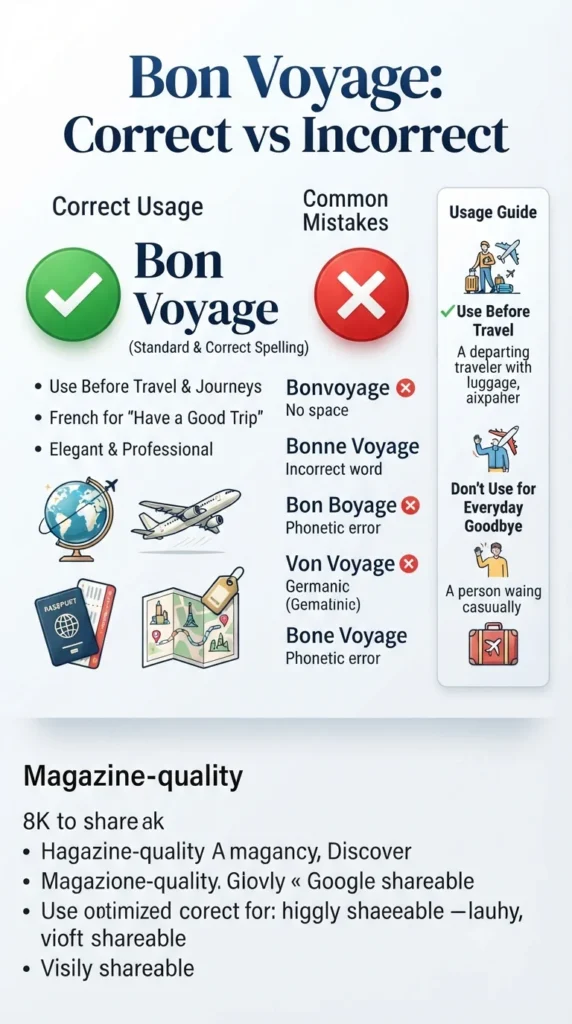
Common Spelling Mistakes
Because the phrase is French, many people misspell it in search engines.
✅ Correct
Bon Voyage
❌ Incorrect
- Bonvoyage
- Bon Boyage
- Bon Voyaje
- Bon Vayage
- Von Voyage
- Bonne Voyage
- Bone Voyage
- Bon Vogage
- Bon Voyag
- Bon Voyege
- Born Voyage
Always write it as two separate words:
Bon Voyage

Is It “Bon Voyage” or “Bonne Voyage”?
This is one of the most common Google searches.
The correct phrase is:
✅ Bon Voyage
NOT
❌ Bonne Voyage
Why?
Because voyage is a masculine noun in French, so the adjective must also be masculine.
Therefore, Bon Voyage is grammatically correct.
Is Bon Voyage Outdated?
Not at all.
Although the phrase has existed for centuries, it continues to be popular because it feels timeless, elegant, and sincere. You’ll still find it in:
- Airport farewell signs
- Travel blogs
- Greeting cards
- Business emails
- Cruise advertisements
- Instagram captions
- Travel agencies
- Study abroad programs
Modern travelers continue to use Bon Voyage because it sounds more meaningful than a simple “Have a nice trip.”
Frequently Asked Questions
1. What does “Bon Voyage” mean?
Bon Voyage means “Have a good trip,” “Safe travels,” or “Have a pleasant journey.” It is a French expression used to wish someone well before they begin traveling.
2. What does “Bon Voyage” literally mean?
Literally, Bon Voyage means “Good Journey.”
- Bon = Good
- Voyage = Journey or Trip
In natural English, it’s understood as “Have a good trip.”
3. What language is Bon Voyage?
Bon Voyage comes from the French language, but today it is commonly used in English and many other languages around the world.
4. Can you say Bon Voyage for a flight?
Yes.
Modern English speakers commonly use Bon Voyage before flights, vacations, cruises, road trips, train journeys, and business travel.
5. Is Bon Voyage only for ships?
No.
Although the phrase originally became popular during the era of sea travel, it now applies to almost every type of journey.
6. Can we say “Happy Bon Voyage”?
You can, but “Bon Voyage!” or “Have a wonderful trip!” sounds more natural in everyday English.
7. Is Bon Voyage formal or informal?
It works in both situations.
You can use it in:
- Greeting cards
- Text messages
- Business emails
- Farewell speeches
- Social media captions
8. How do you pronounce Bon Voyage?
The common English pronunciation is:
Bon Voy-AHZH
9. How do you reply to Bon Voyage?
Some natural replies include:
- Thank you!
- Thanks! I’ll travel safely.
- I appreciate your kind wishes.
- Merci!
- Thanks! I can’t wait for the adventure.
10. What is the difference between Bon Voyage and Safe Travels?
Both express good wishes before travel.
Bon Voyage sounds more elegant and international, while Safe Travels is more casual and commonly used in everyday English.
11. Does Bon Voyage mean goodbye?
Not exactly.
Goodbye is a general farewell.
Bon Voyage specifically wishes someone a pleasant journey before they travel.
12. Is Bon Voyage still popular?
Yes.
Despite being centuries old, it remains popular in travel blogs, greeting cards, airport farewells, business communication, and social media.
13. How do you spell Bon Voyage?
The correct spelling is:
✅ Bon Voyage
Not:
❌ Bonvoyage
❌ Bonne Voyage
❌ Bon Boyage
14. What is the opposite of Bon Voyage?
There isn’t one exact opposite, but depending on the context, possible opposites include:
- Welcome back
- Welcome home
- Safe return
- Glad you’re back
15. Can Bon Voyage be used in business?
Absolutely.
It is commonly used in professional emails, farewell speeches, and corporate travel messages.
Quick Revision Cheat Sheet
| Question | Answer |
|---|---|
| Meaning | Have a Good Trip |
| Literal Translation | Good Journey |
| Language | French |
| English Equivalent | Safe Travels |
| Used Before | Any journey |
| Flight | ✅ Yes |
| Cruise | ✅ Yes |
| Road Trip | ✅ Yes |
| Business Travel | ✅ Yes |
| Greeting Card | ✅ Yes |
| Social Media | ✅ Yes |
Common Mistakes to Avoid
Many people unknowingly make these mistakes when using the phrase.
❌ Saying Bon Voyage After Someone Returns
Incorrect:
Bon Voyage! Welcome back.
Correct:
Welcome back! Hope you had a wonderful trip.
❌ Writing It as One Word
Incorrect:
Bonvoyage
Correct:
Bon Voyage
❌ Using It for Ordinary Goodbyes
Bon Voyage should only be used when someone is traveling.
If your friend is simply leaving work, use:
- Goodbye
- Take care
- See you tomorrow
instead.
Why People Love Saying Bon Voyage
The phrase has remained popular for centuries because it communicates much more than “Have a nice trip.”
It expresses:
- genuine care
- encouragement
- excitement
- optimism
- respect
- warmth
Unlike ordinary farewells, it celebrates a new adventure.
Conclusion
Bon Voyage is far more than a simple farewell. It is a timeless French expression that wishes someone a safe, enjoyable, and memorable journey. From airport departures and family vacations to business travel and study-abroad adventures, it remains one of the most elegant ways to express kindness before someone begins a trip.
Now you know its meaning, literal translation, pronunciation, French origin, correct usage, replies, examples, grammar rules, common mistakes, and cultural significance. Whether you’re writing a greeting card, sending a WhatsApp message, posting a travel caption, or wishing a colleague success on an overseas assignment, you can confidently use Bon Voyage in the right way.
Bon Voyage—and may every journey bring new experiences, lasting memories, and a safe return home.

Lucas Hayes is a content writer at Meanovia, specializing in slang, texting meanings, and internet phrases. He creates simple, clear, and engaging explanations of modern digital language 💬✨