
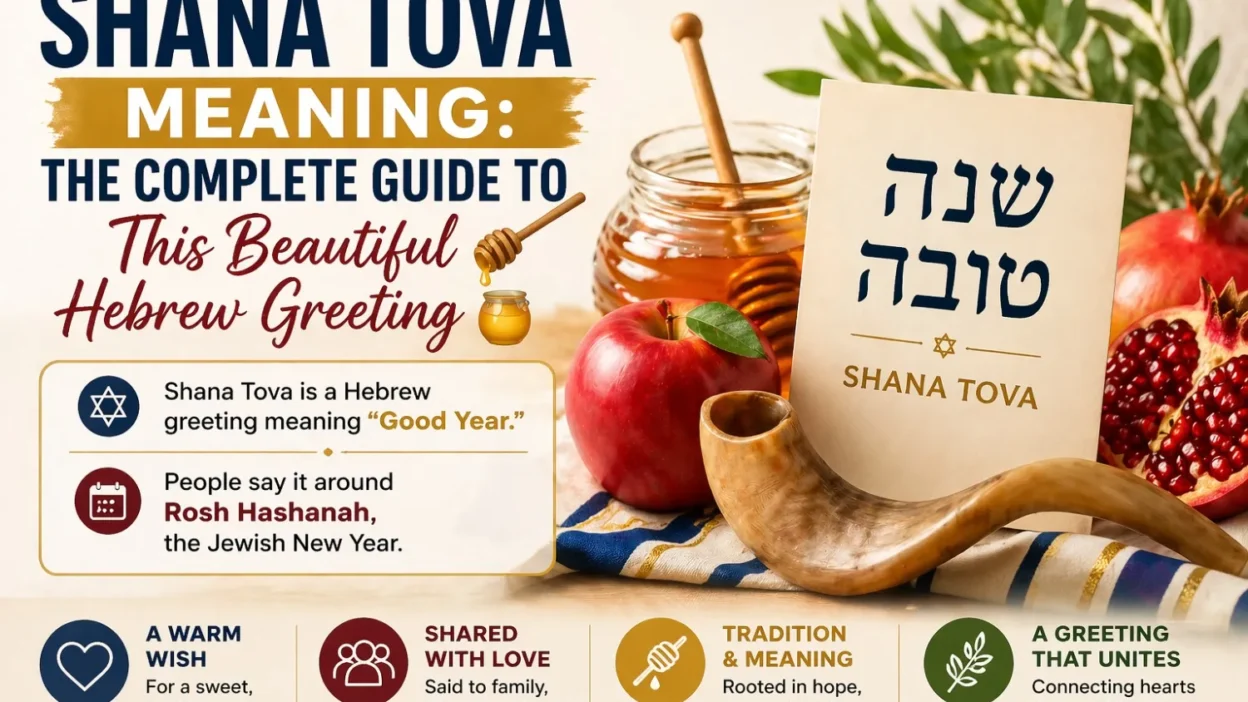
Shana Tova is a Hebrew greeting meaning “Good Year.”
People say it around Rosh Hashanah, the Jewish New Year.
Ever noticed your social feed fill with apples, honey, and the phrase “Shana Tova!” every September? 🍎
Maybe a coworker greeted you with it. Maybe you spotted it in a festive card. Or maybe you saw “L’Shana Tova” and wondered — is that different from “Shana Tova”? What does the “L” mean?
You are in the right place. Shana Tova meaning is beautiful and simple once you understand it — and this guide will explain every single variation, pronunciation, response, and tradition connected to this heartfelt Hebrew greeting.
In this complete guide, you will learn:
- What Shana Tova means in English and Hebrew
- L’Shana Tova meaning — what does the “L” add?
- La Shana Tova and Le Shana Tova meaning
- Shana Tova U’Metuka meaning
- L’Shana Tova Tikatevu meaning
- What “Tova” means by itself in Hebrew
- What “Shana” means in Hebrew
- How to pronounce Shana Tova correctly
- How to respond to Shana Tova
- Shana Tova meaning in Hindi
- Shana Tova in Hebrew letters
- All spelling variations — Shanah Tovah, Shannah Tova, etc.
- Traditions, foods, and symbols connected to the greeting
- A complete FAQ section
Let us get into it.
What Does Shana Tova Mean?
“Shana Tova” (שָׁנָה טוֹבָה) literally translates to “Good Year” in Hebrew.
It is the standard greeting for Rosh Hashanah — the Jewish New Year — which falls in September or October each year.
When someone says Shana Tova, they are wishing you a sweet, happy, and meaningful start to the new year. It is a blessing that combines joy, renewal, and spiritual reflection.
Shana Tova meaning in simple words:
“I wish you a good year ahead — filled with happiness, peace, and sweetness.”
Shana Tova meaning in English: Good Year — a Jewish New Year blessing.
Shana Tova meaning Hebrew: שָׁנָה טוֹבָה — the direct Hebrew phrase meaning “good year.”
What Does “Shana” Mean in Hebrew?
Shana meaning Hebrew and what does Shana mean in Hebrew — let’s break down the phrase word by word.
שָׁנָה (Shana) means “year” in Hebrew.
The word “shana” appears throughout the Hebrew Bible (Torah) and Jewish prayer. It comes from a root related to the idea of change and repetition — which makes sense, because a year is a cycle that repeats and brings change with it.
In Hebrew, “shana” can also be connected to the word “shinui” (שינוי) — meaning “change.” A new year is a time of renewal and transformation.
What Does “Tova” Mean in Hebrew?
Tova meaning and what does Tova mean in Hebrew — the second word in the phrase.
טוֹבָה (Tova) means “good” in Hebrew — specifically the feminine form of “good.”
Hebrew has masculine and feminine forms for adjectives. Since “shana” (year) is a feminine noun in Hebrew, “tova” uses the feminine form. The masculine form of “good” in Hebrew is “tov” (טוֹב).
So:
- Shana Tova = Good Year (feminine agreement — correct)
- Shana Tov = grammatically incorrect in Hebrew
Tova is also a popular Hebrew name for girls — meaning “good” or “goodness.”
L’Shana Tova Meaning — What Does the “L” Mean?
L’Shana Tova meaning, l shana tova meaning, le shana tova meaning, la shana tova meaning, and l’shana tova meaning — this is one of the most searched variations.
L’Shana Tova (לְשָׁנָה טוֹבָה) means “For a Good Year” or “To a Good Year.”
The letter “L” (or “Le” or “La” in English transliteration) represents the Hebrew letter Lamed (ל) — which is a prefix meaning “to,” “for,” or “toward.”
So the difference between Shana Tova and L’Shana Tova is subtle but meaningful:
| Phrase | Hebrew | Meaning |
|---|---|---|
| Shana Tova | שָׁנָה טוֹבָה | “Good Year” — a simple blessing |
| L’Shana Tova | לְשָׁנָה טוֹבָה | “To a Good Year” — a directed wish, like raising a toast |
Think of L’Shana Tova like saying “Here’s to a good year!” — it is slightly more poetic and directed than just “Good Year.”
L shana tova meaning Jewish — in Jewish tradition, L’Shana Tova is the more formal and liturgically precise version of the greeting. It is the form that appears in prayers and synagogue services.
L shana tova or shana tova — which is correct? Both are correct and widely used. Shana Tova is the casual, everyday version. L’Shana Tova is the more formal or poetic version. You will hear and see both in common use.
L’Shana Tova meaning in English: “To a Good Year” — a heartfelt wish for the year ahead.
L’Shana Tova Tikatevu Meaning
L’Shana Tova Tikatevu meaning and l shana tova tikatevu meaning and l’shana tova tikatevu meaning — this is the full, traditional Rosh Hashanah greeting.
L’Shana Tova Tikatevu (לְשָׁנָה טוֹבָה תִּכָּתֵבוּ) means:
“May you be inscribed for a good year.”
This phrase refers to the Book of Life — a central concept in Rosh Hashanah theology. Jewish tradition teaches that on Rosh Hashanah, God opens the Book of Life and writes the fate of each person for the coming year. The greeting expresses the hope that you will be written into this book for a year of goodness and life.
Word by word:
- L’ = To / For
- Shana = Year
- Tova = Good
- Tikatevu = May you be inscribed / written
L’shanah tovah tikatevu pronunciation: Luh-sha-NAH to-VAH tee-kah-TAY-voo
This is the greeting used specifically during Rosh Hashanah — before Yom Kippur (the Day of Atonement). After Rosh Hashanah has passed, a different phrase is used (G’mar Chatima Tova — explained below).
Shana Tova U’Metuka Meaning
Shana Tova U’Metuka meaning and shana tova umetuka meaning and shana tova umetukah meaning — this is the sweeter, warmer version.
Shana Tova U’Metuka (שָׁנָה טוֹבָה וּמְתוּקָה) means:
“A Good and Sweet Year.”
Word by word:
- Shana = Year
- Tova = Good
- U’ = And
- Metuka = Sweet
The addition of “U’Metuka” (and sweet) makes the greeting extra warm and festive. This version is especially common during the apple and honey tradition of Rosh Hashanah — where families dip apple slices in honey to symbolize the hope for a sweet new year.
So when you hand someone honey cake or dip apples together, saying “Shana Tova U’Metuka!” fits the moment perfectly.
Shana Tova U’Metuka meaning in English: “A Good and Sweet Year” — the warmest, most festive version of the Rosh Hashanah greeting.
Shana Tova Meaning in Rosh Hashanah
Shana Tova meaning Rosh Hashanah, shana tova meaning Jewish, and shana tova meaning Jewish New Year — let’s connect the greeting to the holiday.
Rosh Hashanah (ראש השנה) literally means “Head of the Year” in Hebrew. It is the Jewish New Year — a two-day holiday that marks the beginning of the High Holy Days (also called the High Holidays or Days of Awe).
Rosh Hashanah is not just a celebration. It is a deeply spiritual time focused on:
- Reflection — looking back at the past year honestly
- Repentance (Teshuvah) — acknowledging mistakes and committing to do better
- Prayer — asking God for forgiveness and blessings
- Renewal — beginning the new year with a clean slate
Shana Tova is the greeting that captures all of these feelings at once. When you say it, you are not just saying “Happy New Year.” You are saying:
“I wish you goodness, sweetness, reflection, renewal, and hope for the year ahead.”
That is why this two-word phrase carries so much weight.
How to Pronounce Shana Tova
How to pronounce Shana Tova, shana tova pronunciation, pronounce shana tova, and how do you pronounce shana tova — let’s make this simple.
Shana Tova pronunciation:
sha-NAH to-VAH
- sha = soft “a” sound, like “sha” in “shall”
- NAH = stressed, rhymes with “spa”
- to = like the word “toe”
- VAH = stressed, rhymes with “spa”
Syllable stress: sha-NAH to-VAH
L’Shana Tova pronunciation:
luh-sha-NAH to-VAH
The “L” prefix is pronounced like a short “luh” sound — very brief.
Shana Tova U’Metuka pronunciation:
sha-NAH to-VAH oo-meh-TOO-kah
G’mar Chatima Tova pronunciation:
guh-MAR kha-TEE-mah to-VAH
The “Ch” in “Chatima” is a guttural sound from the throat — like the “ch” in the Scottish word “loch.” It is the Hebrew letter Chet (ח).
Shanah Tovah pronunciation: Same as Shana Tova — sha-NAH to-VAH. The “h” at the end in English transliteration is silent.
All Spelling Variations — Which Is Correct?
One of the most confusing things about this greeting is that it is spelled many different ways in English. This is because Hebrew uses a completely different alphabet — and when Hebrew words are written in English letters (transliteration), there is no single official standard.
Here are all the common spelling variations and whether they are correct:
| Spelling | Is It Correct? | Notes |
|---|---|---|
| Shana Tova | ✅ Most common English spelling | Widely used |
| Shanah Tovah | ✅ Correct | More traditional/formal spelling |
| Shana Tovah | ✅ Acceptable | Mixed form — common |
| Shanah Tova | ✅ Acceptable | Mixed form — common |
| Shanna Tova | ❌ Misspelling | Double “n” is incorrect |
| Shona Tova | ❌ Misspelling | Wrong first vowel |
| Sjana Tova | ❌ Misspelling | Non-standard transliteration |
| Shana Tov | ❌ Grammatically wrong | “Tova” is the correct feminine form |
| L’Shana Tova | ✅ Correct | With the “L” prefix |
| La Shana Tova | ✅ Acceptable | Common English spelling of L’Shana |
| Le Shana Tova | ✅ Acceptable | Another common transliteration |
| Lshana Tova | ✅ Acceptable | Without the apostrophe |
| L’Shanah Tovah | ✅ Correct | More formal spelling |
Shana tova spelling tip: All variations with “Shana Tova” or “Shanah Tovah” are correct — the difference is just how you choose to write Hebrew sounds in English letters. The most widely used and recognized spelling is Shana Tova.
How to Respond to Shana Tova
How to respond to Shana Tova, response to Shana Tova, how to reply to Shana Tova, what is the response to Shana Tova, and how to respond to L’Shana Tova — here is everything you need to know.
When someone says “Shana Tova” to you, the most natural responses are:
Option 1 — Say it back:
“Shana Tova!” or “Shana Tova U’Metuka!”
This is the simplest and most common response — wishing them the same in return.
Option 2 — Thank them and return the wish:
“Thank you — Shana Tova to you too!” “Shana Tova U’Metuka — and to you as well!”
Option 3 — The traditional reply: When someone says L’Shana Tova Tikatevu (May you be inscribed for a good year), the traditional response is:
“Gam atah” (גַּם אַתָּה) — meaning “You too” (said to a man) “Gam at” (גַּם אַתְּ) — meaning “You too” (said to a woman)
Or simply respond with the same phrase:
“L’Shana Tova Tikatevu!”
Between Rosh Hashanah and Yom Kippur: During this period, the greeting shifts to G’mar Chatima Tova — and the response is the same phrase back.
Simple rule: Whatever greeting someone uses with you — wish it back to them. You cannot go wrong with “Shana Tova U’Metuka!” in response to almost anything.
Shana Tova in Hebrew Letters
Shana Tova in Hebrew letters and shana tova in Hebrew and hebrew shana tova — here is the greeting written in Hebrew:
שָׁנָה טוֹבָה
Letter by letter (right to left, as Hebrew is written):
שָׁנָה (Shana — Year):
- ש (Shin) — “sh” sound
- נ (Nun) — “n” sound
- ה (Heh) — “ah” sound at the end
טוֹבָה (Tova — Good):
- ט (Tet) — “t” sound
- ו (Vav) — “o” sound
- ב (Bet) — “v” sound
- ה (Heh) — “ah” sound at the end
L’Shana Tova in Hebrew letters:
לְשָׁנָה טוֹבָה
The ל (Lamed) at the beginning is the “L” prefix meaning “to/for.”
L’Shana Tova Tikatevu in Hebrew:
לְשָׁנָה טוֹבָה תִּכָּתֵבוּ
Shana Tova Meaning in Hindi
Shana Tova meaning in Hindi — for Hindi-speaking readers who want to understand this greeting:
Shana Tova का हिंदी में मतलब:
“Shana Tova” का अर्थ है “अच्छा साल” — यह यहूदी नव वर्ष (Rosh Hashanah) की शुभकामना है।
Simple Hindi explanation:
Shana Tova एक Hebrew (हिब्रू) भाषा का शब्द है। इसका मतलब है “शुभ नव वर्ष” — यानी “आपका नया साल अच्छा और मीठा हो।”
यह ग्रीटिंग यहूदी धर्म के नव वर्ष पर्व Rosh Hashanah पर कही जाती है, जो आमतौर पर सितंबर या अक्टूबर में आता है।
In simple terms for Hindi speakers:
- Shana = Saal (साल) = Year
- Tova = Achha (अच्छा) = Good
- Shana Tova = Achha Saal / Shubh Nav Varsh (शुभ नव वर्ष)
Origin and Historical Background
The phrase has deep roots in Biblical Hebrew. The word shana (שנה) means year, while tova (טובה) means good.
Together, they formed a common expression of blessing in early Jewish communities.
In Scripture and Tradition
Although the exact phrase “Shana Tova” does not appear word for word in the Bible, the concept of blessing the new year comes from Torah verses speaking of renewal, harvest, and divine favor.
Over centuries, rabbis and scholars incorporated the phrase into Rosh Hashanah liturgy — connecting the wish for a good year with prayer, repentance (teshuvah), and self-improvement.
Cultural Evolution
By the Middle Ages, Jewish communities across Europe and the Middle East exchanged Shana Tova greetings written in ornate Hebrew calligraphy on parchment — early versions of today’s greeting cards.
With global migration, Shana Tova became a symbol of Jewish identity and continuity, bridging languages and borders.
Modern Popularity
Today you will find Shana Tova everywhere — from synagogue bulletins to TikTok posts. It is not only a religious expression but a universal way to wish anyone a fresh, positive start to a new year.
All Shana Tova Variations — Complete Guide
Here is a complete guide to every variation of the Shana Tova greeting:
Shana Tova (שָׁנָה טוֹבָה)
Meaning: Good Year When to use: Anytime during Rosh Hashanah — casual and formal Tone: Warm, universal, widely understood
L’Shana Tova (לְשָׁנָה טוֹבָה)
Meaning: To a Good Year / For a Good Year When to use: Rosh Hashanah — slightly more formal Tone: Poetic, directed, like “Here’s to a good year!”
Shana Tova U’Metuka (שָׁנָה טוֹבָה וּמְתוּקָה)
Meaning: A Good and Sweet Year When to use: Rosh Hashanah — especially during apple and honey traditions Tone: Extra warm, festive, celebratory
L’Shana Tova Tikatevu (לְשָׁנָה טוֹבָה תִּכָּתֵבוּ)
Meaning: May you be inscribed for a good year When to use: During Rosh Hashanah specifically Tone: Spiritual, traditional, liturgical
Shanah Tovah (שָׁנָה טוֹבָה)
Meaning: Same as Shana Tova — just a different English spelling When to use: Same as Shana Tova Tone: More traditional spelling, same warmth
G’mar Chatima Tova (גְּמַר חֲתִימָה טוֹבָה)
Meaning: May you be sealed for good When to use: Between Rosh Hashanah and Yom Kippur Tone: Solemn, spiritual, reflecting the seriousness of Yom Kippur
Meaning of Shanah Tovah / Shana Tova / L’Shanah Tovah
All of these are the same greeting — just different English spellings of the same Hebrew phrase. They all mean “Good Year” or “To a Good Year.”
G’mar Chatima Tova — The Yom Kippur Greeting
G’mar Chatima Tova pronunciation: guh-MAR kha-TEE-mah to-VAH
After Rosh Hashanah, as Yom Kippur (the Day of Atonement) approaches, the greeting changes.
G’mar Chatima Tova means “May you be sealed for good” — referring to the sealing of the Book of Life on Yom Kippur.
Jewish tradition teaches:
- On Rosh Hashanah, God writes the fate of each person in the Book of Life
- On Yom Kippur (ten days later), God seals the book
So during those Ten Days of Awe between Rosh Hashanah and Yom Kippur, the greeting shifts from “may you be inscribed” to “may you be sealed” — a progression that reflects the spiritual journey of these holy days.
Symbolism and Spiritual Meaning
Shana Tova meaning Jewish goes far deeper than a simple greeting. Here is the spiritual layer:
Renewal and Reflection
Rosh Hashanah begins the Ten Days of Awe — a sacred period of introspection and moral evaluation. Saying Shana Tova invites spiritual cleansing and a renewed relationship with God and with other people.
Sweetness and Abundance
The custom of apples dipped in honey reflects the desire for a life filled with kindness and blessing. The honey represents sweetness — and honey on Rosh Hashanah is symbolic of everything you hope the new year will taste like.
Hope and Peace
Beyond religion, the phrase radiates optimism — an affirmation that the coming year can be better than the last. This is a universal human hope that resonates across all cultures and faiths.
Unity and Continuity
Around the world, Jews and non-Jews alike share the greeting as an act of solidarity and goodwill. It bridges communities, generations, and borders.
Symbolic Foods and Traditions Linked to Shana Tova
🍎🍯 Apples and Honey — The most iconic Rosh Hashanah tradition. Apple slices are dipped in honey while saying Shana Tova U’Metuka — symbolizing the hope for a sweet new year.
🍎 Pomegranates — Symbolize abundance and good deeds. A pomegranate is said to have 613 seeds — matching the 613 commandments in Jewish law. It represents the hope to perform many good deeds in the coming year.
🍞 Round Challah Bread — On Rosh Hashanah, challah (Jewish braided bread) is baked in a round shape instead of the usual braid. The round shape symbolizes continuity and the cyclical nature of life — no beginning, no end, just renewal.
🐟 Fish Head or Dates — Some communities eat a fish head or dates as symbolic foods, expressing hope to be a “head” (leader) in the coming year, not a “tail.”
Each of these traditions complements the Shana Tova message — combining taste, texture, and symbolism in one beautiful celebration.
Shana Tova in Different Contexts
| Context | Tone and Purpose | Example |
|---|---|---|
| Religious | Spiritual blessing during prayers | “L’Shana Tova Tikatevu” |
| Casual conversation | Friendly greeting | “Hey! Shana Tova! Hope this year brings you joy.” |
| Social media | Visual, inclusive message | “🍎🍯 Wishing everyone a sweet New Year! #ShanaTova” |
| Business / formal | Respectful intercultural greeting | “Wishing our partners a prosperous New Year. Shana Tova.” |
| Greeting cards | Personal and poetic | “May your days be filled with light. Shana Tova U’Metuka 🍯” |
Real-Life Examples of Shana Tova in Conversations
Example 1 — Friendly chat:
Friend 1: “Shana Tova! How was your Rosh Hashanah dinner?” Friend 2: “Amazing! We made apple cake this year 🍎 — Shana Tova U’Metuka to you too!”
Example 2 — Social media post:
“Grateful for new beginnings and sweet moments. Shana Tova to everyone celebrating around the world! 🍎🍯”
Example 3 — Formal work greeting:
“Wishing you a meaningful Rosh Hashanah and a year of peace, health, and prosperity. Shana Tova.”
Example 4 — Non-Jewish friend being inclusive:
“I know you’re celebrating Rosh Hashanah this week — Shana Tova! Hope it’s beautiful. 🍎”
Example 5 — Text message exchange:
Person 1: “L’Shana Tova! Thinking of you and your family today 💙” Person 2: “Shana Tova U’Metuka! Thank you so much, same to you and yours 🙏”
Example 6 — Greeting card:
“May your new year be filled with sweetness, laughter, and light. Shana Tova U’Metuka! 🍯🍎”
Related Hebrew Terms and Their Meanings
| Term | Pronunciation | Meaning / When Used |
|---|---|---|
| Rosh Hashanah | rohsh hah-sha-NAH | “Head of the Year” — the Jewish New Year |
| Teshuvah | te-SHOO-vah | Repentance or spiritual return |
| Tikkun Olam | tee-KOON oh-LAHM | “Repairing the world” — doing good deeds |
| G’mar Chatima Tova | guh-MAR kha-tee-MA to-VA | “May you be sealed for good” — used before Yom Kippur |
| Yom Kippur | yom kee-POOR | Day of Atonement — the holiest day in Judaism |
| Tova | to-VAH | “Good” (feminine form in Hebrew) |
| Metuka | meh-TOO-kah | “Sweet” in Hebrew |
Shana Tova in Modern Culture
In pop culture: Celebrities, world leaders, and influencers share Shana Tova posts to show solidarity with Jewish communities. The White House, major corporations, and sports organizations regularly post Shana Tova greetings.
In education: Schools and universities include it in multicultural greetings to promote inclusivity and cultural awareness.
In digital spaces: The hashtag #ShanaTova trends annually across Instagram, X (Twitter), and TikTok — often paired with apple and honey visuals, candle emojis 🕯️, and golden tones.
This global reach transforms Shana Tova from a faith-specific term into a universal expression of goodwill — similar to “Happy New Year” but with centuries of spiritual depth behind it.
How to Use Shana Tova Correctly
Do’s:
- Say it during Rosh Hashanah (usually September–October)
- Use it with anyone celebrating — friends, coworkers, or online communities
- Pronounce it sha-NAH to-VAH
- Add “U’Metuka” to make it extra warm and festive
- Non-Jewish people can absolutely say it — it is a kind, respectful greeting
Don’ts:
- Avoid using it casually outside the holiday period — it loses context
- Do not spell it “Shanna Tova” or “Shona Tova” — these are misspellings
- Do not say “Shana Tov” — “Tova” is the correct form (feminine agreement)
- Do not think of it as only religious — it is also a cultural and universal expression of goodwill
Psychological Perspective
From a cognitive standpoint, repeating positive rituals like Shana Tova strengthens emotional connection and gratitude — core factors in wellbeing.
Psychologists call this ritualized optimism: reinforcing hopeful narratives through language and shared practice.
When an entire community pauses to wish each other a good year — eating symbolic foods, saying specific words, lighting candles — it creates a collective sense of hope and connection that research shows genuinely improves mood and community bonds.
So beyond tradition, saying Shana Tova genuinely helps communities focus on growth, gratitude, and goodness each year.
FAQ Section
Q: What does Shana Tova literally mean? A: Shana Tova literally means “Good Year” in Hebrew. “Shana” means year and “Tova” means good. It is the traditional Jewish New Year greeting used during Rosh Hashanah — wishing the person a year filled with goodness, sweetness, peace, and happiness.
Q: What is the difference between Shana Tova and L’Shana Tova? A: Shana Tova means “Good Year.” L’Shana Tova means “To a Good Year” or “For a Good Year” — the “L'” is the Hebrew letter Lamed, a prefix meaning “to” or “for.” L’Shana Tova is slightly more poetic and formal, like saying “Here’s to a good year!” Both are correct and widely used.
Q: When do you say Shana Tova? A: You say Shana Tova during Rosh Hashanah — the Jewish New Year, which usually falls in September or October. The greeting is used throughout the holiday and in the days leading up to it.
Q: How do you respond to Shana Tova? A: The most natural response is to say “Shana Tova” or “Shana Tova U’Metuka” back to them — wishing them the same. You can also say “Thank you — Shana Tova to you too!” If someone says L’Shana Tova Tikatevu, you can respond with the same phrase or simply “Gam atah/at” (meaning “you too” in Hebrew).
Q: What does Shana Tova U’Metuka mean? A: Shana Tova U’Metuka means “A Good and Sweet Year.” “U'” means “and” and “Metuka” means “sweet” in Hebrew. This is the warmest, most festive version of the greeting — especially used when sharing apples and honey together as part of the Rosh Hashanah tradition.
Q: Is it appropriate for non-Jews to say Shana Tova? A: Yes — absolutely. Saying Shana Tova as a non-Jewish person is a kind, respectful, and inclusive gesture. It shows cultural awareness and goodwill. Many Jewish people genuinely appreciate when friends of other faiths take the time to learn and use the greeting.
Q: What does L’Shana Tova Tikatevu mean? A: L’Shana Tova Tikatevu means “May you be inscribed for a good year.” It refers to the Jewish tradition of the Book of Life — in which God writes each person’s fate for the coming year on Rosh Hashanah. The greeting expresses hope that the person will be written in the book for a year of goodness and life.
Q: What is the meaning of Shana Tova in Hindi? A: In Hindi, Shana Tova (शाना टोवा) का अर्थ है “अच्छा साल” या “शुभ नव वर्ष।” यह यहूदी नव वर्ष (Rosh Hashanah) की हिब्रू भाषा में शुभकामना है। “Shana” का अर्थ है “साल” और “Tova” का अर्थ है “अच्छा।
So, what does Shana Tova really mean?
It is more than “Happy New Year.” It is a centuries-old expression of faith, gratitude, and hope for better days. It carries the warmth of apples dipped in honey, the solemnity of the Book of Life, the joy of family gathered around a round challah, and the universal human desire for a year filled with goodness.
Shana Tova = Good Year. L’Shana Tova = To a Good Year. Shana Tova U’Metuka = A Good and Sweet Year. L’Shana Tova Tikatevu = May you be inscribed for a good year.
Whether you share it in a synagogue, a WhatsApp chat, a LinkedIn post, or a greeting card — the sentiment remains the same:
May this year bring sweetness, peace, and light to you and those you love.
🌅 Conclusion
It’s more than “Happy New Year.” It’s a centuries-old expression of faith, gratitude, and hope for better days.
Whether you share it in a synagogue, a WhatsApp chat, or a LinkedIn post, the sentiment remains the same:
May this year bring sweetness, peace, and light to you and those you love.
🍯 Shana Tova U’Metuka! 🍎