
Can something be relevant but not pertinent? Surprisingly, yes—and understanding the difference can make your writing, conversations, and decisions far more precise. If you’ve ever been asked to include only the pertinent information, answer pertinent questions, or focus on pertinent facts, you may have wondered what the word actually means and why people don’t simply say relevant instead.
Pertinent (pronounced PUR-tuh-nuhnt) describes information, comments, questions, evidence, or details that are not only directly related to the topic but also especially important to the discussion. In other words, while something may be relevant, pertinent emphasizes what is most useful, significant, and worth paying attention to.
That’s why the word frequently appears in business meetings, workplace communication, interviews, academic writing, legal documents, research, and everyday conversations, where choosing the right information improves clarity, saves time, and leads to better decisions.
In simple terms, pertinent means directly relevant and genuinely important to the subject at hand. A pertinent question uncovers valuable insights, pertinent information helps solve a problem, and pertinent evidence strengthens an argument with facts that truly matter. Whether you’re a student, professional, or English learner, this guide explains the meaning of pertinent, its pronunciation, origin, examples, synonyms, antonyms, and exactly when to use it instead of words like relevant, applicable, or appropriate so you can communicate with confidence and precision.
💡 Did You Know?
Although pertinent and impertinent differ by only two letters, their meanings are almost complete opposites.
- Pertinent = directly related, relevant, or appropriate.
- Impertinent = rude, disrespectful, or improperly intrusive.
This is one of the most commonly confused word pairs in English, especially among learners.
🎯 Why Learning “Pertinent” Matters
In today’s world, we’re surrounded by information—but not all information is equally useful.
Imagine you’re in a job interview and the interviewer asks about your experience managing projects. Instead of describing your project work, you spend several minutes talking about your favorite vacation.
Your story might be interesting, but it isn’t pertinent because it doesn’t answer the question.
Now imagine a lawyer presenting evidence in court. The judge won’t allow every fact to be discussed—only the facts that are pertinent to the case.
The same principle applies in business meetings, academic essays, research papers, medical records, and even everyday conversations.
Knowing how to identify pertinent information helps you communicate more effectively, stay focused, and make stronger arguments.
🔊 Pronunciation
American English
/ˈpɝː.tə.nənt/
Pronounced as:
PUR-tuh-nent
British English
/ˈpɜː.tɪ.nənt/
✅ Pronunciation Tip
Stress the first syllable:
PUR – tuh – nent
📝 Part of Speech
Pertinent is an adjective.
It describes a noun by showing that it is directly related or relevant to a particular subject.
Examples
- A pertinent question
- Pertinent information
- Pertinent evidence
- Pertinent documents
- Pertinent comments
🌱 Word Family
Understanding related words helps you build stronger vocabulary and improves topical authority.
| Word | Part of Speech | Meaning |
|---|---|---|
| Pertain | Verb | To relate or belong to something |
| Pertinent | Adjective | Directly related or relevant |
| Pertinently | Adverb | In a relevant or appropriate manner |
| Pertinence | Noun | The quality of being relevant |
| Impertinent | Adjective | Rude, disrespectful, or not appropriate |
Examples
Pertain
“This rule pertains to international students.”
Pertinent
“The report contains pertinent information.”
Pertinently
“She pertinently explained the main issue.”
Pertinence
“The judge questioned the pertinence of the evidence.”
Impertinent
“His impertinent question made everyone uncomfortable.”
📖 What Does Pertinent Mean?
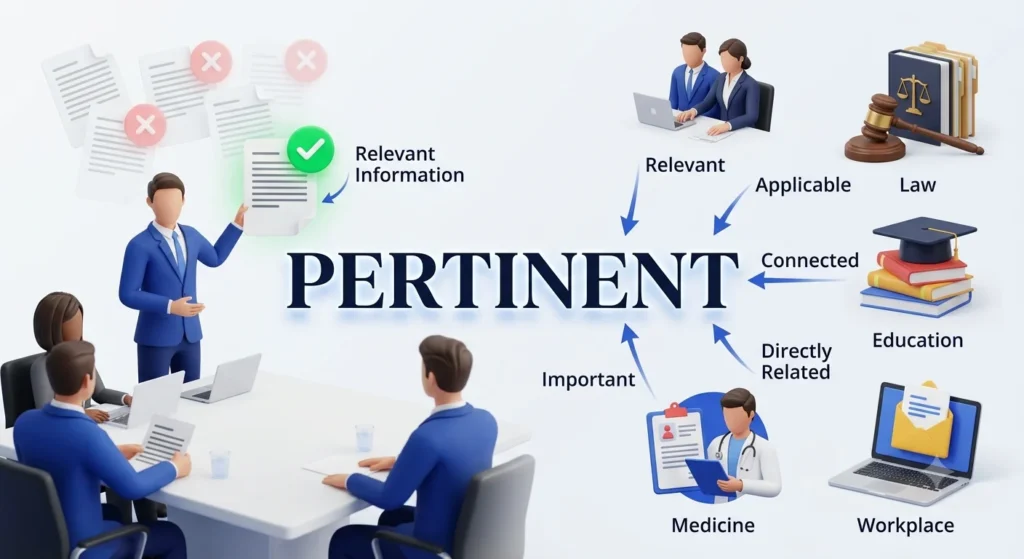
Pertinent (adjective) means directly related, relevant, or applicable to a specific topic, question, or situation. It describes information, facts, evidence, comments, or questions that have a clear and meaningful connection to what is being discussed.
Unlike information that is merely interesting, pertinent information is useful because it helps explain, support, or resolve the matter at hand.
Simple Definition
Pertinent means directly related to the subject being discussed and important because it helps answer or explain that subject.
Dictionary-Style Definition
Pertinent (adjective): Having a logical or direct connection to a particular matter; relevant, applicable, and significant to the discussion or situation.
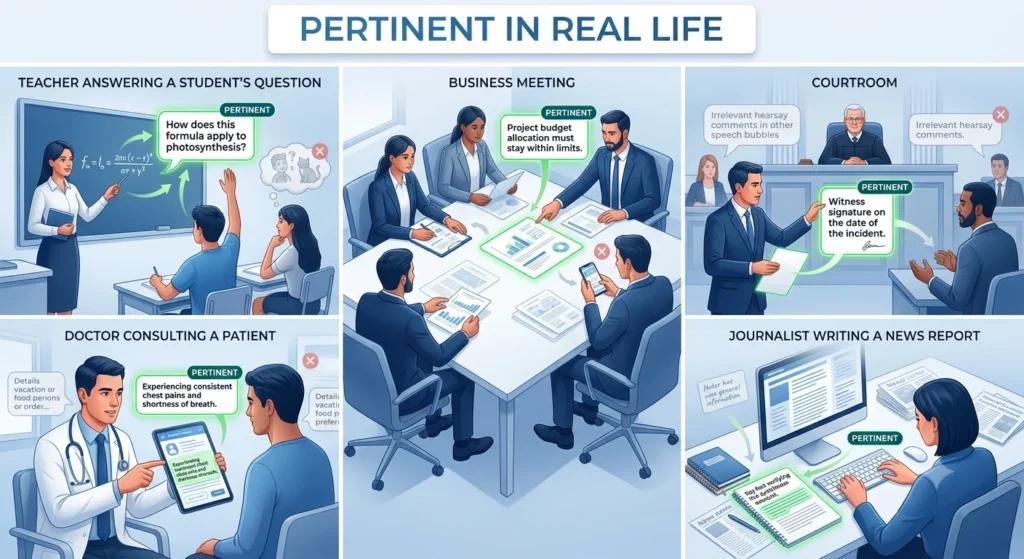
⚡ Quick Examples
Understanding pertinent becomes much easier when you see it in real-life situations.
Example 1
Teacher:
“Please include only the pertinent facts in your essay.”
✅ Only facts that directly support your topic should be included.
Example 2
Manager:
“Let’s focus on the pertinent issues before discussing future plans.”
✅ The manager wants to discuss the issues that are directly affecting the project.
Example 3
Doctor:
“Tell me any pertinent medical history.”
✅ The doctor only needs medical information related to your current condition.
Example 4
Lawyer:
“Only pertinent evidence will be presented to the court.”
✅ The evidence must directly relate to the legal case.
🌍 Origin and Etymology of Pertinent
The word pertinent has been part of the English language for more than 600 years.
It comes from the Latin verb pertinēre, meaning:
- to relate to
- to concern
- to belong to
- to have reference to
The word later passed into Old French as pertinent, where it described something appropriate or closely connected to a particular matter.
During the 14th century, it entered Middle English, appearing mainly in legal and scholarly writing. Over time, its meaning expanded into business, education, medicine, journalism, and professional communication.
Today, pertinent remains one of the clearest and most precise ways to describe information that is directly connected to a subject.
📅 Evolution of the Word
| Time Period | Language | Development |
|---|---|---|
| Ancient Rome | Latin (pertinēre) | To relate to or concern |
| 12th–13th Century | Old French | Used for matters directly connected to a subject |
| 14th Century | Middle English | Adopted into legal and academic writing |
| Modern English | Global English | Common in business, law, medicine, research, education, and professional communication |
🌟 Why “Pertinent” Is Still Important Today
Every day we receive enormous amounts of information through emails, meetings, social media, reports, research papers, and conversations.
The challenge isn’t finding information.
The challenge is identifying which information actually matters.
That’s where pertinent becomes valuable.
Imagine attending a business meeting.
The manager asks everyone for project updates.
One employee starts talking about last weekend’s football match.
Another explains that a supplier delayed delivery by two weeks.
Which response is pertinent?
Clearly, the second one.
It directly relates to the meeting’s purpose and helps the team make informed decisions.
The same principle applies in many professions.
In Law
Only pertinent evidence is considered during a trial.
In Medicine
Doctors record only pertinent medical history before diagnosing a patient.
In Education
Teachers expect students to provide pertinent examples that support their arguments.
In Journalism
Reporters include only pertinent facts that help readers understand the story.
Whether you’re writing an email, giving a presentation, conducting research, or participating in a discussion, understanding what is pertinent helps you communicate with greater clarity and professionalism.
💬 Pertinent Meaning in Different Contexts
Although the core meaning never changes, pertinent takes on slightly different shades depending on where it’s used.
🗣️ Pertinent Meaning in Everyday English
In everyday conversation, pertinent describes something that is directly related to the current discussion or situation.
Examples
✅ “That’s a pertinent question.”
✅ “Her comments were pertinent to today’s topic.”
✅ “Please keep your remarks pertinent.”
People often use relevant instead because it sounds more conversational, but pertinent is more precise.
💼 Pertinent Meaning in Business
In business, pertinent refers to information, reports, updates, documents, or recommendations that directly affect a project, decision, or objective.
Examples
✅ “Submit only the pertinent documents.”
✅ “The report contains all pertinent financial information.”
✅ “Let’s discuss the most pertinent issues first.”
Professional communication often favors pertinent because it emphasizes usefulness as well as relevance.
⚖️ Pertinent Meaning in Law
In legal English, pertinent describes evidence, testimony, documents, or facts that have a direct bearing on a legal matter.
Examples
✅ “The attorney presented only pertinent evidence.”
✅ “The judge ruled that the question wasn’t pertinent.”
Because legal decisions rely on precise facts, pertinent is one of the most frequently used adjectives in legal writing.
🎓 Pertinent Meaning in Academic Writing
Students, professors, and researchers use pertinent to describe evidence, sources, data, and arguments that directly support a research question or thesis.
Examples
✅ “The researcher cited only pertinent studies.”
✅ “Your essay needs more pertinent examples.”
Using pertinent instead of repeatedly writing relevant can make academic writing sound more polished and precise.
🏥 Pertinent Meaning in Medicine
Doctors use pertinent when discussing medical history, symptoms, medications, allergies, and examination findings that directly affect diagnosis or treatment.
Examples
✅ “The physician reviewed the patient’s pertinent medical history.”
✅ “Please report any pertinent allergies.”
📊 Context Comparison
| Context | Meaning | Example |
|---|---|---|
| Everyday English | Directly related | “That’s a pertinent question.” |
| Business | Relevant to a decision | “Share only pertinent updates.” |
| Law | Related to the legal case | “Only pertinent evidence is admissible.” |
| Academic | Supporting the research topic | “Use pertinent sources.” |
| Medicine | Important for diagnosis or treatment | “Record pertinent medical history.” |
💬 How to Use Pertinent Correctly
Knowing the definition of pertinent is only the first step. To sound natural and professional, you also need to know when to use it—and when not to.
A simple rule to remember is this:
Use “pertinent” when something has a direct connection to the topic and helps explain, support, or solve the issue being discussed.
If the information doesn’t contribute to the discussion, it isn’t pertinent—even if it’s interesting.
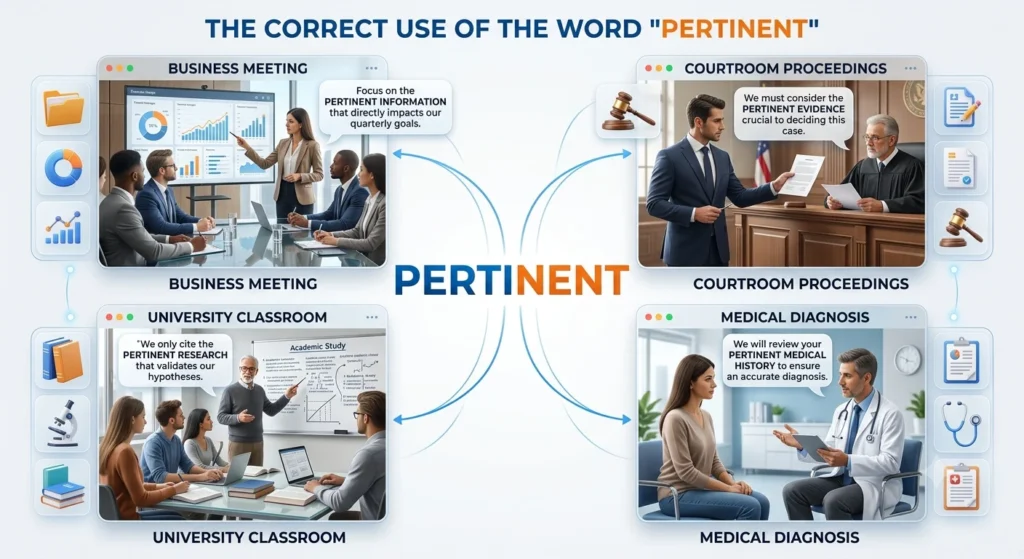
✅ When Should You Use “Pertinent”?
You can confidently use pertinent when referring to:
- Information
- Facts
- Evidence
- Questions
- Comments
- Documents
- Research
- Data
- Findings
- Issues
- Details
- Observations
- Testimony
- Medical history
Examples
✔ “Please include only the pertinent details.”
✔ “The witness provided pertinent evidence.”
✔ “Her question was highly pertinent.”
✔ “The report contains all pertinent information.”
✔ “The professor appreciated the student’s pertinent observations.”
🚫 When Should You NOT Use “Pertinent”?
Many English learners mistakenly use pertinent to describe things that aren’t related to relevance.
Incorrect
❌ The pizza was pertinent.
❌ I bought a pertinent phone.
❌ The weather was pertinent.
❌ She wore a pertinent dress.
These sentences sound unnatural because pertinent doesn’t describe food, weather, clothing, or objects by themselves.
Instead, use it only when talking about how something relates to a specific subject or purpose.
Correct
✔ The information was pertinent.
✔ The documents were pertinent to the investigation.
✔ His comments were pertinent to today’s meeting.
⭐ Real-Life Examples of Pertinent
The best way to master a new word is by seeing it in realistic situations.
Below are examples from different areas of everyday life.
🗣️ Everyday Conversation
Emma:
“Should I mention my vacation during the presentation?”
Liam:
“Only if it’s pertinent to your topic.”
Teacher:
“Does anyone have questions?”
Student:
“I have one pertinent question about today’s lesson.”
Friend:
“Let’s stay focused and discuss only what’s pertinent.”
💼 Business Examples
Business professionals often use pertinent in meetings, reports, emails, and presentations.
Examples
✔ “Please send all pertinent documents before Friday.”
✔ “Let’s focus on the most pertinent issues.”
✔ “The report summarizes the pertinent financial data.”
✔ “The manager requested pertinent project updates.”
✔ “Only pertinent information should be shared with the client.”
Sample Business Email
Subject: Weekly Project Update
Hi Team,
Please include only the pertinent information related to this week’s progress. Focus on completed tasks, current challenges, and any decisions requiring approval.
Thank you.
⚖️ Legal Examples
Because legal decisions rely on facts, pertinent is extremely common in legal writing.
Examples
✔ “The attorney presented only pertinent evidence.”
✔ “The judge ruled that the question wasn’t pertinent.”
✔ “Only pertinent facts should be considered.”
✔ “These documents are pertinent to the investigation.”
✔ “The witness gave pertinent testimony.”
🎓 Academic Examples
Researchers and students frequently use pertinent to describe sources and evidence.
Examples
✔ “Use only pertinent research.”
✔ “The paper contains several pertinent findings.”
✔ “The professor appreciated her pertinent analysis.”
✔ “The article provides pertinent examples.”
✔ “Support every claim with pertinent evidence.”
🏥 Medical Examples
Healthcare professionals use this word every day.
Examples
✔ “The doctor reviewed the patient’s pertinent medical history.”
✔ “Please mention any pertinent allergies.”
✔ “The physician documented pertinent findings.”
✔ “The nurse recorded all pertinent medications.”
✔ “These symptoms are pertinent to the diagnosis.”
📰 Journalism Examples
Good journalists focus only on facts that help readers understand the story.
Examples
✔ “The article included only pertinent facts.”
✔ “Editors removed details that weren’t pertinent.”
✔ “The report focused on the most pertinent issues.”
📚 Common Collocations with “Pertinent”
Native English speakers naturally combine pertinent with certain nouns. Learning these collocations makes your writing sound more fluent and authentic.
| Common Collocation | Example |
|---|---|
| Pertinent information | Please provide pertinent information. |
| Pertinent details | Include only pertinent details. |
| Pertinent question | That’s a pertinent question. |
| Pertinent evidence | The lawyer presented pertinent evidence. |
| Pertinent facts | The report summarizes pertinent facts. |
| Pertinent documents | Submit all pertinent documents. |
| Pertinent findings | The study revealed pertinent findings. |
| Pertinent research | Use pertinent research to support your claim. |
| Pertinent records | The auditor reviewed pertinent records. |
| Pertinent observations | Her pertinent observations improved the report. |
| Pertinent updates | Share pertinent updates every Monday. |
| Pertinent comments | Thank you for your pertinent comments. |
Writing Tip: These word combinations appear frequently in books, newspapers, academic journals, and professional communication, making them valuable for both vocabulary building and natural writing.
🎯 Expert Writing Tips
Professional writers often choose pertinent because it sounds more precise than relevant.
Instead of writing:
“The report contains important information.”
Write:
“The report contains pertinent information that directly supports the decision.”
Instead of:
“She asked a good question.”
Write:
“She asked a pertinent question that moved the discussion forward.”
Small word choices like these make your writing clearer, more professional, and more persuasive.
💡 Memory Trick
If you’re unsure whether to use pertinent, remember this simple formula:
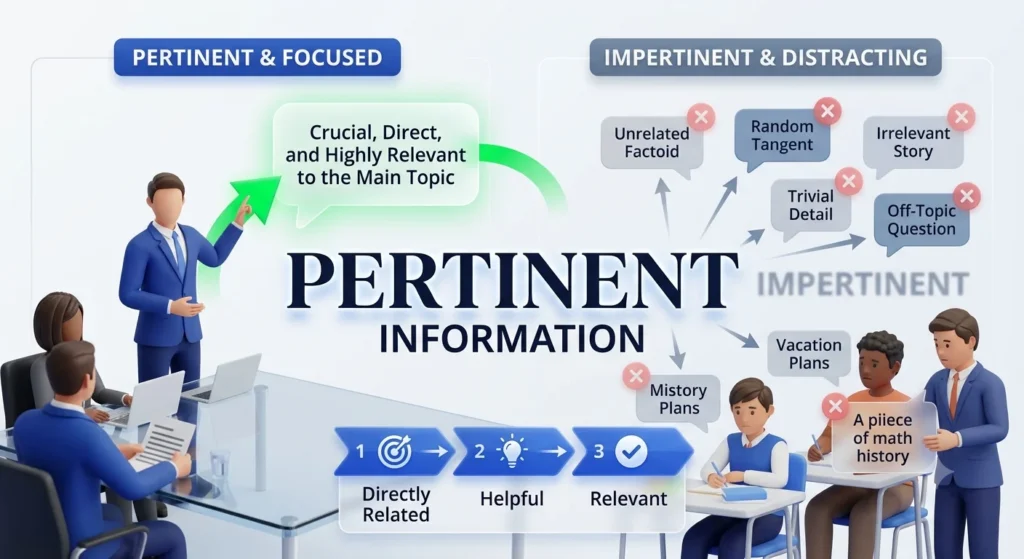
Pertinent = Directly Related + Helpful + Context-Specific
If all three conditions are true, pertinent is probably the right word.
🔍 Pertinent vs. Relevant: What’s the Difference?
Many people assume pertinent and relevant mean exactly the same thing. While they are close synonyms, they are not completely interchangeable.
Both words describe something connected to a topic, but pertinent suggests a stronger and more direct relationship. It emphasizes that the information is not only related but also useful and important to the discussion.

Think of it this way:
- Relevant = Connected to the topic.
- Pertinent = Directly connected and helpful for understanding or solving the topic.
Example
Imagine you’re writing a report about renewable energy.
Information about solar panels is pertinent because it directly supports your topic.
Information about the history of electricity may be relevant, but unless your report discusses historical development, it isn’t the most pertinent information.
Another Everyday Example
Suppose a teacher asks,
“Why did World War II begin?”
A student starts talking about ancient Rome.
Although history is the same subject, the answer isn’t pertinent because it doesn’t directly answer the question
⭐ Pertinent vs. Important
Another common misunderstanding is thinking that important and pertinent mean the same thing.
They don’t.
Something can be very important but still have nothing to do with the current discussion.
Example
Your passport is extremely important.
But if you’re discussing your math homework, your passport isn’t pertinent.
Likewise, your favorite movie may be important to you personally, but it isn’t pertinent during a business meeting unless the discussion is actually about films.
Comparison
| Pertinent | Important |
|---|---|
| Related to the current topic | Valuable or significant |
| Depends on context | Can be important in any situation |
| Helps answer the question | Doesn’t always relate to the discussion |
📚 Pertinent vs. Applicable
These words overlap but focus on different ideas.
Applicable means something can be used in a particular situation.
Pertinent means something directly relates to that situation.
Example
“This company policy is applicable to all employees.”
“This report contains pertinent information for today’s meeting.”
The policy is usable.
The report is directly connected to the discussion
⚠️ Pertinent vs. Impertinent
This pair confuses many English learners because the words look almost identical.
However, they have completely different meanings.
Pertinent
Means:
- Relevant
- Appropriate
- Directly related
Impertinent
Means:
- Rude
- Disrespectful
- Intrusive
- Inappropriate
Examples
✅ “She asked a pertinent question during the presentation.”
(The question helped the discussion.)
❌ “She asked an impertinent question about his salary.”
(The question was too personal and considered rude.)
Side-by-Side Comparison
| Pertinent | Impertinent |
|---|---|
| Relevant | Rude |
| Appropriate | Disrespectful |
| Helpful | Intrusive |
| Professional | Offensive |
| Related to the topic | Not appropriate socially |
🌍 Pertinent vs. Related
Many learners also compare pertinent with related.
Although both indicate a connection, related is much broader.
Two things can be related without being directly useful to the discussion.
Example
Marketing experience is related to business.
This quarter’s sales figures are pertinent to today’s board meeting because they directly influence current decisions.
📊 Which Word Should You Choose?
Use this quick guide whenever you’re unsure.
| Situation | Best Word |
|---|---|
| Everyday conversation | Relevant |
| Formal email | Pertinent |
| Business report | Pertinent |
| Research paper | Pertinent |
| Legal document | Pertinent |
| Medical record | Pertinent |
| Classroom discussion | Pertinent |
| Friendly conversation | Relevant |
| General connection | Related |
| Rule or procedure | Applicable |
💡 Quick Memory Trick
Remember this simple formula:
Relevant = Connected
Pertinent = Connected + Directly Useful
If a piece of information helps answer the question, support an argument, or solve a problem, it’s pertinent.
🚫 Common Misconceptions
❌ Myth 1: Pertinent simply means important.
Reality: Something can be important without being related to the discussion.
❌ Myth 2: Relevant and pertinent are always identical.
Reality: Every pertinent fact is relevant, but not every relevant fact is truly pertinent.
❌ Myth 3: Pertinent sounds too formal to use.
Reality: While it’s more common in professional settings, using pertinent appropriately can make your writing clearer and more precise.
🧠 Expert Communication Tip
If you’re writing an essay, business report, legal document, or research paper, replacing relevant with pertinent in the right places can make your writing sound more polished and authoritative.
For example:
Instead of:
“Please include relevant information.”
You could write:
“Please include only the pertinent information that directly supports your recommendation.”
The second sentence is more specific and conveys exactly what the reader should provide.
📚 Most Common Collocations with “Pertinent”
These natural word combinations frequently appear in books, newspapers, research papers, and professional writing.
| Collocation | Example |
|---|---|
| Pertinent information | Please provide pertinent information. |
| Pertinent details | Include only pertinent details. |
| Pertinent facts | The report summarizes pertinent facts. |
| Pertinent evidence | The lawyer submitted pertinent evidence. |
| Pertinent question | She asked a pertinent question. |
| Pertinent issue | Let’s address the pertinent issue first. |
| Pertinent documents | Bring all pertinent documents. |
| Pertinent findings | The study revealed pertinent findings. |
| Pertinent records | The auditor reviewed pertinent records. |
| Pertinent comments | Thank you for your pertinent comments. |
| Pertinent observations | Her pertinent observations improved the report. |
| Pertinent research | Cite only pertinent research. |
| Pertinent data | The analysis includes pertinent data. |
| Pertinent testimony | The witness gave pertinent testimony. |
| Pertinent updates | Please send pertinent updates by Friday. |
❌ Incorrect vs. ✅ Correct Usage
Learning what not to say is just as important as learning the correct usage.
| ❌ Incorrect | ✅ Correct |
|---|---|
| The pizza was pertinent. | The information was pertinent. |
| She wore a pertinent dress. | She asked a pertinent question. |
| My bicycle is pertinent. | The evidence is pertinent to the case. |
| The weather was pertinent. | His comments were pertinent to the discussion. |
| I bought a pertinent laptop. | Please include only pertinent details. |
Why are these incorrect?
Because pertinent describes relevance to a specific subject, not the quality of ordinary objects like food, clothes, weather, or electronics.
💬 Quote to Remember
“Being pertinent isn’t about saying more—it’s about saying what matters most.”
This idea captures the true meaning of the word and explains why it is so common in professional communication.
🔄 Synonyms of Pertinent
Although pertinent means directly related or relevant, no single synonym works perfectly in every situation. Choosing the right word depends on the context and the level of formality.
Below are the most accurate synonyms and how they differ.
| Synonym | Meaning | Best Used In |
|---|---|---|
| Relevant | Connected to the topic | Everyday and formal English |
| Applicable | Able to be used in a situation | Business, law, education |
| Related | Connected in some way | Casual conversations |
| Appropriate | Suitable for the purpose | General communication |
| Material | Important to a legal matter | Legal writing |
| Germane | Directly relevant | Academic and legal English |
| Significant | Important or meaningful | Research and reports |
| Useful | Helpful or practical | Everyday English |
| Essential | Absolutely necessary | Professional writing |
| Suitable | Right for the situation | General English |
🌟 Best Synonyms by Context
Instead of using the same word repeatedly, native speakers naturally switch between these synonyms depending on the situation.
🗣️ Everyday English
- Relevant
- Related
- Appropriate
- Useful
Example:
“That’s a relevant point.”
💼 Business
- Applicable
- Relevant
- Essential
- Significant
Example:
“This report contains essential and pertinent information.”
🎓 Academic Writing
- Germane
- Relevant
- Significant
- Material
Example:
“The researcher cited only germane studies.”
⚖️ Legal English
- Material
- Pertinent
- Relevant
- Applicable
Example:
“The attorney presented material evidence.”
❌ Antonyms of Pertinent
The opposite of pertinent refers to something that does not relate to the topic or is unsuitable for the discussion.
| Antonym | Meaning |
|---|---|
| Irrelevant | Not related to the subject |
| Unrelated | Having no connection |
| Inapplicable | Cannot be used in the situation |
| Immaterial | Not important to the issue |
| Extraneous | Unnecessary or outside the topic |
| Off-topic | Not part of the discussion |
| Inappropriate | Not suitable |
| Impertinent | Rude or disrespectful |
📚 Common Phrases with “Pertinent”
One of the easiest ways to sound more natural is by learning the phrases that native speakers use most often.
Frequently Used Expressions
- Pertinent information
- Pertinent details
- Pertinent facts
- Pertinent evidence
- Pertinent documents
- Pertinent records
- Pertinent issue
- Pertinent question
- Pertinent findings
- Pertinent comments
- Pertinent observations
- Pertinent research
- Pertinent updates
- Pertinent testimony
- Pertinent examples
These combinations appear frequently in professional writing, research papers, legal documents, and business communication.
🌈 Aura Color Meaning: What Your Colors Say About You 2025
💬 Common Expressions in Context
Pertinent to the discussion
“Please keep your comments pertinent to the discussion.”
Pertinent to the case
“Only evidence pertinent to the case will be admitted.”
Pertinent information
“Applicants should provide all pertinent information.”
Pertinent documents
“Please attach all pertinent documents with your application.”
It is pertinent to note that…
This expression is common in reports, essays, and research papers.
Example:
“It is pertinent to note that customer satisfaction increased after the policy update.”
✍️ Grammar Tips
Using pertinent correctly isn’t difficult, but there are a few grammar rules worth remembering.
Rule 1: Pertinent Is an Adjective
It describes nouns.
✔ Correct
“The evidence is pertinent.”
❌ Incorrect
“The evidence pertinents.”
Rule 2: Use “Pertinent to”
The most natural construction is:
pertinent + to
✔ Correct
“The information is pertinent to the investigation.”
❌ Less Natural
“The information is pertinent for the investigation.”
Rule 3: Avoid Repetition
If you’ve already used pertinent several times in one section, switch naturally to words like:
- relevant
- applicable
- related
- significant
This improves readability and prevents keyword stuffing.
Rule 4: Match the Formality
Because pertinent is a formal word, it’s most appropriate in:
- Academic essays
- Business reports
- Legal writing
- Research papers
- Professional emails
In casual conversations, relevant often sounds more natural.
🚫 Common Mistakes to Avoid
Understanding these mistakes will help you use pertinent confidently.
Mistake 1: Confusing “Pertinent” with “Impertinent”
Although they look similar, their meanings are completely different.
✔ Pertinent = relevant.
✔ Impertinent = rude or disrespectful.
Example
✔ “She asked a pertinent question.”
✔ “He made an impertinent remark.”
Mistake 2: Using It for Unrelated Objects
❌ “That’s a pertinent pizza.”
✔ “That’s pertinent information.”
Remember, pertinent describes relevance, not the quality of an object.
Mistake 3: Assuming It Means “Important”
Something can be important without being pertinent.
Example
Your graduation is important.
But during a meeting about sales targets, it isn’t pertinent.
Mistake 4: Forgetting the Context
Avoid writing:
“This article is pertinent.”
Instead write:
“This article is pertinent to modern environmental policy.”
Adding the context makes your meaning much clearer.
210+ Hooch Meaning Explained 🥃 | Your Ultimate Guide 2025
❓ Frequently Asked Questions
1. What does pertinent mean in simple words?
Pertinent means directly related or relevant to the topic being discussed. It describes information, questions, facts, comments, or evidence that clearly connect to the subject and help explain or solve it.
Example:
“Her question was pertinent to today’s discussion.”
2. Is pertinent the same as relevant?
Not exactly.
Both words describe something connected to a topic, but pertinent usually implies a stronger and more direct connection.
- Relevant = connected to the topic.
- Pertinent = directly connected and especially useful.
Because of this, pertinent is often preferred in professional and academic writing.
3. Is pertinent a formal word?
Yes.
Pertinent is considered a formal English adjective and is commonly used in:
- Business meetings
- Legal documents
- Academic papers
- Medical records
- Research reports
- Professional emails
In everyday conversations, people often use relevant instead because it sounds more natural.
4. What is an example of pertinent?
Here are a few examples:
- “Please include only pertinent information.”
- “The lawyer presented pertinent evidence.”
- “She asked a pertinent question.”
- “The report contains pertinent findings.”
5. What does pertinent information mean?
Pertinent information refers to details that are directly related to a specific subject or situation.
For example, during a doctor’s appointment, your recent symptoms and medical history are pertinent information, while unrelated personal stories are not.
6. What are pertinent documents?
Pertinent documents are documents that directly relate to a particular matter, application, investigation, project, or legal case.
Examples include:
- Employment contracts
- Medical records
- Financial statements
- Court documents
- Research papers
Only documents that help explain or support the issue are considered pertinent.
7. How do you pronounce pertinent?
American English
PUR-tuh-nent
IPA:
/ˈpɝː.tə.nənt/
The stress falls on the first syllable.
8. What part of speech is pertinent?
Pertinent is an adjective because it describes nouns.
Examples:
- pertinent question
- pertinent information
- pertinent evidence
- pertinent documents
9. What is the difference between pertinent and important?
Something may be important without being pertinent.
For example:
Your passport is important.
However, during a classroom discussion about Shakespeare, your passport isn’t pertinent because it has no direct connection to the topic.
10. What is the opposite of pertinent?
Common antonyms include:
- Irrelevant
- Unrelated
- Immaterial
- Inapplicable
- Extraneous
Although impertinent looks similar, it usually means rude or disrespectful, not simply “not pertinent.”
11. Can I use pertinent in everyday conversation?
Yes.
Native speakers understand it, but in casual situations, relevant is more common.
For example:
Formal:
“Your comments are pertinent to the discussion.”
Casual:
“Your comments are relevant.”
Both are correct, but the second sounds more conversational.
12. Is pertinent commonly used in legal English?
Absolutely.
Lawyers, judges, and legal professionals frequently use pertinent when referring to:
- evidence
- testimony
- documents
- facts
- legal arguments
Only information directly related to the case is considered pertinent.
13. Is pertinent used in medicine?
Yes.
Doctors regularly use terms such as:
- pertinent medical history
- pertinent findings
- pertinent symptoms
- pertinent medications
- pertinent negatives
These describe information that directly affects diagnosis or treatment.
14. What is the noun form of pertinent?
The noun form is pertinence.
Example:
“The judge questioned the pertinence of the evidence.”
15. What is the verb form of pertinent?
The verb is pertain.
Example:
“These regulations pertain to international students.”
🌟 Key Takeaways
Before you go, here’s a quick summary of what you’ve learned.
✅ Pertinent means directly related or relevant to a specific topic.
✅ It is widely used in business, law, medicine, education, research, and professional communication.
✅ The word comes from the Latin pertinēre, meaning “to relate to” or “to concern.”
✅ Common phrases include pertinent information, pertinent evidence, pertinent documents, and pertinent question.
✅ Although relevant and pertinent are similar, pertinent usually expresses a stronger and more precise relationship.
✅ Don’t confuse pertinent with impertinent, which means rude or disrespectful.
🏆 Conclusion
Understanding the meaning of pertinent is about more than memorizing a dictionary definition—it’s about learning how to communicate with precision. Whether you’re writing an academic essay, preparing a business report, presenting evidence in court, documenting medical information, or simply joining a conversation, using pertinent correctly helps you focus on what truly matters.
At its core, pertinent describes information that is directly related, relevant, and useful to the subject being discussed. This emphasis on relevance is why the word appears so often in professional writing, legal documents, research papers, healthcare, journalism, and workplace communication.
As your vocabulary grows, you’ll notice that choosing the right word can make a significant difference. While relevant, applicable, and important each have their place, pertinent is often the best choice when you want to emphasize that something has a clear, meaningful connection to the topic.
The next time you hear someone mention pertinent information, pertinent evidence, or a pertinent question, you’ll understand exactly why those details matter—and you’ll be able to use the word naturally and confidently in your own writing and conversations.

Ryan Blake is a content writer at Meanovia, focused on slang, texting meanings, and internet phrases. He simplifies modern online language into easy, clear, and engaging explanations 💬✨