

Ever had someone flash you a quick, half-hearted smile — one that felt more like an obligation than a genuine gesture? 😐 That’s a perfect example of “perfunctory.”
The word “perfunctory” often pops up in books, workplaces, and even conversations. It sounds formal, but its meaning is surprisingly relatable — describing those moments when people (or we) do things just to get them over with.
In this article, we’ll cover:
- The definition of “perfunctory”
- Its origin and history
- How it’s used in different contexts
- Examples you can relate to
- Similar words and how to use it correctly
- A handy FAQ section for quick answers
By the end, you’ll never have to wonder again what someone means when they say, “That was such a perfunctory effort.”
💡 What Does “Perfunctory” Mean?
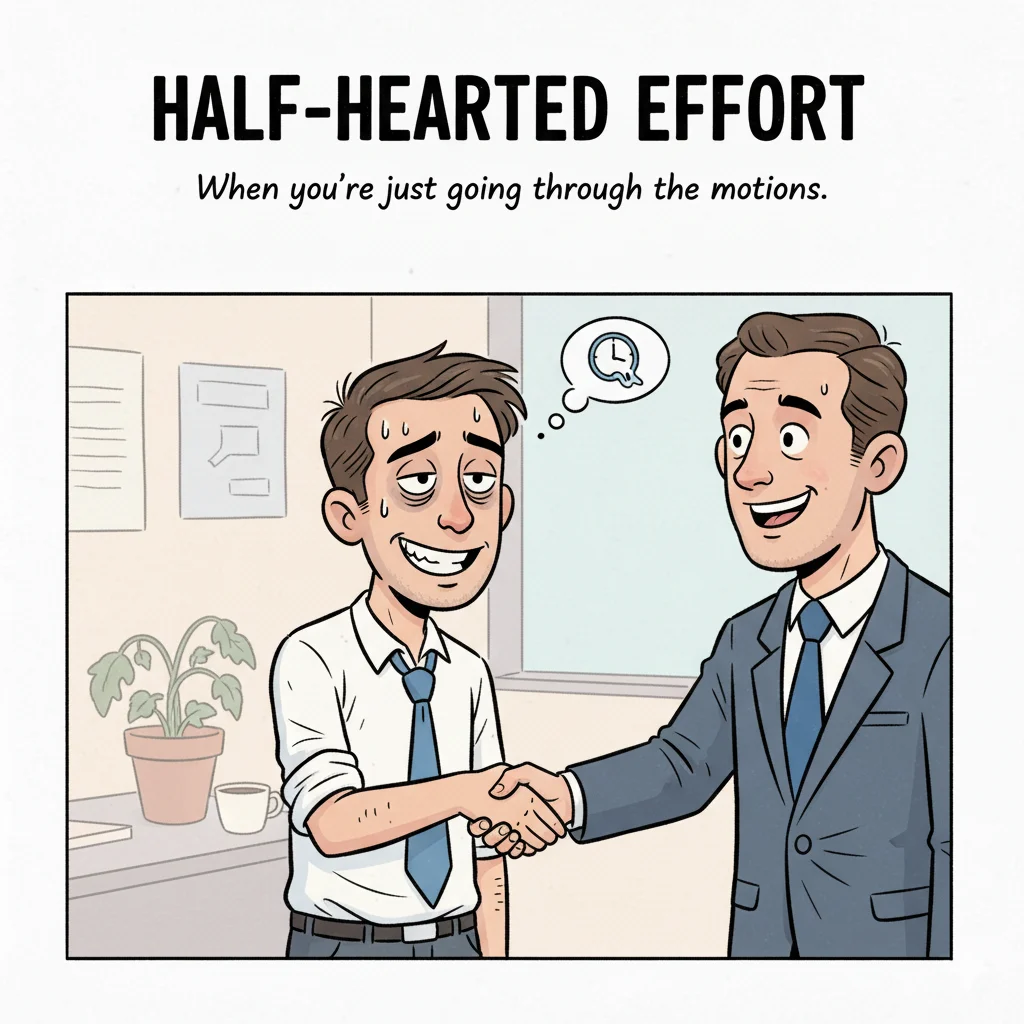
“Perfunctory” means doing something quickly and without genuine interest, care, or enthusiasm — just to get it done.
In other words, when an action is mechanical, superficial, or insincere, it’s perfunctory.
Example:
“He gave a perfunctory nod and moved on.”
It’s not about being lazy — it’s about going through the motions without true engagement.
🧠 Part of Speech: Adjective
📖 Pronunciation: /pər-FUNK-tuh-ree/
📚 Synonyms: mechanical, superficial, routine, indifferent, careless
🕰️ Origin and History
The word “perfunctory” traces back to Latin — from perfungi, meaning “to get through” or “to discharge a duty.”
- 16th century: The word entered English, describing actions performed out of duty rather than desire.
- 17th-18th century: It appeared in religious and legal writings — describing hollow rituals or formalities.
- Modern usage: It’s now common in business, education, and personal settings to describe anything done without sincerity.
📊 Fun Linguistic Note:
Writers like Charles Dickens and George Eliot frequently used “perfunctory” to criticize lifeless or routine behaviors.
💬 Example from literature:
“His apology was perfunctory, lacking the warmth of true regret.”
🌍 Popularity and Modern Usage
While it’s not trending slang, “perfunctory” remains popular in formal writing, essays, and journalism.
It’s often used to describe:
- Customer service interactions that feel fake
- Formal greetings without warmth
- Rushed meetings or reports
- Empty apologies
Search Data Insight (2025):
“Perfunctory meaning” and “perfunctory in a sentence” rank among the top searched vocabulary terms for English learners globally.
🌐 Perfunctory Meaning in Different Contexts
To understand it better, let’s explore how “perfunctory” changes slightly depending on where it’s used.
| Context | Meaning / Tone | Example Sentence |
|---|---|---|
| Everyday Conversation | Doing something without feeling | “She offered a perfunctory laugh at the joke.” |
| Workplace / Business | Completing a task with no attention to detail | “The report seemed perfunctory and lacked depth.” |
| Education / Academia | Fulfilling academic duties formally | “His attendance was perfunctory, just to keep his record clean.” |
| Literary / Creative Writing | Expressing emotional emptiness | “Her kiss was perfunctory — a habit, not love.” |
So, while the tone remains formal, the emotion behind it — indifference, haste, or duty — depends on the context.
💬 Real-Life Examples of “Perfunctory”
Here are examples that show how naturally the word fits into conversations and writing:
Example 1 (Casual):
A: “Did your boss like your idea?”
B: “He gave me a perfunctory smile. I couldn’t tell if he even listened.”
Example 2 (Business):
“The manager gave a perfunctory nod before ending the meeting.”
Example 3 (Literary):
“Her perfunctory apology echoed with insincerity.”
Example 4 (Formal Writing):
“Customer service responses often appear perfunctory when automated.”
Example 5 (Sarcastic):
“Thanks for your perfunctory effort, it really shows!”
Notice how the tone can range from neutral to slightly sarcastic depending on the context.

🧩 Related & Similar Words
Knowing similar or related terms helps you understand subtle differences:
| Word | Meaning | Key Difference |
|---|---|---|
| Mechanical | Done automatically, like a machine | Focuses on habit, not emotion |
| Superficial | Lacking depth or meaning | Broader — not limited to actions |
| Indifferent | Showing no concern or care | Describes attitude, not action |
| Routine | Regular or habitual | Neutral — doesn’t imply insincerity |
| Token | Symbolic gesture without real intent | Common in social or political contexts |
Example Comparison:
- “A mechanical reply” = automatic
- “A perfunctory reply” = emotionless, minimal effort
✍️ How to Use “Perfunctory” Correctly
When you use this word, you’re adding a hint of critique or detachment. It’s perfect for essays, reviews, and thoughtful descriptions — but use it in the right tone.
✅ Do’s
- Use it to describe half-hearted actions or minimal effort.
- Perfect for formal writing, reviews, or character analysis.
- Works beautifully in narrative writing or storytelling.
❌ Don’ts
- Don’t confuse it with “lazy.” It’s about mental disinterest, not physical inactivity.
- Avoid using it in text slang — it’s too formal for that.
- Don’t pair it with obviously emotional phrases (“a perfunctory passion” doesn’t make sense).
Correct Example:
“He gave a perfunctory wave as he left the room.”
Incorrect Example:
“She danced in a perfunctory energy” ❌ (Incorrect usage of emotion + energy.)
⚠️ Common Mistakes and Misunderstandings
- Thinking it means lazy:
❌ “Perfunctory” isn’t laziness — it’s disinterest or lack of care. - Using it for physical acts incorrectly:
You wouldn’t say “perfunctory running.” Use it for emotional or mental engagement. - Confusing with “perfectory”:
“Perfectory” isn’t a real word! It’s a common mishearing of “perfunctory.” - Overusing in casual speech:
It sounds unnatural in daily chats — better suited for writing or professional dialogue.
🧠 Why “Perfunctory” Matters in Communication
In a world full of “quick replies,” “auto-likes,” and “template responses,” perfunctory communication is everywhere.
Understanding this word helps you:
- Identify insincere behavior in others
- Reflect on your own engagement level
- Write with precision and nuance
- Sound more fluent and emotionally intelligent in English
💬 Example Thought:
“When feedback becomes perfunctory, improvement stops.”
That’s why this word is powerful — it captures emptiness beneath effort.
🔠 Etymology Deep Dive
Let’s break it down linguistically:
| Root | Language | Meaning |
|---|---|---|
| per | Latin | through, thoroughly |
| fungi | Latin | to perform or execute |
| perfunctus | Latin past participle | having performed (carelessly) |
When combined, perfungi meant “to perform carelessly or superficially.”
That exact essence lives on in the modern English “perfunctory.”
🏢 Perfunctory in Business Communication
In professional environments, perfunctory describes surface-level work or engagement.
Examples include:
- Sending reports without analysis
- Giving robotic customer responses
- Conducting meetings without true discussion
Example:
“The company’s perfunctory apology after the data breach angered customers.”
A perfunctory approach signals a lack of ownership — something businesses strive to avoid.
📚 Perfunctory in Literature and Media
Authors use “perfunctory” to convey emotional distance or pretense.
Famous examples include:
- Jane Austen: Characters offering polite but perfunctory remarks at social events.
- George Orwell: Depictions of bureaucrats performing duties mechanically.
- Modern journalism: Describing politicians’ perfunctory condolences or statements.
The word elegantly exposes the difference between appearance and sincerity.
🗣️ Quick Grammar Tips
- Adjective form: perfunctory “A perfunctory glance.”
- Adverb form: perfunctorily “He replied perfunctorily.”
- Noun form: perfunctoriness (rare) “The perfunctoriness of his work was obvious.”
📘 “Perfunctory” in Sentences
Here’s how to naturally fit it into various tones:
Formal Writing:
“The audit revealed a perfunctory review process.”
Conversational:
“His apology was so perfunctory — I doubt he even meant it.”
Academic:
“Students often provide perfunctory responses in online discussions.”
Journalistic:
“The government’s perfunctory measures failed to address public concerns.”
Creative Writing:
“Her perfunctory wave was the last sign of a fading friendship.”
🔗 Similar or Related Expressions
Here are a few expressions and idioms that echo the same spirit as “perfunctory”:
- “Going through the motions”
- “Lip service”
- “Half-hearted effort”
- “Bare minimum”
- “Tick-box exercise”
Each captures that same sense of duty without devotion.
❓ FAQ Section
1. What does “perfunctory” mean in simple English?
It means doing something without care or enthusiasm, only because it’s expected.
2. Is “perfunctory” a negative word?
Yes — it often carries a critical tone, implying a lack of sincerity.
3. How do you pronounce “perfunctory”?
Say it like pər-FUNK-tuh-ree.
4. What is an example of perfunctory behavior?
Smiling politely at someone you don’t like, or saying “thanks” without meaning it.
5. Can “perfunctory” describe people?
Indirectly, yes. It’s more accurate for their actions or attitude than their personality.
6. Is “perfunctory” too formal for daily use?
A bit — it’s great for writing, essays, and discussions, but less common in casual chat.
7. What’s the difference between “perfunctory” and “routine”?
“Routine” is neutral. “Perfunctory” adds a negative sense — the act is empty or disinterested.
🏁 Conclusion
So, what’s the true meaning of “perfunctory”?
It’s when something is done out of obligation, not enthusiasm. A perfunctory handshake, smile, or apology may look polite, but it lacks feeling.
Understanding this word helps you recognize and avoid superficial engagement — whether at work, in relationships, or in writing.
Now that you know it, try to spot “perfunctory” moments around you — and replace them with genuine care and attention.
✨ Keep exploring our 2025 Best English Word Guides to upgrade your vocabulary, one meaningful word at a time.

Evie Wyld is a word-meaning specialist at Meanovia.com. She simplifies complex words, phrases, and language trends, helping readers quickly grasp the exact meaning behind every term in a clear and approachable way.