
Most people assume paramour is just another word for lover—but that definition is only half the story. In reality, paramour is a powerful and often misunderstood word that usually describes a lover involved in a secret, extramarital, or otherwise forbidden romantic relationship, giving it a far more dramatic meaning than everyday terms like partner or boyfriend.
In short, paramour refers to a romantic or sexual lover, especially one whose relationship is hidden, illicit, or outside a committed partnership. Because of its emotional weight and historical background, the word frequently appears in classic literature, crime novels, historical accounts, news stories, movies, and song lyrics, where secrecy and passion are central themes.
Whether you’ve encountered paramour in a book, TV series, legal case, article, or online discussion, this guide explains the paramour meaning, pronunciation, origin, history, synonyms, examples, modern usage, and exactly when to use it correctly—and why it conveys a very different message from words like lover, partner, or romantic interest.
What Does Paramour Mean?
In modern English, paramour refers to a person involved in a romantic or sexual relationship, especially one that is kept secret, hidden, or considered socially unacceptable.
Simple Definition
Paramour (noun): A person who is someone’s secret or illicit lover, particularly in a relationship that is hidden or outside a socially accepted partnership.
Although secrecy is now part of the word’s common meaning, it is important to remember that context always matters. In historical writing, poetry, or older literature, paramour may simply mean a beloved person rather than someone involved in an affair.
This distinction is one of the reasons the word is often misunderstood.

What Is a Paramour Person?
A paramour is a person who shares a romantic or intimate relationship with someone, usually under circumstances involving secrecy, privacy, or social restrictions.
Depending on the context, a paramour may be:
- A secret romantic partner
- A hidden boyfriend or girlfriend
- Someone involved in an extramarital relationship
- A lover whose relationship cannot be publicly acknowledged
- A romantic partner in a forbidden love story
The word describes the nature of the relationship, not the value or character of the individual. Using the term paramour does not automatically imply moral judgment.
What Is a Paramour in a Relationship?
A paramour relationship is generally understood as a romantic relationship that exists outside public recognition or is intentionally kept private.
This secrecy may exist for many reasons, including:
- One or both people are already married.
- Cultural or religious expectations discourage the relationship.
- Family or social pressure makes the relationship difficult to reveal.
- The romance is part of a historical or fictional story involving forbidden love.
- The individuals choose to keep their relationship private.
Because of this, the word paramour appears frequently in novels, biographies, historical accounts, true-crime stories, and journalism where secrecy plays an important role.
Is a Paramour Always Someone Involved in Cheating?
No.
This is one of the biggest misconceptions about the word.
While paramour is often used in news reports about affairs or infidelity, it does not automatically mean someone has cheated.
For example, two people from rival families who secretly fall in love in a historical novel could be described as paramours, even if neither person is married. Likewise, in literature, the word may simply emphasize that the relationship is hidden or socially forbidden rather than immoral.
The context, not the word itself, determines whether the relationship involves adultery, secrecy, tragedy, or simply private romance.
📜 Origin and Etymology of “Paramour”
Understanding the origin of paramour reveals why the word feels both romantic and mysterious today.
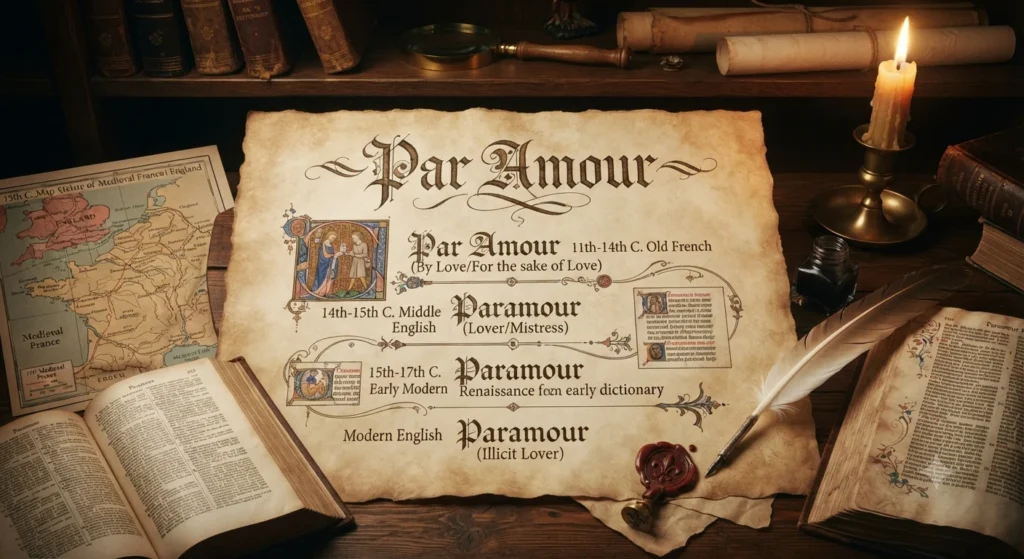
The word paramour comes from the Old French phrase par amour, meaning “for love,” “through love,” or “because of love.” During the Middle Ages, this phrase described actions inspired by affection rather than duty or obligation.
The term entered Middle English in the 13th century, where it originally referred to a beloved person, sweetheart, or someone dearly loved. At that time, it carried no implication of secrecy or infidelity.
As English evolved, so did the word’s meaning. By the 15th and 16th centuries, writers increasingly used paramour to describe lovers whose relationships existed outside marriage or social expectations. Over time, this became the dominant meaning in Modern English.
Today, although the original sense of “beloved” still appears in some historical and literary works, paramour most commonly refers to a secret, forbidden, or socially complicated romantic partner.
Word Origin Timeline
| Period | Meaning |
|---|---|
| Old French | Par amour = “For love” |
| 13th Century | Beloved or sweetheart |
| 15th–16th Century | Hidden or forbidden lover |
| Modern English | Secret or illicit romantic partner |
Did You Know?
Many English words become narrower in meaning over time. Paramour is a classic example—it began as a broad expression of love before gradually becoming associated with secret or forbidden romance.
📚 How Dictionaries Define “Paramour”
While wording differs slightly among dictionaries, they all describe the same central idea.
General Definition
Paramour (noun): A lover, especially one involved in a secret, illicit, or extramarital romantic relationship.
Most modern dictionaries emphasize two ideas:
- Romantic relationship
- Secrecy or social disapproval
Historical dictionaries, however, also recognize its older meaning of beloved.
This difference explains why readers sometimes encounter the word with slightly different meanings depending on the age and style of the text.
🗣️ Paramour Pronunciation
Many people know what paramour means but aren’t sure how to pronounce it correctly.
Standard Pronunciation
PAIR-uh-moor
IPA
/ˈpær.ə.mʊr/
Pronunciation Tip
Think of it as:
PAIR + uh + moor
The emphasis falls on the first syllable.
Common Mispronunciations
❌ para-more
❌ para-mower
❌ pair-more
Practicing the pronunciation a few times makes it sound natural in conversation.
✍️ Word Forms
| Form | Word |
|---|---|
| Singular | Paramour |
| Plural | Paramours |
| Part of Speech | Noun |
| Countable | Yes |
| Gender | Gender-neutral |
| Adjective Form | None commonly used |
| Verb Form | None |
🌍 Paramour Meaning in English
In modern English, paramour refers to a romantic or sexual partner whose relationship is usually hidden or socially disapproved of.
Unlike words such as boyfriend, girlfriend, or partner, the term immediately suggests privacy, secrecy, or forbidden romance.
Because of its formal tone, you’ll most often encounter paramour in:
- Historical novels
- Literature
- Biographies
- Court reports
- Newspapers
- Crime documentaries
- Historical dramas
It is much less common in everyday conversation.
❤️ Paramour Meaning in Love
When people search “paramour meaning in love,” they often wonder whether the word simply means someone you love.
The answer is yes—but with an important difference.
A paramour is certainly a romantic partner, but the relationship usually carries one or more of these characteristics:
- Hidden from others
- Emotionally intense
- Socially complicated
- Forbidden
- Private
Example:
The prince risked everything to protect his beloved paramour.
Here, the relationship is romantic, but the secrecy adds emotional depth.
🧠 The Psychology Behind the Word
One reason paramour continues to fascinate readers is its emotional complexity.
Unlike neutral relationship terms, it often evokes ideas such as:
- longing
- sacrifice
- mystery
- devotion
- hidden affection
- emotional conflict
These associations make the word especially powerful in literature, poetry, and storytelling, where emotional nuance is important.
📖 Paramour in Literature
Authors have used paramour for centuries because it instantly creates an atmosphere of romance and intrigue.
Instead of saying girlfriend or lover, writers often choose paramour when they want readers to sense:
- forbidden love
- secret meetings
- emotional tension
- historical romance
- tragic relationships
Literary Example
Every poem he wrote was dedicated to his loyal paramour.
The word gives the sentence a timeless, poetic quality that simpler alternatives often lack.
🏰 Paramour in History
Historical records frequently mention paramours when describing kings, queens, nobles, and influential public figures.
Secret relationships sometimes affected:
- royal succession
- political alliances
- family reputation
- public opinion
Because of this, historians often used the term paramour when documenting relationships that influenced important historical events.
Its repeated appearance in historical writing helped shape the modern meaning we recognize today.
⚖️ Paramour Meaning in Court
Another common search is:
What does paramour mean in court?
Although paramour is not a legal term, it sometimes appears in legal documents when a romantic relationship is relevant to a case.
Examples include:
- Divorce proceedings
- Child custody disputes
- Estate and inheritance cases
- Criminal investigations
Example:
Investigators questioned the defendant’s alleged paramour during the trial.
In legal writing, the word simply identifies a person connected to the case through a romantic relationship. It does not assign guilt or make a moral judgment.
PTSO Meaning: The Secret Role in Schools You Should Know
💞 Paramour vs. Polyamory
Many readers confuse these terms because both involve romantic relationships.
However, they describe very different situations.
| Paramour | Polyamory |
|---|---|
| Usually hidden | Usually open and consensual |
| Often linked with secrecy | Built on honesty and agreement |
| Frequently appears in literature | Modern relationship term |
| May involve an affair | Does not necessarily involve infidelity |
Someone in a polyamorous relationship is not automatically someone’s paramour.
The key difference is secrecy versus openness.
🌎 Paramour Meaning in Different Languages
Paramour Meaning in Urdu
خفیہ محبوب
خفیہ عاشق
پوشیدہ رومانوی ساتھی
Example:
وہ اپنے خفیہ محبوب سے خاموشی سے ملا۔
Paramour Meaning in Hindi
गुप्त प्रेमी
गुप्त प्रेमिका
छिपे हुए प्रेम संबंध में शामिल व्यक्ति
Paramour Meaning in Arabic
Depending on context:
- عشيق
- عشيقة
The exact translation varies depending on whether the emphasis is on romance, secrecy, or historical context.
Paramour Meaning in French
The English word originates from the Old French phrase:
Par amour
Meaning:
- For love
- Through love
- Because of love
Although Modern French uses different everyday words for “lover,” this historical phrase remains the linguistic root of the English word paramour.
🌍 Meaning in Other Languages
Many readers also search for:
- Paramour meaning in Tamil
- Paramour meaning in Telugu
- Paramour meaning in Malayalam
- Paramour meaning in Marathi
- Paramour meaning in Tagalog
While translations vary slightly between languages and cultures, the central meaning remains:
A romantic partner involved in a relationship that is secret, hidden, or socially restricted.
Because every language expresses relationships differently, there is rarely a perfect one-word equivalent.
Paramour vs. Lover: What’s the Difference?
One of the most common questions people ask is:
“What is the difference between a lover and a paramour?”
Although the two words are closely related, they are not identical.

A lover is any person involved in a romantic or sexual relationship. The relationship may be public, private, casual, committed, or even within marriage.
A paramour, however, usually refers to someone involved in a relationship that is secret, hidden, forbidden, or socially complicated.
In other words, every paramour is a lover, but not every lover is a paramour.
Quick Comparison
| Lover | Paramour |
|---|---|
| Any romantic partner | Usually a secret romantic partner |
| May be public | Usually hidden or discreet |
| Neutral everyday word | Formal and literary word |
| Doesn’t imply secrecy | Often suggests secrecy or forbidden love |
| Common in conversation | More common in books, history, journalism, and legal writing |
Examples
Lover
They have been lovers for many years.
Nothing suggests the relationship is hidden.
Paramour
The politician’s alleged paramour became the focus of media attention.
Here, the word immediately implies a private or controversial relationship.
Paramour vs. Affair Partner
People also search for another word for secret lover or affair partner.
Although these expressions overlap, they are not exact synonyms.
| Paramour | Affair Partner |
|---|---|
| Formal and literary | Modern and straightforward |
| May describe historical or fictional romance | Usually refers to infidelity |
| Doesn’t always involve cheating | Almost always involves cheating |
| Often found in literature | Common in relationship discussions |
An affair partner specifically refers to someone involved in an affair, while paramour can also describe secret or forbidden love in historical, literary, or fictional settings.
Paramour vs. Mistress
Another word people often confuse with paramour is mistress.
Mistress
Traditionally refers to:
- A woman
- In a romantic relationship with a married man
Paramour
Can refer to:
- A man
- A woman
- Any gender
Unlike mistress, paramour is gender-neutral.
Modern writers often prefer paramour because it is more inclusive and places emphasis on the relationship rather than the person’s gender.
Paramour vs. Partner
A partner is simply someone with whom a person shares a romantic relationship.
Examples include:
- Husband
- Wife
- Boyfriend
- Girlfriend
- Fiancé
- Fiancée
- Long-term partner
A paramour, on the other hand, usually suggests that the relationship is hidden or exists outside normal public recognition.
Paramore vs. Paramour
This is one of the biggest search confusions online.
| Paramore | Paramour |
|---|---|
| Name of an American rock band | English word meaning secret lover |
| Proper noun | Common noun |
| Refers to music | Refers to a person |
| Pronounced differently | Means hidden romantic partner |
Many users accidentally type Paramore meaning when they actually want Paramour meaning.
Understanding this difference can save confusion during online searches.
Is Paramour a Bad Word?
A frequent question is:
“Is paramour a bad word?”
No.
The word itself is not offensive, vulgar, or insulting.
However, because it often appears in stories involving secret relationships or affairs, many people assume it carries a negative meaning.
The truth is:
The word is neutral.
Its emotional tone depends entirely on the situation in which it is used.
Comradery Meaning: Why It’s More Than Just Friendship
Is Paramour a Derogatory Term?
Again, no.
A derogatory word is intended to insult someone.
Paramour simply describes a type of romantic relationship.
For example:
The novel tells the tragic story of a soldier and his paramour.
The sentence does not insult either person.
Likewise:
Court records identified the defendant’s alleged paramour.
The word is descriptive rather than judgmental.
Is Paramour Always Secret?
In modern English, usually yes.
However, in older literature, paramour sometimes simply means beloved.
This is why understanding the context is essential.
Can a Husband or Wife Be Called a Paramour?
Generally, no.
People normally use:
- Husband
- Wife
- Spouse
- Partner
Calling your spouse your paramour would sound unusual unless you are deliberately writing in a poetic or humorous style.
Can a Boyfriend or Girlfriend Be a Paramour?
Yes—but only if the relationship is intentionally hidden.
For example:
Two university students secretly dating because their families disapprove.
In that situation, either person could be described as the other’s paramour.
Is Paramour Male or Female?
Another common search is:
Is paramour male or female?
The answer is:
Both.
The word is completely gender-neutral.
Examples:
✔ The king’s paramour
✔ The queen’s paramour
✔ His paramour
✔ Her paramour
✔ Their paramour
The meaning remains the same regardless of gender.
Paramour Synonyms
Depending on the context, these words may have similar meanings.
| Synonym | Best Used When |
|---|---|
| Lover | General romantic relationship |
| Secret lover | Hidden relationship |
| Beloved | Literary writing |
| Sweetheart | Informal affection |
| Romantic partner | Neutral situations |
| Companion | Long-term relationship |
| Affair partner | Infidelity context |
| Admirer | Romantic interest |
| Soulmate | Deep emotional bond |
Although these words are related, none carries exactly the same nuance as paramour, especially when secrecy is central to the relationship.
Paramour Antonyms
There is no perfect opposite, but depending on context, possible antonyms include:
- Spouse
- Husband
- Wife
- Friend
- Stranger
The correct opposite depends on how the word is being used.
Real-Life Examples of “Paramour”
Reading real examples helps you understand how native English speakers naturally use the word.
Everyday Conversation
Friend 1:
“Did you hear about the actor’s alleged paramour?”
Friend 2:
“Yes, it’s been making headlines all week.”
Literature
He crossed the kingdom every winter to see his beloved paramour.
Historical Writing
The emperor secretly protected his paramour despite strong opposition from the royal court.
Journalism
The investigation mentioned the businessman’s alleged paramour several times.
Legal Context
Court documents referred to the witness as the defendant’s alleged paramour.
Romantic Fiction
Every letter he wrote ended with a promise to return to his paramour.
Biography
Historians continue to debate the identity of the artist’s rumored paramour.
How to Use “Paramour” Correctly
✅ Do
- Use it in historical writing.
- Use it in literature and storytelling.
- Use it when secrecy is part of the relationship.
- Use it in formal writing and journalism.
- Use it when discussing historical or legal contexts.

❌ Don’t
- Don’t use it for every boyfriend or girlfriend.
- Don’t assume it always means adultery.
- Don’t use it as an insult.
- Don’t confuse it with spouse or partner.
When NOT to Use “Paramour”
Avoid using paramour when referring to ordinary, publicly acknowledged relationships.
Incorrect
❌ This is my paramour, Sarah.
Better
✔ This is my wife, Sarah.
✔ This is my partner, Sarah.
Incorrect
❌ My husband is my paramour.
Better
✔ My husband is my spouse.
Incorrect
❌ They’re happily married paramours.
Better
✔ They’re happily married.
Using the right word makes your English sound more natural.
Common Spelling Mistakes
Because the word is uncommon, people frequently misspell it.
Common mistakes include:
- Paramore
- Paramor
- Paramoor
- Pramour
- Paramoure
- Paramorr
If you’re referring to a secret lover, the correct spelling is always:
Paramour
Common Mistakes and Misconceptions
❌ Myth: Paramour always means cheating.
Reality: It often implies secrecy, but not every secret relationship involves infidelity.
❌ Myth: Paramour refers only to women.
Reality: It is completely gender-neutral.
❌ Myth: Paramour is slang.
Reality: It is a formal English word used in literature, journalism, and historical writing.
❌ Myth: Paramour means exactly the same as lover.
Reality: A paramour usually suggests secrecy, while a lover is a broader term.
Common Myths vs. Facts
| Myth | Fact |
|---|---|
| Paramour always means adultery. | ❌ No. It usually implies secrecy, but not necessarily cheating. |
| Paramour only refers to women. | ❌ False. It is gender-neutral. |
| Paramour is slang. | ❌ It is a formal English word. |
| Paramour and lover always mean the same thing. | ❌ A paramour usually implies secrecy. |
| The word is offensive. | ❌ It is descriptive, not insulting. |
| Only old books use paramour. | ❌ It still appears in journalism, biographies, legal writing, and modern fiction. |
Frequently Asked Questions (FAQs)
What does paramour mean in simple words?
A paramour is a person involved in a secret or forbidden romantic relationship. While the word often describes a hidden lover, its exact meaning depends on the context. In older literature, it could simply mean a beloved person.
What is a paramour in a relationship?
A paramour is someone with whom a person shares a romantic or intimate relationship that is usually kept secret, socially restricted, or outside a publicly recognized partnership.
What is a paramour person?
A paramour is a romantic partner, especially one whose relationship is private, hidden, or considered socially unacceptable. The word describes the relationship rather than judging the person’s character.
What is the difference between a lover and a paramour?
A lover can be any romantic or sexual partner.
A paramour is usually a lover whose relationship is secret, forbidden, or discreet.
The main difference is secrecy.
Is paramour a derogatory term?
No.
Paramour is a neutral English noun. It is descriptive rather than insulting. Although it often appears in stories involving affairs or hidden relationships, the word itself is not offensive.
Is paramour a bad word?
No.
It is a formal English word used in literature, history, journalism, biographies, and legal writing. Whether the relationship is viewed positively or negatively depends entirely on the surrounding context.
Can a husband or wife be called a paramour?
Generally, no.
Words such as husband, wife, spouse, or partner are more appropriate for publicly recognized relationships. Paramour is usually reserved for relationships involving secrecy or hidden romance.
Can a boyfriend or girlfriend be a paramour?
Yes—if the relationship is intentionally hidden due to family expectations, cultural reasons, social pressure, or other circumstances. In that case, either person could be described as the other’s paramour.
Is paramour always associated with cheating?
No.
Although the word is frequently used in discussions about affairs, it can also describe secret or forbidden love that has nothing to do with infidelity. Context is what determines the meaning.
Is paramour used for individuals?
Yes.
Paramour is completely gender-neutral and may refer to a man, a woman, or any person in a hidden romantic relationship.
What is another word for paramour?
Depending on the situation, similar words include:
- Lover
- Secret lover
- Beloved
- Sweetheart
- Companion
- Romantic partner
- Affair partner
Each carries a slightly different shade of meaning.
What is the opposite of paramour?
There is no exact antonym, but depending on context, possible opposites include:
- Spouse
- Husband
- Wife
- Platonic friend
- Stranger
What does par amour mean?
Par amour is an Old French phrase meaning:
- For love
- Through love
- Because of love
It is the historical origin of the English word paramour.
Conclusion
The word paramour has traveled a remarkable journey through the English language. What began centuries ago as an Old French expression meaning “for love” gradually evolved into a word associated with hidden affection, forbidden romance, and secret relationships.
Today, understanding the paramour meaning goes far beyond memorizing a dictionary definition. It helps you interpret novels, historical records, legal documents, biographies, films, and everyday discussions with greater accuracy. Because the word carries a rich combination of history, emotion, and nuance, it remains one of the most expressive ways to describe a romantic relationship marked by privacy or social complexity.
Whether you searched for what does paramour mean, paramour definition, what is a paramour relationship, paramour meaning in English, paramour meaning in Urdu, or the difference between a lover and a paramour, you now have a complete understanding of its pronunciation, origin, evolution, usage, and modern context.
The next time you encounter paramour, you’ll recognize not only its definition but also the fascinating history and subtle meaning that have allowed this timeless word to remain relevant in modern English.

Kinza ✨ is a content writer at Meanovia, specializing in slang, texting meanings, and internet phrases. She simplifies modern digital language for easy understanding and daily use 💬🔥