
Have you ever met someone who tries to control every detail — telling you what to do, how to do it, and when to do it? That’s what people often describe as “overbearing.”
But what does overbearing actually mean, and when is it appropriate to use the word?
In this article, we’ll break down:
The definition of “overbearing”
Its origin and history
How it’s used in different contexts (texting, workplace, relationships)
Examples in real conversations
Related words, common mistakes, and FAQs
🧠 What Does Overbearing Mean?
Overbearing means domineering, controlling, or excessively bossy behavior — when someone tries to assert power over others in a way that feels overwhelming or intimidating.
It’s an adjective, not a slang or abbreviation, and it’s most often used in formal English to describe personality traits or behavior patterns.
Example:
“His overbearing attitude made everyone uncomfortable during meetings.”
📜 Origin and Popularity
The word “overbearing” comes from the Old English roots — “over” (meaning above or excessively) and “bearing” (from the verb to bear, meaning to carry or behave).
The earliest recorded use dates back to the 1600s, referring to someone “arrogant or domineering in manner.” Over time, it became a common descriptor in workplace, family, and social settings.
⚙️ Timeline Snapshot:
- 1600s: Used in English literature to describe domineering rulers or characters.
- 1900s: Common in psychological and relationship discussions.
- 2000s–present: Used in personal and professional contexts to describe controlling personalities.
Today, “overbearing” is widely recognized and used across news, workplace training, and social media discussions about emotional intelligence and leadership.
💬 Overbearing Meaning in Different Contexts
The term “overbearing” adapts slightly depending on the situation or tone.
👩💼 In the Workplace
Used to describe a boss or manager who is controlling or doesn’t trust others’ input.
“My supervisor is so overbearing that no one feels free to share new ideas.”
💞 In Relationships
Refers to a partner, parent, or friend who becomes too controlling or protective.
“Her overbearing mother still decides what she wears.”
💬 In Texting or Informal Chat
Used less frequently, but sometimes appears as a judgmental remark about someone’s behavior.
“He’s kinda overbearing, don’t you think?”
| Context | Tone / Use | Example Sentence |
| Workplace | Controlling or micromanaging | “Our manager’s overbearing style makes the team stressed.” |
| Relationships | Protective or dominating | “She loves him, but he’s too overbearing sometimes.” |
| Friend Groups | Pushy or bossy | “Stop being overbearing — let others decide too.” |
🗣️ Examples of “Overbearing” in Conversations
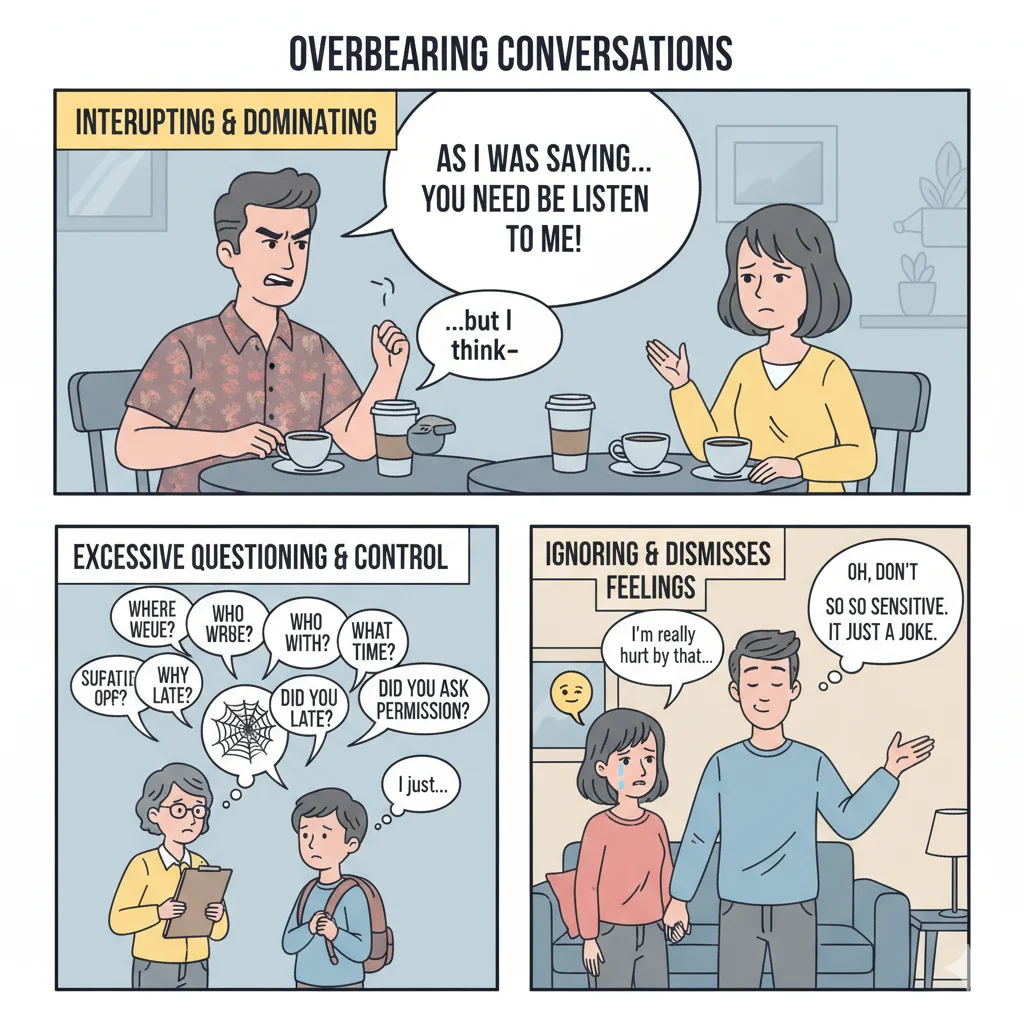
Example 1 (Workplace):
Employee 1: I wish our team could try new ideas.
Employee 2: Yeah, but the boss is too overbearing to allow it.
Example 2 (Family):
“My dad means well, but he can be overbearing when it comes to my career choices.”
Example 3 (Friendship):
Friend 1: You always choose the restaurant!
Friend 2: Sorry, I didn’t mean to be overbearing.
Example 4 (Text Chat):
“I like her, but she’s a bit overbearing — always checking up on me.”
🔄 Similar or Related Terms
Here are words that share similar meanings or nuances with “overbearing” — useful for vocabulary building or writing variety:
| Term | Meaning |
| Domineering | Trying to control others forcefully. |
| Authoritarian | Enforcing strict obedience; bossy. |
| Controlling | Seeking to manage every detail of others’ behavior. |
| Arrogant | Overconfident and dismissive of others’ opinions. |
| Pushy | Trying too hard to influence or persuade others. |
While these words overlap, “overbearing” often carries a tone of emotional dominance — especially in personal or professional relationships.
✍️ How to Use “Overbearing” Correctly
✅ Do’s:
- Use to describe behavior that feels controlling or oppressive.
- Appropriate in formal writing, essays, and spoken English.
- Works well in psychology, leadership, or personality discussions.
❌ Don’ts:
- Avoid using it as slang or humor — it’s a serious descriptive term.
- Don’t confuse it with “overwhelming” — that word means emotionally intense, not bossy.
- Don’t use it lightly to insult — it can sound harsh if misapplied.
Example:
✅ “Her overbearing tone shut down the conversation.”
❌ “That movie was overbearing” → (Incorrect usage; say “overwhelming” instead.)
🚫 Common Mistakes or Misinterpretations
- Confusing “overbearing” with “overwhelming.”
→ “Overbearing” means bossy or controlling; “overwhelming” means too intense or powerful. - Using it as slang.
→ It’s a formal adjective, not a modern or internet slang term. - Misjudging tone.
→ Calling someone overbearing can sound harsh — use it carefully to describe behavior, not identity.
❓ FAQ Section
1. What does “overbearing” mean in simple words?
It means being too controlling, bossy, or dominant toward others — often in a way that feels unpleasant or restrictive.
2. Is “overbearing” a positive or negative word?
It’s generally negative, describing behavior that limits others’ freedom or confidence.
3. Can “overbearing” describe parents or leaders?
Yes. Overbearing parents, bosses, or leaders tend to micromanage and control people’s actions or decisions.
4. What’s the difference between “overbearing” and “assertive”?
Being assertive means confident but respectful; overbearing crosses the line into being controlling or dismissive.
5. Is “overbearing” formal or informal?
It’s a formal English adjective used in writing, professional discussions, and academic contexts.
6. How do I use “overbearing” in a sentence?
“Her overbearing nature makes teamwork difficult.”
🌟 Conclusion
To sum up, “overbearing” describes someone who is excessively controlling, dominant, or bossy, often making others feel pressured or unheard.
Its origins trace back centuries, but it’s still widely used today — especially to describe leadership styles, parental behavior, or personality traits.
Now that you know the true meaning of overbearing, you’ll be able to recognize it in everyday life — and use the term correctly in your writing and conversations.
✨ Keep exploring our site for more definitions and insights into powerful English words and modern communication trends!

Evie Wyld is a word-meaning specialist at Meanovia.com. She simplifies complex words, phrases, and language trends, helping readers quickly grasp the exact meaning behind every term in a clear and approachable way.