Is being called a “novice” a bad thing—or is it simply the first step toward becoming an expert? If you’ve seen the word novice in a job advertisement, sports competition, video game, classroom, training course, or everyday conversation, you may have wondered what it really means and whether it’s different from beginner.
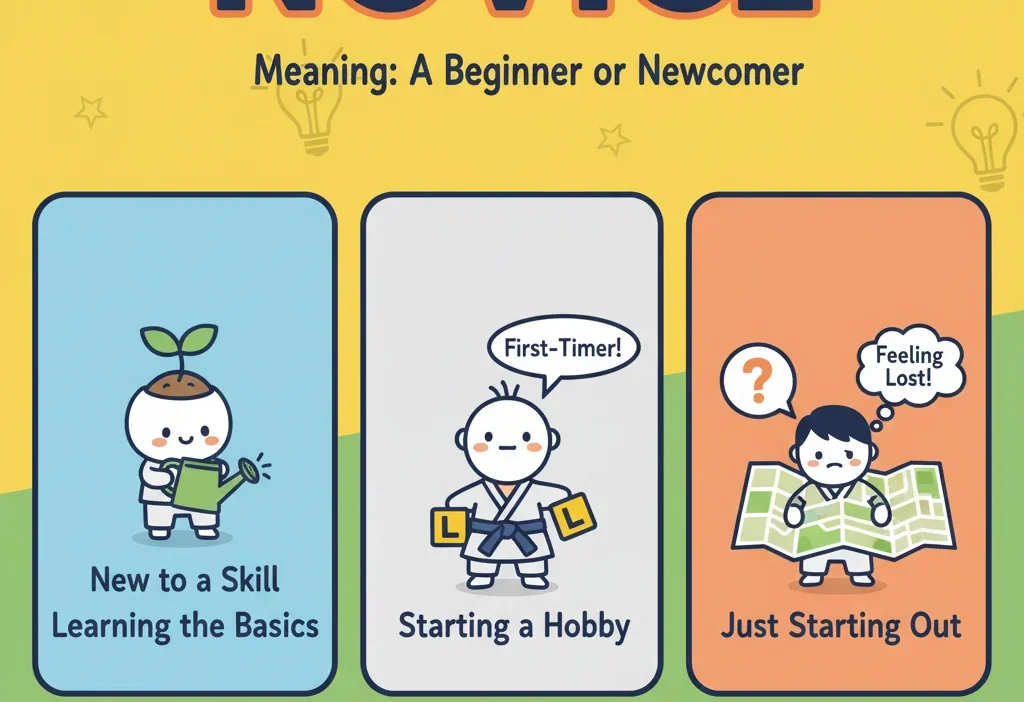
The answer is yes. Novice (pronounced NOV-iss) is a noun or adjective that describes someone who is new to a skill, activity, profession, or subject and has little or no practical experience. Unlike beginner, which simply refers to someone starting something, novice emphasizes limited real-world experience rather than intelligence, talent, or potential.
Most importantly, being a novice is not an insult—it’s a natural stage of learning, and every expert was once a novice. Originally used to describe someone entering a religious order, the word is now widely applied to novice drivers, novice programmers, novice writers, novice gamers, and novice users, making it relevant across education, technology, sports, hobbies, and the workplace.
In simple terms, a novice is someone who is still learning and gaining experience in a particular field or activity. Understanding this word helps you interpret job postings, training programs, competitions, instruction manuals, and everyday conversations more accurately while choosing the right word for the situation. This guide explains the meaning of novice, its pronunciation, origin, real-life examples, synonyms, antonyms, and exactly when to use novice instead of beginner, amateur, or expert, so you can communicate with confidence in both formal and everyday English.
Why Are People Searching for “Novice Meaning”?
People usually search “novice meaning” because they have seen the word in a book, school assignment, sports competition, job advertisement, game, or online course and want to know exactly what it means.
Most readers are looking for:
- A simple definition of novice
- Easy pronunciation
- Real-life examples
- The difference between novice and beginner
- Synonyms and opposite words
- How to use novice correctly in a sentence
- Meanings in different contexts such as sports, business, technology, and education
If that’s why you’re here, this guide covers everything in one place using clear language, practical examples, and easy explanations.
What Does Novice Mean?
A novice is someone who has recently started learning a skill, profession, hobby, or activity and has very little practical experience.
Unlike an expert, a novice is still developing basic knowledge and confidence. Making mistakes, asking questions, and practicing regularly are all normal parts of being a novice.
Simple Definition
A novice is a beginner who has little or no experience and is still learning the basics of a skill, job, subject, or activity.
Although a novice may not know everything yet, they have already taken the most important step—starting.
Dictionary Definition of Novice
Novice (noun)
A person who is new to a skill, profession, activity, or field and is learning the basic knowledge and skills needed to become experienced.
In modern English, the word is commonly used for anyone at the beginning of their learning journey, whether in education, business, technology, sports, healthcare, or creative fields.
Novice Meaning in English
In English, novice means a beginner, newcomer, learner, or inexperienced person who has recently started doing something.
It does not suggest a lack of intelligence or potential. Instead, it simply describes someone’s current level of experience.
For example:
- a novice teacher
- a novice programmer
- a novice driver
- a novice photographer
- a novice investor
- a novice chess player
In each case, the person is learning and improving through practice.
How to Pronounce Novice
IPA Pronunciation
British English: /ˈnɒv.ɪs/
American English: /ˈnɑː.vɪs/
Easy Pronunciation
NAH-viss
The stress falls on the first syllable.
Pronunciation Tip
Think of it as:
NAH + viss
Not:
❌ no-VICE
❌ no-VEECE
Saying it correctly makes your spoken English sound more natural and confident.
How Do You Use “Novice” in Everyday English?
The word novice is most often used to describe someone who is new to learning or doing something. It can refer to people of any age and in almost any field, from education and business to sports, technology, and creative hobbies.
Here are a few everyday examples:
- Sarah is a novice driver, so she avoids busy roads while gaining confidence.
- Our workshop is designed for novice writers who want to improve their skills.
- Even as a novice programmer, Ali quickly learned the basics of coding.
- The hiking club welcomes both novice and experienced members.
- He admitted he was a novice investor, so he started by studying the market before investing.
Notice that novice focuses on experience, not talent. Someone can be naturally gifted but still be a novice because they have only recently started.
What Does It Mean to Be a Novice?
Being a novice means standing at the beginning of a learning journey. At this stage, you’re building fundamental knowledge, developing practical skills, and learning from both successes and mistakes.
Every profession has novices:
- A newly hired teacher is a novice educator.
- A first-year nurse is a novice nurse.
- Someone learning Python is a novice programmer.
- A person trying photography for the first time is a novice photographer.
- Someone exploring artificial intelligence tools is an AI novice.
Being a novice is temporary. With practice, guidance, and experience, today’s novice becomes tomorrow’s expert.
Why Being a Novice Is Not a Weakness
Many people mistakenly think the word novice sounds negative. In reality, it is a neutral and often positive word because it represents growth and learning.
Being a novice means:
- You’re willing to learn.
- You’re developing new skills.
- You’re gaining valuable experience.
- You’re open to improvement.
- You’re building confidence step by step.
In fact, employers, teachers, coaches, and mentors often appreciate novices who are curious, eager to learn, and willing to accept feedback.
Remember this simple truth:
Every expert was once a novice, but every novice has the opportunity to become an expert through consistent learning and practice.
Quick Facts About “Novice”
| Feature | Information |
|---|---|
| Word | Novice |
| Pronunciation | NAH-viss |
| Part of Speech | Noun (sometimes adjective) |
| Meaning | A beginner with little experience |
| Opposite | Expert, professional, veteran |
| Common Synonyms | Beginner, newcomer, learner, rookie |
| Used In | Education, sports, business, healthcare, technology, gaming, hobbies |
| Tone | Neutral and respectful |
🏛️ Origin and Etymology of “Novice”
Understanding where a word comes from often makes its meaning easier to remember.
The word novice traces its roots back to the Latin word novicius, which means “new,” “newcomer,” or “not yet experienced.” This Latin term comes from novus, meaning “new.”
During the Middle Ages, the word entered Old French as novice before becoming part of the English language in the 14th century.
Originally, novice referred to someone who had recently joined a religious community, such as a monastery or convent. Before taking permanent vows, new members spent a period learning the rules, traditions, and responsibilities of religious life. During this training period, they were known as novices.
Over time, the meaning expanded beyond religion. Today, novice is used for anyone who is new to a skill, profession, hobby, or activity.
📅 Evolution of the Word
| Time Period | Meaning of “Novice” |
|---|---|
| Ancient Latin | A new or inexperienced person |
| Old French | Someone beginning religious training |
| Middle English | New member of a religious order |
| Modern English | Any beginner or inexperienced learner |
Although its usage has changed over the centuries, the core idea has remained the same: someone at the beginning of a learning journey.
🌍 Novice Meaning in Different Languages
Many readers search for the meaning of novice in their own language. While the exact translation varies, the idea remains the same: a beginner who is still learning.
| Language | Translation |
|---|---|
| English | Beginner; inexperienced person |
| Urdu (اردو) | نو آموز، مبتدی، نیا سیکھنے والا |
| Hindi (हिन्दी) | नवसिखिया, शुरुआती, प्रारंभिक सीखने वाला |
| Punjabi (ਪੰਜਾਬੀ) | ਨਵਾਂ ਸਿੱਖਣ ਵਾਲਾ, ਸ਼ੁਰੂਆਤੀ |
| French | Novice, débutant |
| Farsi (فارسی) | تازهکار، مبتدی |
| Chinese (中文) | 新手 (Xīnshǒu) |
| Tamil (தமிழ்) | ஆரம்பநிலை கற்றவர் |
| Telugu (తెలుగు) | ప్రారంభకుడు |
| Kannada (ಕನ್ನಡ) | ಆರಂಭಿಕ, ಹೊಸಬ |
No matter which language you speak, novice always refers to someone who is learning something for the first time.
📚 Is “Novice” a Noun or an Adjective?
The word novice is primarily a noun, but it can also act as an adjective before another noun.
As a Noun
A noun names a person.
Examples:
- She is a novice.
- He is a complete novice.
- The novice asked several questions.
As an Adjective
When placed before another noun, novice describes that noun.
Examples:
- novice driver
- novice teacher
- novice class
- novice programmer
- novice skier
- novice gardener
This flexibility makes the word useful in both everyday English and professional writing.
📝 What Is the Plural of Novice?
The plural form of novice is novices.
Examples
- The workshop welcomed thirty novices.
- Experienced coaches trained the novices.
- Novices usually improve quickly with regular practice.
⚖️ Novice vs Beginner
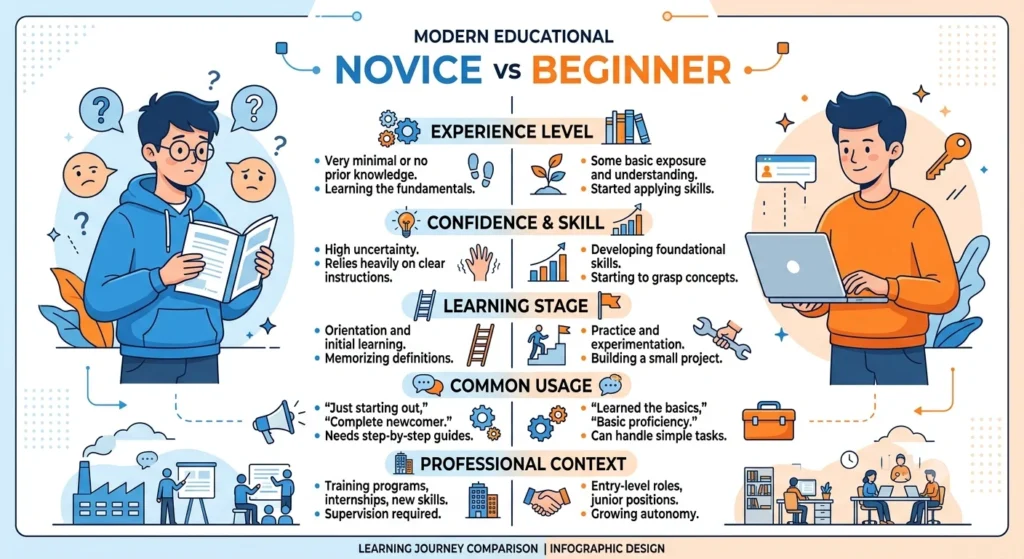
Many people use novice and beginner interchangeably because they have very similar meanings. However, there is a subtle difference.
A beginner is anyone who has recently started learning something.
A novice is also a beginner, but the word is more common in professional, academic, technical, sporting, and formal contexts.
Comparison Table
| Beginner | Novice |
|---|---|
| Everyday word | Slightly more formal |
| Used in casual conversation | Common in professional writing |
| Focuses on starting | Focuses on limited experience |
| Very common | More precise in formal contexts |
Examples
✔ She is a beginner at photography.
✔ She is a novice photographer.
Both sentences are correct, but the second sounds more professional.
Which Word Should You Use?
- Talking to friends → Beginner
- Writing professionally → Novice
- Job descriptions → Novice
- Academic writing → Novice
- Sports competitions → Novice
🏅 Novice vs Rookie
Although these words are similar, they are not identical.
A rookie usually refers to someone in their first season or first year in a sport or profession.
A novice simply means someone with little experience, regardless of how long they have been involved.
| Rookie | Novice |
|---|---|
| Mostly sports and jobs | Used in almost every field |
| Informal | More formal |
| First season or first year | Any early learning stage |
Example:
- He’s a rookie police officer.
- She’s a novice photographer.
🎨 Novice vs Amateur
These words describe different ideas.
A novice lacks experience.
An amateur may have years of experience but participates for enjoyment rather than as a professional.
Example
A retired engineer who paints every weekend may be an experienced amateur artist.
A person attending their first painting class is a novice artist.
🧠 Novice vs Expert
These are direct opposites.
| Novice | Expert |
|---|---|
| Learning fundamentals | Masters advanced skills |
| Needs guidance | Gives guidance |
| Limited experience | Extensive experience |
| Builds confidence | Demonstrates confidence |
Every expert once learned the same basics that every novice learns today.
🤔 Novice vs Naive
This is one of the most common English mistakes.
Although the words look somewhat similar, they have completely different meanings.
| Novice | Naive |
|---|---|
| New to a skill | Easily fooled or overly trusting |
| Related to experience | Related to judgment |
| Neutral meaning | Sometimes negative |
Examples:
✔ He is a novice programmer.
✔ She was naive enough to believe the fake email.
Never use these words interchangeably.
Que Meaning: The Hidden Truth Everyone Gets Wrong
🎯 Why Do Schools, Companies, and Games Use the Word “Novice”?
One reason the word novice appears so often is that many organizations divide learners into skill levels.
🏫 In Schools
Schools use novice, intermediate, and advanced levels to place students in classes that match their current abilities.
This helps teachers provide lessons that are appropriate for each learner.
💼 In Companies
Businesses often describe new employees as novice users or novice professionals during training.
Rather than expecting instant expertise, companies recognize that learning takes time.
🎮 In Video Games
Many games include Novice Mode or Novice Difficulty.
These modes are designed for players who are still learning controls, strategies, and gameplay mechanics.
Starting on novice difficulty allows players to build confidence before moving to harder levels.
🏥 In Healthcare
Hospitals and nursing programs often refer to newly qualified nurses as novice nurses because they are developing practical skills under supervision.
This stage focuses on gaining confidence, accuracy, and real-world experience.
🌱 How Does a Novice Become an Expert?
One of the most interesting things about the word novice is that it describes a temporary stage—not a permanent label.
Most people progress through a learning journey that looks something like this:
Novice → Beginner → Intermediate → Advanced → Expert

Each stage builds on the previous one through:
- Practice
- Feedback
- Observation
- Repetition
- Patience
- Real-world experience
- Continuous learning
There is no shortcut to expertise. Every accomplished professional, athlete, artist, programmer, and entrepreneur once struggled with the same basics that every novice faces today.
Instead of worrying about being inexperienced, focus on making steady progress. Small improvements made consistently over time lead to lasting expertise.
The goal isn’t to avoid being a novice—it’s to keep learning until you’re no longer one.
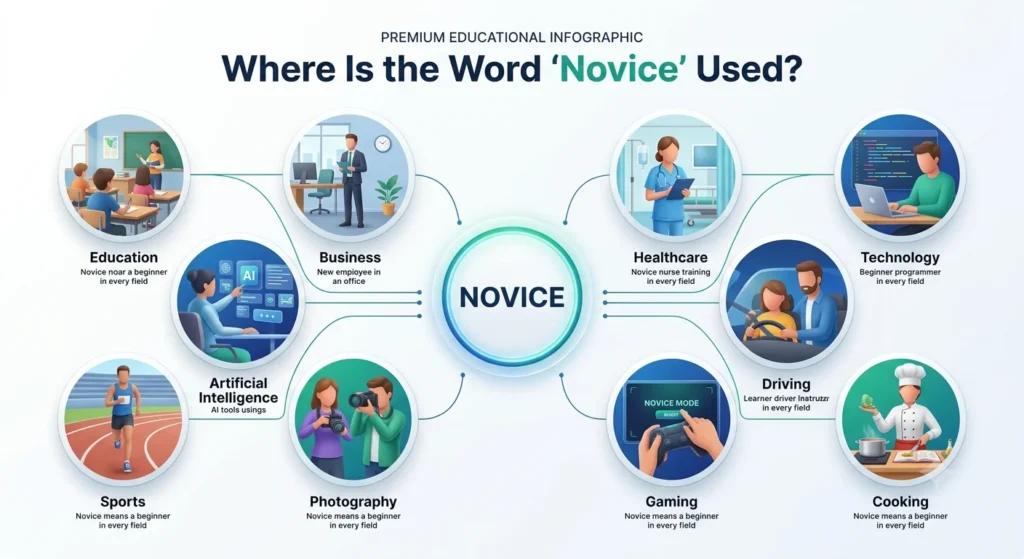
🌍 Novice Meaning in Different Real-Life Situations
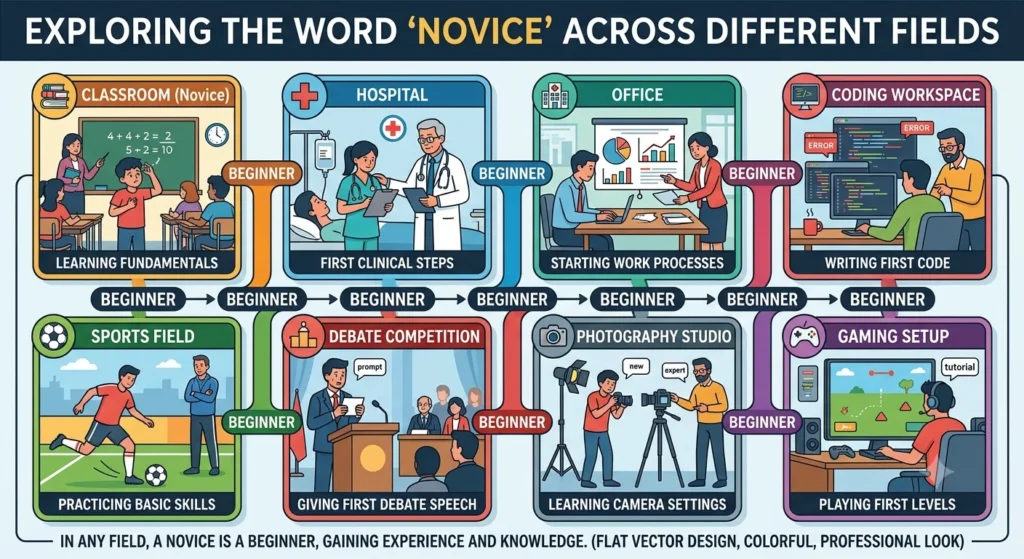
One reason the word novice is so useful is that it can describe a beginner in almost any field. Whether someone is learning to drive, write, code, invest, or play a sport, the meaning stays the same—a person who is still gaining experience.
Let’s explore how the word is used in everyday life.
💻 Computer Novice Meaning
A computer novice is someone who has recently started using computers and is still learning basic digital skills.
They may be learning how to:
- Use email
- Browse the internet
- Create documents
- Install software
- Organize files
- Use online tools safely
Example
My grandfather is a computer novice, so I’m teaching him how to use email.
🤖 AI Novice Meaning
An AI novice is someone who has recently started learning about artificial intelligence or using AI tools.
For example, an AI novice may be learning how to use:
- ChatGPT
- AI image generators
- AI writing assistants
- Machine learning tools
- AI coding assistants
Example
Even AI novices can create impressive projects by learning one step at a time.
💰 Crypto Novice Meaning
A crypto novice is a beginner who is learning about cryptocurrency, blockchain, Bitcoin, or digital investing.
Because cryptocurrency involves financial risk, novices should first understand:
- digital wallets
- blockchain basics
- security practices
- market volatility
- investment risks
Example
Every crypto novice should research carefully before making their first investment.
🏥 Novice Meaning in Nursing
In healthcare, a novice nurse is a newly qualified nurse who is beginning to apply classroom knowledge in real clinical situations.
During this stage, nurses develop confidence through supervised practice and experience.
Example
The hospital assigned an experienced mentor to help each novice nurse.
🎓 Novice Meaning in Education
Teachers often use the word novice to describe students who are just beginning a new subject or skill.
Examples include:
- novice reader
- novice writer
- novice learner
- novice language student
Example
This English course is designed specifically for novice learners.
🗣️ Novice Meaning in Language Learning
Language schools frequently classify students as:
- Novice
- Elementary
- Intermediate
- Advanced
A novice language learner is usually learning:
- basic vocabulary
- simple grammar
- everyday conversations
- pronunciation
💼 Novice Meaning in Business
Businesses often use novice to describe employees who are still developing professional skills.
Examples include:
- novice manager
- novice accountant
- novice marketer
- novice entrepreneur
Example
Although she was a novice manager, her willingness to learn impressed the entire team.
🏃 Novice Meaning in Sports
In sports, a novice is an athlete with limited competitive experience.
Many sports organize novice competitions so beginners can compete fairly.
Examples include:
- novice boxer
- novice swimmer
- novice cyclist
- novice runner
- novice skier
🏃 Novice Meaning in Track
In track and field competitions, novice runners are athletes who have recently started participating in races.
Separate novice categories encourage beginners to gain confidence before competing at higher levels.
🎾 Novice Meaning in Pickleball
Many pickleball clubs organize matches according to skill level.
A novice pickleball player is someone who is learning:
- serving
- scoring
- positioning
- basic strategy
🎤 Novice Meaning in Debate
Debating competitions often have novice divisions.
These events are designed for students with little or no competitive debating experience.
Example
She won the Best Speaker award in the novice debate category.
📚 Novice Meaning in Books
When the word appears in novels or nonfiction books, it usually refers to a character who has just entered a new profession, organization, magical system, or learning environment.
Example:
The story follows a novice wizard learning ancient magic.
✝️ Novice Meaning in Religion
Historically, a novice was someone preparing to become a monk or nun.
Before taking permanent vows, novices studied religious teachings, followed community rules, and learned daily responsibilities.
Although this is the word’s original meaning, today it is used much more broadly.
🌱 25 Real-Life Examples of “Novice”
Seeing the word in different situations makes it much easier to understand and remember.
- She is a novice teacher.
- He is a novice driver.
- I’m a novice photographer.
- They hired a novice programmer.
- Every doctor was once a novice.
- She’s a novice chess player.
- He joined as a novice firefighter.
- Our class welcomes novice learners.
- The novice investor asked thoughtful questions.
- She’s a novice gardener.
- He became a novice cyclist.
- The novice cook followed the recipe carefully.
- She’s a novice artist learning watercolor painting.
- He is a novice guitarist practicing daily.
- The novice writer completed his first novel.
- Our hiking club welcomes novice hikers.
- The novice researcher presented her findings confidently.
- She’s a novice public speaker.
- The novice designer learned new software quickly.
- The novice marketer improved after training.
- He’s a novice baker experimenting with bread recipes.
- She’s a novice yoga student.
- The novice swimmer completed her first race.
- The novice entrepreneur launched his first business.
- Every expert in the room began as a novice.
📝 Common Collocations with “Novice”
Collocations are word combinations that native English speakers use naturally.
Some of the most common include:
- novice driver
- novice teacher
- novice writer
- novice reader
- novice learner
- novice nurse
- novice programmer
- novice investor
- novice photographer
- novice artist
- novice chef
- novice gardener
- novice athlete
- novice player
- novice swimmer
- novice runner
- novice user
- novice manager
- novice class
- novice course
- novice level
- novice training
- novice guide
- novice team
- novice category
Using these combinations will make your English sound more natural.
🔄 Novice Synonyms
The word novice has several synonyms, but each has a slightly different shade of meaning.
| Synonym | Best Used For |
|---|---|
| Beginner | Everyday English |
| Newcomer | General situations |
| Learner | Education |
| Rookie | Sports and jobs |
| Apprentice | Skilled trades |
| Trainee | Professional training |
| Neophyte | Formal writing |
| Starter | Informal situations |
While these words are similar, novice is often the best choice when you want a formal, respectful way to describe someone with little experience.
🔁 Opposite of Novice
The opposite of novice is someone who has developed advanced knowledge and practical experience.
Common antonyms include:
- Expert
- Professional
- Veteran
- Specialist
- Master
- Skilled person
- Authority
- Proficient individual
Example:
A novice needs guidance, while an expert often provides guidance.
✅ How to Use “Novice” Correctly
Use novice when talking about someone who:
- has recently started learning
- has limited experience
- is developing new skills
- needs practice and guidance
Correct Examples
✔ She’s a novice teacher.
✔ He’s a novice investor.
✔ I’m a novice at coding.
✔ The course is designed for novice learners.
❌ Common Mistakes
Mistake 1
Thinking novice means “bad.”
It doesn’t.
It simply means new and learning.
Mistake 2
Confusing novice with naive.
A novice lacks experience.
A naive person lacks judgment or is too trusting.
Mistake 3
Using novice to describe someone with years of experience.
If someone has mastered a skill, words like expert, professional, or veteran are more accurate.
Mistake 4
Assuming novice only relates to religion.
While the word originated in religious communities, today it is widely used in education, technology, healthcare, sports, business, and everyday English.
❓ Frequently Asked Questions About Novice
What does novice mean in simple words?
A novice is a beginner or someone who has little experience in a particular skill, activity, profession, or subject. A novice is still learning and gaining confidence through practice and experience.
Is novice the same as beginner?
Almost. Both words describe someone who is new to something. However, novice is slightly more formal and is often used in education, sports, healthcare, business, and professional training, while beginner is more common in everyday conversation.
What is the opposite of novice?
The opposite of novice is expert. Other common opposites include professional, veteran, master, specialist, and experienced person.
Is novice a positive or negative word?
Neither. Novice is a neutral word that simply describes someone’s level of experience. It does not suggest that a person lacks intelligence or ability.
Can novice be used as an adjective?
Yes. Although novice is mainly a noun, it can also describe another noun.
Examples:
- novice driver
- novice teacher
- novice class
- novice programmer
What is the plural of novice?
The plural form of novice is novices.
Example:
The workshop welcomed several novices.
How do you pronounce novice?
British English: /ˈnɒvɪs/
American English: /ˈnɑːvɪs/
Simple pronunciation:
NAH-viss
What does “I’m a novice” mean?
When someone says,
“I’m a novice,”
they mean,
“I’m new to this and still learning.”
What is a complete novice?
A complete novice is someone with absolutely no previous knowledge or practical experience in a particular field.
What does novice mean in sports?
In sports, a novice is a beginner who has recently started training or competing. Many sports organizations create novice categories so new athletes can compete fairly.
What is a novice user?
A novice user is someone with little experience using software, computers, websites, or digital tools.
What does novice mean in nursing?
A novice nurse is a newly qualified nurse who is beginning to develop practical skills in real clinical settings under supervision.
What is an AI novice?
An AI novice is someone who has recently started learning about artificial intelligence or using AI tools such as ChatGPT and image generators.
Is novice the same as amateur?
No. A novice is new to an activity, while an amateur may have years of experience but participates for enjoyment rather than professionally.
Can a novice become an expert?
Absolutely. With consistent learning, regular practice, constructive feedback, and real-world experience, a novice gradually develops into an intermediate learner, then an advanced practitioner, and eventually an expert.
⭐ Key Takeaways
- Novice means a beginner or someone with little experience.
- It describes a stage of learning, not a person’s intelligence or potential.
- The word is used in education, business, healthcare, sports, gaming, technology, and many other fields.
- Although similar to beginner, novice sounds more formal.
- The opposite of novice is expert or professional.
- Every expert was once a novice.
🌟 Conclusion
A novice is someone who is taking the first steps toward learning a new skill, profession, hobby, or subject. Whether you’re learning to drive, studying a new language, writing your first computer program, starting a new career, or exploring artificial intelligence, being a novice simply means you’re at the beginning of an exciting journey.
Rather than seeing the word as a weakness, think of it as a sign of progress. Every accomplished athlete, skilled teacher, successful entrepreneur, experienced nurse, and talented artist started with little knowledge and gradually improved through patience, practice, and determination.
Now that you understand the novice meaning, pronunciation, origin, real-life examples, and differences between novice, beginner, rookie, and expert, you’ll be able to use the word accurately and confidently in both everyday conversations and professional writing.
Remember: Being a novice isn’t the end of the journey—it’s where every success story begins.

Lucas Hayes is a content writer at Meanovia, specializing in slang, texting meanings, and internet phrases. He creates simple, clear, and engaging explanations of modern digital language 💬✨