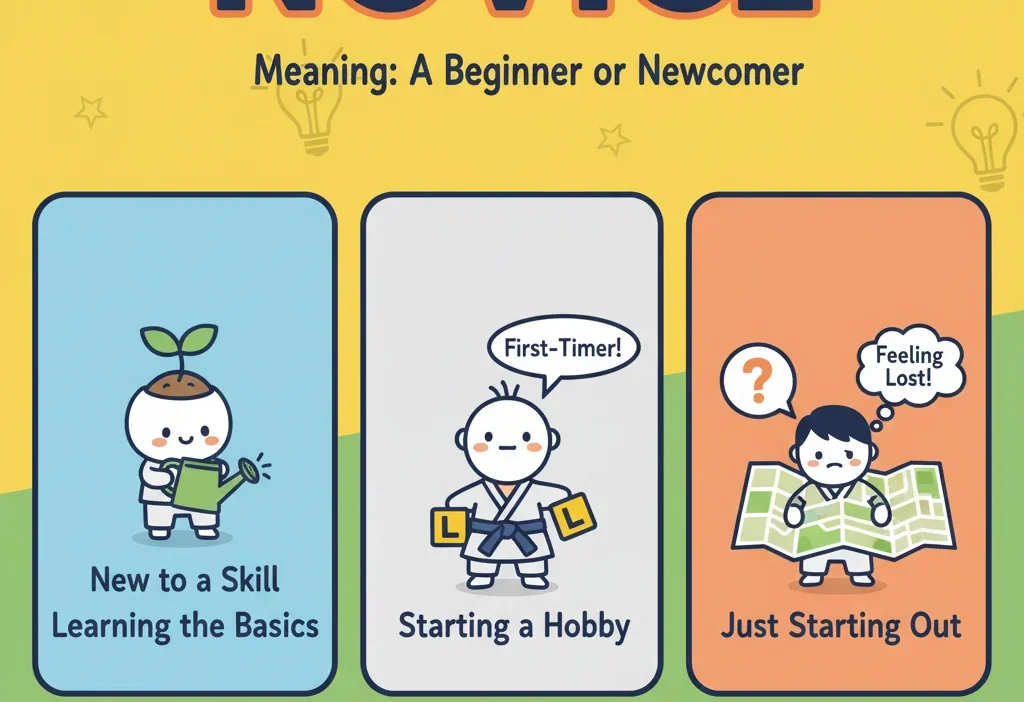
Have you ever started something new and felt slow or unsure? Someone may call you a novice. But what does novice mean?
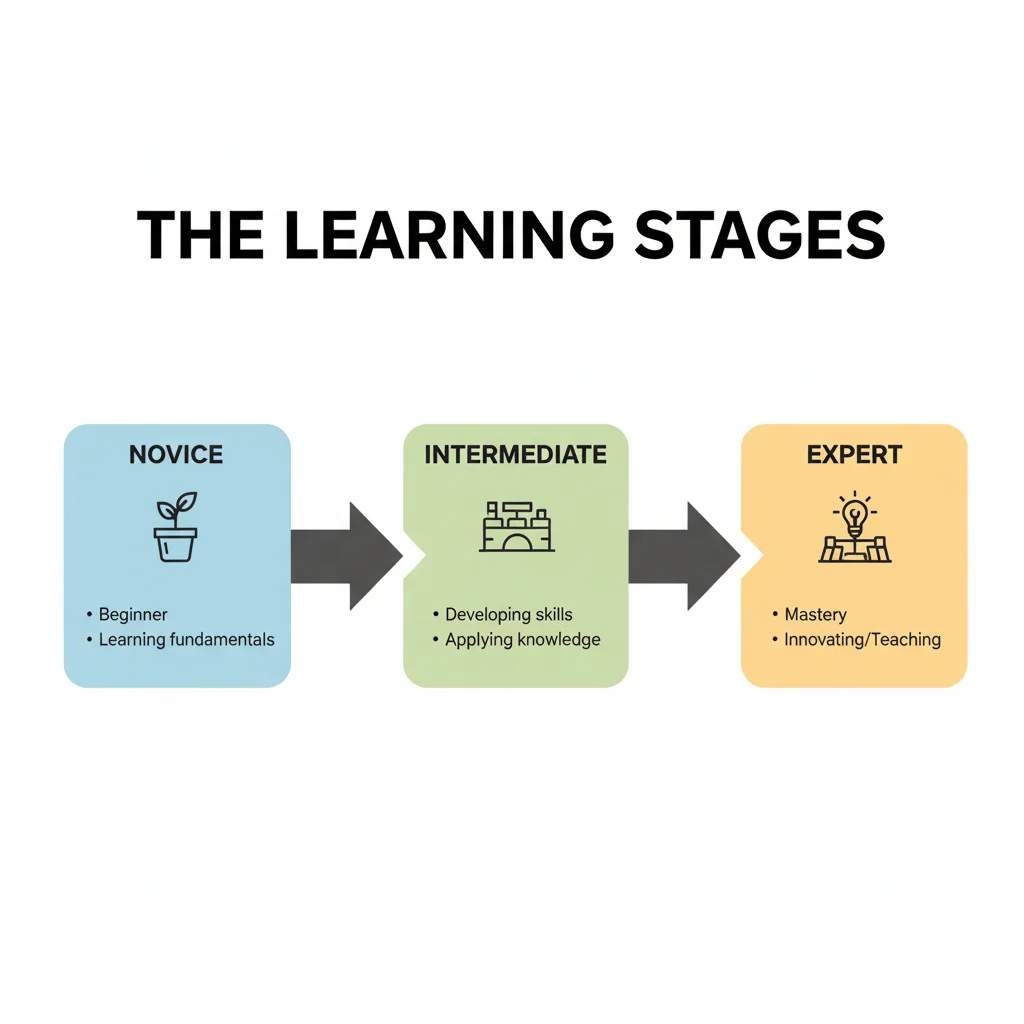
A novice is a beginner. It is a person who is new and still learning. Every expert was once a novice.
People hear this word in school, sports, games, and jobs. So let’s understand novice meaning in the easiest way.
Quick answer: A novice is a beginner. It means a person who is new to a job, sport, or skill. A novice is still learning and has little experience.
From my own work teaching English words to students and readers, I often see people mix up novice with expert. A novice is the opposite of an expert. It simply means someone who has just started and does not have much experience yet.
You can hear this word in school, sports, games, and jobs. For example, a new driver is a novice driver, and a new chess player is a novice player. People search for “novice meaning” when they want to understand this simple word in news, books, or school work.
🔊 How to Pronounce Novice
Novice is pronounced NAH-viss.
It sounds like “nah-vis.”
The stress is on NAH.
📖 What Does Novice Mean?
A novice is someone who is new to a skill, field, or activity and is still learning the basics.
A novice is a beginner. It means a person who is new to a job, game, or skill. If you ask “what does novice mean,” it means someone who is still learning.
It’s a noun (and sometimes used as an adjective) that describes beginners in any area — from jobs and hobbies to religion and sports.
Example: “She’s a novice photographer, still learning how to use the camera settings.”
Novice meaning is simple. A novice is a person with little experience.
If you search “define novice” or “novice definition,” it means a beginner who is still learning.
🏛️ Origin and Popularity
The word “novice” comes from the Latin word “novicius,” meaning new or inexperienced. It entered English through Old French around the 14th century, originally referring to new members in religious communities, such as monks or nuns still in training.
Over time, “novice” expanded beyond religion. Today, it’s commonly used in education, sports, workplaces, and online spaces to describe anyone just starting out.
🕰️ Quick Timeline:
- 1300s: Used in monasteries for trainees.
- 1800s: Adopted in military and vocational training.
- 2000s: Common in workplaces, gaming, and internet learning platforms.
🌍 Novice Meaning in Different Contexts
The meaning of novice stays consistent — “a beginner” — but its tone can shift depending on where it’s used.
💼 In Business or Work
Used to describe someone new to a role or career field.
Example: “As a novice manager, he’s still learning to lead a team.”
🏫 In Education or Training
Refers to a student or learner starting from the basics.
Example: “Our course welcomes novices — no prior experience required.”
🎮 In Gaming or Sports
Used to describe players at entry-level skill.
Example: “This tournament is open to novice and professional players alike.”
Novice Meaning in Sports
In sports, a novice player is a new player.
In track races, novice runners are beginners.
Example:
“The novice team won their first race.”
🙏 In Religion or Spirituality
Traditionally refers to someone in the early stages of a monastic life.
Example: “After a year as a novice, she took her final vows.”
| Context | Meaning of Novice | Example |
| Business | Employee new to a role | “He’s a novice in project management.” |
| Education | Beginner-level learner | “Novice coders will enjoy this workshop.” |
| Sports | New participant | “The novice team performed well for first-timers.” |
| Religion | Trainee in a religious order | “She joined the convent as a novice.” |
💬 Examples of Novice in Conversations
Example 1 (Workplace):
Manager: Don’t worry if you make mistakes — you’re still a novice.
Employee: Thanks, I appreciate the patience!
Example 2 (Education):
Teacher: This course is designed for novice writers.
Student: Perfect! I’ve just started blogging.
Example 3 (Gaming):
Player 1: I’m a total novice at this game.
Player 2: No worries — we all start somewhere!
Example 4 (Religion):
“He lived as a novice for a year before becoming a monk.”
Novice Example Sentences
- He is a novice driver.
- She is a novice teacher.
- I am a novice at chess.
Complete Novice Meaning
A complete novice is a person with no experience at all.
Example:
“I am a complete novice at cooking.”
🔍 Similar or Related Terms
Here are some related words to “novice” that can help broaden your vocabulary:
| Term | Meaning | Level |
| Beginner | Someone just starting | Entry |
| Rookie | Informal term for a new person (often in sports or jobs) | Entry |
| Neophyte | A person new to a belief or skill | Entry |
| Apprentice | Someone learning from a skilled mentor | Entry to Intermediate |
| Trainee | A person in formal training | Entry |
Novice vs Beginner
Novice and beginner mean almost the same.
But novice sounds more formal. Beginner is used in daily talk.
Example:
“She is a novice teacher.”
“He is a beginner driver.”
🧩 How to Use “Novice” Correctly
Do’s ✅
- Use when describing beginners or new learners.
- Use in formal, academic, or professional settings.
- Use as both a noun (“a novice”) or adjective (“novice learner”).
Don’ts ❌
- Don’t use it as slang or in overly casual settings (e.g., texting).
- Don’t confuse it with “naive” — which means innocent or easily fooled.
- Avoid using it to insult someone; it’s a neutral or respectful term.
⚠️ Common Mistakes or Misinterpretations
- Confusing “novice” with “naive.”
→ “Novice” means new at something; “naive” means lacking worldly experience. - Thinking it’s only for religion.
→ While it began in religious contexts, it now applies to any beginner. - Using it informally.
→ It’s more suited to professional, educational, or formal language.
Novice Meaning in Jobs or Skills
A computer novice is new to computers.
A crypto novice is new to crypto trading.
A nursing novice is a new nurse.
The meaning is always the same — beginner.
Novice Meaning in Other Languages
In Hindi, novice means “naya sikhne wala.”
In Punjabi, Tamil, or Chinese, it still means beginner.
❓ FAQ Section
1. What does “novice” mean in simple words?
It means a beginner — someone who has just started learning or doing something new.
2. Is “novice” a positive or negative word?
Neutral. It simply describes experience level, not skill or value. It can even be positive when showing eagerness to learn.
3. What’s the difference between “novice” and “beginner”?
They mean the same thing, but “novice” sounds more formal and is often used in academic or professional contexts.
4. Can “novice” be used as an adjective?
Yes! Example: “She joined a novice class for yoga.”
5. What’s the plural of “novice”?
The plural form is novices. Example: “The program supports new novices in training.”
6. How do you pronounce “novice”?
It’s pronounced NAH-viss, with emphasis on the first syllable.
🪴 Conclusion
In short, the word “novice” means a beginner — someone starting to learn or practice a new skill, job, or belief. It’s a word rooted in centuries of growth, learning, and discovery.
Whether you’re a novice writer, gamer, or teacher, remember: every expert was once a novice. Keep learning, stay curious, and embrace the journey of improvement.
✨ Now that you know what novice means, you’ll recognize it instantly — and maybe even use it proudly to describe your own learning journey.

Patrick Gale is a word-meaning expert at Meanovia.com. He explains complex terms, definitions, and language trends with clarity and precision. His goal is to help readers understand the exact meaning behind every word they search.