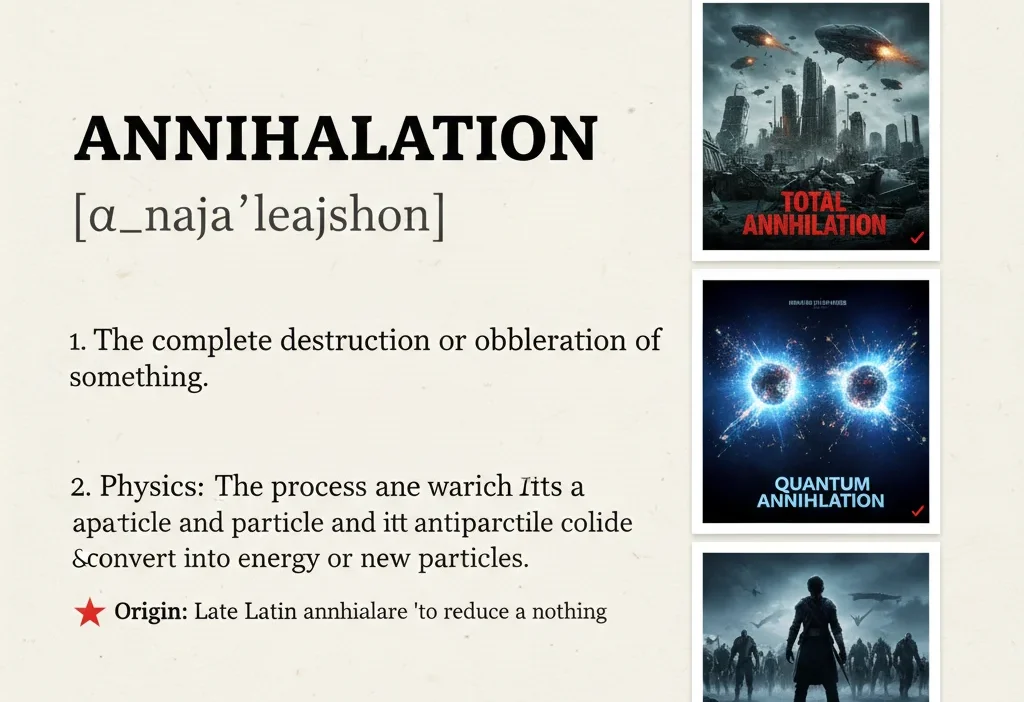
Have you ever heard the word “annihilation” in a movie, history documentary, scientific article, news report, or sports discussion and wondered if it simply means destruction or something much more extreme? Annihilation (pronounced uh-NYE-uh-LAY-shuhn) is a noun that means the complete destruction, elimination, or total defeat of something until nothing remains or no threat continues to exist.
Unlike ordinary words such as damage, loss, or defeat, annihilation describes an extreme level of destruction where something is completely wiped out, removed, or overcome. Because of its powerful meaning, the word is often associated with war, disasters, extinction, science, and overwhelming victories, but it can also be used in a figurative sense.
In simple terms, annihilation means total destruction or complete elimination. For example, the annihilation of an enemy force means the force was completely destroyed, mass extinction can represent the annihilation of a species, and a team’s annihilation of its opponent describes a completely one-sided victory. In physics, annihilation has a specific scientific meaning when particles and antiparticles destroy each other and transform into energy.
If you’ve come across annihilation and weren’t sure what it means, this guide explains its definition, pronunciation, origin, literal and figurative meanings, scientific usage, synonyms, antonyms, real-life examples, and how to understand and use annihilation correctly in every context.
Quick Facts
| Feature | Information |
|---|---|
| Meaning | Complete destruction or total elimination |
| Pronunciation | uh-NYE-uh-LAY-shun |
| IPA | /əˌnaɪ.əˈleɪ.ʃən/ |
| Part of Speech | Noun |
| Verb Form | Annihilate |
| Word Origin | Latin annihilare (“to reduce to nothing”) |
| Difficulty Level | Intermediate to Advanced |
| Tone | Formal, dramatic, scientific |
| Common Contexts | Physics, history, religion, psychology, literature, movies, gaming, news |
| Opposite | Creation, preservation, restoration |
What Does “Annihilation” Mean?
At its core, annihilation means the act of completely destroying, eliminating, or reducing something to nothing.
Unlike words such as damage, loss, or even destruction, annihilation emphasizes totality. It suggests that the thing being described has been removed, defeated, or destroyed so completely that recovery is impossible or highly unlikely.
For example:
- A wildfire may destroy hundreds of trees, but if an entire forest disappears beyond recovery, writers may describe it as annihilation.
- In physics, when an electron meets its antiparticle, both disappear and their mass is converted into energy. Scientists call this particle annihilation.
- A football commentator might say a team suffered “complete annihilation” after losing by a huge margin—not because the players were literally destroyed, but because the defeat was overwhelming.
Although the situations differ, they all share one central idea:
Something has been eliminated completely or almost completely.
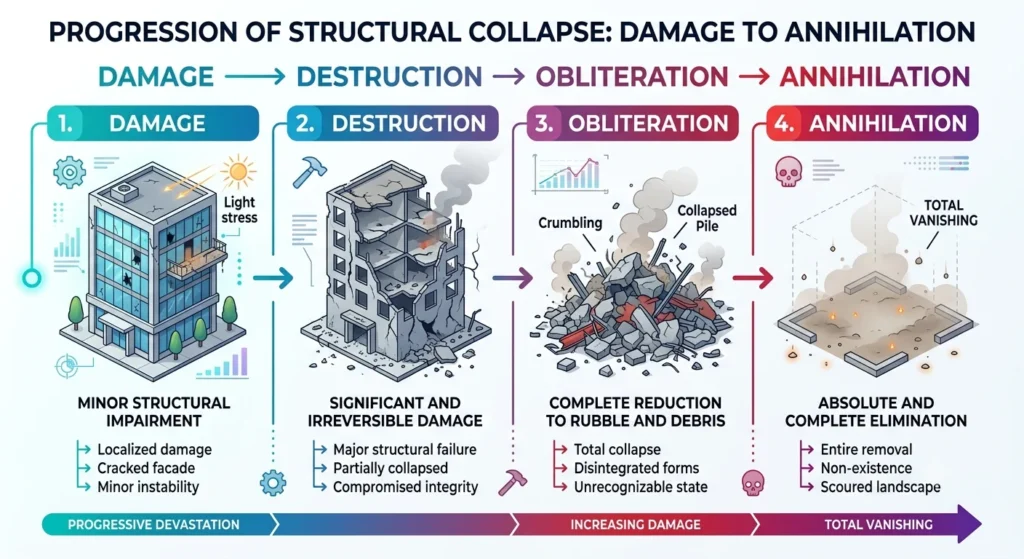
Expert Usage Note
One reason annihilation is frequently misunderstood is that people often confuse it with destruction.
While every annihilation involves destruction, not every destruction is annihilation.
For example:
- A damaged bridge can be repaired.
- A destroyed building can sometimes be rebuilt.
- But something described as annihilated is generally understood to be completely wiped out or beyond recovery.
That’s why journalists, historians, scientists, and authors choose this word only when they want to communicate the highest possible level of loss or elimination.
What Is Annihilation in Simple Words?
If you’re looking for the easiest explanation, think of the word like this:
Imagine drawing a picture on a whiteboard.
If you erase only part of it, you’ve damaged it.
If you erase most of it, you’ve destroyed it.
But if you completely erase every mark until it looks as though nothing was ever there, that’s the idea behind annihilation.
In simple words:
Annihilation means completely wiping something out until little or nothing remains.
This is why the word often appears in discussions about:
- Natural disasters
- Wars
- Scientific reactions
- Extinction
- Catastrophic events
- Overwhelming victories
- Symbolic or emotional loss
Why Is “Annihilation” Such a Powerful Word?
Not all words that describe destruction have the same emotional impact.
Compare these two sentences:
- “The army was defeated.”
- “The army faced annihilation.”
The first sentence tells you who lost.
The second makes you imagine total defeat, complete elimination, and no realistic chance of recovery.
That extra emotional weight is why writers often choose annihilation instead of simpler words.
Quick Comparison
| Word | Meaning | Strength |
|---|---|---|
| Damage | Minor harm | ⭐ |
| Destruction | Serious damage | ⭐⭐⭐ |
| Devastation | Widespread severe damage | ⭐⭐⭐⭐ |
| Obliteration | Almost every trace removed | ⭐⭐⭐⭐ |
| Annihilation | Complete elimination or destruction | ⭐⭐⭐⭐⭐ |
Did You Know?
The English word annihilation comes from the Latin word nihil, meaning “nothing.” This is why the word almost always conveys the idea of reducing something to nothing rather than simply damaging it.
What Is the Full Meaning of Annihilation?
The full meaning of annihilation is:
The complete destruction, elimination, or disappearance of a person, object, force, idea, or system until nothing meaningful remains.
Depending on the situation, annihilation can describe:
- Physical destruction
- Complete military defeat
- Matter–antimatter reactions in physics
- Emotional or psychological collapse
- Financial ruin
- Cultural disappearance
- Symbolic loss of identity
- The end of a civilization or institution
The context changes—but the central idea remains the same: complete and irreversible elimination.
Annihilation Meaning in English
In English, annihilation is a countable or uncountable noun, depending on how it is used.
Dictionary-Style Definition
Annihilation (noun):
The act or process of completely destroying or eliminating someone or something so that nothing remains or recovery is impossible.
Natural English Examples
- The explosion caused the annihilation of the abandoned warehouse.
- Scientists continue studying particle annihilation.
- The team celebrated after the complete annihilation of their rivals.
- Historians documented the annihilation of several ancient kingdoms.
Notice that in every example, the word expresses complete rather than partial destruction.
Annihilation Meaning in Different Contexts
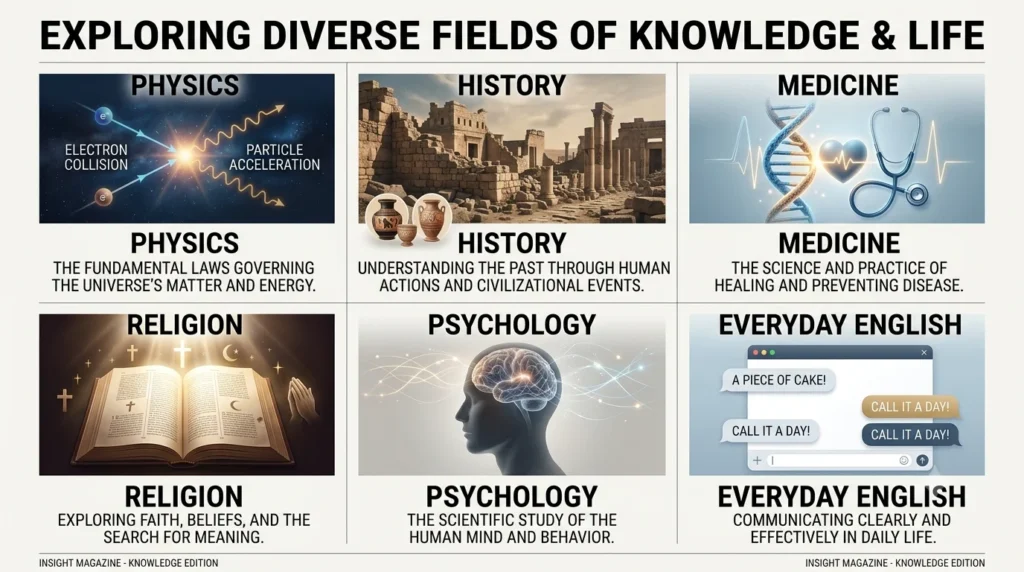
One of the reasons annihilation is such a fascinating English word is that its meaning changes slightly depending on where it is used. Although the core idea always involves complete destruction or elimination, the way people understand the word in science, history, religion, psychology, medicine, literature, movies, and everyday conversation can be very different.
Learning these contextual meanings helps you understand articles, books, movies, and conversations more accurately while also improving your own vocabulary.
Annihilation Meaning in Physics
In physics, annihilation is a highly specific scientific process—not simply “destruction.”
It occurs when a particle and its corresponding antiparticle collide and convert their mass into energy. According to Einstein’s principle of mass-energy equivalence (E = mc²), the mass is transformed into energy rather than disappearing.
One of the best-known examples is electron-positron annihilation.
When an electron meets a positron (its antimatter counterpart), both particles disappear and produce gamma-ray photons.
Example
During the laboratory experiment, scientists observed electron-positron annihilation, producing measurable gamma radiation.
Why It Matters
Scientists study particle annihilation to understand:
- The behavior of matter and antimatter
- The origins of the universe
- High-energy particle interactions
- Quantum physics
- Medical imaging technology
💡 Expert Note:
In physics, annihilation does not violate the law of conservation of energy. Matter is converted into energy—it is not simply “destroyed.”
Annihilation Meaning in Radiology
In radiology, annihilation is one of the scientific principles behind Positron Emission Tomography (PET) scans.
A small amount of radioactive tracer is introduced into the body. As the tracer releases positrons, they collide with nearby electrons.
This interaction causes annihilation, producing gamma rays that are detected by the PET scanner to create detailed images of organs and tissues.
Why Is This Important?
PET scans help doctors diagnose and monitor conditions such as:
- Cancer
- Alzheimer’s disease
- Parkinson’s disease
- Heart disease
- Certain neurological disorders
In this context, annihilation is not destructive in the everyday sense—it is a natural physical process that makes advanced medical imaging possible.
Annihilation Meaning in History
Historians often use annihilation when ordinary words like damage or defeat are not strong enough.
The term usually describes events involving:
- Complete military defeat
- Destruction of entire cities
- Collapse of civilizations
- Large-scale loss of life
- Eradication of political or military power
Example
Historians describe the battle as resulting in the near annihilation of the defending force.
Here, the word emphasizes that the defeat was overwhelming rather than merely significant.
Trump Taco Meaning: Why This Term Is Trending Online
War of Annihilation Meaning
A war of annihilation is a conflict fought with the objective of completely destroying the opposing side, rather than achieving limited military or political goals.
Unlike conventional wars that may end through negotiation or surrender, a war of annihilation seeks to eliminate the enemy’s ability to continue resisting.
Characteristics
- Total military destruction
- Minimal willingness to negotiate
- Large-scale casualties
- Long-term strategic elimination
The phrase is commonly found in military history and political science.
Nuclear Annihilation Meaning
The phrase nuclear annihilation refers to the catastrophic destruction that could result from the use of nuclear weapons.
Although often used in journalism, documentaries, and political discussions, it usually serves as a dramatic expression highlighting the potentially devastating consequences of nuclear conflict.
Example
International agreements aim to reduce the risk of nuclear annihilation by limiting the spread of nuclear weapons.
Atomic Annihilation Meaning
Atomic annihilation is a less technical expression often used in books, movies, and media.
In everyday English, people frequently use atomic annihilation and nuclear annihilation interchangeably, even though scientists usually prefer more precise terminology.
Family Annihilation Meaning
In criminology, family annihilation describes a tragic event in which a person kills multiple members of their own family, often including a spouse and children.
Researchers study these rare incidents to better understand psychological, behavioral, and social factors that may contribute to such crimes.
⚠ Important: Because this term refers to real-world tragedies, it should always be discussed with accuracy and sensitivity rather than sensationalism.
Annihilation Meaning in the Bible
The exact word annihilation appears infrequently in many English Bible translations, but the concept is widely discussed in Christian theology.
One theological perspective is known as annihilationism.
This view teaches that, after final judgment, the wicked ultimately cease to exist rather than experience eternal conscious punishment.
However, not all Christian denominations agree with this interpretation. Other traditions interpret the relevant biblical passages differently.
💡 Good to Know:
When discussing biblical topics, it’s helpful to explain that multiple theological interpretations exist rather than presenting one position as universally accepted.
Fear of Annihilation Meaning
In psychology, fear of annihilation refers to an intense fear of losing one’s identity, sense of self, or psychological existence.
It is broader than the ordinary fear of death.
People experiencing severe anxiety, trauma, or certain psychological conditions may describe feelings that resemble a fear of psychological annihilation.
Example
The therapist explored whether the patient’s panic attacks were connected to a deep fear of annihilation.
Self-Annihilation Meaning
Self-annihilation usually refers to the destruction or complete loss of one’s own identity, beliefs, confidence, or purpose.
The phrase is commonly used in:
- Psychology
- Philosophy
- Literature
- Spiritual discussions
It is often metaphorical rather than literal.
Example
The novel portrays the protagonist’s emotional self-annihilation after years of isolation.
Symbolic Annihilation Meaning
In sociology and media studies, symbolic annihilation refers to the absence, underrepresentation, or distorted portrayal of certain groups in media.
Instead of physical destruction, it describes how individuals or communities may become socially “invisible” when they are consistently ignored or misrepresented.
The term is widely used in discussions about representation, communication, and cultural studies.
Character Annihilation Meaning
In literature and storytelling, character annihilation describes the complete destruction of a character’s identity, influence, reputation, or role within a story.
This can occur through:
- Emotional collapse
- Moral downfall
- Psychological transformation
- Death
- Symbolic loss of identity
Example
The author’s final chapter depicts the complete annihilation of the villain’s legacy.
Annihilation Meaning in the Movie Annihilation
The title of the science-fiction film Annihilation carries multiple layers of meaning.
Without revealing spoilers, the movie explores themes such as:
- Transformation
- Identity
- Survival
- Change
- Self-destruction
- Evolution
- The unknown
Rather than referring only to physical destruction, the title also symbolizes profound psychological and biological change, making it one of the reasons the film has generated extensive discussion.
Annihilation Meaning in Everyday English
Outside technical fields, annihilation is often used figuratively to describe overwhelming defeat or complete failure.
Examples
✔ “Our football team suffered total annihilation.”
✔ “The comedian absolutely annihilated the audience with his jokes.”
✔ “The company faced financial annihilation after years of losses.”
✔ “The storm left entire neighborhoods in near annihilation.”
Native English speakers frequently use the word for emphasis, even when the destruction is not literal.
Smut Book Meaning: What Readers Actually Mean by “Smut”
Annihilation Meaning in Other Languages
Many people search for the meaning of annihilation in different languages. While the exact wording varies, the central idea remains the same: complete destruction or total elimination.
| Language | Translation / Meaning |
|---|---|
| English | Complete destruction or elimination |
| Farsi (Persian) | نابودی کامل (Complete destruction) |
| Tamil | முழுமையான அழிவு |
| Telugu | సంపూర్ణ వినాశనం |
| Chinese | 完全毁灭 |
| Tagalog | Ganap na pagkawasak |
🌍 Language Tip: Although translations differ, understanding the context is just as important as knowing the literal translation because the word may carry scientific, historical, emotional, or symbolic meanings depending on how it is used.
Quick Recap
By now, you’ve learned that annihilation is much more than a single dictionary definition.
Depending on the context, it can describe:
- A scientific reaction between particles
- A medical imaging process
- The complete defeat of an army
- A theological concept
- Psychological fears
- Literary symbolism
- Massive destruction
- Overwhelming victory in sports or gaming
The core meaning never changes—it always involves complete destruction, elimination, or disappearance—but the surrounding context determines how the word should be understood.
How to Use “Annihilation” Correctly
Knowing the definition of annihilation is only the first step. To sound natural and precise in English, you also need to know when the word fits—and when it doesn’t.
A good rule to remember is this:
Use “annihilation” only when something is completely destroyed, eliminated, or overwhelmingly defeated.
Because it is a very strong word, using it for small problems or ordinary situations can sound unnatural or exaggerated.
Correct Uses of “Annihilation”
The word is appropriate when describing:
- Complete physical destruction
- Total military defeat
- Particle-antiparticle reactions in physics
- Catastrophic natural disasters
- Emotional or symbolic collapse
- Financial ruin
- Overwhelming victories in sports or gaming
Examples
✅ The earthquake caused the annihilation of several villages.
✅ Scientists observed matter-antimatter annihilation.
✅ The defending army faced complete annihilation.
✅ The company narrowly escaped financial annihilation.
✅ Our team celebrated after the annihilation of their rivals.
When You Should NOT Use “Annihilation”
Avoid using the word for ordinary events.
Incorrect
❌ I experienced annihilation because I missed my bus.
❌ My phone battery suffered annihilation.
❌ I annihilated my homework.
These examples sound unnatural because the situations are too minor.
Better Alternatives
✔ I missed my bus.
✔ My phone battery died.
✔ I finished my homework.
💡 Native Speaker Tip: Strong words lose their impact when they are used for everyday inconveniences.
Annihilation in Real-Life Sentences
Seeing the word in context is one of the fastest ways to remember it.
Everyday English
“The storm brought near annihilation to the coastal town.”
Science
“Particle annihilation releases tremendous amounts of energy.”
Business
“The startup avoided financial annihilation by securing new investors.”
Sports
“Our team suffered complete annihilation in the championship.”
Gaming
“The boss annihilated every player within seconds.”
Literature
“The novel explores the emotional annihilation of its main character.”
News
“Experts warned of the devastating consequences of nuclear annihilation.”
Common Collocations
Native English speakers often pair annihilation with certain words. Learning these combinations will make your English sound more fluent and natural.
| Common Phrase | Meaning |
|---|---|
| Complete annihilation | Total destruction |
| Total annihilation | Absolute elimination |
| Near annihilation | Almost completely destroyed |
| Mutual annihilation | Both sides destroy each other |
| Nuclear annihilation | Destruction caused by nuclear weapons |
| Financial annihilation | Complete economic collapse |
| Cultural annihilation | Loss of a culture or identity |
| Self-annihilation | Destruction of one’s own identity |
| Mass annihilation | Destruction affecting many people |
| Threat of annihilation | Risk of complete destruction |
These phrases appear frequently in books, newspapers, documentaries, and academic writing.
Synonyms of Annihilation
Several English words are related to annihilation, but each has its own shade of meaning.
| Synonym | Meaning | Common Context |
|---|---|---|
| Destruction | Serious damage or ruin | General English |
| Obliteration | Erasing every trace | Military, disasters |
| Eradication | Removing completely | Medicine, disease |
| Extermination | Destroying living things | Pest control, warfare |
| Devastation | Extensive destruction | Natural disasters |
| Elimination | Removing or defeating | Sports, business |
| Extinction | Complete disappearance of a species | Biology |
| Ruin | Collapse or destruction | Buildings, companies |
| Decimation | Severe destruction (often exaggerated) | Informal English |
💡 Vocabulary Tip: While these words are similar, annihilation is usually the strongest because it suggests complete elimination.
Antonyms of Annihilation
The opposite of annihilation involves creating, protecting, or restoring something.
| Antonym | Meaning |
|---|---|
| Creation | Bringing something into existence |
| Preservation | Protecting from harm |
| Restoration | Returning something to its original state |
| Recovery | Improving after damage |
| Survival | Continuing to exist |
| Revival | Becoming active again |
| Reconstruction | Rebuilding after destruction |
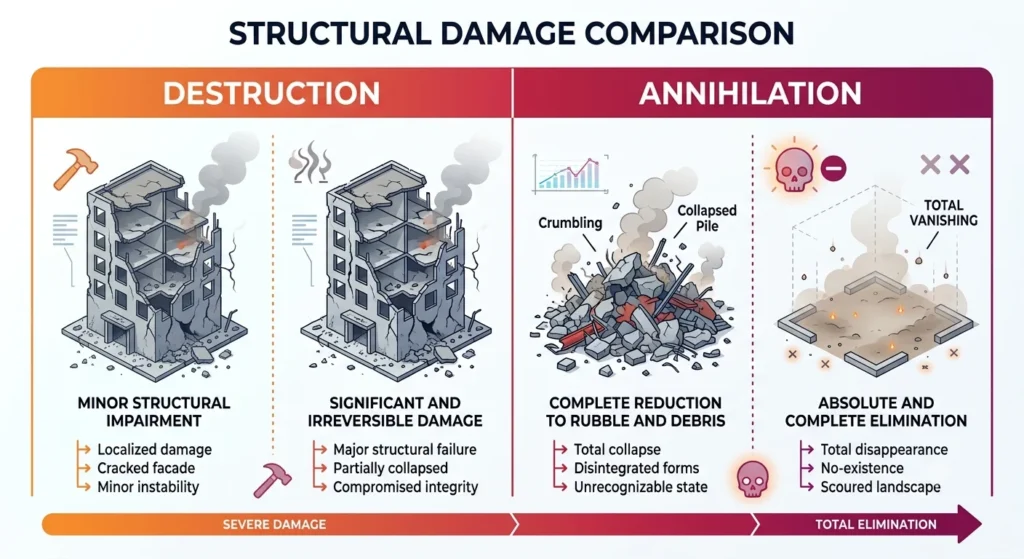
Annihilation vs. Destruction
Although people often use these words interchangeably, they are not exactly the same.
| Annihilation | Destruction |
|---|---|
| Complete elimination | Serious damage |
| Little or nothing remains | Something often remains |
| Stronger word | Broader word |
| Usually irreversible | May be repairable |
Example
Destruction
“The hurricane caused the destruction of several buildings.”
Some buildings may still be standing or repaired.
Annihilation
“The volcanic eruption resulted in the annihilation of the ancient settlement.”
The settlement no longer exists.
Annihilation vs. Obliteration
These two words are close in meaning, but the emphasis is different.
| Annihilation | Obliteration |
|---|---|
| Focuses on complete elimination | Focuses on erasing every visible trace |
| Often used in science and philosophy | Common in military and disaster writing |
| Can describe abstract ideas | Usually describes physical objects or evidence |
Example
“The empire faced annihilation.”
“The explosion obliterated the bridge.”
Word Family
Learning related forms makes it easier to recognize and use the word correctly.
| Word | Part of Speech | Meaning |
|---|---|---|
| Annihilation | Noun | Complete destruction |
| Annihilate | Verb | To destroy completely |
| Annihilated | Verb / Adjective | Completely destroyed |
| Annihilating | Verb | Destroying completely |
| Annihilator | Noun | A person or thing that destroys completely (less common) |
Pronunciation
Many learners find this word difficult because of its length.
Pronunciation
uh-NYE-uh-LAY-shun
IPA
/əˌnaɪ.əˈleɪ.ʃən/
Syllables
an • ni • hi • la • tion
Memory Trick
Break it into smaller parts:
uh → NYE → uh → LAY → shun
Practice saying each part slowly before saying the whole word naturally.
Common Mistakes
Even advanced English learners sometimes misuse annihilation.
Mistake 1: Using it for small problems
❌ “The rain caused the annihilation of my shoes.”
✅ “The rain ruined my shoes.”
Mistake 2: Confusing it with destruction
Remember:
Destruction can be partial.
Annihilation is nearly always complete.
Mistake 3: Using the wrong grammar
❌ “The soldiers annihilation the enemy.”
✅ “The soldiers annihilated the enemy.”
Mistake 4: Thinking it always means violence
Not true.
Scientists use the word to describe particle interactions, and writers often use it metaphorically to describe emotional, financial, cultural, or symbolic loss.
Why Native Speakers Choose This Word
Native English speakers usually choose annihilation when they want to emphasize that a loss, defeat, or destruction was absolute.
Instead of saying:
“The team lost badly.”
They may say:
“The team suffered complete annihilation.”
This creates a much stronger mental image and makes the sentence more dramatic.
Quick Summary
Before moving to the frequently asked questions, remember these key points:
✔ Annihilation means complete destruction or total elimination.
✔ It is one of the strongest words used to describe destruction in English.
✔ The word can be literal or metaphorical depending on the context.
✔ Use it only when something has been completely destroyed, eliminated, or overwhelmingly defeated.
✔ Avoid using it for everyday inconveniences or minor damage.
FAQs
What is annihilation in simple words?
In simple words, annihilation means complete destruction or total elimination. It describes a situation where something is destroyed so completely that little or nothing remains.
What is the full meaning of annihilation?
The full meaning of annihilation is the complete destruction, elimination, or disappearance of a person, object, force, idea, or system. Depending on the context, it can refer to physical destruction, scientific reactions, emotional collapse, or overwhelming defeat.
What does annihilate mean in simple words?
Annihilate means to destroy or defeat completely.
Example
- The explosion annihilated the abandoned factory.
- Our team annihilated the competition.
What is another word for annihilation?
Some common synonyms include:
- Destruction
- Obliteration
- Eradication
- Elimination
- Devastation
- Extermination
- Extinction
Each synonym has a slightly different meaning, but annihilation usually expresses the greatest degree of destruction.
What is the opposite of annihilation?
Common antonyms include:
- Creation
- Preservation
- Restoration
- Recovery
- Survival
- Revival
- Reconstruction
These words describe building, protecting, or restoring rather than destroying.
Is annihilation always negative?
Usually, yes.
Because it refers to complete destruction or elimination, annihilation generally has a negative meaning.
However, in sports, gaming, and casual conversation, it is sometimes used humorously to describe a decisive victory.
Example:
“Our team absolutely annihilated the opposition.”
What does annihilation mean in physics?
In physics, annihilation occurs when a particle and its antiparticle collide, converting their mass into energy. A common example is electron-positron annihilation, which produces gamma rays.
What does annihilation mean in radiology?
In radiology, annihilation is the process that occurs during PET (Positron Emission Tomography) scans when positrons meet electrons. The resulting gamma rays help create detailed medical images.
What does annihilation mean in history?
In history, annihilation refers to the complete destruction or overwhelming defeat of an army, city, civilization, or political power.
What does annihilation mean in the Bible?
In Christian theology, the concept of annihilation is commonly discussed in relation to annihilationism, the belief that the wicked ultimately cease to exist after judgment rather than experiencing eternal conscious punishment. Different Christian traditions interpret these passages differently.
What is nuclear annihilation?
Nuclear annihilation refers to catastrophic destruction resulting from nuclear warfare or large-scale nuclear attacks.
What is family annihilation?
Family annihilation is a criminology term describing a tragic event in which an individual kills multiple members of their own family. Because it refers to real-life tragedies, it should always be discussed with care and sensitivity.
Can annihilation be used metaphorically?
Yes.
Writers often use the word metaphorically to describe:
- Emotional annihilation
- Financial annihilation
- Cultural annihilation
- Psychological annihilation
- The annihilation of hope or confidence
In these cases, the word emphasizes overwhelming loss rather than literal destruction.
How do you pronounce annihilation?
Pronunciation:
uh-NYE-uh-LAY-shun
IPA:
/əˌnaɪ.əˈleɪ.ʃən/
Is annihilation a noun?
Yes.
Annihilation is a noun.
The verb form is annihilate.
Key Takeaways
Before you leave, remember these important points:
- Annihilation means complete destruction or total elimination.
- It is stronger than words such as damage, loss, or destruction.
- The meaning changes slightly depending on the context, but the core idea always remains the same.
- The word is commonly used in physics, history, medicine, psychology, religion, literature, gaming, sports, and everyday English.
- Learning its pronunciation, word family, and common collocations will help you use it naturally and confidently.
Conclusion
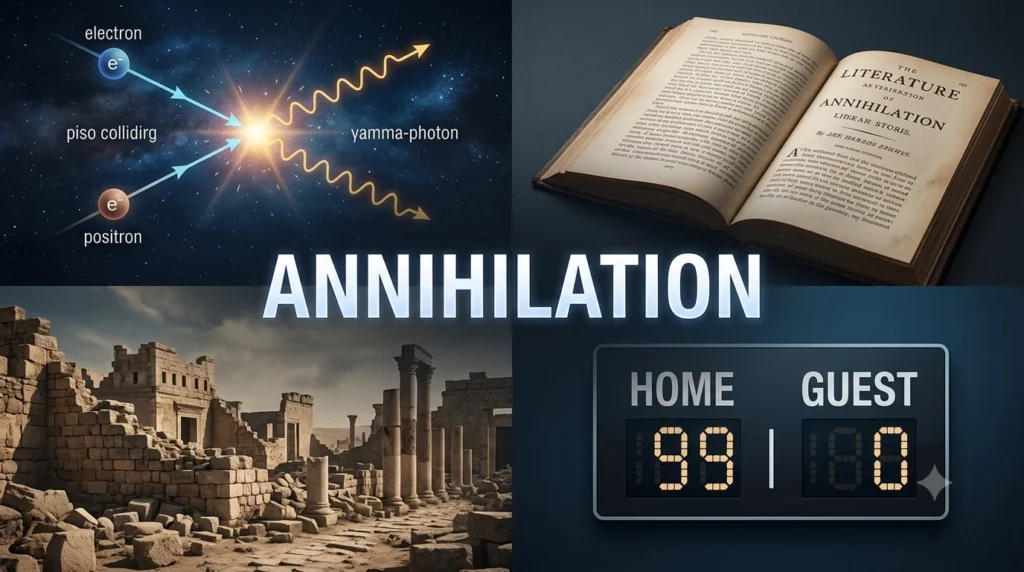
Annihilation is one of the most powerful words in the English language because it expresses the idea of complete destruction, total elimination, or absolute disappearance. Whether you’re reading a history book, watching a science-fiction movie, studying particle physics, or following current events, understanding this word helps you interpret complex ideas with greater accuracy.
What makes annihilation especially interesting is its versatility. In physics, it describes the conversion of matter into energy. In history, it highlights overwhelming defeat. In psychology and literature, it can symbolize the loss of identity or hope. And in everyday conversation, it is often used figuratively to emphasize an extraordinary victory or failure.
The key to using the word correctly is understanding its intensity. Reserve annihilation for situations involving complete or nearly complete destruction rather than ordinary damage or minor setbacks. Doing so will make your writing more precise and your vocabulary more expressive.
As you continue building your English vocabulary, explore related words, compare similar meanings, and pay attention to how native speakers use them in different contexts. The more examples you encounter, the more naturally you’ll understand and use words like annihilation in both speech and writing.

Lucas Hayes is a content writer at Meanovia, specializing in slang, texting meanings, and internet phrases. He creates simple, clear, and engaging explanations of modern digital language 💬✨