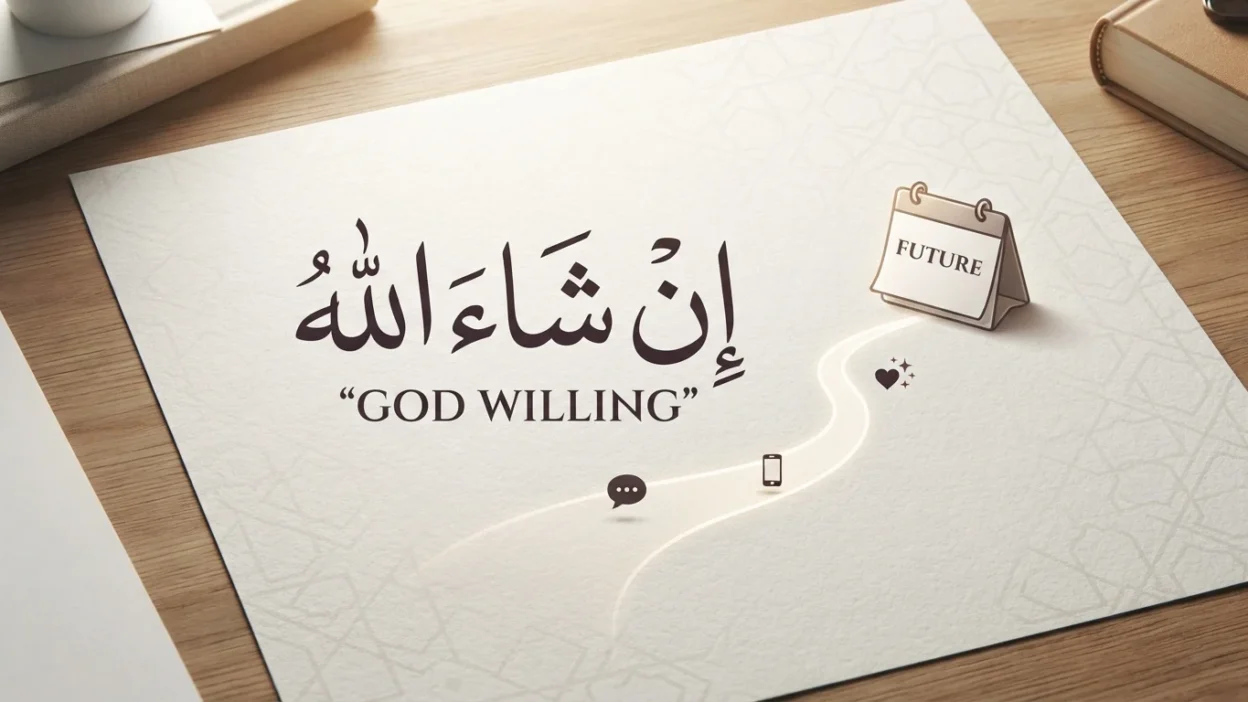
Ever heard someone say “Inshallah” and wondered whether it means “hopefully,” “maybe,” or something more specific? Inshallah (إن شاء الله) literally means “if Allah wills” or “if God wills.”
The Arabic phrase is commonly used when talking about a future event, plan, or hope while acknowledging that the outcome ultimately depends on Allah’s will. For example, “I’ll see you tomorrow, Inshallah” can express an intention to meet while recognizing that the future is not completely within one’s control.
It is sometimes translated as “God willing” or, depending on context, “hopefully,” but Inshallah is not simply another word for “maybe.” “Maybe” mainly expresses uncertainty, while Inshallah explicitly refers to God’s will. The phrase is closely associated with Muslim religious and cultural usage, although it is also used by Arabic speakers in other communities. If you’re searching for Inshallah meaning, this guide explains its definition, Arabic origin, pronunciation, usage, cultural significance, and common examples.
What Does Inshallah Mean?
Inshallah (إن شاء الله) means “God willing” or “if God wills.”
It is an Arabic expression used when talking about something in the future, especially a plan, hope, intention, or expected event.
For example:
“I’ll see you tomorrow, Inshallah.”
The speaker is expressing an intention to meet tomorrow while acknowledging that the future ultimately depends on God’s will.
Inshallah is not an acronym, abbreviation, or ordinary internet slang. Although it is common in casual messages, it remains an Arabic expression with religious and cultural significance.
Inshallah Meaning in English
The most natural Inshallah meaning in English is:
“God willing.”
Other translations can include:
- “If God wills.”
- “If God permits.”
- “God willing, it will happen.”
- “Hopefully, if God wills.”
However, Inshallah should not automatically be translated as “yes” or “maybe.” The speaker’s tone and the situation can affect how the phrase is understood.
For example:
“Will you come tomorrow?”
“Inshallah.”
This may communicate a hopeful intention to come, while recognizing that the outcome is not entirely under the speaker’s control.
Inshallah Meaning in Arabic
The Arabic spelling is:
إن شاء الله
A more precise transliteration is in shā’a Allāh, although English commonly uses Inshallah, InshaAllah, In sha Allah, or In shaa Allah.
The phrase consists of three Arabic elements:
- In (إن) — if
- Shā’a (شاء) — willed
- Allah (الله) — God
Together, the expression conveys the idea of “if God wills.”
Different English spellings do not normally indicate different meanings. Transliteration varies because Arabic sounds and letters do not always map neatly onto English spelling.

Inshallah Meaning in Islam
In Islamic usage, Inshallah expresses the idea that future events ultimately occur according to Allah’s will.
The expression has a direct Quranic connection. In Surah Al-Kahf 18:23–24, believers are instructed not to speak about carrying out a future action without acknowledging Allah’s will; the verse includes the wording commonly translated as “if Allah wills.”
That religious background helps explain why Inshallah can carry meanings of:
- Hope
- Humility
- Intention
- Trust in God
- Recognition that the future is not completely within human control
At the same time, Inshallah is also part of everyday speech. Someone does not necessarily need to be discussing religion when using it. It can naturally appear in a conversation about work, travel, family, education, or tomorrow’s plans.
Inshallah Origin
The Inshallah meaning Arabic phrase comes from the expression إن شاء الله (in shā’a Allāh).
Its use is closely connected with Islamic language and the Quranic discussion of future intentions. Over time, it became deeply established in Arabic-speaking and Muslim communities around the world.
Today, Inshallah is familiar far beyond Arabic-speaking countries. It appears in multilingual conversations, text messages, social media, entertainment, and English-language discussions.
Because people write Arabic expressions using English letters, you may encounter many spellings, including:
- Inshallah
- InshaAllah
- In sha Allah
- In shaa Allah
- Insha’Allah
- Inchallah
The spelling can change, but the underlying Arabic expression remains the same.
Medusa Tattoo Meaning: Protection, Survival & Reclaimed Power
How Do You Pronounce Inshallah?
Cambridge gives the English pronunciation approximately as /ɪnˈʃæl.ə/.
For an English speaker, it can be approximated as:
in-SHAH-lah
Arabic pronunciation can be more precise than an English approximation, so listening to a native speaker is useful if you want to reproduce the original pronunciation accurately.
Inshallah Meaning in Texting
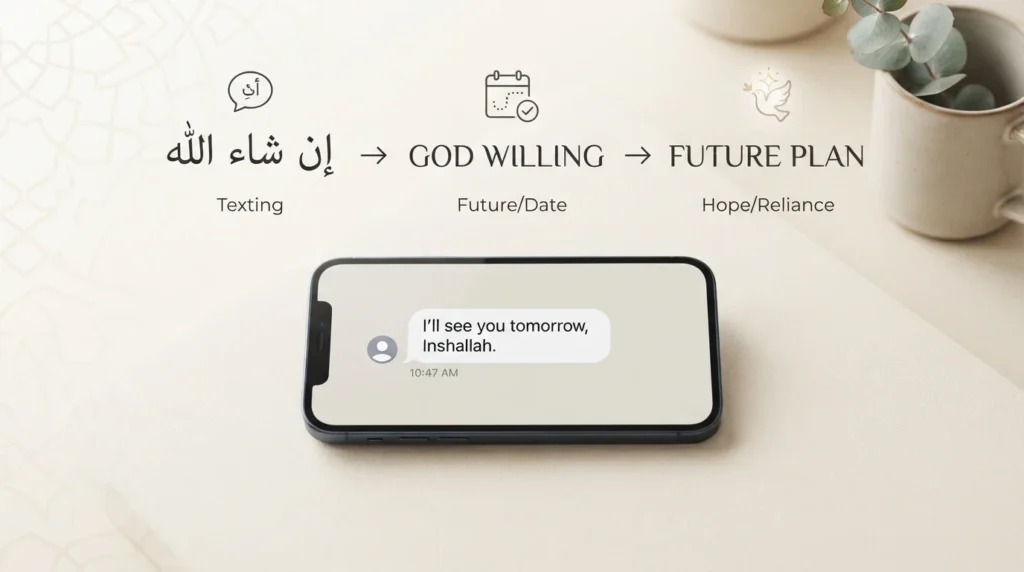
The Inshallah meaning in texting is usually the same as in speech: “God willing” or “if God wills.”
People commonly use it when discussing future plans or hopes.
Examples:
“I’ll call you tonight, Inshallah.”
“See you at the wedding, Inshallah.”
“Inshallah, I’ll finish everything today.”
“We’ll travel next month, Inshallah.”
It may look casual because it appears in a text, but it is not simply texting slang. The phrase keeps its original cultural and religious meaning.
Inshallah Meaning on Instagram and TikTok
On Instagram, TikTok, Facebook, and similar platforms, Inshallah can appear in captions, comments, stories, and personal posts.
For example:
“New beginnings, Inshallah.”
“Graduation day, Inshallah.”
“Dream trip coming soon, Inshallah.”
“Better days ahead, Inshallah.”
On social media, the phrase may communicate hope for a future event, a personal goal, or a positive outcome.
Its tone depends on the post. It can be spiritual, personal, hopeful, celebratory, or simply part of the speaker’s everyday language.
How Do I Use Inshallah Correctly?
A simple rule is to use Inshallah when referring to something that has not happened yet and is being discussed as a future plan, hope, or intention.
Natural examples
“I’ll visit you next week, Inshallah.”
“Inshallah, your exam goes well.”
“We’ll meet again soon, Inshallah.”
“I’m starting my new job Monday, Inshallah.”
The expression can come at the beginning or end of a sentence:
“Inshallah, everything will work out.”
“Everything will work out, Inshallah.”
Use also depends on culture and relationship. If you are speaking with someone who regularly uses Arabic or Islamic expressions, Inshallah may sound completely natural. In an audience unfamiliar with the phrase, “God willing” may communicate the meaning more clearly.
Does Inshallah Mean Yes or Maybe?
This is one of the most misunderstood parts of the expression.
Inshallah does not have a universal “yes” or “maybe” translation.
Its basic meaning is “God willing.” In one context, it may accompany a sincere commitment:
“I’ll be there tomorrow, Inshallah.”
In another conversation, a brief “Inshallah” may leave the exact level of certainty unclear.
That is why it is better not to assume that everyone who says Inshallah means exactly the same thing emotionally.
The phrase can express genuine intention while still recognizing that circumstances and the future are ultimately beyond human control.
Inshallah Meaning Reply: How Do You Respond?
There is no single mandatory reply to Inshallah.
Depending on the context, natural responses include:
- Inshallah.
- Ameen.
- Inshallah, see you then.
- Hopefully!
- A normal response to the plan being discussed.
For example:
Person 1: “Inshallah, I’ll see you tomorrow.”
Person 2: “Inshallah, see you then.”
If the original statement is more like a prayer or hopeful wish, “Ameen” can also be a natural response.
Submissive Meaning: Yielding to Another Person’s Authority
Inshallah vs. Mashallah Meaning
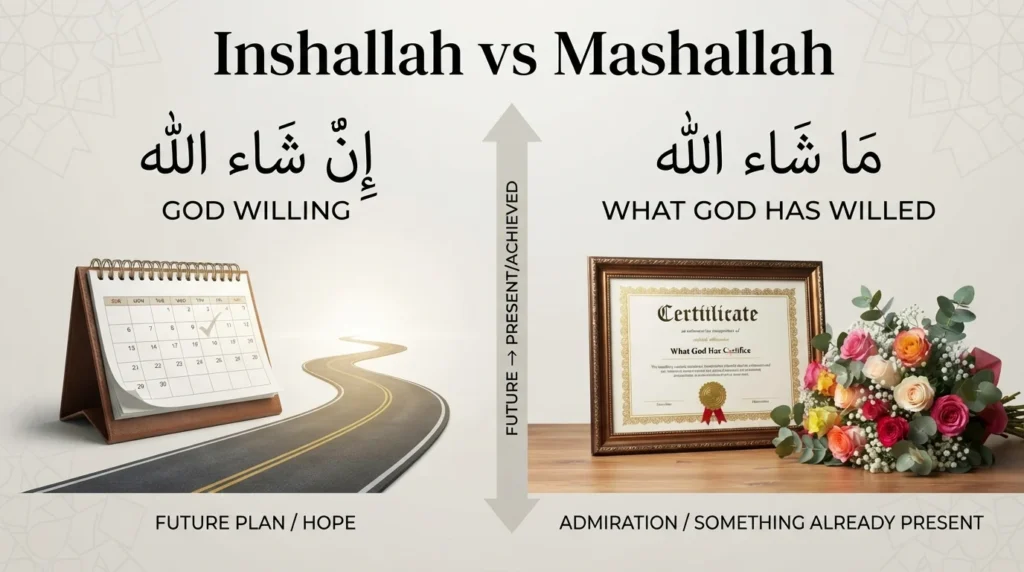
Inshallah and Mashallah are related Arabic expressions, but they are not interchangeable.
| Expression | Basic meaning | Common function |
|---|---|---|
| Inshallah | God willing | Future plans and hopes |
| Mashallah | What God has willed | Admiration or recognition |
| Alhamdulillah | Praise be to God | Gratitude or praise |
| Bismillah | In the name of God | Beginning an action |
A simple way to remember the first two is:
Inshallah → future
Mashallah → something present or already accomplished that is being admired or acknowledged
For example:
“I’ll get the new job, Inshallah.”
versus:
“Mashallah, you got the new job!”
The meanings overlap in their religious context, but their practical uses are different.
What Does Mashallah Mean?
Mashallah (ما شاء الله) is commonly translated as “what God has willed.”
It is often used when expressing admiration or acknowledging something good.
For example:
“Mashallah, your baby is beautiful.”
“Mashallah, you worked very hard.”
This is different from Inshallah, which generally points toward a future plan or hoped-for outcome.
What Does Alhamdulillah Mean?
Alhamdulillah (الحمد لله) means “praise be to God” or “all praise is due to God.”
It is commonly used to express gratitude, praise, or thankfulness.
Compare:
“Inshallah, I’ll finish the project tomorrow.”
This refers to a future hope or plan.
“Alhamdulillah, I finished the project.”
This expresses gratitude about something that has happened.
What Does Bismillah Mean?
Bismillah (بسم الله) means “in the name of God.”
It is commonly used before beginning an action.
For example:
“Bismillah, let’s begin.”
So although these expressions are often heard together in Muslim communities, each has a distinct function.
Inshallah Habibi Meaning
“Inshallah habibi” combines Inshallah with habibi, an Arabic term of affection.
Habibi can mean “my dear,” “my beloved,” or “my love,” depending on context and relationship.
Therefore:
Inshallah habibi = “God willing, my dear” or “God willing, my love.”
For example:
“See you tomorrow, Inshallah habibi.”
The exact emotional tone depends on who is speaking to whom. Habibi can be affectionate without necessarily being romantic, so context matters.
Khair Inshallah Meaning
Khair Inshallah combines khair, meaning “goodness” or “good,” with Inshallah.
Depending on the dialect and situation, Khair Inshallah can express hope that things will turn out well, especially when something unexpected, worrying, or uncertain happens.
For example:
“My manager suddenly called me.”
“Khair Inshallah?”
In some contexts, the phrase can carry a sense similar to “Is everything okay?”, “What happened?”, or “Hopefully, it will be for the best.”
Tone is especially important here because everyday Arabic expressions can shift meaning with the situation and dialect. Levantine usage, for example, can give Khair Inshallah several shades of meaning.
Inshallah Meaning in Urdu English
For Urdu speakers, Inshallah is commonly understood through expressions such as:
“Allah chahe to”
or
“Allah ne chaha to.”
In simple English, this is close to:
“If Allah wills.”
Because Inshallah is already familiar in Urdu-speaking communities, speakers may naturally combine it with English:
“I’ll call you later, Inshallah.”
“We’ll meet tomorrow, Inshallah.”
“Inshallah, everything will be fine.”
Inshallah Meaning Christian: Can Christians Use It?
The answer requires a little context.
Allah is the Arabic word used for God, and Cambridge notes that “Allah” is the name of God for Muslims and Arab Christians.
Inshallah is strongly associated with Islamic and Muslim cultural contexts, but Arabic-speaking Christians also use Arabic religious vocabulary. Whether an individual Christian uses Inshallah depends on their language, culture, community, and personal habits.
So it would be inaccurate to say that the Arabic expression can only ever be spoken by Muslims.
Is Inshallah Slang?
No. Inshallah is not originally slang.
It is an established Arabic expression with religious and cultural significance.
It can certainly be used casually in a text or conversation, but casual use does not turn it into slang.
For example:
“See you tomorrow, Inshallah.”
is casual in tone, but Inshallah itself is still the same Arabic expression.
Is Inshallah Formal or Informal?
Inshallah can appear in both everyday and more formal communication.
It may be used in:
- Family conversations
- Friend-to-friend messages
- Social media
- Community discussions
- Religious conversations
- Some professional settings where the expression is culturally familiar
However, the audience matters. If you are communicating with people who may not know Arabic, “God willing” can be clearer in English.
Inshallah Meaning and Cultural Context
One reason Inshallah can confuse English speakers is that a literal translation does not always capture its conversational role.
A person may say:
“I’ll send it tomorrow, Inshallah.”
The sentence can communicate both intention and recognition that the future is not completely under human control.
In some communities, the expression can also be used more loosely in everyday conversation. This does not mean the core definition has changed; rather, conversational tone and cultural expectations influence how listeners interpret it.
That distinction is important. You should understand the phrase from the whole conversation instead of assuming that every Inshallah means either a firm promise or a polite refusal.
Why Is Inshallah Suddenly Everywhere Online?
Inshallah has appeared increasingly often in English-language social media and popular culture.
A notable 2026 example involved Anne Hathaway, who used Inshallah during an interview while discussing her hopes for a long and healthy life. The moment attracted substantial online attention and prompted media outlets to explain the phrase to audiences unfamiliar with Arabic.
This is one reason someone searching “Inshallah meaning Anne Hathaway” may be looking for the meaning behind that particular viral moment.
The phrase itself, however, is much older than the recent social-media attention. The 2026 interest reflects renewed visibility, not a new meaning.
Common Mistakes When Using Inshallah
1. Treating it as a guaranteed promise
Inshallah acknowledges God’s will, so it should not automatically be interpreted as an absolute guarantee.
2. Translating it only as “maybe”
“Maybe” can miss the religious and hopeful meaning of the expression.
3. Using it interchangeably with Mashallah
The two phrases have different common functions.
4. Assuming it is texting slang
It is an Arabic expression, even when written casually online.
5. Ignoring context
Tone, relationship, dialect, and situation can affect how a listener understands the phrase.
6. Using it as a joke without understanding it
Because Inshallah has religious significance for many people, respectful use is important.
Inshallah Examples in Everyday Conversation
Here are some natural examples:
Future plan:
“I’ll visit you next month, Inshallah.”
Hope:
“Inshallah, you get the job.”
Travel:
“We’ll reach Dubai tomorrow, Inshallah.”
Study:
“Inshallah, I’ll pass the exam.”
Family:
“We’ll see everyone this weekend, Inshallah.”
Texting:
“Good night! See you tomorrow, Inshallah.”
The common idea is that the speaker is talking about something that has not happened yet.
Frequently Asked Questions
What does Inshallah mean in English?
Inshallah means “God willing” or “if God wills.” It is an Arabic expression commonly used for future plans, hopes, and intentions.
What does Inshallah mean in Arabic?
إن شاء الله (in shā’a Allāh) literally conveys the idea of “if God wills.” In English, “God willing” is the most natural translation.
What does Inshallah mean in Islam?
In Islamic usage, Inshallah acknowledges Allah’s will when discussing future events. The expression has a Quranic connection through Surah Al-Kahf 18:23–24.
What is the reply to Inshallah?
There is no single required reply. Depending on the context, you can say “Inshallah,” “Ameen,” or respond naturally to the statement.
Is Inshallah or Mashallah correct?
Both are correct expressions, but they are used differently. Inshallah commonly refers to future hopes or plans, while Mashallah is commonly used when expressing admiration or acknowledging something good.
What does Inshallah habibi mean?
It means approximately “God willing, my dear” or “God willing, my love.” Habibi is an Arabic term of affection.
What does Khair Inshallah mean?
Khair Inshallah can express hope that things will turn out well. Depending on dialect and context, it can also be used as a concerned reaction meaning something like “Is everything okay?”
Can Christians say Inshallah?
Arabic-speaking Christians may use Arabic expressions for God, including Allah. Whether someone uses Inshallah depends on their language, culture, community, and personal practice.
Is Inshallah slang?
No. It is an established Arabic expression. It can be used casually, including in texting, but it is not originally internet slang.
Does Inshallah mean yes or maybe?
Neither translation is universally correct. Its core meaning is “God willing.” Context and tone determine how a particular speaker intends the expression to function in conversation.
Final Takeaway
The Inshallah meaning is “God willing” or “if God wills.” It is an Arabic expression commonly used when talking about future plans, hopes, and intentions, while acknowledging that the final outcome is not completely within human control.
Its meaning becomes much clearer when you understand the differences between related expressions. Inshallah generally points toward the future, Mashallah commonly expresses admiration or recognition, Alhamdulillah expresses gratitude or praise, and Bismillah refers to beginning an action in the name of God.
Whether you see Inshallah in a text, Instagram caption, conversation, Islamic context, or a viral celebrity interview, the best interpretation comes from both the words and the context around them.

Lucas Hayes is a content writer at Meanovia, specializing in slang, texting meanings, and internet phrases. He creates simple, clear, and engaging explanations of modern digital language 💬✨