
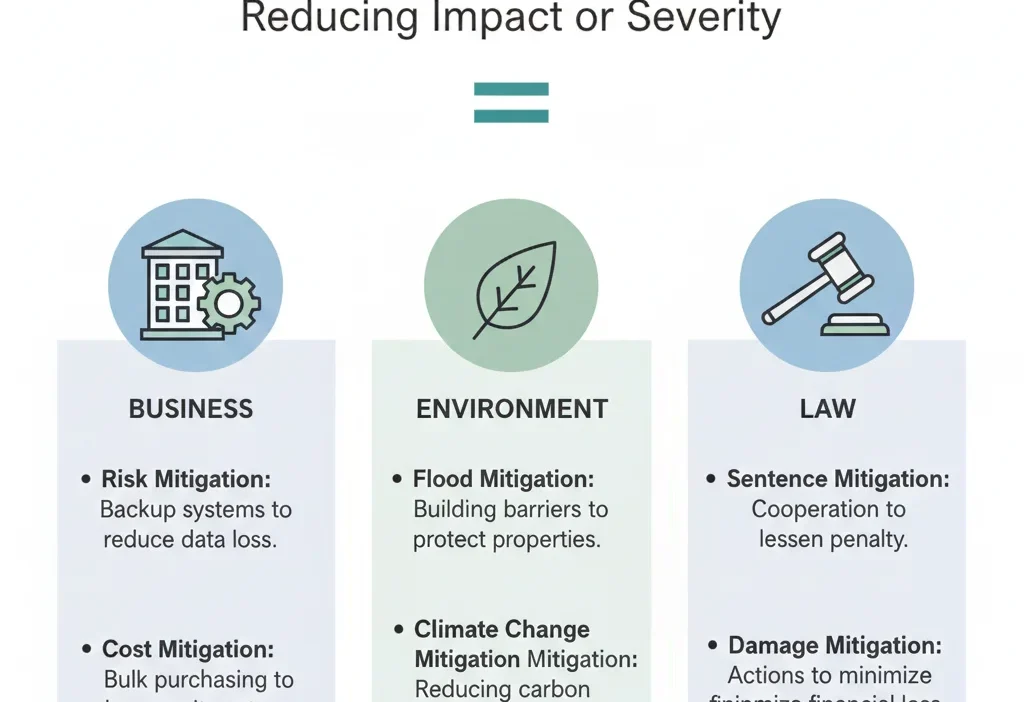
Ever heard someone use the word “mitigation” in a meeting or news report and wondered what it really means? You’re not alone. This term often pops up in discussions about risk management, climate change, and law, but its meaning can shift slightly depending on the context.
In this article, we’ll break down:
- What mitigation means
- Its origin and history
- How it’s used in different fields
- Examples in real conversations and writing
- Common mistakes and FAQs about its use
What Does Mitigation Mean?
Mitigation means reducing the severity, seriousness, or harmful effects of something.
In simple terms, to mitigate means to lessen a problem or minimize damage.
It’s commonly used in business, law, environmental studies, and everyday speech to describe actions that make bad situations less severe.
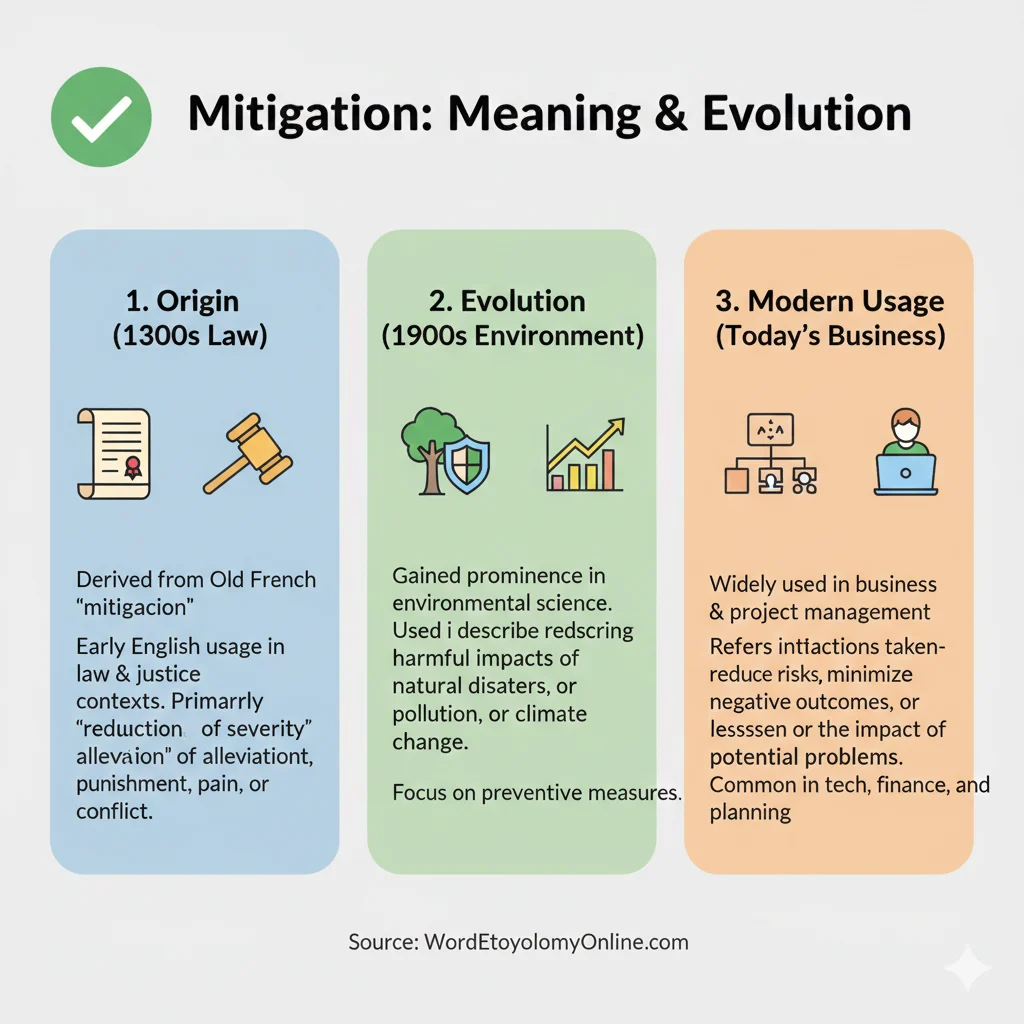
Origin and Popularity
The word mitigation comes from the Latin term “mitigare,” which means “to soften” or “make gentle.” It entered the English language in the 14th century, often used in legal and academic writing.
Over time, mitigation became popular in fields like:
- Law – referring to reducing penalties or damages.
- Environmental science – reducing climate change impacts.
- Project management and business – managing or minimizing risks.
By the 21st century, “mitigation” had become a staple in corporate reports, climate discussions, and global policies.
Mitigation Meaning in Different Contexts
Let’s explore how “mitigation” takes on slightly different meanings depending on where it’s used:
1. In Business and Risk Management
Mitigation refers to steps taken to reduce potential risks.
- Example: “Our company developed a risk mitigation plan to handle supply chain delays.”
Key idea: It’s about being proactive — preventing or minimizing losses.
2. In Environmental Studies
Here, mitigation means reducing the impact of human activity on the environment.
- Example: “Carbon mitigation involves lowering greenhouse gas emissions to slow climate change.”
Key idea: It focuses on long-term, global-scale solutions.
3. In Law
In legal settings, mitigation means reducing the severity of a crime, penalty, or damage.
- Example: “The defendant’s remorse was considered a mitigating factor in sentencing.”
Key idea: It’s about fairness and context — showing factors that justify a lighter punishment.
4. In Everyday Language
Even outside formal contexts, people use “mitigation” casually.
- Example: “We added a second backup system as a mitigation for possible failures.”
Key idea: It’s about taking action to make things less bad.
| Context | Meaning of Mitigation | Example |
| Business | Reducing risks or losses | “Risk mitigation plan for project delays.” |
| Environment | Reducing negative impacts on nature | “Climate mitigation strategies focus on renewable energy.” |
| Law | Reducing severity of punishment or damages | “Mitigating circumstances led to a lesser sentence.” |
| Everyday Use | Making something less harmful or serious | “Extra safety checks act as a mitigation measure.” |
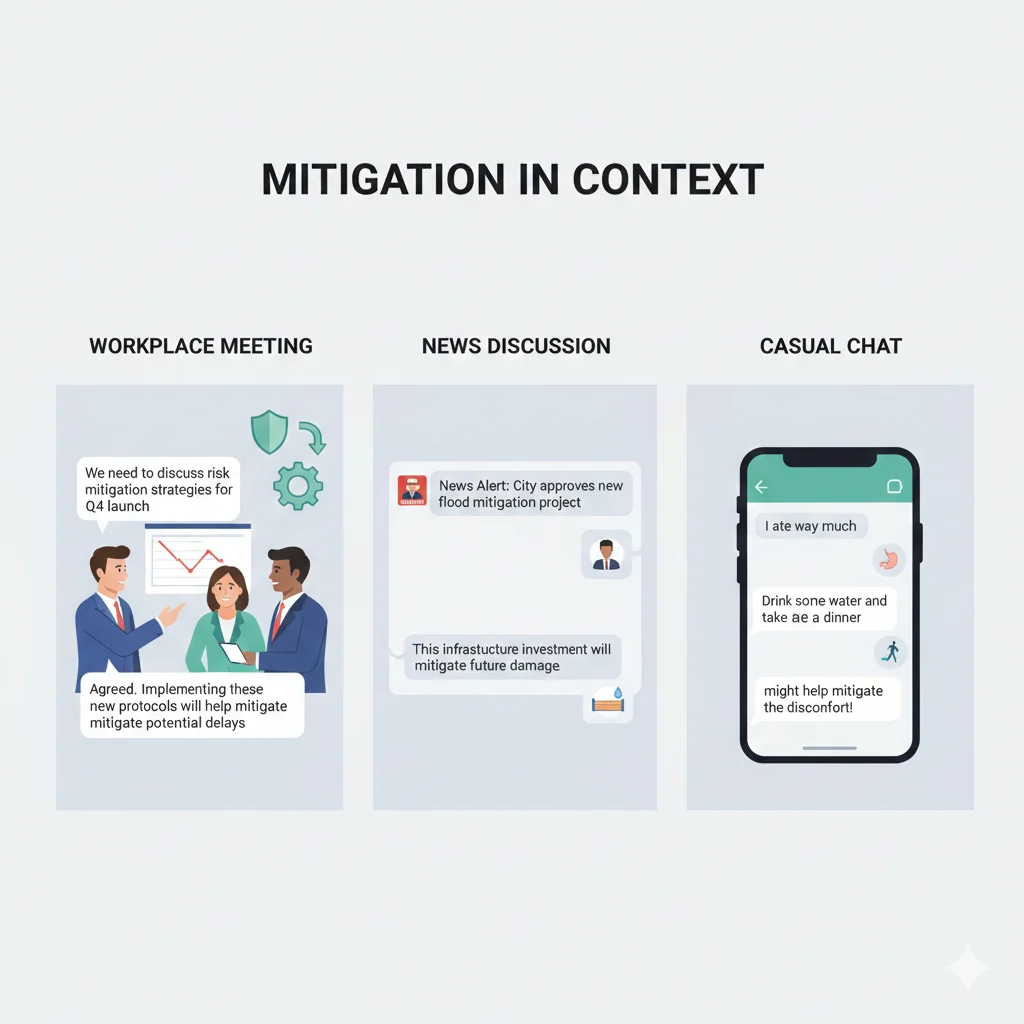
Examples of Mitigation in Conversations
Here are a few realistic examples showing how “mitigation” is used in everyday and professional contexts:
Manager: We need a mitigation strategy in case our suppliers face delays.
Team Lead: Agreed — we can add two alternative vendors to the list.
Teacher: Carbon mitigation helps fight global warming.
Student: So, using public transport instead of cars counts as mitigation?
Lawyer: We’ll present evidence in mitigation of the client’s actions.
Judge: That may influence the final sentencing.
Similar or Related Terms
Here are some related words and phrases that share a similar meaning:
| Term | Meaning | Common Use |
| Alleviation | Making something less severe | Social and humanitarian contexts |
| Reduction | Lowering intensity or quantity | General, everyday use |
| Prevention | Stopping something from happening | Health, safety, and planning |
| Remediation | Fixing or correcting a problem | Environmental and education fields |
| Compensation | Offsetting a loss or damage | Business and legal contexts |
These terms are sometimes used interchangeably, but mitigation specifically implies reducing negative effects, not necessarily eliminating them.
How to Use “Mitigation” Correctly
✅ Do use “mitigation” when referring to reducing risks, harm, or damage.
✅ Use in formal or professional settings — like business reports, legal documents, or policy discussions.
✅ Pair with strong action verbs like “plan,” “strategy,” or “measure.”
❌ Don’t use “mitigation” casually when “solution” or “fix” fits better.
❌ Avoid using it as a verb incorrectly — the verb form is mitigate, not mitigation.
Example:
- ✅ Correct: “We need to mitigate the risks.”
- ❌ Incorrect: “We need to mitigation the risks.”
Common Mistakes or Misinterpretations
- Confusing “mitigate” with “alleviate” or “prevent.”
- Mitigate = make less severe
- Prevent = stop completely
- Mitigate = make less severe
- Using “mitigation” as a verb.
- The correct verb form is mitigate.
- The correct verb form is mitigate.
- Overusing it in casual speech.
- It’s best for formal or professional discussions.
- It’s best for formal or professional discussions.
- Assuming it means “solve.”
- Mitigation doesn’t mean the problem is gone — just reduced.
- Mitigation doesn’t mean the problem is gone — just reduced.
FAQ
1. What does mitigation mean in simple words?
Mitigation means reducing the harm or severity of something bad. For example, wearing seatbelts is a mitigation against car accident injuries.
2. Is mitigation the same as prevention?
Not exactly. Prevention stops something from happening, while mitigation lessens its effects once it happens.
3. What is a mitigation plan?
A mitigation plan is a strategy designed to reduce potential risks, damages, or losses. Businesses and governments often create these plans for crises, disasters, or environmental issues.
4. What does mitigation mean in business?
In business, mitigation refers to reducing financial, operational, or reputational risks through planning and control measures.
5. What are examples of mitigation strategies?
Examples include backup systems, insurance coverage, disaster recovery plans, and reducing carbon emissions in environmental policies.
6. What’s the difference between mitigation and adaptation?
In environmental terms, mitigation means reducing causes of climate change (like cutting emissions), while adaptation means adjusting to its effects (like building flood defenses).
Conclusion
In short, mitigation means reducing the impact or severity of a problem — whether it’s a natural disaster, business risk, or legal issue. It’s about minimizing harm, not eliminating it entirely.
Now that you know what mitigation means, you’ll recognize it in news reports, business documents, or climate discussions — and use it confidently in your own conversations.
Keep exploring our site for more clear, expert explanations of common terms and professional jargon!

Jon McGregor is a language and word-meaning expert at Meanovia.com. He specializes in explaining complex words, phrases, and modern language trends in a clear, approachable style. His mission is to help readers quickly grasp the true meaning behind every term, making language learning and understanding effortless and engaging.