Have you ever heard someone describe a movie, restaurant, performance, student, app, or piece of work as “mediocre” and wondered whether it simply meant average or something more disappointing? Mediocre (pronounced mee-dee-OH-ker) is an adjective that describes something that is only ordinary and falls below the level of quality, skill, or success that people expect.
Although many people use mediocre and average interchangeably, they are not exactly the same. Average is generally neutral, while mediocre usually carries a negative meaning, suggesting that something failed to reach its potential or left people underwhelmed. Whether describing a person’s performance, customer service, a film, product, or creative work, mediocre implies a lack of excellence, originality, or distinction rather than complete failure.
In simple terms, mediocre means ordinary but disappointingly below expectations. For example, a mediocre movie may be watchable but forgettable, a mediocre restaurant may serve acceptable food without impressing customers, and a mediocre performance may show effort but lack the quality needed to stand out.
The word is widely used in everyday English, education, business, entertainment, sports, reviews, and social media to describe results that are neither terrible nor exceptional. This guide explains its definition, pronunciation, origin, synonyms, antonyms, real-life examples, and how to recognize when mediocre is the right word—and when average, ordinary, or subpar may be a better choice.
What Does “Mediocre” Mean?
The word mediocre describes something that is only average or slightly below average and fails to stand out because it lacks excellence, originality, or high quality.
Unlike words such as terrible or awful, mediocre doesn’t suggest complete failure. Instead, it refers to something that meets only the minimum expectation without leaving a positive impression.
For example:
- A movie that’s watchable but forgettable.
- A restaurant with acceptable food but poor presentation.
- A student who has potential but consistently produces average work.
- An employee who completes assigned tasks but rarely exceeds expectations.
In all of these examples, the quality isn’t terrible—it simply isn’t impressive.
Simple Definition:
Mediocre means ordinary, unimpressive, or of only average quality, especially when something better was expected.
Mediocre Definition
According to standard English usage, mediocre is an adjective that describes something of moderate, average, or below-expected quality.
Dictionary-Style Definition
Mediocre (adjective): Of only average quality; not very good and not especially bad; ordinary or uninspiring.
However, in real-life conversations, the word often carries a stronger emotional meaning than dictionary definitions suggest.
Expert Insight
Many English learners think mediocre simply means average, but native speakers often use it to express disappointment.
For example:
“The presentation was average.”
This sounds neutral.
“The presentation was mediocre.”
This suggests it could and should have been much better.
That subtle emotional difference is one of the most important things to understand when using this word.
At a Glance: Where Does “Mediocre” Fit?
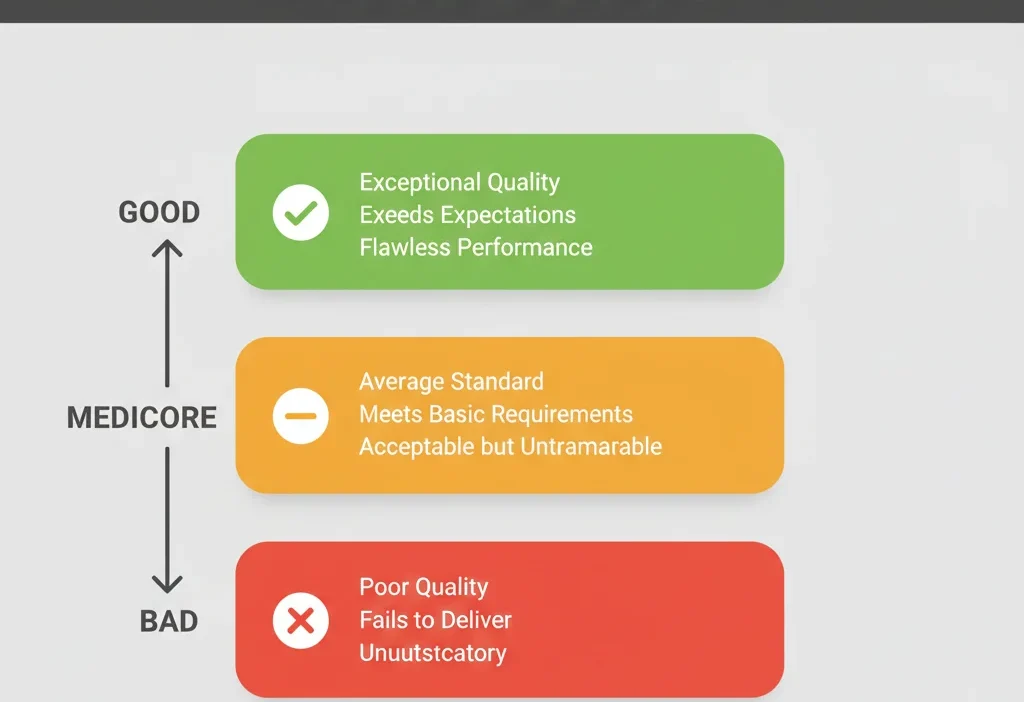
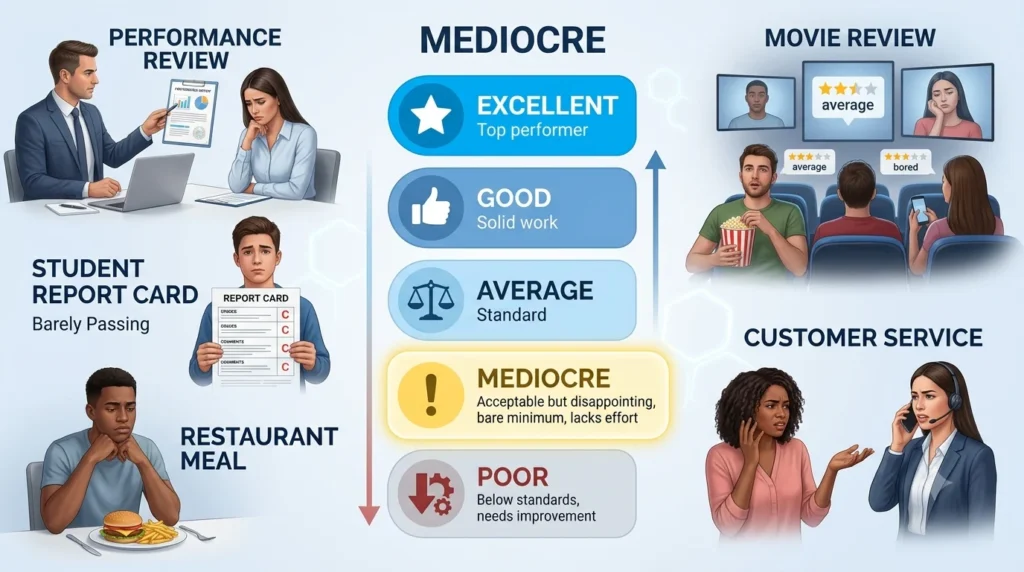
Instead of thinking of mediocre as another word for average, imagine a quality scale:
| Quality Level | Meaning |
|---|---|
| ⭐⭐⭐⭐⭐ Excellent | Outstanding and exceeds expectations |
| ⭐⭐⭐⭐ Good | Better than expected |
| ⭐⭐⭐ Average | Typical or ordinary without judgment |
| ⭐⭐ Mediocre | Acceptable but disappointing or unimpressive |
| ⭐ Poor | Clearly below acceptable quality |
Quick Tip:
Every mediocre thing may be average, but not every average thing is mediocre. The word mediocre almost always hints that something should have been better.
Mediocre Pronunciation
Many people know the meaning of mediocre but hesitate when saying it aloud.
American English
mee-dee-OH-ker
IPA: /ˌmiːdiˈoʊkər/
British English
mee-dee-OH-kuh
IPA: /ˌmiːdiˈəʊkə/
Easy Pronunciation Trick
Break it into four parts:
mee • dee • OH • ker
The strongest emphasis falls on OH.
✔ mee-dee-OH-ker
❌ MEE-dee-oh-ker
Reading the word aloud a few times will make it sound much more natural.
Part of Speech and Word Family
Mediocre is an adjective, meaning it describes a person, thing, performance, experience, or quality.
Examples
- mediocre performance
- mediocre movie
- mediocre food
- mediocre service
- mediocre student
- mediocre results
- mediocre work
- mediocre quality
Related Words
| Word | Part of Speech | Meaning |
|---|---|---|
| Mediocre | Adjective | Average or unimpressive |
| Mediocrity | Noun | The state of being mediocre |
| Mediocrely (rare) | Adverb | In a mediocre manner |
Among these, mediocre and mediocrity are by far the most common in modern English.
Origin and History of “Mediocre”
The word mediocre has been used in English for hundreds of years, but its original meaning was much more neutral than it is today.
It comes from the Latin word mediocris, meaning “middle,” “moderate,” or “of medium degree.” Through French, it entered the English language during the late 16th century. Over time, the meaning gradually shifted. Instead of simply describing something in the middle, English speakers began using mediocre to describe work, performance, or quality that was merely ordinary and failed to impress.
Today, the word almost always carries a mildly negative tone because it suggests that expectations were not fully met.
Timeline
- Latin: Mediocris = moderate or middle in degree.
- 16th Century: Adopted into English through French.
- 18th–19th Century: Increasingly used for ordinary or uninspiring quality.
- Modern English: Commonly appears in education, business, entertainment, product reviews, sports, and everyday conversations.
Why This Matters
Understanding the history of mediocre explains why the word feels more negative than average. While both can refer to the middle, mediocre implies missed potential or a lack of excellence.
Why Understanding “Mediocre” Matters
Knowing the true meaning of mediocre helps you avoid misunderstandings in both personal and professional communication.
For example:
- In a performance review, calling someone’s work mediocre suggests improvement is needed.
- In a movie review, it tells readers the film isn’t terrible but probably isn’t worth high expectations.
- In everyday conversation, it allows people to express disappointment without using stronger or harsher words.
Understanding this nuance will make your English sound more natural and help you interpret feedback more accurately.
Mediocre Meaning in Different Contexts
Although the basic definition of mediocre stays the same, its exact meaning can change slightly depending on where it’s is used. Whether you’re reading a performance review, watching a movie review, or talking with friends, the word usually suggests that something is acceptable but failed to impress.
Learning these different meanings will help you understand how native English speakers use mediocre in real-life situations.
Mediocre in Everyday Conversation
In everyday English, mediocre describes something that is neither terrible nor excellent. It simply means the experience was ordinary, forgettable, or less satisfying than expected.
People often use the word when talking about:
- Restaurants
- Movies
- Shopping experiences
- Travel
- Customer service
- Sports
- Hobbies
Examples
- The pizza looked amazing, but it tasted mediocre.
- Our vacation was fun, although the hotel was mediocre.
- His speech wasn’t bad—it was just mediocre.
- The new phone works well enough, but its camera is mediocre.
Mediocre Performance Meaning
One of the most searched questions is “What does mediocre performance mean?”
A mediocre performance is one that meets only the basic requirements but doesn’t demonstrate excellence, creativity, consistency, or strong results.
For example, a student may complete every assignment on time but still produce work that lacks originality. Similarly, an athlete may perform adequately but fail to compete at their highest level.
Examples
- The team’s mediocre performance ended their winning streak.
- Investors were disappointed by the company’s mediocre financial performance.
- Despite months of practice, his performance remained mediocre.
In the Workplace
Managers often use terms like mediocre performance to describe employees who consistently meet minimum expectations but rarely exceed them. Rather than indicating failure, it usually highlights opportunities for growth and improvement.
Mediocre Work Meaning
Mediocre work refers to work that is completed but lacks attention to detail, creativity, accuracy, or professionalism.
It may satisfy the minimum requirements, but it doesn’t stand out as high-quality work.
Examples
- The report contained useful information, but the writing was mediocre.
- Customers expect excellent service—not mediocre work.
- The project met the deadline, yet the final result felt mediocre.
Real-Life Example
Imagine hiring two designers.
The first creates a clean, original design that exceeds expectations.
The second delivers a design that’s usable but generic and uninspiring.
The second designer’s work would likely be described as mediocre.
Mediocre Person Meaning
The phrase mediocre person usually describes someone whose abilities, achievements, or performance are considered ordinary rather than exceptional.
However, this expression should be used carefully.
Calling someone a mediocre person can sound judgmental because it criticizes the individual rather than a specific action or result.
Better Alternatives
Instead of saying:
❌ He’s a mediocre employee.
You could say:
✔ His recent performance has been mediocre.
Instead of:
❌ She’s mediocre.
You could say:
✔ Her presentation could be improved.
Focusing on actions instead of labeling people leads to clearer and more respectful communication.
Mediocre Student Meaning
A mediocre student is not necessarily unintelligent.
Instead, the phrase often describes someone who consistently performs at an average level despite having the potential to do better.
Teachers may use this expression when discussing:
- Average grades
- Limited participation
- Inconsistent effort
- Lack of improvement
Example
Although Jake understood the lessons well, his lack of preparation resulted in mediocre grades throughout the semester.
Mediocre Results Meaning
The phrase mediocre results describes outcomes that fall short of expectations.
This expression is common in:
- Business reports
- Marketing campaigns
- Research projects
- School exams
- Product launches
- Sports competitions
Examples
- The advertising campaign delivered mediocre results.
- After six months of training, she was disappointed with her mediocre results.
- The company expected significant growth but achieved only mediocre sales figures.
Whenever people invest time, money, or effort, mediocre results usually suggest that the outcome wasn’t worth the investment.
Amor Fati Meaning: Love Your Fate or Accept It?
Mediocre Quality Meaning
When something has mediocre quality, it functions adequately but lacks the craftsmanship, durability, or excellence people expect.
You’ll often hear this phrase when discussing:
- Electronics
- Furniture
- Clothing
- Restaurants
- Hotels
- Customer service
- Digital products
Example
The laptop performs everyday tasks smoothly, but its screen quality is mediocre compared to similarly priced models.
Quality Scale
Excellent → Good → Average → Mediocre → Poor
This comparison shows why mediocre is generally viewed as a mild criticism rather than a compliment.
Mediocre Life Meaning
The phrase mediocre life appears frequently in self-improvement books, motivational speeches, and career advice.
It usually describes a life that feels repetitive, unchallenging, or lacking meaningful personal growth.
For example:
- He refused to settle for a mediocre life.
- She believed continuous learning was the best way to avoid mediocrity.
- Success often begins when people stop accepting a mediocre mindset.
Important Note
A mediocre life is a subjective opinion—not an objective fact. What feels ordinary to one person may feel deeply fulfilling to another. Because of this, the phrase should be interpreted in context rather than as a universal judgment.
Mediocre in Movies, Books, and Product Reviews
Reviewers frequently use mediocre when something fails to live up to its potential.
Common examples include:
- mediocre movie
- mediocre acting
- mediocre writing
- mediocre gameplay
- mediocre service
- mediocre product
- mediocre restaurant
Examples
- Critics praised the visuals but called the storyline mediocre.
- The novel had an exciting beginning but a mediocre ending.
- Despite its premium price, the headphones offered only mediocre sound quality.
Why Reviewers Use This Word
Professional reviewers often choose mediocre because it communicates a balanced opinion. It tells readers that the product isn’t terrible, but it’s also not good enough to recommend enthusiastically.
Mediocre in Business and Professional Communication
In business, the word mediocre often appears in discussions about:
- Performance
- Productivity
- Leadership
- Innovation
- Customer satisfaction
- Sales
- Service quality
For example:
- The company reported mediocre quarterly earnings.
- Managers encouraged employees to move beyond mediocre performance.
- Businesses that accept mediocrity often struggle to stay competitive in the long run.
💼 Workplace Tip
Professional feedback is usually more effective when it explains why something feels mediocre instead of simply labeling it that way.
For example:
❌ “Your work is mediocre.”
✔ “Your report is well-organized, but adding stronger evidence and clearer recommendations would improve its overall quality.”
Constructive feedback encourages improvement while maintaining respect.
Common Collocations with “Mediocre”
Native speakers naturally combine mediocre with certain nouns. Learning these common word pairings will make your English sound much more fluent.
| Common Phrase | Meaning |
|---|---|
| Mediocre performance | Average or disappointing performance |
| Mediocre work | Work lacking quality or creativity |
| Mediocre employee | Someone who consistently performs at an average level |
| Mediocre student | A student whose academic performance is average |
| Mediocre movie | A film that isn’t memorable or impressive |
| Mediocre food | Food that’s acceptable but forgettable |
| Mediocre service | Customer service that doesn’t meet expectations |
| Mediocre quality | Ordinary or below-expectation quality |
| Mediocre results | Outcomes that are only average |
| Mediocre experience | An experience that leaves little positive impression |
Why Context Matters
The meaning of mediocre depends heavily on expectations.
A beginner’s average performance in their first week may be perfectly acceptable. The same performance from an experienced professional might be considered mediocre because higher standards are expected.
This is why the word is closely connected to context, expectations, and comparison, not just quality alone.
Is “Mediocre” an Insult?
One of the most common questions people ask is “Is mediocre an insult?” The short answer is sometimes—but not always.
The word mediocre isn’t automatically offensive. It simply describes something that is ordinary, average, or less impressive than expected. However, the way it’s used makes a big difference.
For example:
✔ The movie was mediocre. (A criticism of the movie.)
✔ The report was mediocre. (A criticism of the work.)
❌ You’re mediocre. (A criticism of the person, which may sound insulting.)
In everyday conversation, people often use mediocre to express mild disappointment without using stronger words like terrible, awful, or poor. But when the word is directed at a person rather than their work, it can feel personal and hurtful.
💡 Language Expert Tip
When giving feedback, describe the performance instead of the person.
Instead of saying:
❌ “You’re mediocre.”
Say:
✔ “This presentation met the basic requirements, but adding more examples and stronger evidence would make it more effective.”
This approach is clearer, more respectful, and much more useful.
Mitigation Meaning: What It Really Means in Simple Words
Is Mediocre Good or Bad?
Another common question is “Is mediocre a bad word?”
The answer is not exactly.
Mediocre usually has a mildly negative meaning because it suggests something failed to reach its full potential. However, it does not mean something is completely bad.
Think of it like this:
| Rating | Description |
|---|---|
| ⭐⭐⭐⭐⭐ Excellent | Exceptional and exceeds expectations |
| ⭐⭐⭐⭐ Good | Better than expected |
| ⭐⭐⭐ Average | Typical or ordinary |
| ⭐⭐ Mediocre | Acceptable but disappointing |
| ⭐ Poor | Clearly unsatisfactory |
Something mediocre may still be usable or acceptable—it simply isn’t memorable or impressive.
Example
Imagine trying a restaurant for the first time.
- If the food is excellent, you’ll probably return.
- If it’s average, you may feel neutral.
- If it’s mediocre, you’ll likely think, “I expected better.”
- If it’s poor, you probably won’t finish the meal.
That emotional difference is what makes mediocre unique.
Does Mediocre Mean Average?
This is one of the biggest misunderstandings.
Many people assume mediocre and average have exactly the same meaning. Although they’re closely related, they are not identical.
Average is a neutral word that simply describes the middle point.
Mediocre often expresses disappointment because the quality wasn’t as good as expected.
Example
Imagine two students both score 70 out of 100.
If the class average is 70, then their result is simply average.
But if the student normally scores 95, their teacher might describe the result as mediocre because it falls below expectations.
This shows that mediocre isn’t just about numbers—it’s about expectations.
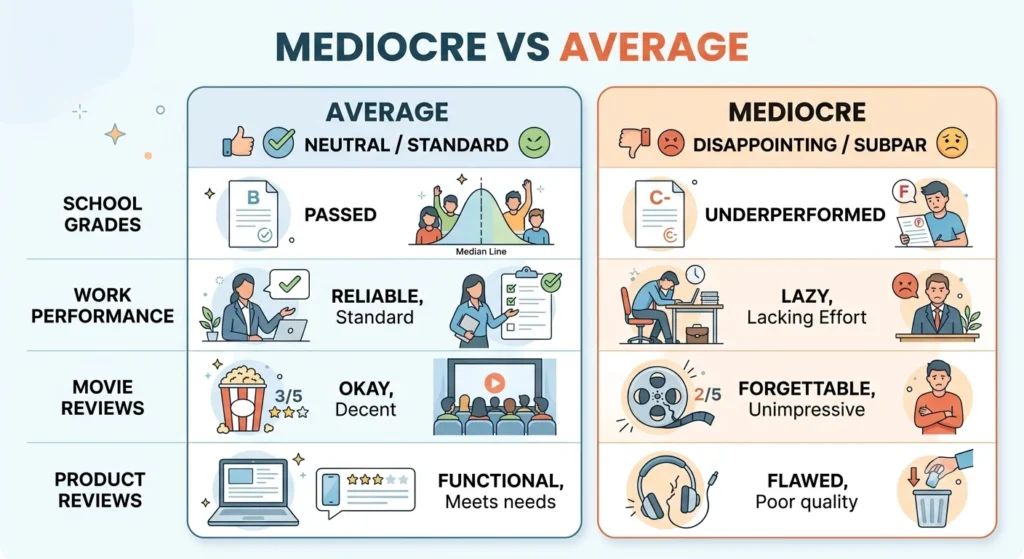
Mediocre vs Average
Although these words overlap, native speakers use them differently.
| Average | Mediocre |
|---|---|
| Neutral meaning | Mildly negative meaning |
| Describes the middle level | Suggests disappointment |
| Often used for statistics | Often used for opinions |
| Doesn’t imply failure | Suggests unrealized potential |
| Can be positive in some contexts | Rarely sounds positive |
Quick Rule
If you’re talking about facts, use average.
If you’re expressing an opinion, mediocre is often the better choice.
Examples
Average
- The average salary increased this year.
- Her grades are close to the class average.
Mediocre
- The movie was mediocre despite its talented cast.
- His presentation was mediocre because it lacked preparation.
Mediocre vs Poor
Many learners think mediocre means poor, but there is an important difference.
A poor result usually fails to meet acceptable standards.
A mediocre result meets the minimum standard but doesn’t do anything particularly well.
| Mediocre | Poor |
|---|---|
| Acceptable | Unacceptable |
| Ordinary | Clearly bad |
| Mild criticism | Strong criticism |
| Meets basic expectations | Often fails to meet expectations |
Example
A mediocre employee completes assigned tasks but rarely contributes new ideas.
A poor employee regularly misses deadlines and creates additional problems.
Mediocre vs Subpar
Both words describe something that isn’t very good, but subpar is usually stronger.
| Mediocre | Subpar |
|---|---|
| Average or slightly below average | Clearly below the expected standard |
| Mild criticism | Strong criticism |
| Often acceptable | Frequently unacceptable |
Example
- The conference was mediocre, but I still learned a few useful things.
- The hotel’s cleanliness was subpar, so we requested another room.
Mediocre vs Excellent
The opposite of mediocre is excellent.
Excellent work goes beyond expectations through quality, creativity, consistency, or outstanding performance.
| Mediocre | Excellent |
|---|---|
| Ordinary | Outstanding |
| Forgettable | Memorable |
| Meets minimum expectations | Exceeds expectations |
| Limited impact | Strong positive impact |
Understanding this contrast helps clarify why mediocre usually carries a negative tone.
Synonyms of Mediocre
The best synonym depends on the context. Some words are nearly identical, while others express stronger criticism.
Close Synonyms
- Average
- Ordinary
- Unremarkable
- So-so
- Adequate
- Fair
- Routine
- Typical
- Passable
- Commonplace
Stronger Negative Synonyms
- Lackluster
- Underwhelming
- Subpar
- Inferior
- Unsatisfactory
- Second-rate
- Disappointing
- Weak
- Run-of-the-mill
- Forgettable
Which Synonym Should You Choose?
- Average → Neutral.
- Mediocre → Mild disappointment.
- Subpar → Below acceptable standards.
- Poor → Clearly bad.
- Lackluster → Lacking excitement or energy.
Choosing the right synonym makes your writing more accurate and natural.
Antonyms of Mediocre
The opposite of mediocre includes words that describe excellence and outstanding quality.
Common antonyms include:
- Excellent
- Outstanding
- Exceptional
- Superb
- Brilliant
- Remarkable
- Extraordinary
- Impressive
- First-class
- Superior
- High-quality
- Distinguished
Example
Mediocre:
“The customer service was mediocre.”
Excellent:
“The customer service was outstanding and exceeded every expectation.”
When Should You Use the Word “Mediocre”?
Use mediocre when something:
- Meets only basic expectations.
- Lacks originality or creativity.
- Feels ordinary or forgettable.
- Could have been much better.
- Doesn’t deserve strong praise or harsh criticism.
Examples include:
- Movies
- Restaurants
- Products
- Customer service
- Essays
- Presentations
- Business performance
- School assignments
- Sporting performances
When Should You Avoid Using “Mediocre”?
Avoid using mediocre when:
- Giving sensitive personal feedback.
- Writing professional evaluations without explanation.
- You actually mean poor or excellent.
- Describing numerical averages.
Instead of saying:
❌ “Your work is mediocre.”
Try:
✔ “Your report covers the main points well, but adding stronger evidence and clearer examples would improve its overall quality.”
This style of feedback is constructive, specific, and much more likely to help someone improve.
Mediocre in a Sentence: 30 Real-Life Examples
The easiest way to understand the meaning of mediocre is to see how native English speakers use it in everyday situations. These examples show the word in natural contexts, helping you use it confidently in conversations, writing, and professional communication.
Everyday Conversation
- The movie wasn’t terrible, but it was definitely mediocre.
- The food looked delicious, but the taste was mediocre.
- Our vacation was enjoyable even though the hotel was mediocre.
- His excuse sounded mediocre and unconvincing.
- The concert started well but ended on a mediocre note.

Workplace
- The team delivered mediocre results this quarter.
- Her presentation contained useful information but was mediocre overall.
- The manager encouraged employees to move beyond mediocre performance.
- Customers expect excellent service, not mediocre support.
- The report met the deadline but lacked originality, making it feel mediocre.
Education
- He earned mediocre grades despite having great potential.
- The teacher challenged students not to settle for mediocre work.
- Her essay was informative but had a mediocre conclusion.
- The project showed effort but lacked creativity.
- Average preparation often leads to mediocre results.
Reviews
- Critics described the sequel as mediocre because of its predictable storyline.
- The restaurant received mediocre reviews despite its beautiful location.
- The phone offers decent battery life but mediocre camera quality.
- The software works well enough, although its interface feels mediocre.
- The hotel provides clean rooms but only mediocre customer service.
Personal Growth
- Don’t let fear keep you trapped in mediocrity.
- Small daily improvements help you move beyond mediocre habits.
- Successful people rarely become satisfied with mediocre results.
- Learning new skills is one way to avoid a mediocre career.
- Growth begins when you stop accepting less than your potential.
How to Use “Mediocre” Correctly
Although mediocre is a common adjective, using it correctly makes your English sound more natural and precise.
✅ Use It When
- Describing average or below-expected quality.
- Reviewing products, services, movies, books, or restaurants.
- Discussing work, school, or sports performance.
- Giving balanced criticism without sounding overly harsh.
❌ Avoid Using It When
- You mean something is truly terrible.
- You’re trying to compliment someone.
- Referring to numerical averages or statistics.
- Criticizing a person’s worth instead of their work.
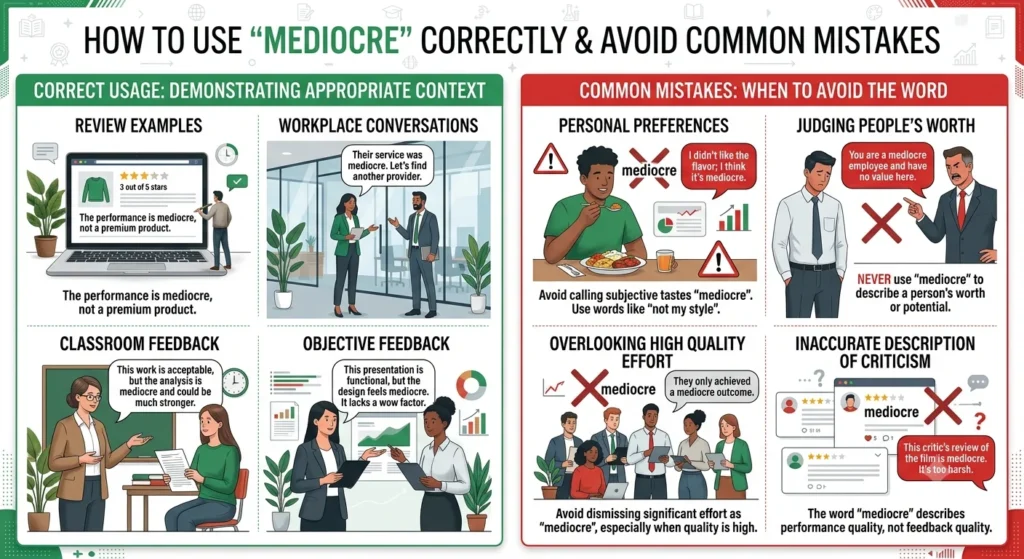
Common Mistakes to Avoid
1. Thinking “Mediocre” Means Terrible
This is the most common misunderstanding.
Mediocre means ordinary or disappointing, not completely bad.
✔ The meal was mediocre.
✘ The meal was disgusting.
Those describe very different experiences.
2. Confusing “Average” with “Mediocre”
Although related, these words aren’t interchangeable.
- Average is neutral.
- Mediocre implies disappointment.
Understanding this subtle difference will make your English sound much more natural.
3. Using It for Quantity Instead of Quality
“Mediocre” describes quality, not amount.
✔ The presentation was mediocre.
✘ We received a mediocre amount of rain.
4. Labeling People Instead of Actions
Rather than saying:
❌ You’re mediocre.
Say:
✔ Your presentation could be stronger with more evidence.
This approach is respectful, constructive, and much more effective.
Frequently Asked Questions
What does mediocre mean in simple words?
Mediocre means average or not very good. It describes something that is acceptable but not impressive, outstanding, or memorable.
Is mediocre an insult?
Not always. It becomes insulting when used to describe a person directly. When it describes work, products, or performances, it usually expresses mild criticism rather than a personal attack.
Is mediocre a bad word?
No. It’s better described as a mildly negative word. It suggests disappointment without implying complete failure.
Does mediocre mean average?
Not exactly. Average is neutral, while mediocre usually implies that something failed to meet expectations.
What’s the difference between mediocre and average?
Average describes the middle without judgment. Mediocre suggests that the quality is ordinary and somewhat disappointing.
What is the synonym of mediocre?
Common synonyms include:
- average
- ordinary
- so-so
- unremarkable
- lackluster
- underwhelming
- subpar (stronger)
- uninspired
What is the opposite of mediocre?
Common antonyms include:
- excellent
- exceptional
- outstanding
- remarkable
- superb
- extraordinary
How do you use mediocre in a sentence?
Example:
“The restaurant looked beautiful, but the food was mediocre.”
Can a person be mediocre?
Yes, but the phrase can sound harsh because it judges the person rather than their actions. In professional and everyday communication, it’s usually better to describe someone’s work or performance instead.
Does mediocre mean below average?
Not always. It usually means average or slightly below expectations, depending on the context and the standards being applied.
What does mediocrity mean?
Mediocrity is the noun form of mediocre. It refers to the state of being ordinary, average, or lacking excellence.
Example:
“The company encourages innovation instead of mediocrity.”
How do you pronounce mediocre?
American English:
mee-dee-OH-ker
IPA:
/ˌmiːdiˈoʊkər/
Key Takeaways
Before you go, here are the most important things to remember:
- Mediocre means average or slightly below expectations.
- The word usually carries a mildly negative tone.
- It doesn’t mean “terrible,” but it isn’t a compliment either.
- Native speakers often use it to express disappointment politely.
- It’s generally better to describe a person’s work as mediocre than to describe the person that way.
- Understanding the difference between average and mediocre helps you communicate more accurately in both professional and everyday English.
Conclusion
The word mediocre may seem simple, but its meaning goes beyond “average.” In modern English, it usually describes something that meets the minimum standard while failing to stand out because of limited quality, effort, creativity, or impact. Whether you’re talking about a movie, a meal, a workplace performance, or a product review, mediocre communicates mild disappointment rather than complete failure.
Understanding this distinction helps you interpret reviews, workplace feedback, classroom evaluations, and everyday conversations more accurately. It also allows you to choose the right word when expressing opinions, giving constructive feedback, or improving your own English vocabulary.
The next time you hear someone describe something as mediocre, you’ll know they aren’t saying it’s terrible—they’re saying it simply wasn’t good enough to be memorable or exceed expectations.

Liza is a content writer at Meanovia, focused on slang, texting meanings, and internet phrases. She makes modern online language simple, clear, and easy to understand 💬✨