
Have you ever heard people discussing the “lore” of a video game, anime, movie, TV series, book, or ancient civilization and wondered whether it simply meant history or something much deeper? Lore (pronounced LOR) is a noun that refers to the collection of knowledge, traditions, stories, beliefs, myths, and background information connected to a culture, community, subject, or fictional world.
Unlike history, which focuses on recorded facts, lore often includes traditions, legends, and stories that explain origins, characters, events, customs, and the rules of a world, making it richer and more immersive. That’s why phrases like game lore and deep lore are so popular among fans who want to fully understand a fictional universe or a long-standing tradition.
In simple terms, lore means the shared stories, traditions, and background knowledge that give meaning and depth to a person, place, culture, or fictional world. For example, Greek mythology forms part of ancient lore, the hidden history and characters of a fantasy kingdom make up its game lore, and a community’s customs, legends, and beliefs become its local lore. The word is widely used in gaming, literature, mythology, history, anime, movies, TV series, comics, and online fan communities to describe the information that helps people understand how a world, culture, or story fits together.
If you’ve come across lore and weren’t sure what it means, this guide explains its definition, pronunciation, origin, different meanings, real-life examples, synonyms, and how to recognize the difference between lore, history, and legend so you can understand and use lore naturally and confidently in any context.
What Does Lore Mean?
Definition
Lore is the collection of knowledge, traditions, myths, legends, beliefs, customs, historical events, and background information connected to a person, place, culture, family, or fictional universe.
Unlike the main story, lore explains the events that happened before, around, or behind the story. It gives people the missing pieces that help everything make sense.
Simple Definition
Lore is the hidden history, traditions, myths, and background knowledge that give depth and meaning to real or fictional worlds.
Think of it as everything you don’t immediately see but need to understand the bigger picture.
For example:
- The history of Hogwarts is part of Harry Potter lore.
- The ancient kingdoms of Middle-earth belong to The Lord of the Rings lore.
- Hidden civilizations, gods, and wars form the Elden Ring lore.
- Stories passed through generations become family lore.
- Local legends shared within a town become local lore.
Without lore, many stories would feel incomplete because we’d only know what happened, not why it happened.
Lore Meaning in Simple Words
If someone asked,
“What is lore in simple words?”
you could answer like this:
Lore is the background story that explains everything.
Imagine watching a superhero movie.
You see the hero save the world.
But then you discover:
- how their powers were created,
- who founded the superhero organization,
- why the villain became evil,
- ancient wars fought centuries earlier,
- legendary weapons,
- forgotten prophecies.
That hidden information is called lore.
The easiest way to remember it
Story = What happens.
Lore = Why it happens and everything behind it.
That’s why people often spend hours reading lore after finishing a game, movie, or book. They want to understand the complete world, not just the main events.
Lore Meaning in English
In English, lore is a noun.
Pronunciation
Lore
/lɔːr/
It rhymes with:
- more
- core
- door
- shore
Part of Speech
Noun
Plural Form
The plural is lores, although it’s rarely used in everyday English.
Most native speakers simply say:
✔ The game has fascinating lore.
instead of
❌ The game has fascinating lores.
What Does the Word Lore Mean Today?
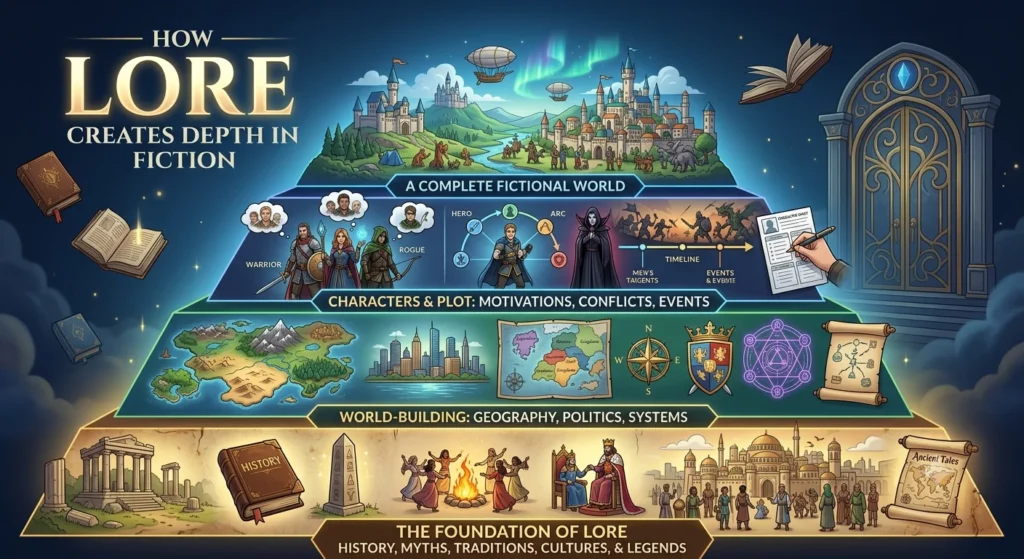
Originally, lore meant knowledge or teaching passed from one generation to another.
Today, its meaning is much broader.
People use lore to describe:
- hidden history,
- mythology,
- legends,
- traditions,
- world-building,
- fictional timelines,
- family stories,
- internet culture,
- gaming universes,
- and shared community knowledge.
This modern meaning has become especially popular because audiences now enjoy exploring worlds beyond the main story.
Where Does the Word Lore Come From? (Etymology)
One of the most common questions people ask is:
“Where did the word lore come from?”
The answer goes back more than 1,000 years.
The word lore comes from the Old English word lār, meaning:
- learning,
- knowledge,
- teaching,
- instruction,
- wisdom.
In medieval England, lore referred to valuable knowledge passed from parents, teachers, elders, and communities. Long before books became common, people preserved their traditions through spoken stories, songs, myths, and legends. These teachings became known as lore.
As English evolved, the meaning gradually shifted. Instead of referring only to education, lore became closely connected with folklore, mythology, and traditional stories.
Today, the word has expanded again. Modern audiences use lore to describe the rich background histories found in fantasy novels, movies, comics, anime, role-playing games, and even internet communities.
How the Meaning of Lore Changed Over Time
The evolution of the word reflects the evolution of storytelling itself.
| Time Period | Meaning of Lore |
|---|---|
| Old English | Learning, teaching, wisdom, instruction |
| Middle English | Traditional knowledge passed between generations |
| 18th–19th Century | Folklore, myths, legends, and cultural traditions |
| 20th Century | Cultural history and inherited beliefs |
| Modern Era | World-building, fictional history, gaming universes, fandoms, internet culture, and hidden backstories |
Today, lore has become one of the defining features of successful franchises such as:
- Harry Potter
- The Lord of the Rings
- Star Wars
- Marvel
- The Witcher
- The Elder Scrolls
- Dark Souls
- Elden Ring
- Minecraft
- Five Nights at Freddy’s
These fictional worlds are remembered not just because of their stories—but because of their incredibly detailed lore.
Where Is the Word “Lore” Used Today?
Although lore originally referred to traditional knowledge passed from one generation to another, its meaning has expanded dramatically. Today, you’ll hear the word in video games, movies, books, anime, social media, online communities, and even everyday conversations.
No matter where it’s used, the core idea remains the same:
Lore is the background information that explains the bigger picture.
Let’s explore how its meaning changes across different contexts.
Lore Meaning in Stories
In storytelling, lore is the background history, mythology, traditions, cultures, and rules that shape a fictional world. It explains events that happened before the main plot and helps readers understand why characters, places, and conflicts exist.
Imagine opening the first page of a fantasy novel.
You meet the hero immediately.
But you don’t yet know:
- Why the kingdom is at war.
- How magic was created.
- Who built the ancient castle.
- Why dragons disappeared.
- What caused an ancient prophecy.
Those hidden details are the lore.
A great story tells you what is happening today.
Great lore explains everything that happened before today.
This is why readers often become fascinated with fictional worlds long after finishing the book—they want to discover the lore that lies beneath the surface.
Examples
- Harry Potter lore includes Hogwarts’ founders, magical creatures, wizarding history, and ancient spells.
- The Lord of the Rings lore covers thousands of years of Middle-earth history.
- The Wheel of Time contains centuries of political, magical, and cultural lore.
- The Witcher explores kingdoms, monsters, prophecies, and legendary events beyond Geralt’s journey.
⭐ Expert Insight
Many bestselling fantasy authors create the world’s lore before writing the main story. This makes characters, cultures, religions, and historical events feel believable and internally consistent.
Lore Meaning in Games
In gaming, lore is the hidden history, characters, civilizations, mythology, and events that explain the game’s universe.
Unlike movies, many games don’t tell players everything directly.
Instead, they encourage players to discover lore through:
- Item descriptions
- NPC conversations
- Hidden journals
- Ancient ruins
- Environmental storytelling
- Secret locations
- Collectible documents
This approach rewards curiosity and makes exploration more meaningful.
Why Gamers Love Lore
Modern games aren’t just about completing missions—they’re about uncovering mysteries.
Every hidden diary, abandoned castle, mysterious symbol, or forgotten kingdom becomes another piece of the puzzle.
That’s why communities spend years discussing game lore even after finishing the story.
Some games are famous primarily because of their lore.
Examples include:
- Elden Ring
- Dark Souls
- Bloodborne
- The Elder Scrolls
- Hollow Knight
- Destiny
- Five Nights at Freddy’s
- The Legend of Zelda
- Minecraft
Entire YouTube channels now exist solely to explain these games’ lore.
Lore Meaning in Gaming
Although people often search for “lore meaning in gaming,” the meaning is slightly broader than game lore.
Gaming lore refers to the complete fictional universe surrounding an entire franchise.
For example:
When someone says,
“The Zelda lore is incredible.”
they aren’t talking about just one game.
They’re referring to:
- Ancient timelines
- Legendary heroes
- Magical relics
- Forgotten civilizations
- Gods and goddesses
- Historical wars
- Different kingdoms
- Recurring villains
All of these elements work together to create a believable world that extends far beyond a single storyline.
📌 Pro Tip
Games with rich lore often have stronger fan communities because players enjoy creating theories, discovering hidden details, and debating unanswered questions.
Te Amo Meaning: What It Really Means in Love
Lore Meaning in Movies and TV Shows
Movie lore refers to the background history, mythology, timelines, characters, and world-building that connect a fictional universe beyond the main plot.
Today’s biggest movie franchises rely heavily on lore.
Without it, many stories would feel disconnected.
Marvel Lore
Marvel’s lore includes:
- The Infinity Stones
- Celestials
- Asgard
- Wakanda
- The Multiverse
- Secret Wars
- Ancient civilizations
- Character origins
Each movie adds another layer to the larger Marvel universe.
Star Wars Lore
Star Wars isn’t just about Luke Skywalker.
Its lore spans:
- Thousands of years
- The Jedi Order
- Sith history
- The Galactic Republic
- Ancient Force users
- Legendary battles
- Hundreds of planets
That’s why fans continue exploring Star Wars decades after the original films.
Lore Meaning in Books
Books have relied on lore for centuries.
Fantasy writers often spend years creating:
- Maps
- Kingdoms
- Religions
- Languages
- Family trees
- Legends
- Historical timelines
- Magical systems
These elements make fictional worlds feel authentic.
Famous examples include:
- The Lord of the Rings
- The Chronicles of Narnia
- A Song of Ice and Fire
- Mistborn
- The Stormlight Archive
Readers don’t just enjoy the story—they enjoy discovering the world’s hidden history.
Lore Meaning on the Internet
The internet has transformed the meaning of lore.
Today, people use it to describe the background history behind:
- memes,
- YouTubers,
- streamers,
- influencers,
- Discord servers,
- Reddit communities,
- viral trends,
- and online jokes.
Example:
“That meme has years of internet lore.”
This means the meme has developed a long history that only longtime internet users fully understand.
Internet lore often grows naturally as communities create jokes, references, and shared experiences over time.
Lore Meaning on TikTok
TikTok introduced lore to millions of younger users.
Instead of referring only to fantasy worlds, people now use it jokingly to describe the story behind almost anything.
Examples include:
- “What’s the lore behind this friendship?”
- “I need the full lore.”
- “Don’t skip the lore.”
- “The office lore is getting out of control.”
In these situations, lore simply means:
“Tell me the complete backstory.”
The word has become a humorous way of asking for context before judging a situation.
Heads Up Meaning: What It Really Means in Conversation
Lore Meaning in Gen Z Slang
Among Gen Z, lore has evolved into playful internet slang.
Instead of talking about fictional universes, people now describe their own lives using the word.
Examples:
- “What’s your lore?”
- “That’s part of my villain lore.”
- “My gym lore is embarrassing.”
- “Everyone has lore.”
Here, lore refers to:
- personal history,
- unforgettable experiences,
- embarrassing memories,
- funny incidents,
- dramatic life events.
Although humorous, this usage still follows the original meaning of background information that explains who someone is.
Family Lore Meaning
Family lore includes the stories, traditions, memories, sayings, and legends shared across generations.
Examples include:
- stories about grandparents,
- family recipes,
- immigration journeys,
- military service,
- humorous traditions,
- treasured heirlooms,
- local legends connected to the family.
These stories preserve a family’s identity and help younger generations understand their roots.
Example:
“Our grandmother’s stories have become part of our family lore.”
Personal Lore Meaning
A newer internet phrase, personal lore refers to the collection of life experiences that shape someone’s identity.
Examples include:
- childhood adventures,
- career milestones,
- travel stories,
- embarrassing moments,
- life-changing decisions.
Example:
“Getting lost during my first solo trip is now part of my personal lore.”
People often use this phrase humorously on TikTok and social media, but it reflects the same idea of building a meaningful personal history.
Cultural, Ancient, and Local Lore
The oldest meaning of lore relates to traditions passed from generation to generation.
Examples include:
- Greek mythology
- Norse legends
- Celtic folklore
- Japanese folk tales
- Native American traditions
- Arabic folklore
This type of lore helps preserve culture, beliefs, customs, and shared identity.
Many towns also have local lore—stories about haunted houses, mysterious landmarks, famous historical figures, or unique traditions that become part of the community’s identity.
Why Is Lore So Important?
Many people think lore is just “extra information.” In reality, it’s one of the most powerful storytelling tools ever created.
Without lore, stories often feel shallow because readers only know what is happening. With lore, they understand why it is happening, how the world evolved, and what events shaped the present.
Think of lore as the foundation of a building. You may not always see it, but without it, the entire structure becomes weaker.
Whether it’s a fantasy novel, a blockbuster movie, a role-playing game, or even a family’s traditions, lore creates emotional depth and makes everything feel connected.
Why Do Writers and Game Developers Create Lore?
Writers and developers create lore to make fictional worlds believable, immersive, and memorable. Instead of inventing random events, they build a complete history that gives every character, place, and conflict a meaningful purpose.
Strong lore helps creators:
- Build believable worlds
- Explain character motivations
- Connect different stories
- Create mystery and suspense
- Reward curious readers and players
- Encourage fan theories and discussions
- Keep audiences engaged for years
This is why franchises with rich lore often develop passionate fan communities.
Different Types of Lore
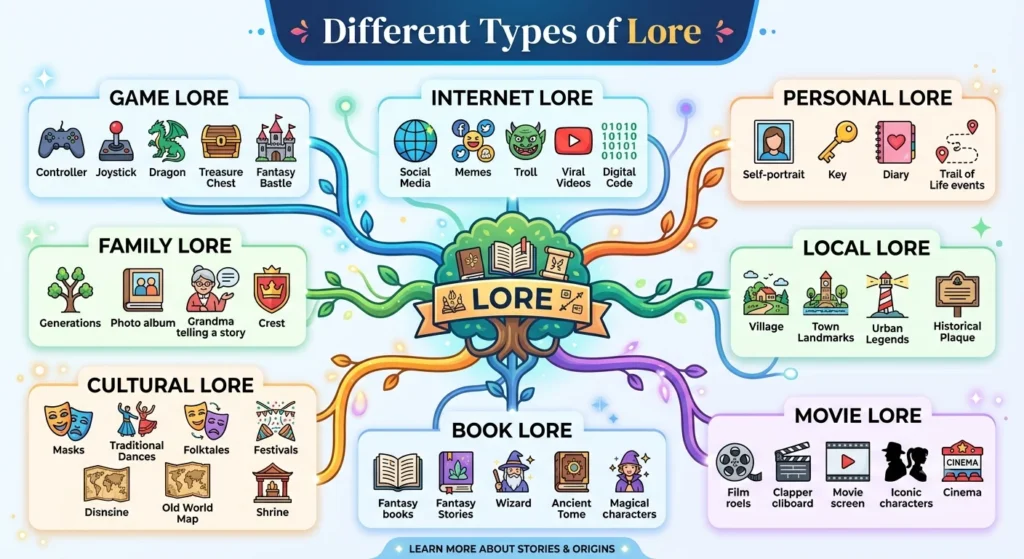
Although the word lore has one general meaning, it can describe several different kinds of background knowledge.
| Type of Lore | What It Includes |
|---|---|
| Historical Lore | Ancient events, rulers, wars, civilizations |
| Cultural Lore | Traditions, customs, folklore, beliefs |
| Family Lore | Stories, memories, sayings, family history |
| Game Lore | Hidden history, characters, timelines, locations |
| Movie Lore | Connected universes, mythology, character origins |
| Book Lore | World-building, magical systems, kingdoms |
| Internet Lore | Memes, online communities, creator history |
| Personal Lore | Life experiences, milestones, memorable events |
| Local Lore | Legends, haunted places, regional traditions |
Although each type is different, they all share one purpose:
They explain the hidden context behind something.
Lore vs Story
This is one of the biggest questions people ask online.
Although the two words are closely related, they are not the same.
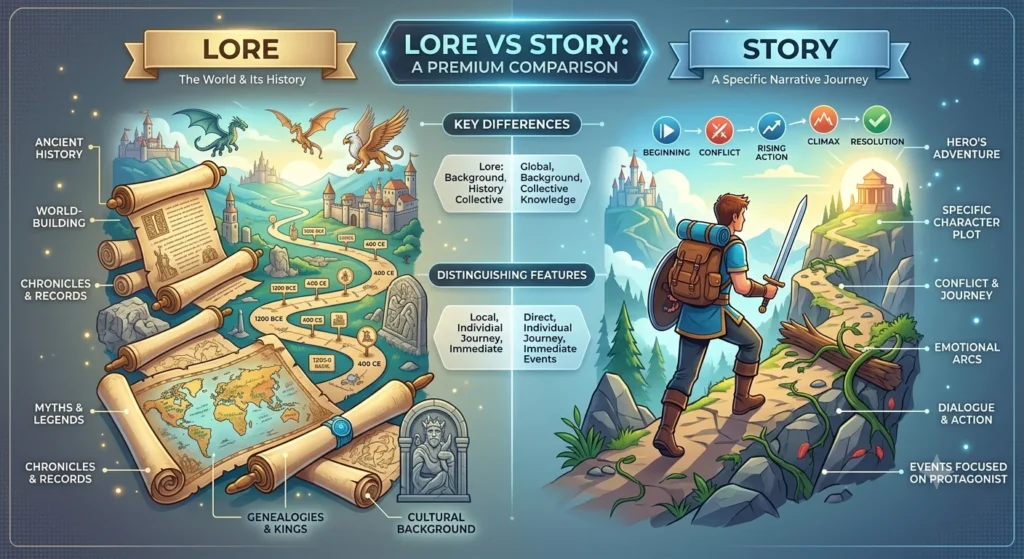
| Story | Lore |
|---|---|
| Tells what happens | Explains why it happens |
| Focuses on the main events | Focuses on background history |
| Has a beginning, middle, and end | Can span hundreds or thousands of years |
| Drives the plot | Builds the world |
| Follows characters | Explains cultures, traditions, myths, and history |
Example
Imagine watching a superhero movie.
The story follows the hero defeating the villain.
The lore explains:
- where the hero’s powers came from,
- how previous heroes shaped the world,
- why the villain became evil,
- what happened decades before the movie began.
In short:
Story tells today’s events. Lore tells yesterday’s history.
Lore vs Canon
People often confuse lore with canon, especially in gaming and fandoms.
They are related, but they have different meanings.
| Lore | Canon |
|---|---|
| Background history and world-building | Official events accepted as true |
| Includes myths, traditions, and hidden details | Includes only officially confirmed information |
| Expands understanding of the world | Defines what is officially part of the story |
Example
A fan theory about a hidden kingdom is not canon.
If the creators officially confirm it, it becomes canon and part of the world’s lore.
Lore vs Backstory
These words are often used together, but they describe different things.
| Backstory | Lore |
|---|---|
| Focuses on one character | Covers the entire world |
| Explains a person’s past | Explains history, cultures, and civilizations |
| Usually personal | Usually much broader |
Example:
A hero’s difficult childhood is their backstory.
The history of the kingdom they live in is lore.
Lore vs History
History and lore both describe the past, but they are not identical.
| History | Lore |
|---|---|
| Based on recorded facts | Can include myths, legends, traditions, and fictional events |
| Usually real | Can be real or fictional |
| Focuses on documented events | Focuses on meaning, culture, and storytelling |
For example:
The history of Ancient Egypt is history.
Stories about magical creatures protecting hidden tombs are lore.
Common Examples of Lore
Sometimes the easiest way to understand a word is by seeing it used naturally.
Gaming
“Players spent years uncovering the hidden lore behind the ruined kingdom.”
Movies
“Marvel’s lore stretches across thousands of years.”
Books
“The novel’s rich lore makes the fictional world feel believable.”
Family
“Every holiday, our grandparents share family lore with the younger generation.”
Internet
“There’s so much lore behind that viral meme.”
Workplace
“Ask the senior employees—they know all the office lore.”
How to Use “Lore” Correctly
Here are some natural examples.
✅ Correct
- The game’s lore explains the origin of the dragons.
- I love reading fantasy lore.
- Family lore helps preserve traditions.
- The movie expands the universe’s lore.
- We spent hours discussing the lore behind the characters.
❌ Incorrect
- I ate some lore for breakfast.
- She bought a lore from the store.
- Lore is my favorite color.
- The weather became lore today.
Remember:
Lore always refers to knowledge, history, traditions, or background information—not physical objects or everyday actions.
Common Mistakes People Make
⚠ Mistake 1: Thinking lore means story
A story is the main sequence of events.
Lore is the background that supports the story.
⚠ Mistake 2: Believing lore only belongs to fantasy
Lore can describe:
- family traditions,
- cultural beliefs,
- local legends,
- historical customs,
- internet communities,
- and real-world folklore.
⚠ Mistake 3: Assuming every backstory is lore
A single character’s history is usually a backstory.
Lore describes the wider world surrounding that character.
FAQs About Lore Meaning
This FAQ section is designed to answer the most common questions people search online while naturally expanding the article’s topical authority.
What Is the Meaning of Lore?
Lore is the collection of stories, traditions, knowledge, myths, legends, beliefs, and background history associated with a person, culture, family, place, or fictional world. It provides the context that explains how something came to exist and why it matters.
What Does Lore Mean in Simple Words?
In simple words, lore means the backstory behind something.
It includes everything that happened before the main story, such as history, traditions, legends, and important events.
Think of it like this:
Story = What happens.
Lore = Why it happens.
Is Lore a Real English Word?
Yes.
Lore is a genuine English word that has existed for more than a thousand years. It comes from the Old English word lār, meaning learning, knowledge, or instruction.
Although its meaning has evolved over time, it remains a commonly used word in modern English.
What Does Lore Mean in Gaming?
In gaming, lore refers to the hidden history, mythology, characters, civilizations, timelines, and events that shape the game’s universe.
Players often discover lore through:
- hidden journals,
- item descriptions,
- NPC conversations,
- environmental clues,
- secret areas,
- and collectible documents.
Games with deep lore encourage exploration and discussion long after the main story ends.
What Does Lore Mean in Movies?
In movies, lore refers to the larger fictional universe behind the main plot.
It includes:
- ancient events,
- character origins,
- mythology,
- timelines,
- historical conflicts,
- and world-building.
Movie franchises such as Marvel and Star Wars are famous for their extensive lore.
What Does Lore Mean in Books?
In books, lore describes the background history that supports the story.
It often includes:
- magical systems,
- kingdoms,
- maps,
- religions,
- family lineages,
- myths,
- and legends.
Rich lore helps fictional worlds feel believable and immersive.
What Does Lore Mean on TikTok?
On TikTok, lore is often used humorously.
Instead of talking about fantasy worlds, people use it to ask about the complete backstory behind a situation.
Examples:
- “What’s the lore?”
- “I need the full lore.”
- “Don’t skip the lore.”
In this context, lore simply means the full explanation behind something.
What Does Lore Mean in Gen Z Slang?
Among Gen Z, lore usually refers to someone’s personal history or memorable experiences.
For example:
“That’s part of my villain lore.”
This jokingly means that the event became part of their personal backstory.
What Is Family Lore?
Family lore includes the stories, traditions, memories, sayings, recipes, and experiences passed down from one generation to another.
These stories help preserve family history and strengthen cultural identity.
What Is Personal Lore?
Personal lore refers to the experiences that shape someone’s identity.
Examples include:
- childhood memories,
- travel adventures,
- embarrassing moments,
- career milestones,
- unforgettable achievements.
People often use this phrase humorously on social media.
What Is Deep Lore?
Deep lore refers to highly detailed background information that goes far beyond the main story.
It often includes:
- forgotten civilizations,
- ancient wars,
- hidden characters,
- lost kingdoms,
- secret organizations,
- mythical events.
Fans who enjoy exploring every hidden detail often refer to themselves as “lore enthusiasts.”
Is Lore the Same as Story?
No.
A story tells you what happens.
Lore explains why it happens by providing the history, traditions, and background that shaped the story.
Is Lore the Same as Canon?
No.
Canon refers to information officially confirmed by the creator.
Lore includes the broader history and world-building that supports the fictional universe.
Most canon becomes part of the lore, but not every fan theory or interpretation becomes canon.
Is Lore the Same as Backstory?
No.
A backstory focuses on one person’s past.
Lore explains the history of the entire world or community.
Can Lore Be Real?
Absolutely.
Lore doesn’t only belong to fantasy.
Real-life examples include:
- family traditions,
- cultural customs,
- local legends,
- folklore,
- indigenous stories,
- historical beliefs.
These are all forms of lore.
Why Is Lore Important?
Lore makes stories richer by giving readers and viewers a deeper understanding of characters, places, and events.
Strong lore also:
- creates emotional connections,
- encourages curiosity,
- supports world-building,
- keeps fans engaged,
- inspires discussion and theories.
How Do You Use Lore in a Sentence?
Here are a few examples:
✔ The game’s lore explains the origin of the dragons.
✔ I enjoy learning about ancient mythology and folklore.
✔ Their family lore has been passed down for generations.
✔ The movie expands the universe’s lore beautifully.
✔ Fans spent years uncovering the hidden lore.
Can Real Life Have Lore?
Yes.
Communities, schools, workplaces, families, sports teams, and even friend groups often develop their own lore through shared experiences, traditions, and memorable stories.
Why Has Lore Become So Popular?
Modern audiences enjoy exploring worlds beyond the main story.
Streaming platforms, video games, online communities, and social media encourage people to discuss hidden details, create theories, and discover deeper connections.
As a result, lore has become one of the defining concepts of modern storytelling.
Conclusion
The word lore is much more than another way to say “story.” It represents the history, traditions, myths, and hidden knowledge that give people, cultures, and fictional worlds their identity. Whether you’re exploring a fantasy novel, playing a role-playing game, watching a movie, or scrolling through TikTok, understanding the lore helps you appreciate the bigger picture behind every event.
From ancient folklore passed down through generations to the complex universes of modern games and films, lore connects the past with the present. It transforms simple plots into immersive worlds, strengthens communities through shared traditions, and keeps fans returning to discover new details.
The next time someone asks, “What’s the lore?”, you’ll know they’re asking for more than just the story—they’re asking for the history, the context, and everything that makes that story meaningful.

Liza is a content writer at Meanovia, focused on slang, texting meanings, and internet phrases. She makes modern online language simple, clear, and easy to understand 💬✨