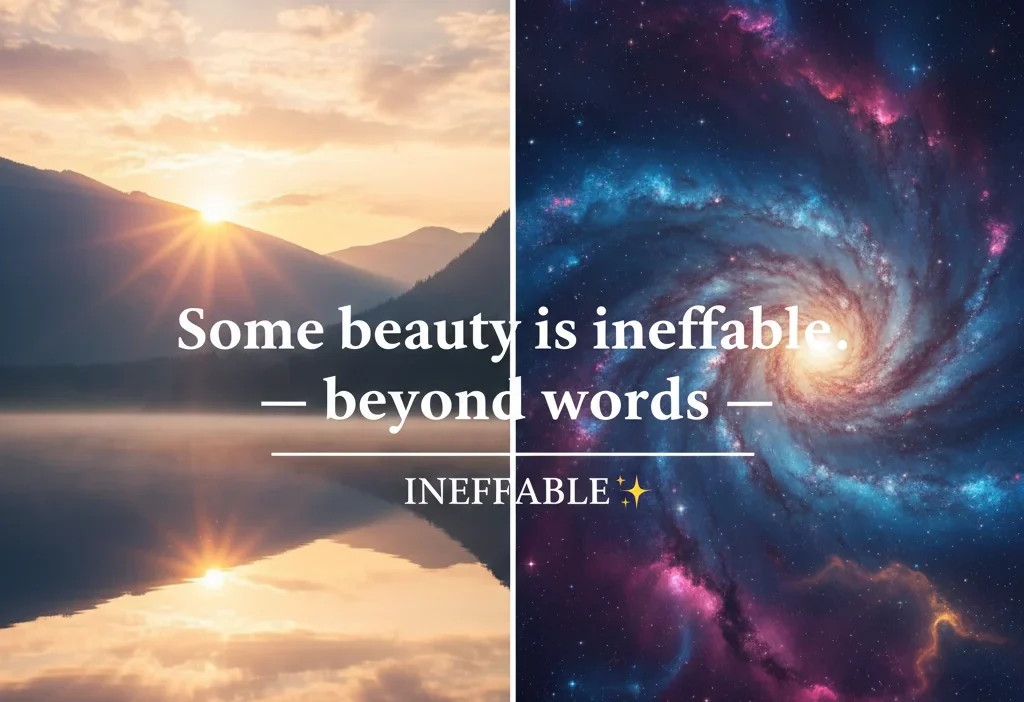
Have you ever read the word ineffable and wondered why something could be described as “beyond words”? You’re not alone. In short, ineffable means too extraordinary, beautiful, powerful, or profound to be fully described or expressed in words.
It is often used for deep emotions, breathtaking experiences, spiritual moments, natural beauty, and feelings that language simply cannot capture completely.
Whether you discover the word in a novel, poem, speech, religious text, or everyday conversation, understanding its true meaning can instantly enrich your vocabulary and help you express ideas with greater precision.
This guide explains the ineffable meaning, pronunciation, origin, synonyms, antonyms, example sentences, and exactly how to use ineffable correctly in writing and conversation, while exploring why some experiences are considered truly beyond words.
What Does Ineffable Mean?
Ineffable is an adjective used to describe something so profound, beautiful, powerful, emotional, or sacred that words cannot fully explain it.
Instead of simply meaning “very beautiful,” it suggests that the experience is beyond the limits of language itself.
Simple Definition
Ineffable = Too extraordinary to be fully described with words.
If someone says:
“The moment was ineffable.”
They mean:
“No words can truly capture how amazing that moment was.”
Dictionary-Style Definition
Ineffable (adjective)
Definition: Too great, beautiful, profound, or sacred to be expressed completely in words.
At a Glance
| Feature | Details |
|---|---|
| Word | Ineffable |
| Pronunciation | in-EF-uh-buhl |
| IPA | /ɪnˈef.ə.bəl/ |
| Part of Speech | Adjective |
| Meaning | Beyond words; impossible to describe fully |
| Origin | Latin ineffabilis |
| Tone | Formal and expressive |
| Common Contexts | Literature, philosophy, spirituality, emotions, art |
How to Pronounce “Ineffable”
Many learners understand the meaning but aren’t sure how to pronounce it correctly.
Standard Pronunciation
in-EF-uh-buhl
IPA
/ɪnˈef.ə.bəl/
The stress falls on the second syllable:
in- EF -uh-buhl
Pronunciation Tip
Think of it like this:
in + EFF + uh + bull
Say it smoothly rather than emphasizing every syllable.
What Does It Mean to Be Ineffable?
When a person, feeling, place, or experience is described as ineffable, it means its qualities are so remarkable that ordinary language cannot fully communicate them.
For example:
- A breathtaking mountain sunrise
- The birth of a child
- Hearing a symphony that moves you to tears
- Standing inside an ancient cathedral
- Experiencing unconditional love
- Witnessing an act of extraordinary kindness
These moments often leave people searching for words—and that’s exactly where ineffable fits.

Why Is “Ineffable” Such a Powerful Word?
English has many words for strong emotions:
- Amazing
- Wonderful
- Incredible
- Beautiful
- Magnificent
- Extraordinary
But ineffable goes one step further.
It doesn’t simply praise something.
It tells the reader that language itself is not enough.
That’s why authors, poets, philosophers, and speakers often choose ineffable when describing experiences that feel almost impossible to explain.
The Origin and Etymology of Ineffable
The word ineffable has a rich history dating back hundreds of years.
It comes from the Latin word ineffabilis, which literally means “not able to be spoken.”
It is formed from:
- in- = not
- effari = to speak out or utter
Combined, they create the idea of something that cannot be fully expressed through speech.
The word entered English during the 14th century, initially appearing in religious writings to describe God’s greatness, divine mysteries, and sacred experiences believed to be beyond human understanding.
Over time, writers expanded its meaning to include profound beauty, overwhelming emotions, unforgettable memories, and life-changing moments.
Today, ineffable remains one of the most elegant words in English for expressing the indescribable.
Historical Timeline
| Period | Development |
|---|---|
| 14th Century | First recorded in Middle English, mainly in religious texts. |
| 16th–17th Century | Adopted by poets and philosophers to describe beauty, mystery, and wonder. |
| 18th–19th Century | Widely used in Romantic literature for nature, imagination, and emotion. |
| Modern English | Common in literature, speeches, psychology, philosophy, and thoughtful writing. |
Why Do People Search for “Ineffable Meaning”?
People usually encounter the word in places where emotion and imagination matter.
Common sources include:
- Classic literature
- Modern novels
- Poetry
- Religious texts
- Philosophy books
- Motivational speeches
- Song lyrics
- Television and films
- Social media captions
- Thoughtful blog posts
Most readers are looking for answers to questions like:
- What does ineffable mean?
- Is ineffable a compliment?
- Can ineffable describe love?
- Is ineffable positive or negative?
- How do you pronounce ineffable?
- How do you use ineffable in a sentence?
This guide answers each of these questions with practical explanations and real-world examples.

Ineffable Meaning in Different Contexts
One of the biggest reasons the word ineffable has remained popular for centuries is its versatility. Although its core meaning always stays the same—something too extraordinary to be fully expressed in words—the emotion behind it changes depending on the situation.
Let’s explore how the word is used in real life.
1. Ineffable Meaning in Love ❤️
Love is one of the most common situations where people use the word ineffable because some emotions simply feel impossible to explain.
If someone says,
“My love for you is ineffable.”
they’re not just saying they love someone deeply.
They mean their feelings are so profound that no words can truly express them.
Examples
- Her love for her children was ineffable.
- They shared an ineffable connection that grew stronger every year.
- Looking into his eyes filled her with ineffable happiness.
- Their reunion after years apart created an ineffable moment.
Common Love Expressions
- ineffable love
- ineffable affection
- ineffable romance
- ineffable connection
- ineffable devotion
Expert Tip: Native English speakers rarely use ineffable in casual romantic conversations. You’ll see it more often in novels, wedding speeches, poetry, or heartfelt writing.

2. Ineffable Meaning in Literature
Authors love using ineffable because it creates emotion without over-explaining.
Instead of describing every detail, the word encourages readers to imagine something beyond language.
Examples
“The castle possessed an ineffable beauty that fascinated every visitor.”
“An ineffable silence settled over the ancient forest.”
“She carried an ineffable grace that couldn’t be captured in words.”
Classic literature often pairs ineffable with themes such as mystery, beauty, destiny, hope, and sorrow.
3. Ineffable Meaning in Religion & Spirituality
Historically, this is the word’s original home.
Many religious traditions believe that God’s nature cannot be completely understood or described by humans.
For that reason, writers often describe God as ineffable.
Common Religious Expressions
- ineffable glory
- ineffable mercy
- ineffable wisdom
- ineffable holiness
- ineffable presence
- ineffable grace
Example
“The pilgrims felt the ineffable presence of God.”
Here, ineffable means beyond human understanding and language.
4. Ineffable Meaning in Nature
Nature often leaves people speechless.
Whether it’s a mountain sunrise, a powerful waterfall, or the Northern Lights, some landscapes seem impossible to describe completely.
Examples
- The desert at sunrise possessed ineffable beauty.
- Standing beneath the stars created an ineffable feeling.
- The waterfall inspired ineffable wonder.
- The colorful autumn forest looked ineffably beautiful.
5. Ineffable Meaning in Art & Music
Great works of art often create emotions that are difficult to explain logically.
That’s why critics frequently use ineffable.
Examples include:
- an ineffable masterpiece
- ineffable emotion
- ineffable elegance
- ineffable harmony
Example
“The symphony expressed an ineffable sadness.”
6. Ineffable Meaning in Philosophy
Philosophers often discuss ideas that cannot be fully explained through language.
Some experiences, they argue, must be lived rather than described.
Example
“Human consciousness contains ineffable mysteries.”
7. Ineffable Meaning in Everyday English
Although the word is formal, native speakers still use it in meaningful conversations.
Examples:
- The birth of my daughter was ineffable.
- Winning after years of hard work brought ineffable joy.
- Visiting my grandparents again filled me with ineffable gratitude.
- The kindness of strangers was truly ineffable.
Is Ineffable a Compliment?
Yes—almost always.
Calling someone or something ineffable is a powerful compliment because it suggests they possess qualities so extraordinary that ordinary words are not enough.
For example:
✅ Your kindness is ineffable.
✅ Her talent is ineffable.
✅ His generosity is ineffable.
✅ The performance was simply ineffable.
These examples express admiration at a very high level.
Grille Meaning: Is It Grill, Grille, or Both?
Can Ineffable Be Negative?
Yes.
Although ineffable usually carries a positive tone, it can also describe emotions that are painfully deep.
Examples
- ineffable grief
- ineffable sadness
- ineffable sorrow
- ineffable loneliness
- ineffable pain
Example:
“The community experienced ineffable grief after the tragedy.”
The word still means beyond words, but the emotion is negative rather than positive.
Is Ineffable Positive or Negative?
The word itself is neutral.
Its emotional tone depends on the noun it describes.
| Positive | Negative |
|---|---|
| ineffable joy | ineffable grief |
| ineffable beauty | ineffable sorrow |
| ineffable peace | ineffable fear |
| ineffable love | ineffable pain |
| ineffable happiness | ineffable loneliness |
Ineffable Meaning in Different Languages
Many readers also search for translations. While exact wording varies, the central idea remains the same: something beyond the power of words.
| Language | Meaning |
|---|---|
| English | Too great or beautiful to describe in words |
| Urdu | ناقابلِ بیان |
| Hindi | अवर्णनीय |
| Punjabi | ਬਿਆਨ ਤੋਂ ਪਰੇ |
| Bengali | অবর্ণনীয় |
| Farsi | غیرقابل توصیف |
| French | Ineffable |
| Russian | Неописуемый |
| Chinese | 难以言喻 |
| Spanish | Inefable |
| Telugu | వర్ణించలేనిది |
| Marathi | अवर्णनीय |
| Malayalam | വിവരിക്കാനാകാത്ത |
| Nepali | अवर्णनीय |
| Tagalog | Hindi mailarawan |
Note: These translations are the closest equivalents. The exact nuance can vary between languages and contexts.
Ineffable Meaning in Good Omens
If you’ve searched for “ineffable meaning good omens,” you’re not alone.
In the novel and TV series Good Omens, the phrase “The Ineffable Plan” refers to God’s mysterious plan—one that humans, angels, and demons cannot completely understand or explain.
In this context, ineffable means beyond complete human understanding, not simply “beautiful.”
Ineffable vs. Similar Words
Choosing the right word depends on what you’re trying to express.
| Word | Best Used For | Key Difference |
|---|---|---|
| Ineffable | Deep emotions, beauty, spirituality | Beyond words entirely |
| Indescribable | Everyday experiences | Difficult to describe |
| Inexpressible | Personal feelings | Hard for a person to express |
| Sublime | Nature, art, beauty | Inspires awe and admiration |
| Transcendent | Philosophy, religion | Beyond ordinary limits |
Example
A beautiful sunset can be indescribable.
A deeply spiritual experience may be ineffable.
A magnificent mountain landscape can feel sublime.
A profound spiritual truth may be transcendent.
Synonyms for Ineffable
Depending on the context, these words can work as alternatives:
- indescribable
- inexpressible
- unutterable
- sublime
- transcendent
- awe-inspiring
- breathtaking
- marvelous
- magnificent
- extraordinary
- heavenly
- divine
- wondrous
- incomparable
- beyond words
- beyond description
Antonyms of Ineffable
Common opposites include:
- describable
- expressible
- explainable
- ordinary
- common
- mundane
- typical
- simple
- understandable
Torta Meaning: Sandwich, Cake, or Insult?
30 Real-Life Example Sentences
The experience changed her life forever.
The sunrise was ineffable.
Her smile carried ineffable warmth.
Their friendship was ineffable.

The cathedral inspired ineffable awe.
The mountain air brought ineffable peace.
He felt ineffable gratitude.
The music created an ineffable atmosphere.
Her kindness seemed ineffable.
The baby filled the room with ineffable joy.
The painting expressed ineffable beauty.
Their reunion was ineffable.
Nature revealed its ineffable glory.
The silence felt ineffable.
The stars created an ineffable spectacle.
His sacrifice deserves ineffable respect.
The moment became unforgettable and ineffable.
The ocean possessed ineffable power.
They experienced ineffable happiness.
Her courage inspired everyone.
The forest held an ineffable mystery.
The temple radiated ineffable serenity.
His words carried ineffable wisdom.
The loss caused ineffable sorrow.
The celebration brought ineffable excitement.
The child looked at the world with ineffable wonder.
Their bond remained ineffable through every challenge.
The performance left the audience speechless.
The night sky revealed ineffable beauty.
Every memory of that day felt ineffable.
How to Use Ineffable Correctly
Understanding the meaning is only half the job. To sound natural, you also need to know when and where to use the word.
Use ineffable when describing:
- Powerful emotions
- Deep love or affection
- Extraordinary beauty
- Spiritual experiences
- Nature’s wonders
- Life-changing moments
- Great works of art
- Profound gratitude
- Awe-inspiring memories
Correct Examples
✔ The view from the mountain was ineffable.
✔ Her kindness had an ineffable beauty.
✔ The orchestra created an ineffable atmosphere.
✔ Their reunion brought ineffable joy.
✔ The experience remains ineffable, even years later.
When You Shouldn’t Use “Ineffable”
Because ineffable is a strong literary word, it doesn’t fit ordinary situations.
Avoid sentences like:
❌ My sandwich was ineffable.
❌ My phone is ineffable.
❌ My homework was ineffable.
These sound exaggerated because the situations don’t suggest something beyond words.
Instead, use simpler adjectives such as great, excellent, delicious, or impressive.
Common Mistakes (And How to Avoid Them)
Mistake 1: Confusing Ineffable with Ineffective
These words sound similar but have completely different meanings.
| Word | Meaning |
|---|---|
| Ineffable | Too extraordinary to describe |
| Ineffective | Not producing the desired result |
Example:
✔ The beauty was ineffable.
✔ The treatment was ineffective.
Mistake 2: Using It Too Often
Because ineffable is an expressive word, overusing it weakens its impact.
Instead of writing:
The garden was ineffable. The flowers were ineffable. The weather was ineffable.
Write:
The garden was beautiful, but the sunset behind it was truly ineffable.
Mistake 3: Using It for Ordinary Praise
Reserve ineffable for moments that genuinely feel beyond description.
Good examples:
- witnessing the Northern Lights
- holding your child for the first time
- hearing an unforgettable performance
- standing before a historic monument
- experiencing profound gratitude
Common Collocations
Native English speakers often combine ineffable with these nouns.
Positive
- ineffable beauty
- ineffable joy
- ineffable love
- ineffable happiness
- ineffable peace
- ineffable grace
- ineffable kindness
- ineffable wonder
- ineffable glory
- ineffable wisdom
Neutral
- ineffable mystery
- ineffable quality
- ineffable experience
- ineffable feeling
- ineffable presence
- ineffable silence
Negative
- ineffable grief
- ineffable sadness
- ineffable pain
- ineffable sorrow
- ineffable loneliness
- ineffable horror
Learning these combinations will help your English sound more natural.
Word Family
| Word | Part of Speech | Meaning |
|---|---|---|
| Ineffable | Adjective | Beyond words |
| Ineffably | Adverb | In a way that cannot be fully expressed |
| Ineffability | Noun | The quality of being beyond words |
Examples
Ineffably
She smiled ineffably, expressing emotions words couldn’t capture.
Ineffability
The ineffability of the experience stayed with him forever.
15 More Advanced Example Sentences
- The old cathedral possessed an ineffable sense of peace.
- Her compassion left an ineffable impression on everyone she met.
- The artist captured an ineffable beauty in the landscape.
- The ceremony filled the room with ineffable joy.
- Their friendship had an ineffable quality that time could not weaken.
- The silence after the concert felt ineffable.
- The traveler stood in ineffable awe beneath the night sky.
- His gratitude was almost ineffable.
- The novel explores the ineffable mysteries of human existence.
- Their love remained ineffable despite the distance.
- The painting conveyed an ineffable sadness.
- The forest’s beauty seemed ineffable at dawn.
- The memory continues to hold ineffable meaning.
- The choir’s performance created an ineffable atmosphere.
- Standing beside the ocean filled her with ineffable wonder.
Quick Comparison
| If You Mean… | Best Word |
|---|---|
| Beyond words | Ineffable |
| Difficult to describe | Indescribable |
| Hard to express emotionally | Inexpressible |
| Inspiring awe | Sublime |
| Beyond ordinary limits | Transcendent |
Writing Tips
To make your writing stronger:
✔ Pair ineffable with vivid details.
Instead of:
The view was ineffable.
Try:
As the first rays of sunlight touched the snow-covered peaks, the landscape revealed an ineffable beauty that left every traveler speechless.
Specific details help readers understand why the experience felt beyond words.
Frequently Asked Questions
What does ineffable mean?
It means something so extraordinary, beautiful, emotional, or profound that it cannot be fully expressed with words.
Is ineffable a compliment?
Yes. In most situations, describing a person, quality, or experience as ineffable expresses deep admiration.
Can ineffable describe negative emotions?
Yes. It can describe grief, sorrow, fear, or pain that feels impossible to express fully.
What are the best synonyms for ineffable?
Common synonyms include indescribable, inexpressible, unutterable, sublime, transcendent, and awe-inspiring. The best choice depends on the context.
What is an example of ineffable?
“Watching the sunrise over the mountains filled us with ineffable wonder.”
Is ineffable a rare word?
It’s uncommon in everyday conversation but remains widely used in literature, essays, speeches, and thoughtful writing.
Can a person be described as ineffable?
Yes. People may be described as ineffable when their kindness, beauty, wisdom, or presence seems beyond ordinary description.
Example:
“Her generosity was truly ineffable.”
What is the opposite of ineffable?
Common antonyms include describable, expressible, ordinary, common, and explainable.
Conclusion
The word ineffable reminds us that not every experience fits neatly into language. Some moments—whether joyful, heartbreaking, spiritual, or awe-inspiring—feel larger than words themselves.
By understanding its meaning, pronunciation, origin, and proper usage, you can choose ineffable with confidence when ordinary adjectives simply aren’t enough. Whether you’re writing an essay, reading literature, or describing a life-changing experience, this timeless word adds precision and emotional depth.

Ryan Blake is a content writer at Meanovia, focused on slang, texting meanings, and internet phrases. He simplifies modern online language into easy, clear, and engaging explanations 💬✨