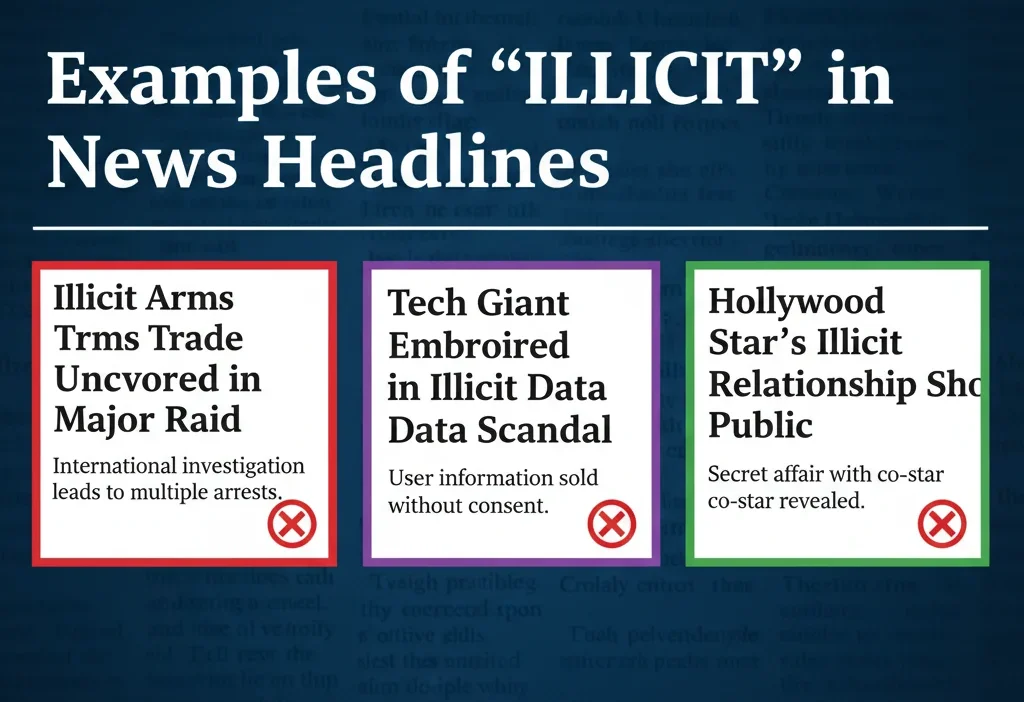
Ever come across the word “illicit” in a movie, article, or social media post and wondered what it really means? 🤔
Whether it’s describing an illicit affair, illicit trade, or illicit substances, this word carries a strong sense of something forbidden or unlawful — but its usage can vary depending on context.
In this guide, you’ll learn:
- The definition of “illicit”
- Its origin and popularity
- How it’s used in different contexts (law, business, and everyday language)
- Examples of “illicit” in real sentences
- Similar words, FAQs, and more
🧐 What Does Illicit Mean?
“Illicit” means forbidden by law, rules, or customs.
It’s an adjective used to describe actions or things that are illegal, immoral, or socially unacceptable — such as illicit activities, illicit relationships, or illicit substances.
It’s most often used in formal writing, journalism, and law, rather than casual texting or slang.
“Illicit” means something not legally or morally permitted.
📜 Origin and Popularity
The word “illicit” comes from the Latin word illicitus, meaning “not allowed” or “unlawful.”
It entered English in the 16th century, primarily used in legal and moral discussions.
Over time, “illicit” gained popularity in news, politics, and entertainment — often used to describe hidden or prohibited actions like illicit drug trade or illicit love affairs.
Timeline Snapshot:
- 1500s: First recorded use in English legal contexts.
- 1900s: Common in media and literature to describe forbidden love or activities.
- Today: Widely used in law enforcement reports, news, and moral discussions.
🌐 Illicit Meaning in Different Contexts
In Legal or Formal Settings
- Refers to activities that break the law.
- Example: “Authorities seized illicit drugs during the operation.”
- Example: “Authorities seized illicit drugs during the operation.”
In Relationships or Morality
- Describes secret or forbidden relationships, often romantic.
- Example: “The movie portrays an illicit affair between two colleagues.”
- Example: “The movie portrays an illicit affair between two colleagues.”
In Business or Economics
- Refers to illegal financial or trade practices.
- Example: “Illicit trade in counterfeit goods affects global economies.”
- Example: “Illicit trade in counterfeit goods affects global economies.”
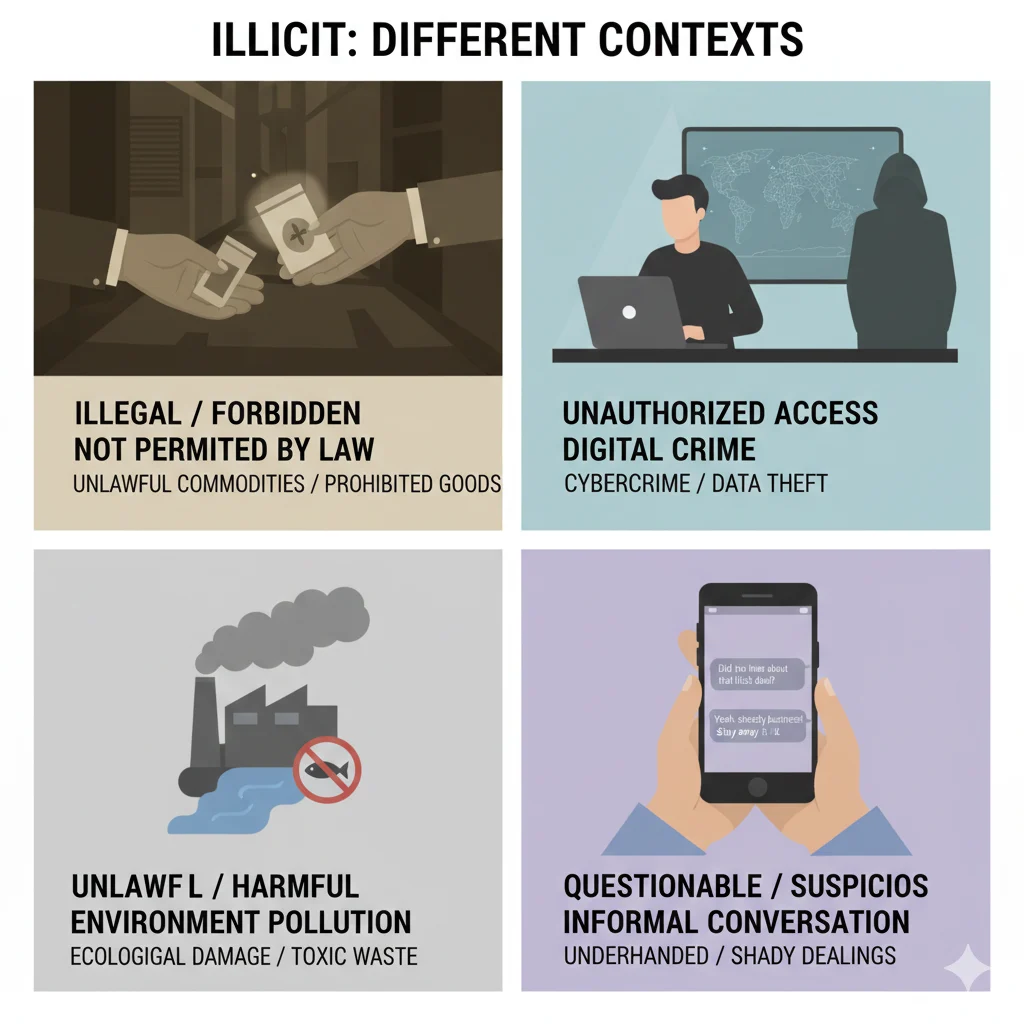
| Context | Meaning | Example |
| Legal | Against the law | Illicit drugs or trade |
| Romantic | Secret or immoral | Illicit affair |
| Business | Unethical or hidden | Illicit profit or activity |
💬 Examples of “Illicit” in Conversations
News Anchor: Authorities cracked down on illicit trade along the border.
Reporter: Yes, millions worth of goods were seized.
Friend 1: I can’t believe that movie was about an illicit romance!
Friend 2: Yeah, it was intense — definitely not your typical love story.
Teacher: Discuss the effects of illicit activities on society in your essay.
🔄 Similar or Related Terms
| Word | Meaning | Usage Example |
| Illegal | Against the law | Illegal substances were confiscated. |
| Immoral | Against moral values | Cheating is considered immoral behavior. |
| Unlawful | Not permitted by law | The court deemed the act unlawful. |
| Illegitimate | Not authorized or valid | They ran an illegitimate business. |
These words are often used interchangeably, but “illicit” usually carries both a legal and moral sense — something that’s wrong and hidden.
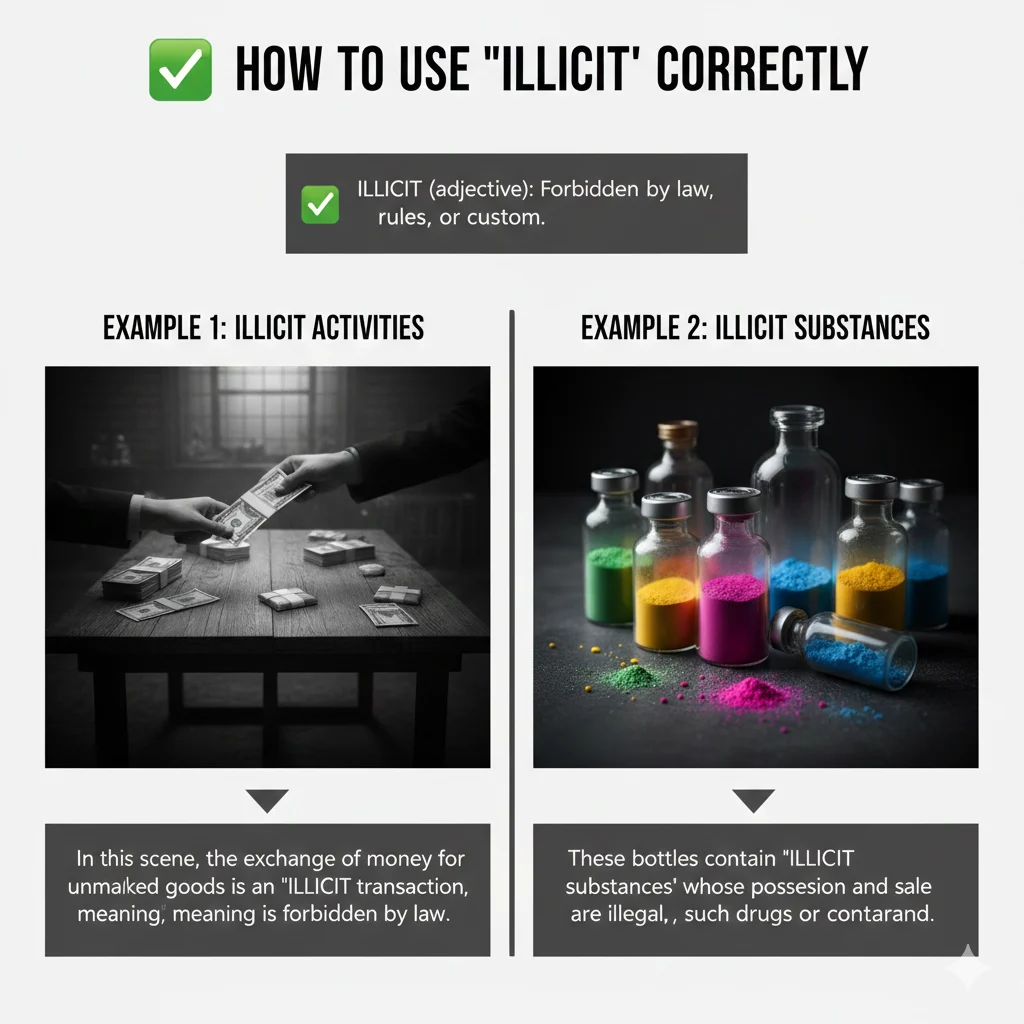
✅ How to Use “Illicit” Correctly
Here’s how to make sure you use the word in the right context:
Do’s:
✅ Use “illicit” when describing something forbidden or secret.
✅ Ideal for formal writing, essays, or reports.
✅ Use with nouns like activities, affair, relationship, trade, or substances.
Don’ts:
❌ Don’t use “illicit” for simple rule-breaking (use “illegal” instead).
❌ Avoid using it casually in text messages — it sounds too formal or heavy.
⚠️ Common Mistakes or Misinterpretations
Many people confuse “illicit” with “elicit.”
- Illicit (adjective) → means forbidden or illegal.
- Elicit (verb) → means to draw out or provoke a response.
🔹 Example:
❌ Wrong: He was arrested for elicit drugs.
✅ Correct: He was arrested for illicit drugs.
❓ FAQ Section
1. What does “illicit” mean in simple terms?
“Illicit” means something not allowed by law or society — like illegal activities, secret relationships, or unethical behavior.
2. Is “illicit” slang or formal?
It’s formal, not slang. You’ll find it in news reports, essays, or legal documents rather than everyday texting.
3. What’s the difference between “illicit” and “illegal”?
“Illegal” focuses strictly on law, while “illicit” also includes moral or social disapproval — it can be illegal, immoral, or both.
4. How do you use “illicit” in a sentence?
Example: The police discovered an illicit shipment of goods hidden in the truck.
5. Where is “illicit” most commonly used?
It’s widely used in law enforcement, journalism, academic writing, and politics, especially in contexts involving crime, trade, or relationships.
6. When should you not use “illicit”?
Avoid using it to describe minor misbehavior or casual wrongdoing — it implies serious legal or moral violations.
🏁 Conclusion
In short, “illicit” means forbidden, unlawful, or morally wrong — often used to describe actions or relationships that must be kept secret.
It originated from Latin roots and remains a strong, formal term used in law, media, and academic writing.
Now that you know the true meaning and usage of “illicit,” you’ll be able to use it confidently — and correctly!
Keep exploring our site for more word meanings, slang breakdowns, and trending language insights.

Evie Wyld is a word-meaning specialist at Meanovia.com. She simplifies complex words, phrases, and language trends, helping readers quickly grasp the exact meaning behind every term in a clear and approachable way.