

Have you ever listened to someone speak so smoothly that they sounded convincing at first—but later wondered if their words were sincere or just cleverly chosen? You’re not alone. The word glib describes exactly that kind of speech, making it one of the most misunderstood words in the English language.
In short, glib refers to someone who speaks fluently, confidently, and persuasively, but often without genuine sincerity, careful thought, or real substance behind their words.
Because of this, glib is usually used as a criticism rather than a compliment, especially when describing politicians, salespeople, public speakers, or anyone whose charm seems too polished to trust.
Whether you’ve encountered glib in books, news articles, interviews, workplaces, exams, or everyday conversations, understanding its true meaning can help you avoid misinterpreting both the word and the person it describes. This guide explains the glib meaning, pronunciation, origin, synonyms, antonyms, examples, and exactly how to use glib correctly and confidently in real-life English.
Why Do People Search for “Glib Meaning”?
People rarely search this word by accident. Most are trying to understand how it’s used after hearing it in real life.
If you’ve searched “glib meaning,” you’re probably looking for answers to one or more of these questions:
- What does glib actually mean?
- Is glib a compliment or an insult?
- What does it mean if someone is glib?
- What is a glib person?
- What is a glib response?
- Is glib positive or negative?
- What’s the difference between glib and eloquent?
- What is a synonym for glib?
- How do you pronounce glib?
- How do you use glib in a sentence?
This guide answers all of those questions in one place with clear explanations and practical examples.
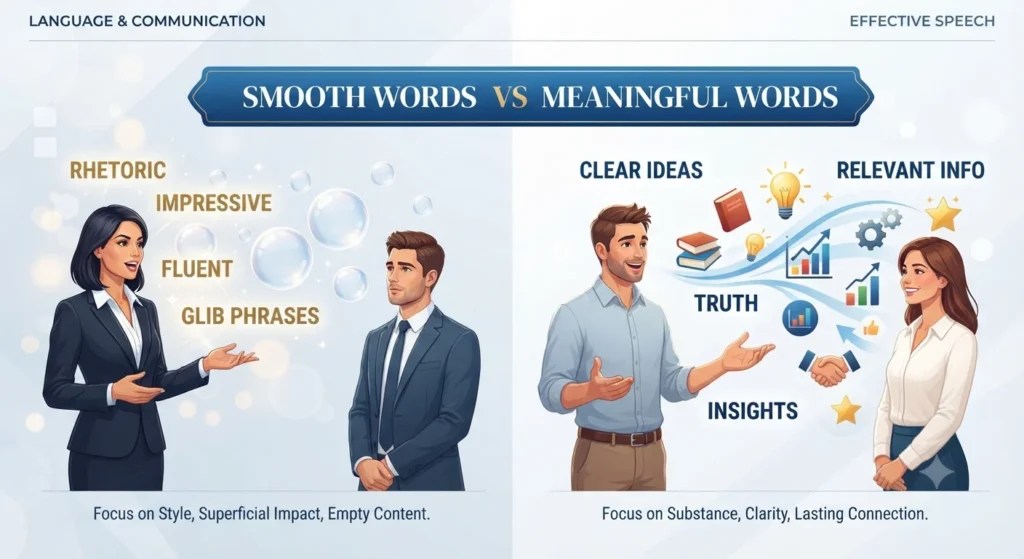
What Does Glib Mean?
At its core, the glib meaning is simple:
Glib describes someone who speaks smoothly and confidently but often without sincerity, careful thought, or meaningful substance.
A glib person usually sounds persuasive, yet their words may leave listeners feeling that nothing important was actually said.
Unlike words such as eloquent or articulate, which praise effective communication, glib questions the quality and honesty of what’s being said.
Simple Definition
Glib (adjective):
A person, comment, response, or speech that is fluent, polished, and persuasive but lacking genuine depth, sincerity, or thoughtful consideration.
In Plain English
Think of glib as:
“Smooth words with little substance.”
It’s the difference between sounding convincing and actually being convincing.
What Does It Mean If Someone Is Glib?
When someone is described as glib, it doesn’t automatically mean they’re dishonest. Instead, it means their communication feels polished on the surface while lacking enough evidence, emotion, or thoughtful explanation.
A glib person often:
- Speaks confidently in almost every situation.
- Gives quick answers before thinking deeply.
- Sounds persuasive without explaining much.
- Uses charm to influence others.
- Avoids difficult questions.
- Makes complex problems sound unrealistically simple.
Example
The executive gave a glib explanation for the company’s poor results, but employees were left with more questions than answers.
Notice that the criticism isn’t about confidence—it’s about the lack of meaningful information.

Glib Definition
In modern English, glib is an adjective used to describe communication that sounds smooth, fluent, and convincing but often lacks honesty, depth, or genuine understanding.
Quick Facts
| Feature | Information |
|---|---|
| Word | Glib |
| Part of Speech | Adjective |
| Pronunciation | /ɡlɪb/ |
| Tone | Usually Negative |
| Common Contexts | Conversation, politics, business, journalism, literature |
| Opposite Words | Sincere, genuine, thoughtful, earnest |
One-Sentence Definition
Glib means expressing ideas with impressive fluency but without enough sincerity or substance.
How to Pronounce Glib
Many English learners know the spelling but aren’t sure how to say it.
IPA Pronunciation
/ɡlɪb/
It rhymes with:
- Bib
- Rib
- Crib
Easy Pronunciation Tip
Say it as one short syllable:
GLIB
Because it’s only one syllable, the entire word receives the stress.
Word Forms of Glib
Learning the related forms of a word helps you recognize it in books, articles, news reports, and conversations.
| Word | Part of Speech | Meaning |
|---|---|---|
| Glib | Adjective | Smooth but insincere speech |
| Glibly | Adverb | In a glib manner |
| Glibness | Noun | The quality of speaking glibly |
| Glib speaker | Noun Phrase | A person whose speech lacks depth |
| Glib response | Noun Phrase | A polished but shallow answer |
| Glib speech | Noun Phrase | Fluent communication without much substance |
| Glib remark | Noun Phrase | A comment that sounds clever but lacks thoughtful content |
Examples
- She glibly dismissed everyone’s concerns.
- His glibness impressed some listeners but frustrated others.
- The journalist challenged the minister’s glib response.
- Everyone admired her confidence, but her glib remarks avoided the real issue.
Glib Meaning in English
In English, glib describes speech that is fluent and persuasive on the surface but often lacks genuine thought or sincerity.
Unlike an eloquent speaker, who combines clarity with meaningful ideas, a glib speaker may rely on confidence, charm, or rehearsed phrases instead of providing real insight.
Example
The interview sounded polished, but many viewers felt the candidate’s answers were glib rather than informative.
Origin and Etymology of Glib
Every word has a story, and glib has one that’s surprisingly interesting.
The word dates back to the 16th century and comes from the Middle English word glibbe, meaning smooth, slippery, or glossy. In its earliest form, it described physical qualities, such as sleek hair or a slippery surface.
As English evolved, speakers began using glib metaphorically. Instead of describing something physically smooth, the word came to describe speech that flowed smoothly and effortlessly.
By the 18th century, glib had developed the meaning we recognize today: speech that is fluent and persuasive but lacking sincerity or depth.
Today, the word commonly appears in:
- Newspapers and magazines
- Political commentary
- Business communication
- Literature
- Academic writing
- Everyday English

Why the Meaning of “Glib” Changed Over Time
Language changes because people begin using familiar words in new ways.
Originally, glib described something physically smooth. Over time, English speakers noticed that some people also spoke “smoothly.” Eventually, the word shifted from describing surfaces to describing communication.
This change is called semantic shift, where a word gradually develops a new meaning while keeping part of its original idea. In the case of glib, the idea of being “smooth” remained—but it moved from appearance to speech.
Is Glib Positive or Negative?
This is one of the most frequently asked questions.
Is Glib a Compliment?
Usually, no.
Although a glib person may sound confident, intelligent, or charismatic, the word almost always suggests that their communication lacks sincerity, careful thought, or meaningful substance.
That’s why glib is generally considered a criticism rather than praise.
Think About It This Way
A person can be:
- Fluent ✔
- Confident ✔
- Persuasive ✔
…and still be glib if they avoid facts, ignore important details, or rely on polished language instead of honest communication.
Examples
✅ Correct
The spokesperson’s glib answer failed to address the public’s concerns.
✅ Correct
His glib comments sounded convincing but lacked evidence.
❌ Incorrect
She gave a glib and deeply heartfelt speech.
These ideas contradict each other because heartfelt implies genuine emotion, while glib suggests a lack of sincerity.
Glib Meaning in Different Contexts
The meaning of glib stays generally the same across different situations, but the reason someone is called glib can vary depending on the context.
Whether you’re reading a novel, watching a political interview, attending a business meeting, or chatting with friends, glib usually describes speech that sounds smooth and confident but lacks sincerity, depth, or meaningful content.
Understanding these different contexts helps you recognize when native English speakers use the word—and why it’s almost always intended as criticism rather than praise.
Glib Meaning in Everyday Conversation
In everyday English, glib describes someone who always seems to have the perfect answer but rarely gives a thoughtful one.
Imagine asking a friend why they forgot an important event.
Instead of offering a sincere explanation, they quickly reply:
“Oh, you know how busy life gets!”
The response sounds polished, but it doesn’t really answer the question. Many people would describe that as a glib excuse or glib response.
Everyday Examples
- His glib excuse didn’t convince anyone.
- She laughed and gave a glib answer instead of apologizing.
- Please don’t be glib—I’m asking a serious question.
- His glib comments made the conversation feel less genuine.
Glib Meaning in Business
Professional communication depends on trust, credibility, and clear explanations. That’s why glib is rarely a compliment in the workplace.
A manager, consultant, salesperson, or executive may sound confident and polished, but if their words lack facts or practical solutions, people may describe their communication as glib.
Business Examples
- The CEO’s glib promises failed to reassure investors.
- Her presentation was polished but surprisingly glib.
- The consultant relied on glib marketing language instead of evidence.
- Customers wanted honest answers, not glib sales pitches.
Why It Matters
Successful professionals don’t just speak confidently—they support their ideas with facts, transparency, and accountability.

Glib Meaning in Politics
Political discussions are one of the most common places you’ll encounter the word glib.
Journalists, commentators, and voters often use it to criticize politicians who avoid difficult questions by giving polished but vague responses.
Example
Reporter:
“How exactly will your new policy reduce inflation?”
Politician:
“We’re committed to building a stronger future for every citizen.”
Although the statement sounds optimistic, it doesn’t answer the question.
That kind of response is often described as glib.
Political Examples
- The minister’s glib remarks frustrated reporters.
- Many voters dismissed the candidate’s glib promises.
- Critics called the speech glib because it lacked practical solutions.
Glib Meaning in Journalism and Media
Journalists frequently use glib when evaluating interviews, speeches, public statements, and media appearances.
A news article might describe an executive’s explanation as glib if it sounds polished but avoids responsibility.
Movie and book reviewers also use the word to criticize stories that treat serious topics too lightly.
Examples
- The review criticized the film’s glib treatment of mental health.
- The newspaper described the company’s apology as glib.
- The documentary avoided glib conclusions and explored the issue thoughtfully.
Glib Meaning in Literature
Authors often use glib to reveal something important about a character.
A glib character may:
- Speak confidently.
- Charm everyone they meet.
- Avoid emotional honesty.
- Hide insecurity behind clever language.
- Use humor to escape difficult conversations.
At first, these characters often appear charismatic. As the story develops, readers realize that their confidence hides emotional shallowness or avoidance.
Literary Example
The lawyer’s glib personality impressed clients, but his inability to admit mistakes eventually damaged his reputation.
Glib Meaning on Social Media
Today’s online world encourages fast opinions, short videos, and instant reactions. While quick communication can be useful, it sometimes leads to glib comments that oversimplify complicated issues.
For example, imagine someone sharing a personal struggle online.
Instead of responding thoughtfully, another user writes:
“Just stay positive.”
Although the comment may sound encouraging, it ignores the person’s situation and offers little meaningful support.
Many readers would consider this a glib response because it prioritizes simplicity over empathy.
Social Media Examples
- His glib tweet received criticism for ignoring the real issue.
- The influencer apologized with a glib statement that many followers found insincere.
- People appreciated honest discussion rather than glib motivational quotes.
What Is a Glib Person?
One of the most searched questions is:
What is a glib person?
A glib person is someone who communicates smoothly and confidently but often relies on polished words instead of genuine understanding, careful reasoning, or emotional honesty.
Being glib doesn’t necessarily mean someone is lying. Instead, it suggests that they focus more on sounding convincing than being convincing.
Characteristics of a Glib Person
A glib person often:
- Speaks confidently about almost every topic.
- Answers difficult questions very quickly.
- Rarely admits they don’t know something.
- Uses charm to influence people.
- Avoids detailed explanations.
- Makes complicated problems seem simple.
- Sounds persuasive without providing evidence.
Example
Although Daniel was an entertaining speaker, many colleagues considered him glib because his confident answers rarely contained practical solutions.
What Is Glib Speech?
Glib speech refers to communication that is smooth, polished, and persuasive but lacks genuine substance.
Instead of helping listeners understand a problem, glib speech often creates the illusion of understanding.
Signs of Glib Speech
- Vague promises
- Overused clichés
- Lack of evidence
- Avoiding direct answers
- Excessive confidence
- Oversimplified explanations
Example
Instead of saying:
“We made several planning mistakes, and here’s how we’ll correct them.”
A glib speaker might simply say:
“Everything is under control.”
The second statement sounds reassuring but provides no useful information.
Idler Meaning: The Secret Role You Didn’t Know
What Is a Glib Response?
A glib response is an answer that sounds polished while avoiding the real issue.
Poor Example
Question:
“Why did the project fail?”
Answer:
“Sometimes things just don’t work out.”
The response sounds calm but doesn’t explain anything.
Better Response
“The project failed because we underestimated costs, delayed testing, and didn’t communicate effectively with stakeholders.”
The second answer builds trust because it’s specific, honest, and informative.
What Is Glib Talk?
The phrase glib talk describes speech that relies more on style than substance.
People engaging in glib talk often:
- Use impressive-sounding language.
- Avoid concrete details.
- Rely on clichés.
- Offer easy answers to difficult questions.
- Focus on sounding persuasive rather than being informative.
Example
The interview contained plenty of glib talk but very few meaningful answers.
What Does “Gift of the Glib” Mean?
The expression gift of the glib is a well-known English idiom.
It refers to someone’s natural ability to speak easily, confidently, and persuasively.
However, the expression has two possible meanings depending on context.
Positive Meaning
Sometimes it simply praises someone who is an engaging public speaker or storyteller.
Example:
She has the gift of the glib and always keeps her audience interested.
Negative Meaning
More commonly, it suggests someone uses charm and persuasive language to avoid difficult questions or create a misleading impression.
Example:
He certainly has the gift of the glib, but people eventually realized his promises lacked substance.
Why Do People Become Glib Speakers?
This is a question many articles never answer.
People are rarely born glib. Instead, glib communication often develops because of habits, environments, or personal motivations.
Some common reasons include:
Overconfidence
People who believe they always have the right answer may speak before fully thinking through an issue.
Fear of Looking Uninformed
Rather than admitting, “I don’t know,” some people give confident but shallow answers to protect their image.
Media Training
Public figures are often taught to stay calm and speak confidently under pressure. While this can be effective, it may sometimes result in responses that sound polished but lack meaningful detail.
Desire to Impress
Some people use sophisticated language or quick wit to appear knowledgeable, even when they don’t fully understand the topic.
Avoiding Accountability
A glib response can sometimes be a way of avoiding responsibility by replacing honest explanation with vague reassurance.
Glib Meaning in Different Languages
Although the core meaning of glib is similar across many languages, there isn’t always a single word that perfectly captures its nuance. In most languages, glib describes someone who speaks smoothly and confidently but without enough sincerity, honesty, or depth.
Note: These translations are approximate because the exact meaning depends on context.
Glib Meaning in Urdu
In Urdu, glib is commonly understood as:
- چکنی چپڑی باتیں کرنے والا
- سطحی انداز میں بات کرنے والا
- روانی سے مگر غیر سنجیدگی سے بولنے والا
- ایسا شخص جو بات تو بہت اچھی کرے لیکن دل سے سچا نہ لگے
Urdu Example
اس نے اتنا چکنی چپڑی انداز میں جواب دیا کہ کسی کو یقین نہیں آیا۔
English Translation:
He answered so smoothly that no one believed him.
Glib Meaning in Hindi
In Hindi, the closest meanings include:
- चिकनी-चुपड़ी बातें करने वाला
- ऊपरी तौर पर प्रभावशाली लेकिन असत्य बोलने वाला
- बिना गहराई के सहज बोलने वाला
Example
उसका जवाब सुनने में अच्छा लगा, लेकिन उसमें सच्चाई नहीं थी।
Glib Meaning in Arabic
A close Arabic equivalent is:
لبق في الكلام لكنه سطحي أو غير صادق
Meaning:
A person who speaks fluently but lacks sincerity or depth.
Glib Meaning in Farsi
In Persian (Farsi), glib may be expressed as:
- خوشزبان اما سطحی
- فصیح اما غیرصادق
Meaning:
Someone who speaks well but lacks genuine sincerity.
Glib Meaning in French
Depending on the context, the closest French expressions are:
- Beau parleur
- Superficiel
- Éloquent mais peu sincère
Among these, beau parleur is often the closest because it describes someone who speaks attractively but may not be trustworthy.
Glib Meaning in Bengali
A close Bengali translation is:
মসৃণভাবে কথা বলে কিন্তু আন্তরিক নয়
Meaning:
Someone who speaks smoothly but isn’t completely sincere.
Glib Meaning in Tamil
In Tamil, the idea can be expressed as:
நன்றாக பேசுபவர் ஆனால் உண்மையான ஆழம் இல்லாதவர்
Meaning:
A person who speaks well but lacks genuine depth.
Glib Meaning in Telugu
In Telugu, glib may be explained as:
మాటలు చక్కగా చెప్పినా నిజమైన లోతు లేదా నిజాయితీ లేని వ్యక్తి
Meaning:
Someone whose words sound polished but lack sincerity.
Glib Synonyms
One of the most common questions is:
What is a synonym for glib?
There isn’t one perfect synonym because glib combines fluency, confidence, charm, and lack of sincerity. However, several words share part of its meaning.
| Synonym | Meaning | Tone |
|---|---|---|
| Smooth-talking | Speaks persuasively | Neutral |
| Slick | Clever but possibly dishonest | Negative |
| Facile | Oversimplified and superficial | Negative |
| Superficial | Lacking depth | Negative |
| Insincere | Not genuine | Negative |
| Fast-talking | Speaks quickly to persuade | Neutral/Negative |
| Silver-tongued | Extremely persuasive | Usually Positive |
| Fluent | Speaks easily | Positive |
| Articulate | Expresses ideas clearly | Positive |
| Eloquent | Speaks beautifully with substance | Positive |
| Persuasive | Convinces others | Neutral |
| Polished | Refined and smooth | Positive |
Best Synonyms for “Glib”
If you need the closest alternatives, these work best depending on context:
- Smooth-talking
- Slick
- Facile
- Superficial
- Insincere
- Fast-talking
Glib Antonyms (Opposite Words)
The opposite of glib emphasizes honesty, authenticity, and thoughtful communication.
| Antonym | Meaning |
|---|---|
| Sincere | Honest and genuine |
| Genuine | Authentic |
| Honest | Truthful |
| Earnest | Serious and sincere |
| Thoughtful | Carefully considered |
| Authentic | Real and trustworthy |
| Heartfelt | Full of genuine emotion |
| Meaningful | Rich in substance |
| Frank | Open and direct |
| Truthful | Based on facts |
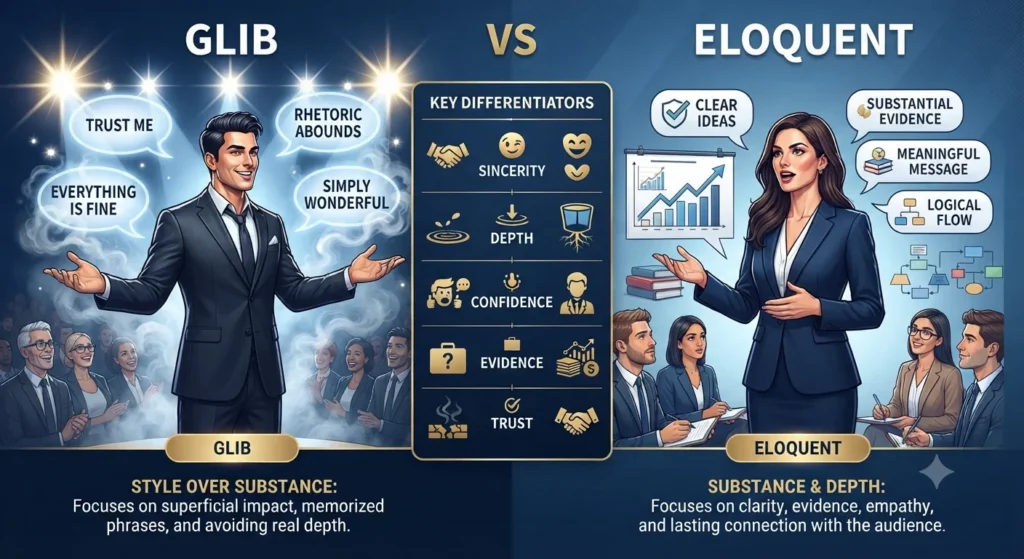
Glib vs. Eloquent
Many English learners confuse glib and eloquent because both describe fluent speakers. However, they have almost opposite meanings.
| Glib | Eloquent |
|---|---|
| Smooth speech | Meaningful speech |
| Often lacks depth | Rich in ideas and emotion |
| Usually negative | Positive |
| Style over substance | Style supported by substance |
| Can sound rehearsed | Sounds genuine and inspiring |
Example
Glib
“Everything will be fine.”
(No explanation.)
Eloquent
“Although the challenge is significant, careful planning and teamwork will help us overcome it.”
The second statement provides both inspiration and substance.
UNC Meaning: The Secret Uses You Didn’t Know
Glib vs. Facile
These two words are closely related but not identical.
| Glib | Facile |
|---|---|
| Describes speech | Describes ideas or solutions |
| Focuses on communication | Focuses on thinking |
| Smooth talking | Oversimplified reasoning |
| Often about confidence | Often about shallow analysis |
Example
Glib
“His speech sounded polished but empty.”
Facile
“The article offered a facile solution to a complex problem.”
Glib vs. Slick
People also confuse glib with slick.
Although both words can be negative, slick often refers to someone who is stylish, polished, or even manipulative, while glib specifically focuses on speech.
| Glib | Slick |
|---|---|
| About speech | About overall style or behavior |
| Lacks depth | Can seem manipulative |
| Focuses on communication | Focuses on image and presentation |
Example
- His glib explanation lacked evidence.
- The salesman gave a slick presentation designed to impress customers.
Glib vs. Smooth-Talking
A smooth-talking person is persuasive and charming. That isn’t always a bad thing.
A glib person, however, usually sounds persuasive without offering enough genuine substance.
Smooth-Talking
May be:
- Honest
- Charismatic
- Persuasive
Glib
Often appears:
- Superficial
- Overconfident
- Insincere
- Vague
Glib vs. Persuasive
This is an important distinction.
A persuasive speaker changes minds by using:
- Facts
- Logic
- Evidence
- Clear reasoning
A glib speaker often tries to persuade through:
- Confidence
- Charm
- Polished language
- General statements
Expert Insight
Persuasion becomes glibness when confidence replaces evidence.
Glibly Meaning
Glibly is the adverb form of glib.
It means:
Speaking in a smooth, confident, but superficial or insincere manner.
Examples
- She glibly dismissed everyone’s concerns.
- The spokesperson glibly answered difficult questions.
- He glibly promised immediate success without explaining how.
Glibness Meaning
Glibness is the noun form of glib.
It refers to the habit or quality of speaking fluently without enough sincerity, thought, or depth.
Example
His glibness impressed the audience at first, but they soon realized his arguments lacked evidence.
Glib in a Sentence (20 Practical Examples)
Seeing real examples makes the word much easier to understand.
Everyday Conversation
- His glib excuse didn’t fool anyone.
- Please don’t give me a glib answer.
- Her glib comments ended the discussion instead of solving the problem.
- I expected honesty, not a glib explanation.
Workplace
- The manager’s glib promises worried the staff.
- Clients wanted facts rather than glib marketing language.
- The interview panel questioned his glib responses.
Politics
- Many voters criticized the candidate’s glib remarks.
- The senator’s glib answer avoided the real issue.
- Journalists challenged the minister’s glib statement.
Education
- The teacher encouraged thoughtful discussion instead of glib opinions.
- His essay sounded glib because it lacked supporting evidence.
Media
- The review described the ending as glib and unrealistic.
- Critics felt the documentary offered glib conclusions.
Personal Relationships
- A glib apology isn’t the same as a sincere one.
- Her glib response made him feel unheard.
- They wanted empathy, not glib advice.
Social Media
- People criticized the influencer’s glib comments.
- His glib tweet oversimplified a complex issue.
General
- The company’s glib statement failed to rebuild public trust.
Can Being Glib Damage Trust?
Yes. In many situations, being glib can damage credibility because people often value honesty and thoughtful communication more than polished language.
A glib response may create a good first impression, but if it lacks substance, listeners quickly begin to question the speaker’s knowledge, intentions, or sincerity.
For example, imagine a company apologizing after making a mistake. Instead of explaining what happened and how it will improve, the spokesperson simply says:
“We remain committed to excellence and customer satisfaction.”
While the statement sounds professional, it doesn’t answer the public’s concerns. Many people would describe it as a glib response because it avoids meaningful information.
The same principle applies to personal relationships, workplaces, classrooms, and leadership roles. Confidence may capture attention, but trust grows from honesty, evidence, and accountability.
Why Glib Communication Can Harm Trust
- It avoids difficult questions.
- It replaces facts with vague statements.
- It can sound rehearsed instead of genuine.
- It may make listeners feel ignored.
- It often creates doubt about credibility.
How to Respond to a Glib Person
If someone gives a glib answer, arguing usually isn’t the best approach. Instead, encourage a more thoughtful conversation.
Here are some effective ways to respond.
Ask Follow-Up Questions
Instead of accepting a vague answer, politely ask for more detail.
Example:
“Could you explain what you mean by that?”
Request Specific Examples
Concrete examples often reveal whether someone truly understands the topic.
Example:
“Can you give an example?”
Focus on Facts
If the conversation involves an important decision, ask for evidence rather than opinions.
Example:
“What information supports that conclusion?”
Stay Calm
A glib speaker may rely on confidence to steer the discussion. Remaining calm and asking thoughtful questions often leads to a more productive conversation.
How to Use “Glib” Correctly
Knowing the glib meaning is one thing. Using it naturally is another.
Use glib when describing speech that is:
- Smooth
- Fluent
- Confident
- Persuasive
- But lacking sincerity or meaningful depth
Correct Examples
✔ His glib explanation failed to answer the question.
✔ The article criticized the politician’s glib remarks.
✔ She apologized, but her response sounded glib.
✔ The manager’s glib promises didn’t reassure employees.
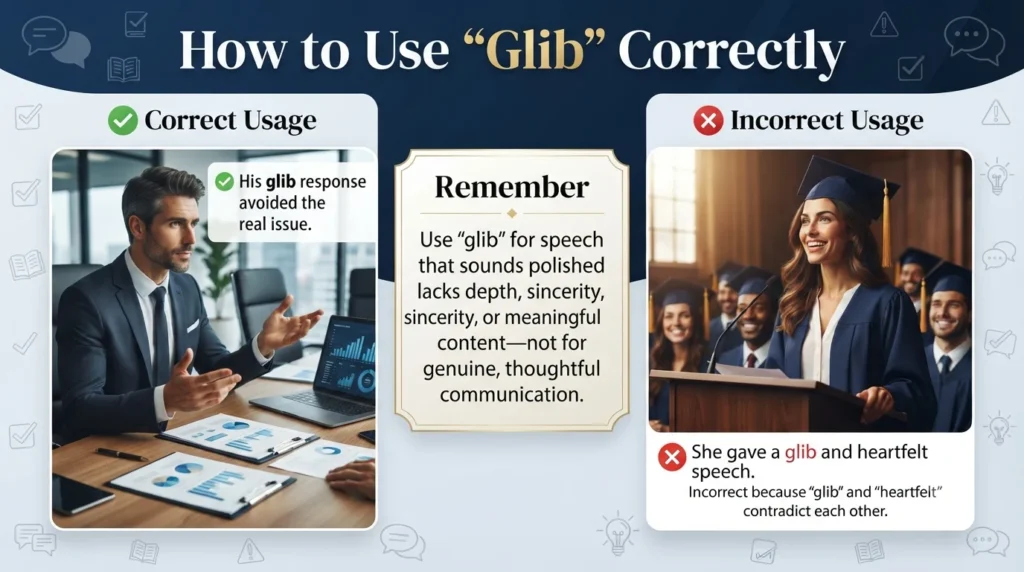
When NOT to Use “Glib”
Don’t use glib to describe someone who communicates thoughtfully or honestly.
For example, avoid sentences like:
❌ She delivered a glib and heartfelt speech.
This sounds contradictory because heartfelt implies sincerity, while glib suggests the opposite.
Better alternatives include:
- Eloquent
- Articulate
- Thoughtful
- Genuine
- Insightful
Common Mistakes People Make
Mistake 1: Thinking Glib Means “Eloquent”
This is the most common misunderstanding.
An eloquent speaker communicates beautifully with substance.
A glib speaker communicates smoothly without enough substance.
Mistake 2: Using Glib as a Compliment
Although a glib speaker may appear confident, calling someone glib is usually criticism rather than praise.
Mistake 3: Assuming Glib Means “Lying”
Not necessarily.
A glib person may genuinely believe what they’re saying. The criticism is usually about the lack of depth, careful reasoning, or meaningful explanation—not automatic dishonesty.
Mistake 4: Confusing Confidence with Credibility
Confidence helps people listen.
Credibility makes people believe.
A glib speaker often has the first without fully earning the second.
Mistake 5: Overusing the Word
Because glib has a specific meaning, avoid using it for every confident speaker. Reserve it for situations where polished speech genuinely lacks substance.
Frequently Asked Questions
What does glib actually mean?
Glib means speaking fluently and confidently in a way that sounds convincing but often lacks sincerity, careful thought, or meaningful substance.
What does it mean if someone is glib?
A glib person speaks smoothly and persuasively but may rely on polished language instead of genuine understanding or thoughtful explanations.
Is glib an insult?
It usually isn’t a harsh insult, but it is generally a criticism. Calling someone glib suggests their words sound impressive without enough honesty or depth.
Is glib positive or negative?
In modern English, glib almost always carries a negative meaning because it questions the sincerity or substance of someone’s communication.
What is a synonym for glib?
Common synonyms include:
- Smooth-talking
- Slick
- Facile
- Superficial
- Fast-talking
- Insincere
The best synonym depends on the context.
What is the opposite of glib?
Common antonyms include:
- Sincere
- Honest
- Genuine
- Earnest
- Thoughtful
- Authentic
What does “don’t be glib” mean?
It means:
Don’t give a quick, shallow, or dismissive answer. Think carefully and respond sincerely.
Is glib a formal word?
Yes. You’ll frequently find it in books, newspapers, academic writing, professional communication, and political commentary.
Is glib slang?
No. Glib is a standard English adjective, not internet slang or texting slang.
Can writing be glib?
Yes. A book, article, review, speech, or social media post can be described as glib if it oversimplifies serious issues or lacks thoughtful analysis.
What does glibly mean?
Glibly means speaking in a smooth, confident, but superficial or insincere manner.
What does glibness mean?
Glibness is the quality or habit of speaking fluently without enough depth or sincerity.
How do you pronounce glib?
Glib is pronounced /ɡlɪb/ and rhymes with rib, bib, and crib.
Is a glib person always dishonest?
No. A glib person isn’t necessarily dishonest, but they often communicate in a way that feels superficial, overly polished, or lacking thoughtful detail.
Why is glib considered negative?
Because it suggests that someone values sounding convincing more than providing meaningful, truthful, or well-reasoned communication.
Key Takeaways
- Glib describes speech that is smooth, fluent, and persuasive but often lacks sincerity or substance.
- The word is usually used as a criticism rather than a compliment.
- A glib response may sound impressive while avoiding the real issue.
- Glib differs from eloquent because eloquence combines style with meaningful ideas.
- Understanding this word helps you recognize the difference between polished communication and genuine credibility.
Conclusion
The true glib meaning goes beyond smooth speech. It reminds us that effective communication isn’t measured by confidence alone—it’s measured by honesty, clarity, evidence, and genuine understanding.
In everyday conversations, workplaces, politics, journalism, and literature, the word glib highlights an important lesson: style can attract attention, but substance earns trust. Someone may speak fluently and still fail to communicate meaningfully if their words lack depth or sincerity.
Now that you understand what glib means, its origin, pronunciation, synonyms, examples, and correct usage, you’ll be able to recognize it confidently in real-life conversations and use it accurately in your own writing and speech.
The next time you hear someone described as glib, you’ll know it’s rarely about how well they speak—it’s about whether their words truly deserve to be believed.

Kinza ✨ is a content writer at Meanovia, specializing in slang, texting meanings, and internet phrases. She simplifies modern digital language for easy understanding and daily use 💬🔥