

Ever heard someone mention an “ex parte hearing” or “ex parte order” in a courtroom drama and wondered what it means?
If you’ve ever watched legal shows or read court documents, you’ve likely seen this phrase pop up — and it might sound complicated at first.
In this guide, we’ll explain:
✅ The definition of “ex parte”
✅ Its origin and legal background
✅ How it’s used in court and other contexts
✅ Examples of “ex parte” in real cases
✅ Related terms and common misconceptions
⚖️ What Does Ex Parte Mean?
“Ex parte” is a Latin legal term meaning “from one party” or “on behalf of one side only.”
It refers to a legal proceeding or communication conducted for the benefit of one party without the other being present or notified.
It’s commonly used in court cases, petitions, and legal documents.
🏛️ Origin and Popularity
The term “ex parte” originates from Latin, where ex means “from” or “out of,” and parte means “party” or “side.”
This phrase has been part of legal terminology since ancient Roman law, later adopted into English common law during the Middle Ages.

📜 Timeline Snapshot:
- Roman Era: Used in legal rhetoric to describe one-sided pleas.
- 13th–15th Century: Integrated into English legal language.
- Modern Law: Commonly used in court orders, motions, and emergency petitions.
Today, “ex parte” remains a standard legal phrase used globally in courts, particularly in the United States, the UK, Canada, and other common law countries.
⚖️ Ex Parte Meaning in Different Contexts
“Ex parte” can have slightly different nuances depending on the legal or professional context.
🏛️ In Court Proceedings
An ex parte hearing happens when only one side appears before a judge — usually because of urgency or confidentiality.
Example: A judge may issue an ex parte restraining order to protect someone immediately, even before the other party is notified.
📜 In Legal Documents
“Ex parte” may appear in case titles to indicate who initiated the motion.
Example: Ex Parte Johnson means Johnson filed the motion individually, not jointly with another party.
⚙️ In Administrative or Business Contexts
Sometimes used in formal settings to describe one-sided requests or confidential decisions without consultation.
Example: “The committee made an ex parte recommendation to speed up the process.”
| Context | Meaning | Example |
| Court | Legal action by one party without the other | Ex parte hearing for emergency relief |
| Case Titles | Indicates who filed the motion | Ex Parte Brown |
| Business / Admin | One-sided communication | Ex parte meeting between advisor and regulator |
🗣️ Examples of “Ex Parte” in Sentences
Here are real-world examples showing how “ex parte” is used:
Example 1 (Legal Context):
“The court granted an ex parte injunction to prevent the sale of property until the case was reviewed.”
Example 2 (Case Title):
“In Ex Parte Smith, the applicant requested a temporary custody order.”
Example 3 (Ethics Context):
“Ex parte communication between a judge and one lawyer can violate fairness rules.”
Example 4 (Informal Description):
“The company acted ex parte, making a decision without consulting the stakeholders.”
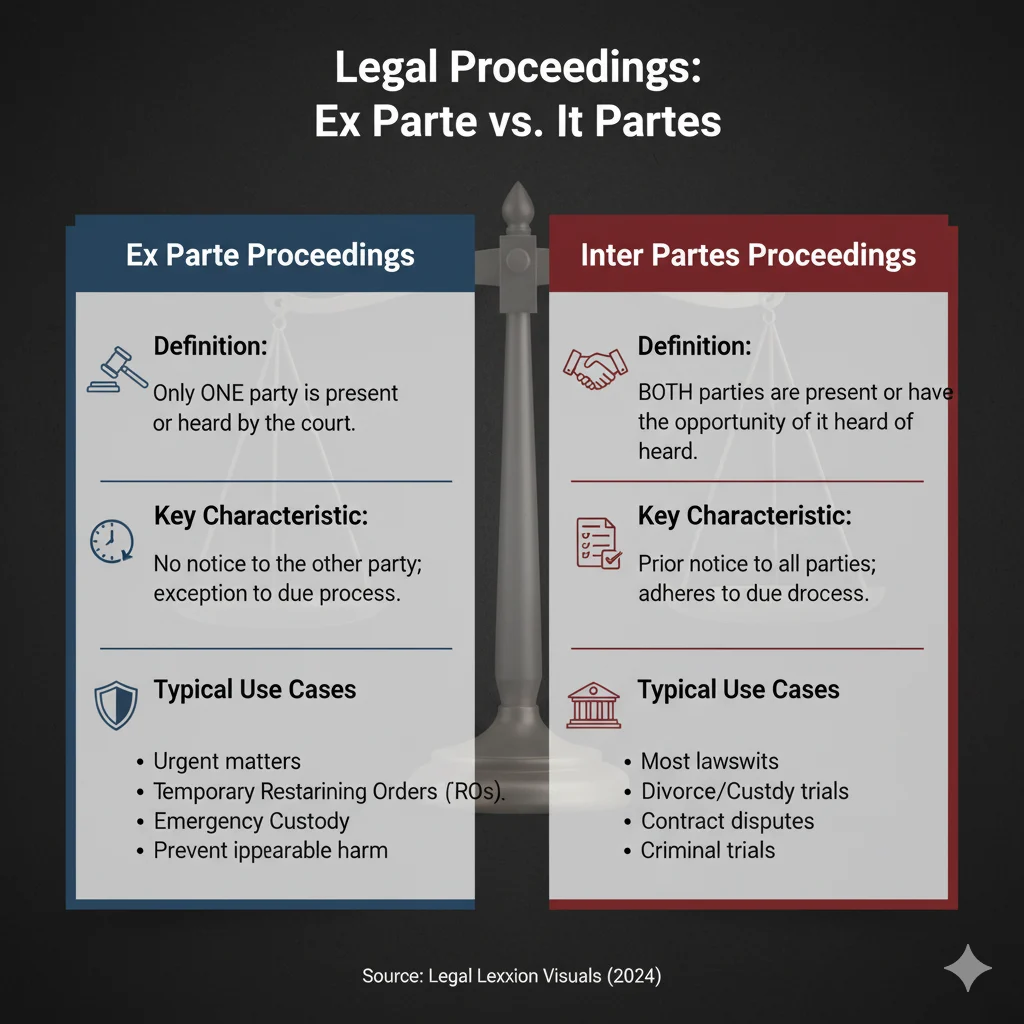
| Term | Meaning | Participants Involved |
| Ex Parte | Action by one party only | One side present |
| Inter Partes | Action between both parties | Both sides present |
🔍 Similar or Related Legal Terms
To better understand “ex parte,” it helps to know these related terms:
| Term | Meaning |
| Inter Partes | Involving all parties in a dispute. |
| In Camera | A private or closed court session. |
| Ad Hoc | Formed for a specific purpose or case. |
| Sub Judice | Under judicial consideration; not yet decided. |
| Pro Bono | Legal work done for free or public good. |
These terms often appear in similar contexts, but “ex parte” uniquely refers to one-sided legal actions.
🧾 How to Use “Ex Parte” Correctly
✅ Do’s:
- Use it in formal legal writing or discussions.
- Use to describe actions, motions, or communications made by one party only.
- Use correctly in case titles (e.g., Ex Parte Miller).
❌ Don’ts:
- Don’t use it in casual or non-legal contexts unless metaphorically.
- Don’t confuse it with “inter partes,” which includes both parties.
- Avoid assuming all ex parte actions are unethical — many are legally valid in emergencies.
⚠️ Common Mistakes or Misinterpretations
- Mistake: Thinking “ex parte” means secret or illegal.
→ Reality: It’s legal when justified, especially in emergencies. - Mistake: Using it for any private meeting.
→ Reality: Only applies in formal or legal contexts. - Mistake: Confusing it with “in absentia.”
→ Reality: “In absentia” means “in the absence of,” while “ex parte” means “by one side only.”
❓ FAQ Section
1. What does “ex parte” mean in law?
“Ex parte” means a legal action or communication made by one party without the other being present or notified — usually due to urgency or confidentiality.
2. Is an ex parte hearing fair?
Generally, yes. The other side is often given a chance to respond later, ensuring due process.
3. Can judges talk to one side ex parte?
No, ex parte communication between a judge and one party outside official proceedings is prohibited as it compromises fairness.
4. What is the difference between ex parte and inter partes?
“Ex parte” involves one party; “inter partes” involves both parties in open court.
5. When is an ex parte order used?
It’s used in emergency cases, like domestic violence restraining orders or child protection motions, when waiting could cause harm.
6. Can an ex parte order be challenged?
Yes. The other party can file a motion to modify or set aside the order once notified.
🧠 Conclusion
To sum up, “ex parte” is a Latin legal term meaning “from one party” — used to describe court actions or communications made without the other side’s participation.
It plays a vital role in emergency legal processes, ensuring protection and justice when immediate action is required.
Now that you understand the ex parte meaning, you can interpret legal documents and court discussions more confidently. ⚖️ Keep exploring our site for more easy-to-understand explanations of legal and business terms!

Evie Wyld is a word-meaning specialist at Meanovia.com. She simplifies complex words, phrases, and language trends, helping readers quickly grasp the exact meaning behind every term in a clear and approachable way.