
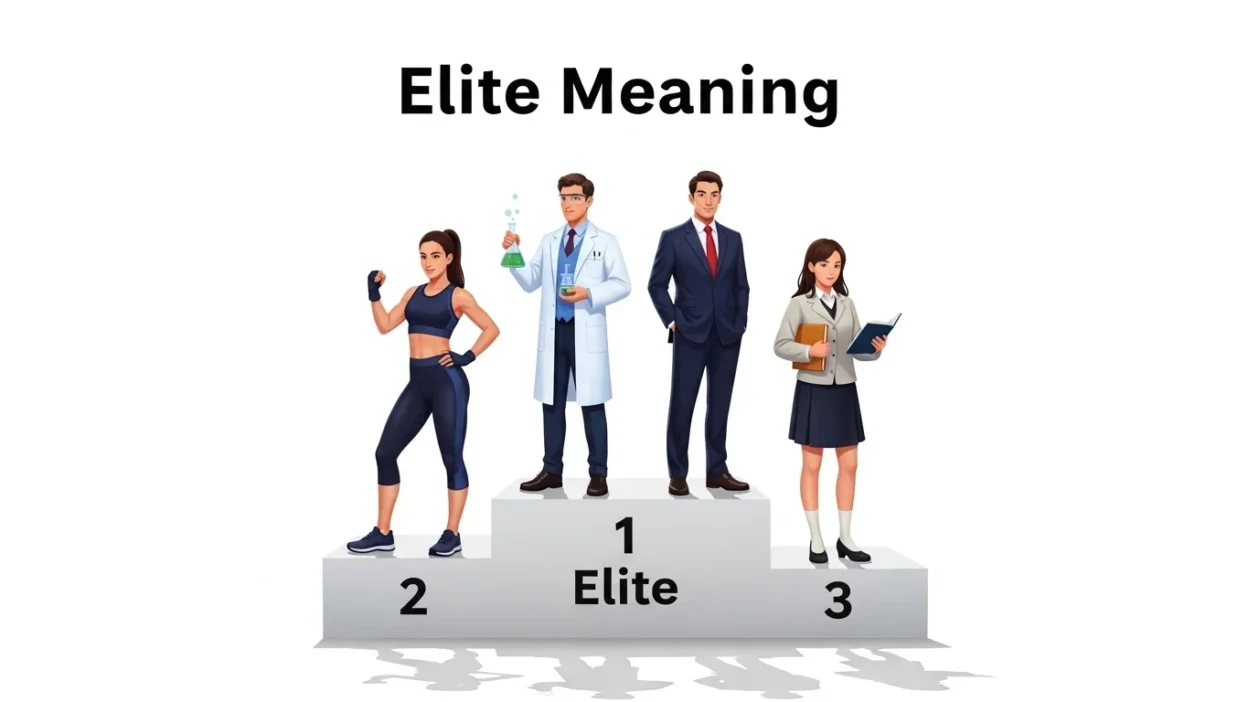
In school, sports, or even news headlines, we often hear phrases like “elite athletes” or “elite universities.” But what does the word elite actually mean?
Quick answer: Elite refers to a small group of people considered the best, most skilled, or most influential in a particular field.
As someone who explains vocabulary to English learners and website readers every day, I often notice that people confuse elite with simply “rich” or “famous.” In reality, the word is about top-level performance or status, not just money. An elite runner, elite student, or elite team earns that label through exceptional ability or achievement.
The term comes from the French élite, meaning “chosen.” Today it appears in education, sports, business, and social discussions — sometimes with praise (elite talent) and sometimes with criticism (elite class).
People usually search for “elite meaning” after seeing the word in news, job ads, or academic writing and wanting to understand whether it refers to skill, social status, or influence.
Elite is an English word meaning a small group considered the best, most skilled, or most powerful in a particular field. The elite definition refers to top-level performance, high status, or exceptional ability rather than simply wealth or fame.
🧠 What Does Elite Mean?
“Elite” refers to a group of people or things considered the best, most skilled, or most powerful in a particular field.
It’s a formal English word, not slang or an acronym, and is commonly used in business, sports, education, and social media to describe excellence or exclusivity.
Example: “He’s part of an elite team of scientists working on advanced AI technology.”
🔊 How to Pronounce “Elite”
Elite is pronounced ih-LEET.
Phonetic spelling: /ɪˈliːt/
The stress falls on the second syllable. In British English, it may sound slightly like ee-LEET.
🕰️ Origin and Popularity
The word “elite” originates from the French word “élite”, meaning selection or chosen one. It entered the English language in the 17th century, initially referring to nobility or individuals of high social rank.
Over time, its meaning expanded to include any top-performing or highly respected group — whether in sports, academia, military, or culture.
Quick Timeline of Usage
- 1600s: Used for aristocratic or noble classes.
- 1800s: Adopted in military and academic circles.
- 1900s: Common in sports and professional industries.
- 2000s–2020s: Popular in pop culture, gaming, and online slang (e.g., “elite player,” “elite skills”).
Today, “elite” often symbolizes success, exclusivity, and excellence, but can also carry negative tones when used to criticize privilege or detachment from common people.
📚 Elite Meaning in History and Society
In history and sociology, elite refers to groups with significant power, influence, or privilege. Terms like economic elite, social elite, or global elite describe people who shape political or financial decisions.
For example, the “power elite” concept describes individuals who hold authority in business, government, and the military.
🌍 Elite Meaning in Different Contexts
The meaning of “elite” changes slightly based on where and how it’s used. Let’s break it down:
⚽ In Sports
Used to describe top-performing athletes or teams who outperform others.
Example: “Cristiano Ronaldo is considered an elite footballer.”
💼 In Business
Refers to high-ranking professionals, executives, or exclusive organizations.
Example: “She belongs to an elite circle of Silicon Valley investors.”
🎓 In Education
Describes prestigious institutions or top academic performers.
Example: “Harvard and Oxford are elite universities.”
🧑💻 On Social Media or Internet Slang
Used informally to praise excellence or mock exclusivity.
Example (Twitter/X): “That comeback was elite 😂”
Example (TikTok): “This outfit combo is elite behavior.”
💬 Elite Meaning in Slang
In slang, elite is used as a compliment to mean impressive, amazing, or top-tier. For example, gamers may say “That move was elite” to praise skill. The elite slang meaning is usually positive and playful rather than formal.
🔎 Special Uses of the Word “Elite”
Some phrases use elite in very specific ways:
• Coastal elite meaning — refers to wealthy or influential people living on major coastal cities.
• WASP elite meaning — describes traditional upper-class White Anglo-Saxon Protestant families in American history.
• Laurentian elite meaning — used in Canada to describe influential groups in central Canada.
These phrases show how elite can describe cultural or political groups, not just skill level.
| Platform/Context | Meaning of “Elite” | Tone/Usage |
| Sports | Top-level skill or performance | Respectful |
| Business | Exclusive or high-ranking individuals | Formal |
| Education | Prestigious or outstanding academic | Professional |
| Social Media | Cool, impressive, or unmatched | Casual/Fun |
📖 Elite Meaning in Literature
In novels like The Outsiders, elite may refer to socially privileged groups or popular students. Writers often use elite to contrast powerful characters with ordinary people.
This explains searches like “elite meaning in The Outsiders” or “elite meaning in books.”
💬 Examples of “Elite” in Conversations
Example 1 (Casual Chat):
Friend 1: That meal was incredible!
Friend 2: Yeah, your cooking skills are elite. 👏
Example 2 (Business Setting):
“Our company aims to provide elite customer service standards worldwide.”
Example 3 (Sports Context):
Commentator: “Only elite athletes can maintain this level of consistency.”
Example 4 (Online Post):
“The new iPhone camera quality is elite — hands down.”
✍️ Use Elite in a Sentence
Here are more examples to understand elite in different contexts:
• “She joined an elite research team.”
• “Only elite athletes qualify for the Olympics.”
• “They belong to the economic elite.”
• “That goal was elite!”
These examples help learners searching “use elite in a sentence” understand natural usage.
🔗 Similar or Related Terms
Here are some words and expressions that often appear alongside “elite” — useful for semantic SEO and better understanding:
| Term | Meaning |
| Exclusive | Limited to select members or groups |
| Prestigious | Highly respected and admired |
| Premium | Of superior quality or value |
| Top-tier | Among the best or highest level |
| High-class | Associated with wealth or sophistication |
While these terms overlap, “elite” implies not just quality, but also selectiveness — belonging to a small, exceptional group.
✅ How to Use “Elite” Correctly
Here’s how to use the term naturally and appropriately:
Do’s
- ✅ Use to describe excellence or superiority.
- ✅ Apply in formal or complimentary contexts.
- ✅ Use as an adjective (“elite school”) or noun (“the elite”).
Don’ts
- ❌ Don’t use sarcastically in professional communication.
- ❌ Avoid labeling yourself as “elite” in serious settings — it may sound arrogant.
- ❌ Don’t confuse it with slang unless used playfully online.
✅ Correct: “She’s part of an elite research group.”
❌ Incorrect: “I’m elite, better than everyone.”
⚠️ Common Mistakes or Misinterpretations
- Confusing “elite” with “elitist.”
→ “Elitist” describes someone who looks down on others — not the same as “elite.” - Assuming it’s only about wealth.
→ “Elite” can refer to skills, performance, or influence, not just money. - Overusing it online.
→ While “elite” sounds trendy, excessive use can reduce its impact.
❓ FAQ Section
1. What does “elite” mean in texting or online?
In online slang, “elite” means amazing, top-notch, or impressive. For example: “That playlist is elite 🔥.”
2. Is “elite” a positive or negative term?
Usually positive, though it can sound negative when used to describe exclusivity or privilege.
3. What’s the difference between “elite” and “elitist”?
“Elite” refers to the best or most skilled, while “elitist” describes someone who acts superior or excludes others.
4. Can “elite” describe things, not people?
Yes! You can say “elite service,” “elite design,” or “elite performance” to describe excellence.
5. Where is “elite” most used?
Common in sports commentary, corporate settings, academia, and internet slang.
6. When should you avoid using “elite”?
Avoid it in casual bragging or when it may sound arrogant — context matters.
7. Is Elite an Acronym?
Elite is not an acronym. It comes from the French word élite, meaning chosen or selected. Searches like “elite acronym” usually come from confusion with business abbreviations.
🏁 Conclusion
In summary, “elite” means the best of the best — whether that’s a person, team, or product.
From its noble French origins to today’s global slang, the word has evolved into a symbol of excellence, exclusivity, and admiration.
Now that you know the true meaning of “elite”, you’ll recognize it in every field — from sports to business and social media.
Keep exploring our site for more guides on trending words, cultural phrases, and modern meanings!

Deborah Levy is a word-meaning expert at Meanovia.com. She explains complex terms, phrases, and language trends in a clear, relatable way, helping readers quickly understand the exact meaning behind every word.