

Discernment is more than simply making a decision—it is knowing how to recognize what matters, notice important differences, and judge a situation carefully. In simple terms, discernment means the ability to understand people, choices, or situations clearly and make a thoughtful judgment based on what you observe.
For example, you might use discernment to decide whether advice is trustworthy, compare two opportunities, or assess someone’s words and actions before making a choice. The word can describe everyday judgment as well as professional, personal, and spiritual situations, where careful understanding may be especially important.
Although discernment, judgment, wisdom, intuition, and insight are related, they do not mean exactly the same thing. If you’re searching for discernment meaning, understanding these differences can help you use the word accurately. This guide explains its definition, origin, synonyms, examples, and common uses in clear, simple English.
What Does Discernment Mean?
Discernment means the ability to recognize differences, understand something clearly, and make a sound judgment.
Cambridge Dictionary defines discernment as the ability to judge people and things well, and labels the word as formal.
In simple English, having discernment means being able to look beyond the surface and recognize what is important, true, useful, trustworthy, or appropriate.
Quick example
Suppose someone gives you financial advice. Instead of accepting it immediately, you check their experience, look at the evidence, consider your own situation, and think about possible risks. That careful process shows discernment.
Featured-snippet-ready answer:
Discernment is the ability to distinguish important differences, understand situations clearly, and make careful, wise judgments.
Discernment can involve perception, insight, wisdom, judgment, and careful evaluation. However, it does not mean automatically being suspicious or assuming that your first impression is correct.
Discernment Origin and Etymology
The history of discernment is closely connected to the verb discern.
The verb discern dates to the late 14th century and came through Old French from Latin discernere, meaning to separate, distinguish, or perceive. The noun discernment itself is recorded from the 1580s, originally referring to keenness of intellectual perception, insight, and sharpness of judgment.
This distinction matters because saying that discernment itself entered English in the 14th century is inaccurate. The earlier date belongs to discern, not the noun discernment.
The basic idea behind the Latin root is separation or distinction. That fits the modern meaning well: discernment helps a person separate one possibility from another and recognize meaningful differences.
Discernment Meaning in Different Contexts
The word changes slightly depending on where it is used, but its central idea remains careful recognition and judgment.
| Context | What discernment means |
|---|---|
| Everyday life | Thinking carefully before making an important choice |
| Relationships | Recognizing patterns, character, trust, and boundaries |
| Work | Evaluating information, people, risks, and opportunities |
| Leadership | Making balanced decisions using evidence and experience |
| Spiritual life | Evaluating spiritual matters carefully |
| Christianity | Seeking wisdom and recognizing what is true or consistent with faith |
| Education | Separating reliable information from weak or misleading claims |
This is why discernment is more precise than simply saying someone is “smart.” Knowledge gives you information; discernment helps you decide how to understand and use it.
Discernment Meaning in the Bible
The discernment meaning in the Bible is associated with wisdom, understanding, knowledge, and the ability to recognize what is right or wrong.
Proverbs 2:3–5 connects seeking discernment and understanding with seeking wisdom and knowledge of God. Proverbs 15:14 describes the discerning heart as one that seeks knowledge, while Proverbs 18:15 similarly connects a discerning heart with acquiring knowledge.
This shows an important biblical idea: discernment is not simply following every feeling that seems strong. It involves seeking understanding and developing wisdom.
The Bible also presents discernment in moral and spiritual contexts. Bible reference material describes discernment as sound judgment, including distinguishing good from evil and recognizing appropriate courses of action.

What Does God Say About Discernment?
When people search “What does God say about discernment?”, they are often looking for biblical guidance about making wise choices.
One relevant passage is James 1:5, which encourages those who lack wisdom to ask God for it. Proverbs 2 also presents understanding and discernment as something to seek rather than something to take for granted.
So, in a Christian context, seeking discernment can mean asking for wisdom, studying God’s Word, considering the situation carefully, and seeking to make a decision consistent with one’s faith.
Spiritual Discernment Meaning
Spiritual discernment means carefully evaluating spiritual ideas, teachings, experiences, decisions, or claims to understand what should be accepted, questioned, or rejected within a particular faith framework.
The spiritual discernment meaning is therefore broader than simply “having a feeling.” In Christian contexts, spiritual discernment may involve prayer, Scripture, wisdom, reflection, and careful evaluation.
For example:
“She prayed for spiritual discernment before deciding how to respond to the situation.”
The goal is not to become suspicious of everything. Instead, spiritual discernment involves thoughtful examination.
Discernment Meaning in Christianity
The discernment meaning in Christianity commonly involves seeking wisdom and understanding before making choices and evaluating whether beliefs, teachings, actions, or spiritual claims are consistent with Christian teaching.
Bible reference material describes discernment as being connected with God’s Word, spiritual understanding, and a renewed mind.
A Christian may use discernment when:
- evaluating a teaching or message
- making an important personal decision
- seeking wise counsel
- considering motives and consequences
- deciding whether advice is trustworthy
- distinguishing sound teaching from misleading claims
- praying for wisdom before taking action
This does not mean every Christian tradition interprets spiritual discernment in exactly the same way. The phrase can have broader or more specific meanings depending on denomination and context.
Gift of Discernment Meaning
The gift of discernment meaning is more specific than ordinary good judgment.
In Christian teaching, the phrase commonly refers to the spiritual gift described in 1 Corinthians 12:10, where “distinguishing between spirits” is listed among spiritual gifts.
That concept should not be confused with everyday discernment. Someone can have good judgment in ordinary situations without claiming to possess a particular spiritual gift.
So:
- Everyday discernment = careful perception and judgment.
- Spiritual discernment = careful evaluation of spiritual matters.
- Gift of discernment = a specific spiritual gift understood within Christian teaching.
Spirit of Discernment Meaning
The phrase “spirit of discernment” is often used in Christian conversation to describe spiritual wisdom or an ability to recognize what is genuine and what is misleading.
However, it is important not to treat every use of the phrase as a single technical definition. Its meaning can depend on the speaker and their Christian tradition.
In practical terms, someone saying “I need a spirit of discernment” may be expressing a desire for spiritual wisdom, clarity, and the ability to recognize what is consistent with their faith.
Discernment Meaning in a Relationship
The discernment meaning in a relationship is the ability to look beyond attraction, promises, or first impressions and carefully evaluate a person’s character and behavior.
For example, a person may ask:
- Do this person’s actions match their words?
- Do they respect boundaries?
- Are they consistent over time?
- Can I trust the information they give me?
- How does this relationship affect my values and well-being?
That process can involve discernment.
Example:
“Her discernment helped her notice that his promises were not supported by consistent actions.”
Discernment does not mean assuming that another person has bad intentions. It means noticing patterns and making a decision based on what you can reasonably observe.
Celibate Meaning: What Does It Really Mean?
What Is Good Discernment?
Good discernment means considering relevant information before reaching a conclusion.
A person showing good discernment may:
- Pause before reacting.
- Separate facts from assumptions.
- Consider more than one explanation.
- Look for patterns rather than isolated incidents.
- Consider possible consequences.
- Ask trustworthy people for perspective.
- Change their mind when better evidence appears.
This is why discernment is not the same as stubborn certainty. A discerning person can recognize uncertainty and still make a careful decision.
Lack of Discernment Meaning
The lack of discernment meaning is the failure to recognize important differences, warning signs, context, or consequences when making a judgment.
For example, someone may show a lack of discernment by:
- believing every claim without checking it
- confusing confidence with expertise
- ignoring repeated warning signs
- making decisions based only on emotion
- accepting promises without considering behavior
- treating assumptions as facts
Good Discernment vs. Lack of Discernment
| With discernment | Without discernment |
|---|---|
| Checks important information | Accepts claims immediately |
| Notices patterns | Focuses on one detail |
| Considers consequences | Acts impulsively |
| Separates facts from assumptions | Treats assumptions as facts |
| Seeks useful advice | Follows every opinion |
| Remains open to new evidence | Refuses to reconsider |

Discernment vs. Judgment, Wisdom, and Intuition
These words overlap, but they are not identical.
| Word | Main idea |
|---|---|
| Discernment | Recognizing differences and evaluating them carefully |
| Judgment | Forming an opinion or making a decision |
| Wisdom | Applying knowledge and experience well |
| Insight | Understanding something deeply |
| Intuition | An immediate feeling or impression |
| Prudence | Acting carefully after considering practical consequences |
| Perception | Noticing or understanding something |
The easiest distinction is this:
Discernment helps you recognize what you are dealing with; judgment helps you decide what to do about it.
Discernment can include intuition, but intuition alone is not necessarily proof. A strong feeling may be a useful signal to investigate further, while discernment involves examining the situation more carefully.
What Is Another Word for Discernment?
There is no single perfect synonym for discernment because each related word emphasizes a slightly different idea.
Depending on context, useful alternatives include:
- Judgment
- Insight
- Wisdom
- Perception
- Prudence
- Understanding
- Acumen
- Discrimination in the sense of recognizing differences
Be careful with discrimination, because the word also has a very different modern meaning involving unfair treatment. In a general vocabulary article, judgment, insight, wisdom, and perception are usually clearer alternatives.
How to Use Discernment in a Sentence
Here are natural examples:
- She showed great discernment when choosing a business partner.
- His discernment helped him separate useful advice from empty promises.
- The manager used discernment when evaluating the two proposals.
- Her discernment helped her recognize the difference between confidence and arrogance.
- The pastor encouraged the congregation to pray for discernment.
- Good discernment is valuable when information is incomplete.
- He handled the situation with patience and discernment.
- Her discernment in relationships helped her recognize unhealthy patterns.
Common expressions include use discernment, show discernment, exercise discernment, develop discernment, seek discernment, and pray for discernment.
Contingent Meaning: Definition, Examples & Different Uses
Praying for Discernment Meaning
The phrase “praying for discernment” generally means asking God for wisdom, clarity, and understanding when facing a difficult situation.
Someone may pray for discernment when:
- choosing between difficult options
- evaluating advice
- facing a relationship decision
- seeking spiritual direction
- trying to understand a confusing situation
- deciding whether a teaching or message is trustworthy
This idea fits passages such as James 1:5, which encourages people who lack wisdom to ask God for it.
Similarly, “pray for discernment” can be used as advice:
“Before making a major decision, she decided to pray for discernment.”
God’s Discernment Meaning
The phrase “God’s discernment” is not usually a separate dictionary definition of discernment. In Christian conversation, however, it can refer to the wisdom and spiritual understanding a person believes comes from God.
For example:
“He asked for God’s discernment before making the decision.”
In this usage, the speaker is emphasizing dependence on divine guidance rather than claiming that discernment is simply personal intelligence.
Power of Discernment Meaning
The power of discernment refers to the practical value of being able to recognize important differences and make sound decisions.
Its “power” comes from what good discernment can prevent or clarify. It may help a person avoid misleading information, recognize unhealthy patterns, evaluate opportunities, and make decisions with greater awareness.
It does not mean having perfect knowledge or always making the correct decision.
Having Discernment: What Does It Look Like?
Someone who is having discernment or “shows discernment” usually does not rush to conclusions.
They may:
- listen before responding
- ask thoughtful questions
- compare evidence
- notice inconsistencies
- recognize context
- consider long-term effects
- distinguish facts from opinions
- seek advice when appropriate
For example:
“She has good discernment when evaluating online information.”
This means she can recognize which details deserve confidence and which require more investigation.
Discernment Meaning in Farsi, Chinese, and Polish
People searching for discernment meaning in Farsi, discernment meaning in Chinese, or discernment meaning in Polish are usually looking for the closest translation of the concept.
Because the word can mean a combination of judgment, insight, perception, distinction, and wisdom, the best translation depends on the sentence.
For example, a sentence about choosing wisely may need a word related to judgment, while a sentence about recognizing subtle differences may need a word closer to perception or distinction.
That is why context matters more than choosing one fixed translation for every use.
Discernment Meaning in AI
In discussions about AI, discernment is usually used in its ordinary meaning rather than as a special technical AI term.
For example, a person might say:
“AI can provide information, but human discernment is still important when evaluating its answers.”
Here, discernment means checking whether information is accurate, relevant, biased, incomplete, or appropriate for the situation.
This is especially useful when an AI system produces a confident answer that still needs human verification.
Common Mistakes About Discernment
1. Discernment does not mean indecision
A discerning person may take time to think, but the goal is better judgment—not endless hesitation.
2. Discernment is not the same as intelligence
A person can know many facts and still make poor decisions. Discernment concerns how information is understood and evaluated.
3. Discernment is not only spiritual
The word is used in relationships, business, leadership, education, art, communication, and everyday decision-making.
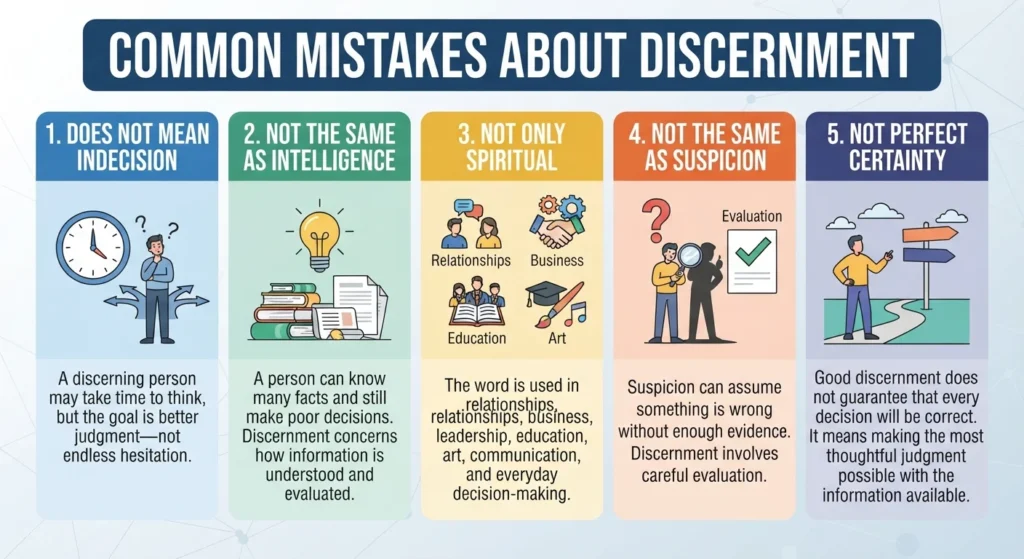
4. Discernment is not the same as suspicion
Suspicion can assume something is wrong without enough evidence. Discernment involves careful evaluation.
5. Discernment is not perfect certainty
Good discernment does not guarantee that every decision will be correct. It means making the most thoughtful judgment possible with the information available.
FAQ: Discernment Meaning
What is the true meaning of discernment?
Discernment is the ability to recognize meaningful differences, understand situations clearly, and make careful judgments.
What is a good example of discernment?
Checking someone’s claims, experience, actions, and evidence before deciding whether to trust their advice is a good example of discernment.
What is another word for discernment?
Depending on the context, related words include judgment, insight, wisdom, perception, prudence, and understanding. None is a perfect replacement in every sentence.
What does discernment mean in the Bible?
In the Bible, discernment is associated with wisdom, understanding, knowledge, and recognizing what is right or appropriate. Proverbs connects discernment with seeking wisdom and understanding.
What does God say about discernment?
Biblical passages such as Proverbs 2 and James 1:5 connect wisdom and understanding with actively seeking God and asking for wisdom.
What is spiritual discernment?
Spiritual discernment is the careful evaluation of spiritual matters, teachings, experiences, or claims within the beliefs and principles of a particular faith.
What is the gift of discernment?
In Christian teaching, the gift of discernment commonly refers to the spiritual gift associated with distinguishing between spirits in 1 Corinthians 12:10. It is more specific than ordinary good judgment.
Can discernment be learned?
Yes. Discernment can become stronger through experience, reflection, checking evidence, learning from mistakes, seeking wise counsel, and remaining open to new information.
Is discernment the same as intuition?
No. Intuition is an immediate feeling or impression. Discernment involves evaluating what you notice and considering evidence, context, and consequences before reaching a conclusion.
What does “pray for discernment” mean?
It generally means asking God for wisdom and clarity when trying to understand a situation or make a decision.
Final Takeaway
The discernment meaning is the ability to recognize important differences, understand what you are dealing with, and make a thoughtful judgment. It can help you evaluate advice, relationships, opportunities, information, and difficult decisions.
In the Bible and Christian contexts, discernment is closely connected with wisdom, understanding, spiritual evaluation, and seeking God’s guidance. Spiritual discernment, the gift of discernment, and the spirit of discernment can have more specific meanings depending on Christian tradition and context.
The simplest way to remember the word is:
Discernment means looking carefully, recognizing what matters, and choosing wisely.
Whether you are learning the word for everyday English, exploring discernment meaning in the Bible, understanding discernment meaning in a relationship, or looking into praying for discernment, the central idea remains careful and informed judgment.

Lucas Hayes is a content writer at Meanovia, specializing in slang, texting meanings, and internet phrases. He creates simple, clear, and engaging explanations of modern digital language 💬✨