

Someone can sound polite, helpful, or even patient while still being condescending. In simple terms, condescending means speaking or behaving as if you are more intelligent, capable, or important than someone else.
It often involves a patronizing attitude that makes another person feel talked down to or treated as inferior. For example, saying, “Don’t worry, I’ll explain it in a way you can understand,” can sound condescending if the speaker assumes the other person cannot understand the topic. Condescending behavior does not always include an obvious insult; it can appear through an overly simple explanation, dismissive comment, exaggerated patience, or patronizing tone.
This is why being condescending is different from simply being helpful, clear, or polite. If you’re searching for condescending meaning, this guide explains its definition, examples, tone, synonyms, and how it differs from being rude, patronizing, or genuinely helpful.
What Does Condescending Mean?
Condescending is an adjective describing a person, tone, comment, or behavior that suggests superiority toward someone else.
Simple definition
Condescending means treating someone as if you are better, smarter, or more important than they are.
For example:
“I’ll explain it slowly so you can understand.”
If the listener already understands the subject, this comment may sound condescending because it assumes the speaker is more capable or intelligent.
Cambridge defines condescending as treating someone as if you are more important or intelligent than them.
Condescending meaning for kids
For kids, you can explain the word this way:
Condescending means acting like you are better or smarter than another person and talking down to them.

For example:
“You probably don’t know how to do this, so let me show you.”
If the other person already knows how to do it, the comment can feel condescending.
Condescending meaning in one sentence
Condescending = talking down to someone because you act as though you are above them.
Being Condescending Meaning
Being condescending means behaving toward another person in a way that suggests you think you are superior to them.
This can happen through:
- Words
- Tone of voice
- Facial expressions
- Unnecessary explanations
- Mocking praise
- Dismissive comments
- Overly simple explanations
For example:
“Oh, you finally figured it out!”
Depending on the situation, this could be friendly teasing. But if someone says it after another person solves a simple problem, it may sound condescending because it suggests the achievement was surprising or beneath the speaker’s expectations.
Being condescending does not always mean someone deliberately wants to insult you. A person may believe they are helping while their wording makes the other person feel inferior.
That is why context, tone, relationship, and intention all matter.
What Does “You Are So Condescending” Mean?
When someone says “You are so condescending,” they are criticizing the way you are speaking or treating them.
In simple English, they mean:
“You are talking to me as if you are better or smarter than I am.”
For example:
Alex: “You clearly don’t understand the instructions. I’ll explain them again.”
Sam: “You are so condescending.”
Sam is not necessarily saying the explanation itself is wrong. Sam is objecting to the superior way Alex delivered it.
The phrase is normally negative because calling someone condescending suggests that their behavior makes others feel talked down to.
What Does “Sounds Condescending” Mean?
“Sounds condescending” means that someone’s words, tone, or message gives the impression that they are treating another person as inferior.
For example:
“Your message sounds condescending.”
This does not necessarily prove that the person intended to be insulting.
That distinction is especially important in text messages because readers cannot hear the writer’s voice or see their facial expression.
Compare these two sentences:
Helpful:
“If you’d like, I can walk you through the steps.”
Possibly condescending:
“Since you don’t seem to understand it, I’ll walk you through the steps.”
Both offer help, but the second sentence assumes the other person lacks understanding.
Very Condescending Meaning
If someone describes a person or comment as very condescending, they mean the sense of superiority is especially noticeable or strong.
For example:
“Her response was very condescending.”
This might mean she used dismissive language, an exaggeratedly patient tone, unnecessary correction, or a manner that made the other person feel inferior.
The word very does not create a different definition. It simply increases the intensity.
To Be Condescending Meaning
To be condescending means to communicate with someone as though you are above them.
For example:
“Don’t be condescending. I understand the problem.”
Here, the speaker believes the other person’s manner is unnecessarily superior.
A person can be knowledgeable, experienced, or confident without being condescending. The important issue is how that knowledge or confidence is directed toward another person.
IIRC Meaning: “If I Recall Correctly” and When to Use It
Condescending Meaning and Examples
Here are several everyday examples:
Example 1: Workplace
“Don’t worry about the technical details. They’re probably too complicated for you.”
This may be condescending because it assumes the listener cannot understand the subject.
Example 2: Friendship
“Aww, that’s cute. You actually thought that was a good idea?”
The phrase may sound patronizing if it is intended to make the friend’s idea seem childish.
Example 3: Texting
“I’ll explain it again, but I’ll use really simple words this time.”
This can sound condescending because it implies the other person is incapable of understanding normal language.
Example 4: Classroom
“Even you should be able to understand this one.”
The phrase insults the listener while presenting the speaker as superior.
Example 5: Customer service
“If you had read the instructions properly, you wouldn’t have this problem.”
This can be both rude and condescending because it blames the customer while implying intellectual carelessness.
How to Recognize a Condescending Tone
A single sentence does not always prove that someone is being condescending. Look at the whole situation.
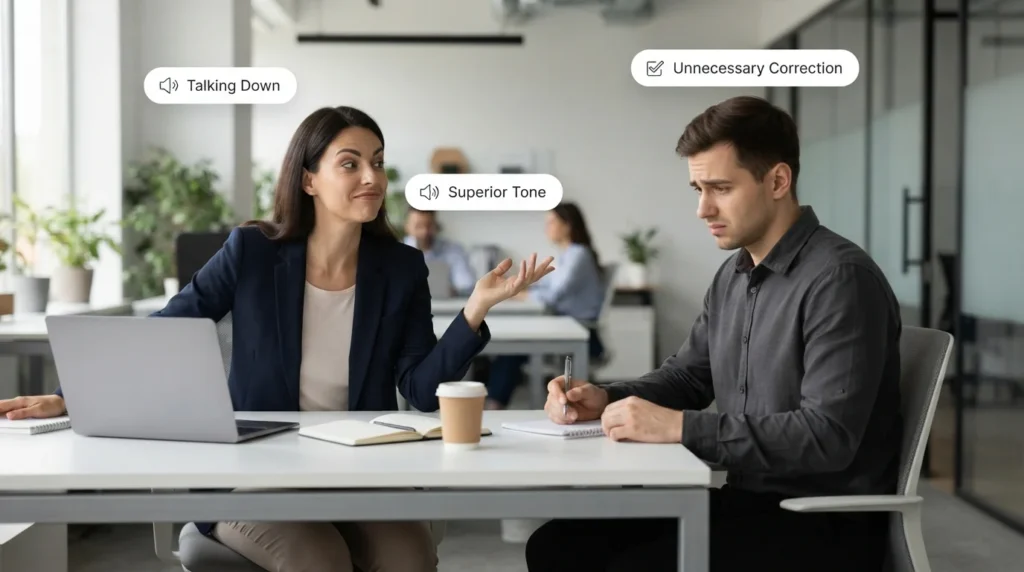
Common signs include:
- Explaining something the listener clearly already understands.
- Speaking to an adult like a child without a reason.
- Using “obviously” or “clearly” to dismiss another person’s understanding.
- Giving exaggerated praise for an ordinary task.
- Correcting someone mainly to display superiority.
- Making another person’s question seem stupid.
- Using fake patience or an overly sweet tone.
- Acting surprised when someone understands something.
- Dismissing another person’s experience or knowledge.
- Repeatedly emphasizing one’s own expertise.
The strongest clue is usually implied superiority.
For example:
“Here’s another way to look at it.”
is normally neutral.
But:
“I’ll try to explain it in a way you can actually understand.”
suggests that the speaker believes the listener lacks the ability to understand.
Condescending vs. Rude
Condescending and rude are related, but they are not identical.
Rude means impolite, disrespectful, or offensive.
Condescending specifically involves treating someone as though you are above them.
| Term | Main idea | Example |
|---|---|---|
| Condescending | Treating someone as inferior | “I’ll explain this slowly for you.” |
| Rude | Being impolite or disrespectful | “Go away.” |
| Arrogant | Having an exaggerated sense of importance | “Nobody knows this better than me.” |
| Sarcastic | Using mockery or saying something that may mean the opposite | “Brilliant job,” after an obvious mistake |
| Patronizing | Showing apparent kindness while implying superiority | “That’s adorable. You tried.” |
So, is condescending the same as rude?
No. A condescending comment can be rude, but rudeness does not always involve superiority.
Patronizing vs. Condescending Meaning
Patronizing and condescending are very close in meaning. Both can describe behavior that makes another person feel inferior.
The difference is mainly one of emphasis.
Condescending focuses strongly on the speaker’s attitude of superiority.
Patronizing can suggest a superior attitude hidden behind apparent kindness, helpfulness, or approval.
For example:
“Let me explain that.”
This is not automatically condescending.
But:
“Aww, don’t worry. I’ll explain that little concept to you.”
can sound patronizing or condescending.
Because the meanings overlap, the two words can often be used as synonyms, but they are not interchangeable in every sentence.
Is Condescending an Insult?
Condescending is a negative description, but it is not a swear word.
If someone says:
“Your tone is condescending.”
they are criticizing the person’s manner of communication.
It can certainly feel insulting because the statement suggests the person’s behavior shows superiority or disrespect.
So, is condescending an insult? It can function as a personal criticism, but the word itself is an adjective describing behavior or attitude.
What Is the Synonym of Condescending?
There is no single perfect synonym for every context.
Common related words include:
- Patronizing
- Superior
- Arrogant
- Pompous
- Haughty
- Overbearing
- Supercilious
- Snobbish
However, their meanings are slightly different.
For example, arrogant focuses on an exaggerated sense of self-importance, while condescending focuses on how that superiority is directed toward another person.
Condescending vs. Assertive
Being assertive does not mean being condescending.
An assertive person can be confident, direct, and clear while still respecting others.
Assertive:
“I disagree with that approach. Here’s another option.”
Condescending:
“You clearly don’t understand how this works.”
The first statement expresses disagreement.
The second attacks the other person’s knowledge or ability.
This difference matters in workplaces, classrooms, relationships, and leadership because confidence does not require putting someone else down.
Is Condescending the Same as Arrogant?
Not exactly.
Arrogant describes an inflated sense of one’s own importance, abilities, or status.
Condescending describes behavior toward another person that suggests superiority.
Someone can be arrogant without directly talking down to another person. Likewise, someone might make a single condescending comment without generally behaving arrogantly.
The two words overlap, but they focus on different parts of the behavior.
Rude and Condescending Meaning
When someone is described as rude and condescending, both parts of the phrase add information.
Rude describes disrespectful or impolite behavior.
Condescending explains that the disrespect also carries an attitude of superiority.
For example:
“That was a ridiculous question. Did you even read the instructions?”
This may be rude because it is insulting and condescending because it treats the other person’s ability or understanding with contempt.
Discernment Meaning: Seeing the Difference and Judging Wisely
Non-Condscending Meaning: What Does Non-Condescending Mean?
Non-condescending means communicating without talking down to another person or implying that you are superior.
For example:
Condescending:
“You probably won’t understand this, but…”
Non-condescending:
“Here’s another way to look at it.”
A non-condescending explanation can still be detailed, corrective, or instructional. The difference is that it respects the other person’s intelligence.
“I Associate Support With Condescending” Meaning
If someone says “I associate support with condescending” or says that support can feel condescending, they may be describing a situation where help feels like judgment.
For example:
“Don’t worry. You need me to help you with this.”
The speaker may intend to offer support, but the wording suggests that the other person is incapable.
A more respectful version would be:
“Would you like some help with this?”
The key difference is choice and respect. Support is not inherently condescending. It can become condescending when help is offered in a way that assumes weakness or superiority.
What Does Self-Condensing Mean?
The phrase “self-condescending” is not a common standard expression in everyday English.
If someone means putting themselves down, the more natural expression is usually self-deprecating.
For example:
“I’m terrible at everything.”
That is self-deprecating because the speaker is making themselves seem worse than they are.
So, if you searched for self condescending meaning, it is important not to treat “self-condescending” as a normal synonym for self-deprecating.
Condescending Meaning in Texting, TikTok, and Reddit

In texting, social media, TikTok comments, Reddit discussions, and other online conversations, condescending usually keeps its standard English meaning.
Someone may write:
“That reply was so condescending.”
or:
“Why are you being condescending?”
Online, tone is especially easy to misunderstand because readers cannot hear someone’s voice.
A short reply such as:
“Obviously.”
could be neutral in one context but condescending in another.
That is why online examples should always be interpreted in context rather than by one word alone.
Condescending Meaning in Urdu
A simple Urdu explanation of condescending is:
تحقیر آمیز انداز میں بات کرنا، کسی کو کمتر سمجھنا، یا برتری کے احساس کے ساتھ پیش آنا۔
In simple Urdu, it describes someone who talks to another person as if that person is less intelligent, less important, or inferior.
For example:
“وہ مجھ سے ایسے بات کر رہا تھا جیسے میں کچھ نہیں جانتا۔”
This conveys the idea of being treated in a condescending way.
Condescending Meaning in Farsi
In Farsi, condescending can be expressed with terms such as:
تحقیرآمیز
or
از بالا به پایین
The best translation depends on the sentence and context because condescending describes an attitude or manner of treating someone, not just one physical action.
Condescending Meaning AI: How AI Can Help Explain the Word
If you search “condescending meaning AI,” an AI explanation should still distinguish the word from related terms instead of treating every negative tone as condescending.
A useful AI-generated explanation should identify the central idea:
A condescending person communicates as though they are superior to another person.
For example, an AI assistant can compare:
“Let me explain.”
with:
“Let me explain because you clearly don’t understand.”
The second sentence contains a stronger suggestion of superiority.
Common Mistakes About Condescending
1. Thinking condescending simply means mean
Not every mean statement is condescending. Condescension specifically involves an implied sense of superiority.
2. Thinking confidence is condescending
Confidence, expertise, and direct communication are not automatically condescending.
3. Thinking every correction is condescending
A respectful correction can be helpful. The problem is the attitude behind an unnecessary or belittling correction.
4. Assuming intention is always obvious
Someone can sound condescending without deliberately trying to insult anyone.
5. Treating sarcasm and condescension as synonyms
Sarcasm can be condescending, but the two terms describe different things.
6. Assuming patronizing and condescending always mean exactly the same thing
They overlap strongly, but patronizing behavior can have a stronger sense of apparent kindness or approval.
How to Respond to Someone Who Is Condescending
You do not always need to argue when someone sounds condescending.
A calm response might be:
“I understand your point, but I’d appreciate it if you spoke to me without talking down to me.”
Or:
“You can explain the issue without assuming I don’t understand it.”
In a workplace:
“Could we focus on the issue rather than how it is being explained?”
These responses address the communication problem without adding unnecessary hostility.
FAQ
What does a condescending person mean?
A condescending person behaves as though they are more intelligent, important, knowledgeable, or capable than someone else.
What does being condescending mean?
It means treating or speaking to someone as though you are superior to them.
What does “you are so condescending” mean?
It means, “You are talking to me as if you are better or smarter than I am.”
What does “sounds condescending” mean?
It means something gives the impression that the speaker is talking down to another person.
Is condescending the same as rude?
No. Rudeness means being disrespectful or impolite, while condescension specifically involves an attitude of superiority.
What is the synonym of condescending?
Common related words include patronizing, superior, arrogant, pompous, haughty, overbearing, and supercilious, although they are not exact substitutes in every context.
Is condescending an insult?
It is a negative description of someone’s behavior or tone and can be used as a personal criticism, but it is not a swear word.
What does condescending mean in simple English?
It means talking down to someone as if you are better or smarter than they are.
What does condescending mean for kids?
It means acting like you are better or smarter than someone else and making them feel small.
What does condescending mean in texting?
It means using a text, reply, or message that makes the recipient feel as though the writer considers themselves superior.
What is the difference between patronizing and condescending?
Both suggest superiority. Condescending emphasizes talking down to someone, while patronizing can suggest superiority disguised as kindness or approval.
When is someone being condescending?
Someone may be being condescending when they unnecessarily simplify things, dismiss another person’s knowledge, use mocking praise, or communicate as though the other person is inferior.
Conclusion
The condescending meaning is straightforward: treating or speaking to someone as though you are better, smarter, or more important than they are.
The word can describe a tone, comment, attitude, facial expression, or pattern of behavior. You may encounter it in conversations, texting, workplace communication, social media, Reddit discussions, classrooms, and everyday relationships.
Remember the simplest definition:
Condescending = talking down to someone as if you are above them.
It is also useful to remember what the word does not automatically mean. Being confident is not condescending. Being knowledgeable is not condescending. Correcting a mistake is not automatically condescending. The key is whether the communication suggests superiority or treats the other person as inferior.
Understanding this distinction makes it easier to recognize condescending behavior, describe it accurately, and choose respectful language when communicating with others.

Lucas Hayes is a content writer at Meanovia, specializing in slang, texting meanings, and internet phrases. He creates simple, clear, and engaging explanations of modern digital language 💬✨