
Have you ever heard the word “barren” in a story, news report, geography lesson, or everyday conversation and wondered whether it only refers to empty land or something more? Barren (pronounced BAR-uhn) is an adjective that means unable to produce life, growth, or results.
It is most commonly used to describe land or soil that cannot grow plants, but it can also be used in a wider sense to describe situations, ideas, or periods of time that lack productivity, success, or development. Because of this, the meaning of barren changes slightly depending on whether it is used literally or figuratively.
In simple terms, barren means empty, lifeless, or unproductive. For example, barren land has no vegetation, while a barren landscape may appear dry, empty, and lifeless. In a figurative sense, people may refer to a barren effort or barren idea when something produces no useful outcome or result. The word usually carries a negative meaning, emphasizing lack of growth, fertility, or success.
If you’ve come across barren and want to fully understand how to use it correctly, this guide breaks down its meaning, pronunciation, origin, synonyms, antonyms, examples, and real-life usage in both literal and figurative contexts.
What Does Barren Mean?
At its core, barren describes something that cannot produce or support life, growth, offspring, crops, creativity, or positive results.
The word originally referred to infertile land, but today it is also used figuratively to describe emotions, ideas, relationships, periods of life, and artistic creativity.
For example:
- Barren land cannot grow crops or plants.
- A barren tree produces no fruit.
- A barren landscape has little or no vegetation.
- A barren imagination lacks fresh ideas.
- An emotionally barren relationship lacks warmth or affection.
Although these examples are different, they all express the same underlying idea: the absence of growth, life, or productivity.
Quick Summary
Barren = unable to produce life, growth, fertility, creativity, or meaningful results.
Barren Definition in Simple English
In simple English, barren means nothing can grow, develop, or succeed there.
Imagine a dry desert where no plants survive or a tree that never produces fruit. Both can be described as barren because they do not produce what is naturally expected.
The word can also describe things that are not physical.
For example:
- A person may feel emotionally barren after years of loneliness.
- A writer may experience a barren period with no new ideas.
- A conversation may seem barren if it produces no useful outcome.
In One Sentence
Barren means unable to produce life, growth, offspring, creativity, or useful results.
How to Pronounce Barren
Correct pronunciation helps you recognize and use the word confidently.
IPA Pronunciation
/ˈbær.ən/
Phonetic Spelling
BAIR-uhn
Syllables
Bar • ren
Stress Pattern
The first syllable (BAR) receives the primary stress.
Pronunciation Tip
Think of the word as:
Bear + uhn
Say it slowly:
BAIR — uhn
Listening to native speakers and repeating the word aloud a few times is the easiest way to master its pronunciation.
Part of Speech
Barren is primarily an adjective.
It describes a noun by showing that it lacks the ability to produce life, growth, fertility, or useful results.
Examples
- The barren valley received almost no rainfall.
- The old apple tree became barren.
- The team experienced a barren season with few victories.
Word Forms
| Word | Part of Speech | Meaning |
|---|---|---|
| Barren | Adjective | Unable to produce life, growth, or results |
| Barrenness | Noun | The condition of being barren |
| Barrenly (rare) | Adverb | In a barren manner (rarely used in modern English) |
Tip: The adjective barren is far more common than barrenly, which is rarely used in everyday writing.
Barren Meaning for Kids
For children, barren simply means a place or thing where nothing can grow or live.
Easy Definition
A barren place has very few or no plants, trees, or living things because the conditions are too harsh for growth.
Examples for Kids
- A dry desert with no trees is barren.
- Rocky ground where no flowers grow is barren.
- A fruit tree that produces no apples may be called barren.
- Land without grass or crops can be barren.
Easy Way to Remember
Think of a dry, cracked desert where nothing grows. That’s one of the easiest ways to remember the meaning of barren.
Is “Barren” a Negative Word?
Usually, yes. The word often suggests a lack of life, growth, hope, creativity, or productivity.
However, in subjects such as geography, environmental science, and agriculture, barren is simply a neutral descriptive term. It does not express judgment—it only describes the condition of the land.
For example:
- The island has a barren landscape. ✅ (Neutral description)
- The drought left the fields barren. ✅ (Factual description)
In emotional or literary contexts, however, barren often creates a feeling of loneliness, emptiness, or loss.
Is It Respectful to Call Someone “Barren”?
Historically, the word barren was often used to describe a woman who could not have children. Today, many people consider that wording old-fashioned or insensitive.
In modern English, especially in medical or everyday conversations, people usually prefer expressions such as:
- Infertile
- Experiencing infertility
- Unable to conceive
These terms are more respectful and medically accurate.
You’ll still encounter barren in older books, historical writing, religious texts, and classic literature, where it reflects the language of its time.
Barren Meaning in Different Contexts
The meaning of barren depends on how it is used, but the central idea always remains the same: something lacks the ability to produce life, growth, fertility, creativity, or meaningful results.
In one situation, barren may describe dry land where nothing grows. In another, it may describe a person’s emotions, a writer’s imagination, or an older term for infertility. Understanding the context helps you interpret the word correctly.
Quick Summary:
Although the examples differ, barren always suggests a lasting absence of growth, productivity, or vitality.
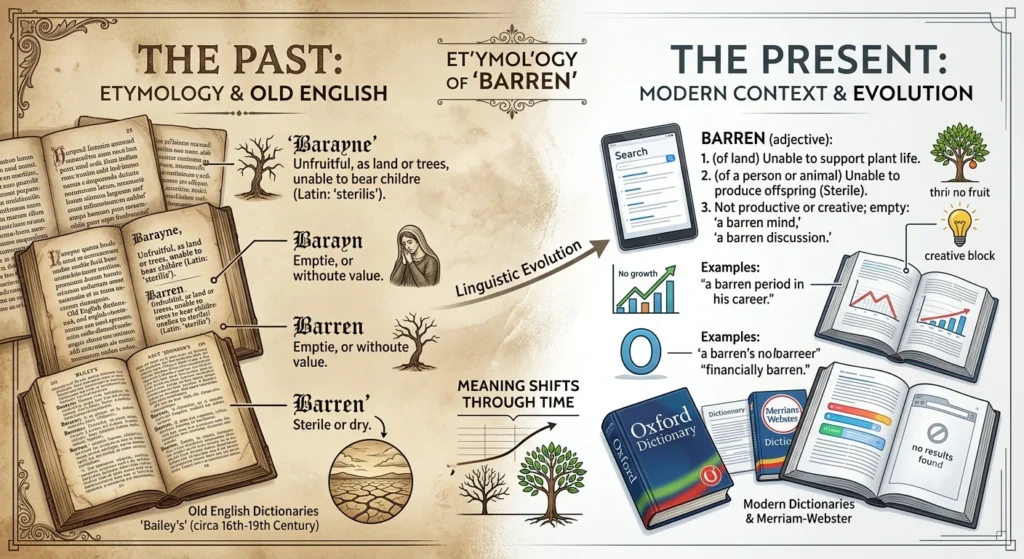
Barren Meaning in Geography
In geography, barren describes land that supports little or no plant life because of poor soil, limited rainfall, extreme temperatures, or rocky conditions.
A barren landscape may appear dry, empty, and lifeless, but it is still an important part of many natural ecosystems.
Common causes of barren land
- Poor soil quality
- Long periods of drought
- Desert climates
- Rocky terrain
- Extreme cold
- Volcanic activity
- Soil erosion
- Deforestation
Examples
- The explorers crossed a vast barren landscape.
- Years of drought left the farmland barren.
- The mountain slopes remained barren throughout the winter.
Quick Definition:
A barren area is land where plants struggle or fail to grow.
Sniffies Gay Meaning: What It Really Refers To Online
What Does Barren Land Mean?
A barren land is an area where crops, grass, trees, or other vegetation cannot grow successfully because the environment cannot support healthy plant life.
People often search for:
- What does barren land mean?
- Definition of barren land
- Land barren meaning
- Meaning of barren land
The answer is simple:
Barren land is land that cannot naturally support healthy plant growth.
Examples of barren places
- Deserts
- Salt flats
- Rocky mountains
- Volcanic fields
- Dry plains
- Polar regions with little vegetation
Can barren land become fertile again?
Sometimes, yes. Depending on the cause, land may recover through:
- irrigation
- soil restoration
- reforestation
- sustainable farming
- erosion control
Some naturally barren environments, such as deserts or high mountain regions, may always support only limited vegetation.
Barren Meaning in Human Context
Historically, barren referred to a person—usually a woman—who could not have children.
Today, this use is much less common because it can sound outdated or insensitive. Modern English generally prefers more respectful and medically accurate terms such as infertile or experiencing infertility.
Example
Older usage:
The queen was believed to be barren.
Modern usage:
The couple sought medical advice after experiencing infertility.
Quick Summary:
When referring to people, barren is mainly found in historical writing, literature, and religious texts rather than everyday conversation.
Barren Woman Meaning
The phrase barren woman traditionally means a woman who is unable to conceive or give birth to children.
In the past, the word appeared frequently in:
- historical records
- classic literature
- religious writings
- older medical texts
Today, many people consider the term emotionally harsh. Healthcare professionals usually prefer:
- infertile
- experiencing infertility
- unable to conceive
These alternatives are more respectful and reflect modern medical language.

Barren Meaning in Pregnancy
People often search for barren meaning in pregnancy or what does barren mean in pregnancy.
In this context, barren is an older expression describing someone who is unable to become pregnant naturally.
However, infertility is a medical condition with many possible causes and treatments. Being diagnosed with infertility does not necessarily mean pregnancy is impossible.
For this reason, healthcare providers usually avoid the word barren and use medically accurate terminology instead.
Barren Meaning in Biology
In biology, barren describes plants, animals, or living organisms that are unable to reproduce or produce offspring.
It can also describe plants that no longer produce flowers, seeds, or fruit.
Examples
- The old apple tree became barren after disease damaged its branches.
- Researchers studied why some plants became barren under harsh conditions.
Barren Meaning in Agriculture
Farmers use barren to describe soil or farmland that produces few or no healthy crops.
Land may become barren because of:
- nutrient depletion
- drought
- salinity
- pollution
- over-farming
- erosion
Example
Continuous drought gradually turned the fertile fields into barren farmland.
Emotionally Barren Meaning
An emotionally barren person, relationship, or environment lacks emotional warmth, empathy, affection, or meaningful connection.
This does not mean someone has no emotions. Instead, it suggests emotional distance or difficulty expressing care.
Examples
- Their relationship became emotionally barren after years of conflict.
- The novel portrays an emotionally barren childhood.
- He described the workplace as emotionally barren and uninspiring.
Morally Barren Meaning
A person who is morally barren lacks compassion, integrity, or strong ethical values.
This expression is most common in literature, philosophy, and opinion writing.
Example
The story portrays a morally barren society where greed outweighs kindness.
Barren Heart Meaning
A barren heart is a figurative expression describing emotional emptiness or an inability to love, trust, or connect with others.
Writers often use this phrase to symbolize:
- grief
- loneliness
- disappointment
- emotional exhaustion
- hopelessness
Example
Years of betrayal left him with a barren heart.
Barren Life Meaning
A barren life refers to a life that feels empty, unfulfilled, or lacking purpose, personal growth, or meaningful relationships.
It is a figurative expression commonly found in essays, novels, and poetry.
Example
Without dreams or close friendships, he believed he was living a barren life.
Barren Meaning in Creativity
Creative professionals often use barren to describe periods without ideas or inspiration.
Common expressions include:
- barren imagination
- barren creativity
- barren ideas
- barren writing period
- barren artistic phase
Example
After completing her novel, the author experienced a barren creative period before beginning her next book.
Rebuke Meaning: What It Really Means in Context
Barren Meaning in Literature
In literature, barren is often symbolic rather than literal.
Authors use it to represent:
- loneliness
- despair
- emotional isolation
- failure
- hopelessness
- spiritual emptiness
- loss
Literary Example
The barren hills reflected the villagers’ fading hope.
Here, the hills symbolize emotional despair rather than simply dry land.
Barren Meaning in the Bible
In the Bible, barren most commonly refers to women who were unable to have children. However, the word also carries deeper symbolic meanings.
Depending on the passage, it may represent:
- waiting
- faith
- hardship
- dependence on God
- hope
- restoration
- future blessing
Several biblical stories describe women who were initially barren but later became mothers, emphasizing themes of perseverance and divine promise.
Because of this, barren in Scripture often has both a literal meaning and a symbolic spiritual message.
Blessed Are the Barren Meaning
The phrase “blessed are the barren” is interpreted according to the surrounding passage.
Rather than celebrating infertility itself, the phrase points toward themes such as:
- compassion
- endurance
- hope
- God’s justice
- comfort during suffering
Understanding the broader biblical context is important before interpreting the phrase.
Barren Meaning in Hebrew
One of the primary Hebrew words translated as barren is עֲקָרָה (Aqarah), meaning a woman who has not borne children.
In the Hebrew Bible, barrenness often symbolizes both personal hardship and the hope of future blessing.
Barren Meaning in English
In modern English, barren has both literal and figurative meanings.
Literal Uses
- barren land
- barren soil
- barren tree
- barren desert
- barren landscape
Figurative Uses
- barren imagination
- barren relationship
- barren heart
- barren years
- barren discussion
- barren life
The intended meaning always depends on the context, but every use reflects the idea of little or no growth, productivity, or vitality
Word Forms of Barren
| Word | Part of Speech | Meaning | Example |
|---|---|---|---|
| Barren | Adjective | Unable to produce life, growth, or results | The land is barren. |
| Barrenness | Noun | The condition or state of being barren | Years of drought caused barrenness. |
| Barrenly (rare) | Adverb | In a barren manner | The valley stretched barrenly ahead. |
Note: The adverb barrenly is rare in modern English. Most writers prefer natural expressions such as across barren land or in a barren landscape.
Dictionary Definition
Barren means unable to produce, support, or sustain life, growth, fertility, creativity, offspring, or useful results.
Depending on the context, the word may describe:
- land
- soil
- deserts
- trees
- plants
- people (historical usage)
- ideas
- imagination
- relationships
- emotions
- literature
- biblical themes
Although the examples differ, the central meaning remains the same: a lasting absence of growth, productivity, or vitality.
Barren Synonyms
Several words have meanings similar to barren, but each is used in different situations. Choosing the right synonym makes your writing clearer and more natural.
| Synonym | Best Used For | How It Differs from Barren |
|---|---|---|
| Infertile | People, animals, soil | Scientific or medical term for inability to reproduce or produce crops |
| Sterile | Medicine, biology | Often means free from germs or unable to reproduce |
| Arid | Climate, deserts | Emphasizes extreme dryness rather than fertility |
| Desolate | Places, emotions | Focuses on loneliness, abandonment, or sadness |
| Unproductive | Work, business, ideas | Producing few or no useful results |
| Fruitless | Efforts, attempts | Producing no successful outcome |
| Lifeless | Places, art, descriptions | Lacking energy or signs of life |
| Bleak | Landscapes, situations | Cold, empty, or without hope |
| Unfruitful | Trees, discussions, ideas | Producing little benefit or success |
Which Synonym Should You Use?
- Land → barren, arid
- Medicine → infertile, sterile
- Ideas → unproductive, fruitless
- Literature → barren, desolate, bleak
- Emotions → barren, empty, desolate
Choosing the synonym that matches the context makes your writing more precise.
Barren Antonyms
The opposite of barren depends on what is being described.
| Antonym | Meaning | Example |
|---|---|---|
| Fertile | Able to produce crops or offspring | Fertile land supports healthy crops. |
| Productive | Producing useful results | It was a productive meeting. |
| Fruitful | Successful or rewarding | Their discussion was fruitful. |
| Lush | Rich with healthy vegetation | The valley became lush after the rainy season. |
| Abundant | Existing in large quantities | The forest has abundant wildlife. |
| Thriving | Growing successfully | A thriving ecosystem supports many species. |
| Prosperous | Successful and flourishing | The farming community became prosperous. |
Barren vs. Infertile
Although people often use these words interchangeably, they are not exactly the same.
| Barren | Infertile |
|---|---|
| Broader meaning | More specific meaning |
| Used literally and figuratively | Mostly medical, biological, or agricultural |
| Common in literature and descriptive writing | Common in healthcare and science |
| Can describe land, ideas, emotions, or people | Usually describes people, animals, or soil |
Examples
- The barren landscape stretched to the horizon.
- Doctors diagnosed the couple with infertility, not “barrenness.”
Writing Tip: In modern medical or everyday contexts, infertile is generally the preferred term when referring to people.
Barren vs. Sterile
These words overlap but have different meanings.
| Barren | Sterile |
|---|---|
| Unable to produce life or growth | Often means free from bacteria or unable to reproduce |
| Frequently used in literature | Common in medicine and science |
| Carries emotional or symbolic meaning | Usually technical or clinical |
Examples
- The doctor used sterile surgical equipment.
- The wildfire left the hillsides barren.
Barren vs. Arid
These words are closely related but describe different things.
| Barren | Arid |
|---|---|
| Focuses on lack of growth | Focuses on lack of rainfall |
| May describe land, ideas, or emotions | Usually describes climate |
| Can be literal or figurative | Mostly literal |
Examples
- Antarctica contains many barren landscapes.
- The Sahara has an arid climate.
A place may be arid because it receives little rain, while a place is barren because little or nothing grows there.
Barren vs. Desolate
Although these words create similar images, they emphasize different ideas.
| Barren | Desolate |
|---|---|
| Unable to support life or growth | Empty, lonely, abandoned, or depressing |
| Focuses on productivity | Focuses on isolation and atmosphere |
| Common for land | Common for places and emotions |
Examples
- The barren field produced no crops.
- The abandoned village looked desolate.
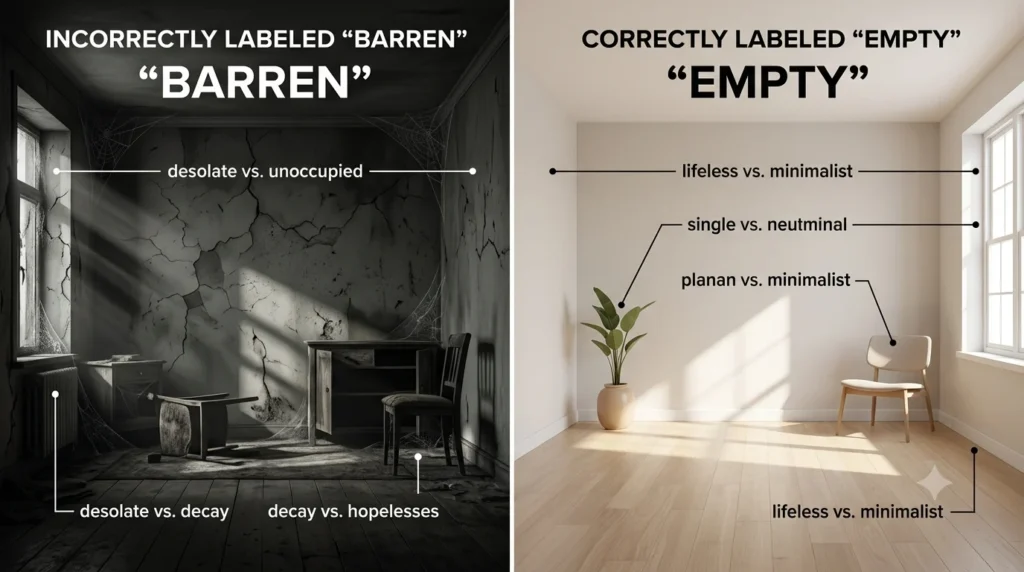
Barren vs. Empty
Many learners confuse these words, but they are not interchangeable.
| Barren | Empty |
|---|---|
| Suggests a lasting lack of life or productivity | Simply means nothing is inside |
| Often implies little future potential | Does not necessarily imply permanence |
| More descriptive and expressive | More general and neutral |
Examples
- The room was empty after everyone left.
- The valley remained barren for decades after the volcanic eruption.
Is “Barren” Always a Negative Word?
Usually, yes. The word often suggests:
- lack of life
- lack of growth
- infertility
- emotional emptiness
- creative block
- failure to produce
However, in subjects such as geography, agriculture, and environmental science, barren is simply a neutral descriptive term.
Can “Barren” Describe People?
Historically, yes. The word was used for someone—especially a woman—who could not have children.
Today, many people consider this wording outdated or insensitive. In modern English, especially in medical settings, expressions such as infertile, experiencing infertility, or unable to conceive are generally preferred.
Barren in Everyday English
In daily English, barren is used to describe something that lacks life, growth, creativity, or meaningful results.
It is more formal than words like empty or dry, and is often used in writing, storytelling, education, and descriptions.
Everyday Examples
- The garden looked barren after months without rain.
- His ideas felt barren during the meeting.
- The old house stood on a barren hill.
- Without practice, the mind becomes barren.
- The conversation turned barren quickly.
40+ Example Sentences of “Barren”
🌍 Nature & Geography
- The desert stretched into a vast barren land.
- Nothing grows in this barren soil.
- The explorers crossed a barren valley.
- The volcano left the land completely barren.
- The island is rocky and barren.
- Strong winds made the region barren.
- The frozen landscape remained barren year-round.
- The farmland turned barren after the drought.
- Years of erosion created a barren plain.
- The cliff tops looked cold and barren.
🌱 Agriculture & Environment
- Over-farming made the soil barren.
- The once fertile field is now barren.
- The land became barren due to pollution.
- Farmers struggled with barren crops.
- The drought left entire villages barren.
- Without irrigation, the fields remain barren.
- The region is trying to restore barren land.
🧠 Ideas & Creativity
- The writer faced a barren period.
- His imagination felt barren after stress.
- The discussion was barren and unproductive.
- She went through a barren creative phase.
- The project ended in barren results.
- A barren mind cannot create new ideas.
- The brainstorming session was barren.
❤️ Emotions & Relationships
- The relationship felt emotionally barren.
- Years of silence created a barren connection.
- He described his life as barren and lonely.
- The marriage became emotionally barren.
- Her heart felt barren after the loss.
- The house felt barren without laughter.
📚 Literature & Symbolism
- The author described a barren landscape.
- The poem uses barren imagery to show sadness.
- The story reflects a barren existence.
- The hills looked barren and lifeless.
- The setting symbolized a barren future.
🧍 Human Context (Historical Usage)
- The queen was said to be barren in old records.
- The woman remained barren in the story.
- Ancient texts often mention barren women.
- The couple struggled with barren years.
⚠️ Note: In modern English, this usage is considered sensitive and is usually replaced with “infertile.”
Common Collocations with Barren
These are natural word combinations used by native speakers.
🌍 Nature
- barren land
- barren desert
- barren landscape
- barren field
- barren soil
- barren terrain
- barren mountains
- barren region
- barren island
🧠 Abstract Uses
- barren imagination
- barren ideas
- barren mind
- barren creativity
- barren discussion
- barren effort
- barren result
❤️ Emotional Uses
- barren life
- barren heart
- barren relationship
- barren years
- barren existence
Common Phrases with “Barren”
- become barren
- remain barren
- turn barren
- leave barren
- render barren
- appear barren
- seem barren
- lie barren
- stretch barren
Example Usage
- The land became barren after the fire.
- The fields remain barren due to drought.
- Pollution can render soil barren.
- The valley lies barren in winter.
Common Mistakes with “Barren”
❌ Mistake 1: Using it like “empty”
Wrong: The room is barren. (if just empty temporarily)
✔ Correct: The room is empty.
👉 Use barren only when something lacks life or productivity in a deeper sense.
❌ Mistake 2: Using it for short-term situations
Wrong: The park is barren today.
✔ Better: The park is quiet today.
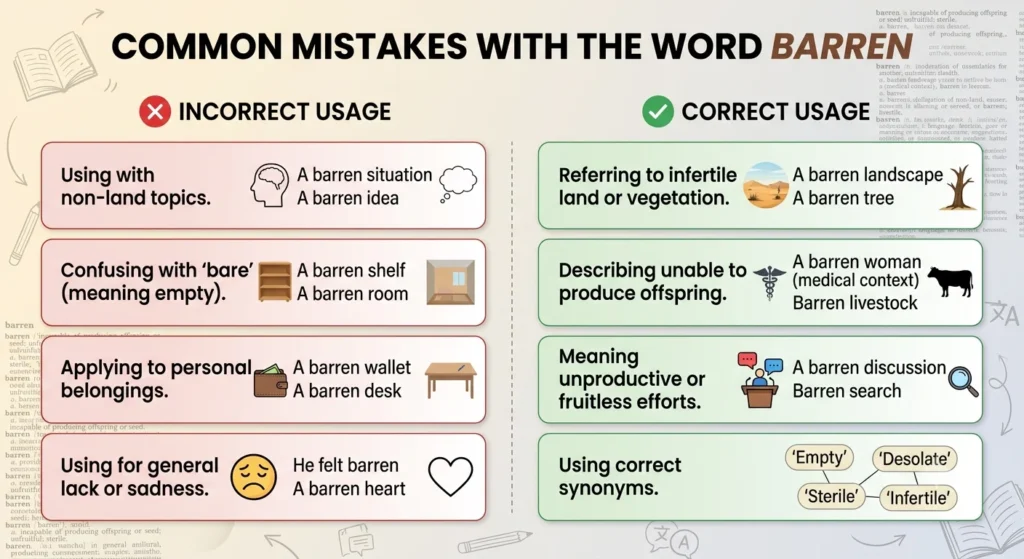
❌ Mistake 3: Using it casually for people
Wrong: He is barren.
✔ Better: He is infertile / experiencing infertility (medical context).
❌ Mistake 4: Overusing in writing
Too many “barren” phrases can make writing repetitive. Use synonyms like:
- desolate
- arid
- lifeless
- unproductive
How to Use “Barren” Correctly
✔ Use it when describing long-term lack of growth
✔ Use it in descriptive or formal writing
✔ Use it for land, ideas, emotions, or symbolic meaning
✔ Avoid using it casually for people in modern contexts
FAQ
1. What is the simple meaning of barren?
Barren means something that cannot produce life, growth, or useful results. It is commonly used for land, ideas, emotions, or creativity.
2. What does barren land mean?
Barren land refers to land where plants, crops, or trees cannot grow due to poor soil, lack of water, extreme weather, or environmental conditions.
3. What is the meaning of barren in humans?
In humans, barren is an older term that refers to someone who cannot have children. Today, the preferred word is infertile or experiencing infertility.
4. Is barren a negative word?
Yes, in most contexts it has a negative meaning because it suggests emptiness, lack of growth, or absence of productivity. However, in geography or science, it can be neutral.
5. What is the difference between barren and infertile?
- Barren → broader, used in literature, land, emotions, ideas
- Infertile → medical/scientific term, mainly for humans or animals
6. Can barren describe emotions?
Yes. For example:
- barren heart → emotional emptiness
- barren life → lack of purpose or happiness
- barren relationship → lack of emotional connection
7. What is the opposite of barren?
Common opposites include:
- fertile
- productive
- lush
- fruitful
- thriving
8. Is barren still used in modern English?
Yes. It is still commonly used in:
- geography
- literature
- environmental science
- symbolic writing
But it is less commonly used for people in modern conversation.
Conclusion
In simple terms, barren describes something that cannot produce life, growth, or useful results. It is commonly used for land, soil, landscapes, and trees, but it also has powerful figurative meanings in emotions, creativity, relationships, and literature.
While the word originally referred to infertility in humans, modern English prefers more respectful terms like “infertile.” Understanding the context is essential to using the word correctly.
Whether in geography, writing, or everyday language, barren always highlights absence, emptiness, or lack of productivity. Learning its correct usage helps you read, write, and understand English more clearly and confidently in real-life situations.

Lucas Hayes is a content writer at Meanovia, specializing in slang, texting meanings, and internet phrases. He creates simple, clear, and engaging explanations of modern digital language 💬✨