Ever heard someone say “Let’s discuss this vis-à-vis last quarter’s results” and wondered what it really means?
You’re not alone — “vis-à-vis” is one of those elegant French phrases that still pops up in business meetings, literature, and casual conversation.
In this guide, we’ll cover:
The definition of “vis-à-vis” Its French origin and English adaptation
How it’s used in different contexts (business, writing, everyday talk)
Examples, similar terms, and FAQs to help you master its use
📘 What Does “Vis-à-Vis” Mean?
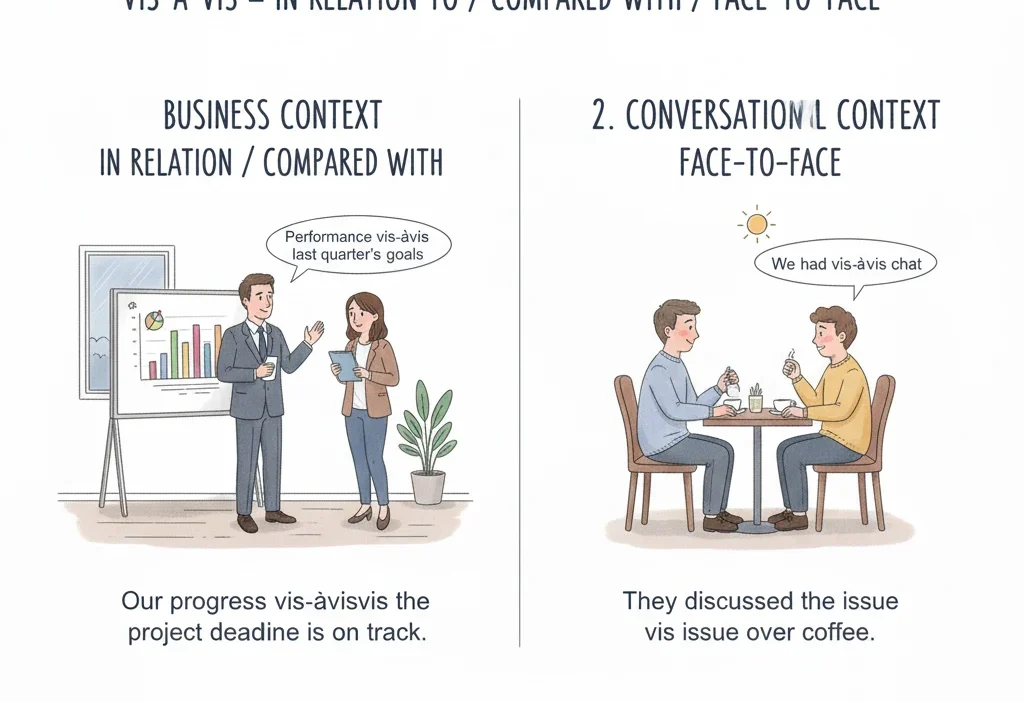
“Vis-à-vis” means “in relation to,” “compared with,” or “opposite to” — depending on the context.
It’s a French phrase that literally translates to “face to face,” and it’s used in formal writing, business discussions, and comparative analysis.
✅ Definition (for featured snippet):
Vis-à-vis means “in relation to” or “as compared with.” It’s often used to express a relationship or comparison between two subjects.
🕰️ Origin and Popularity
The phrase “vis-à-vis” comes directly from French, where it literally means “face to face.”
It entered the English language in the 18th century, originally describing physical position — two people or things facing each other.
Over time, it evolved to carry figurative meanings such as “in comparison to” or “regarding.”
✨ Timeline Snapshot
- 1700s: Borrowed into English from French, meaning “face to face.”
- 1800s: Gained use in formal writing and diplomacy to mean “in relation to.”
- Modern day: Common in academic, legal, and corporate English.
The phrase remains popular because it adds a refined, professional tone — especially in writing, discussions, and media.
🧩 “Vis-à-Vis” Meaning in Different Contexts
The meaning of “vis-à-vis” slightly shifts based on where it’s used. Here’s how it works in various settings:
💼 In Business and Formal Writing
Used to compare performance, strategies, or results.
Example: “The company’s revenue increased vis-à-vis last year’s figures.”
Meaning: Compared to last year.
🗣️ In Everyday Conversation
Used informally to mean “regarding” or “in relation to.”
Example: “I’d like to talk to you vis-à-vis the project updates.”
Meaning: About or concerning.
✍️ In Academic or Analytical Contexts
Used when discussing relationships between concepts or ideas.
Example: “The study explores human behavior vis-à-vis social structures.”
Meaning: In relation to social structures.
| Context | Meaning of “Vis-à-Vis” | Example Sentence |
| Business | Compared with | “Profits rose vis-à-vis last year.” |
| Conversation | Concerning / Regarding | “We need to meet vis-à-vis your proposal.” |
| Academia | In relation to | “Cultural identity vis-à-vis globalization.” |
💬 Examples of “Vis-à-Vis” in Sentences
Here are some real-world examples to help you understand how to use the phrase naturally:
Example 1:
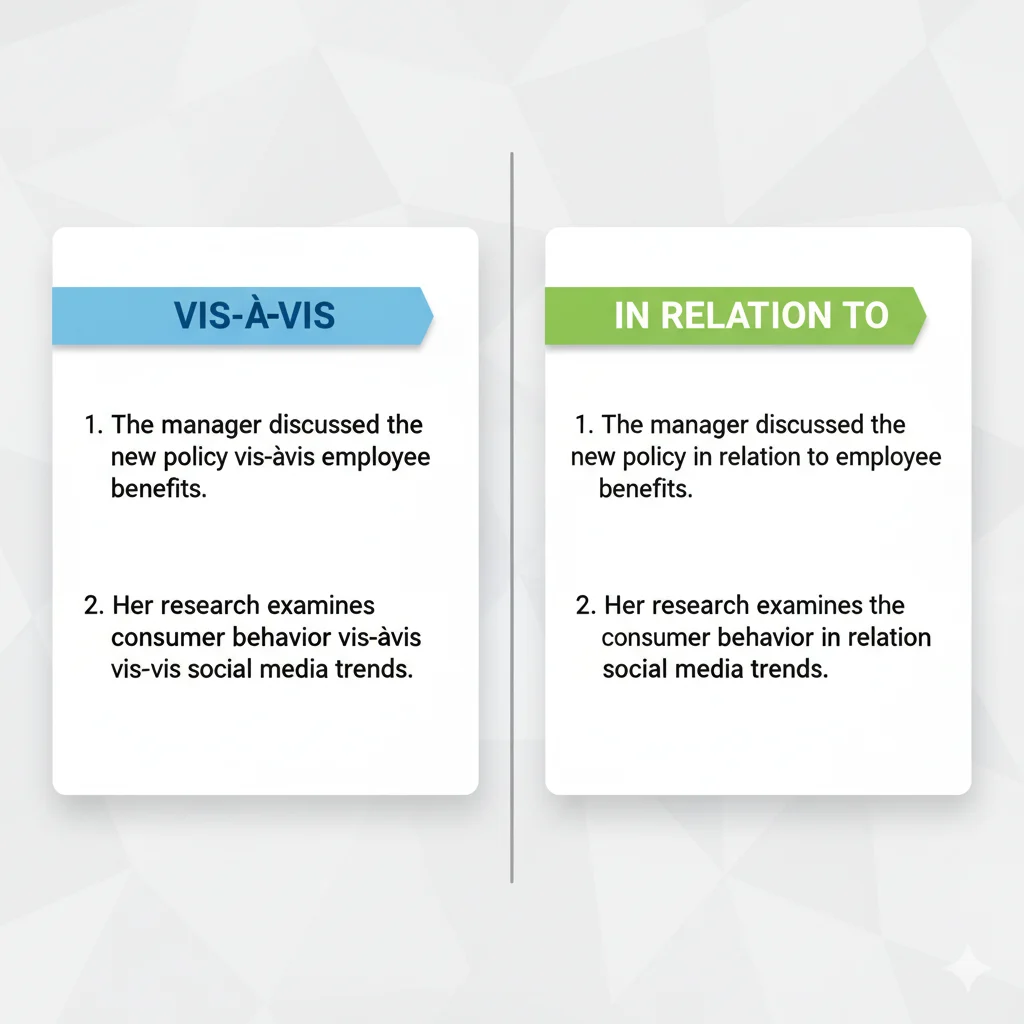
“The team discussed their goals vis-à-vis the company’s mission.”
Example 2:
“Her salary is higher vis-à-vis her colleagues’ due to experience.”
Example 3:
“We need to analyze these numbers vis-à-vis our competitors.”
Example 4 (informal use):
“I wanted to talk to you vis-à-vis our travel plans next month.”
Example 5 (academic tone):
“The paper examines environmental policy vis-à-vis economic growth.”
🔍 Similar or Related Terms
To expand your vocabulary, here are similar expressions that can replace or clarify “vis-à-vis” in different situations:
| Term / Phrase | Meaning | Example |
| In relation to | About or regarding | “We discussed the plan in relation to budget limits.” |
| Compared with | Evaluating two things | “Sales increased compared with last year.” |
| Regarding | Concerning a topic | “Regarding your inquiry, we’ll respond soon.” |
| With respect to | Formal version of “about” | “With respect to the new policy, changes are pending.” |
| Concerning | Dealing with a topic | “I’m writing concerning your recent application.” |
✅ How to Use “Vis-à-Vis” Correctly
Do’s
- ✅ Use it in formal or professional writing (business, academic, or legal).
- ✅ Use it to show comparison or relationship between subjects.
- ✅ Use proper hyphens and accents (vis-à-vis) for formal contexts.
Don’ts
- ❌ Don’t use it casually in text messages or social media slang.
- ❌ Avoid using it when “about” or “regarding” would sound simpler in everyday speech.
- ❌ Don’t confuse it with “face-to-face meeting” — though related, the phrase is often metaphorical now.
⚠️ Common Mistakes or Misinterpretations
- Mistake: Thinking “vis-à-vis” only means “face to face.”
→ Reality: It also means “in relation to” or “compared with.” - Mistake: Using it without hyphens or accents (“vis a vis”).
→ Reality: The correct spelling is “vis-à-vis.” - Mistake: Using it in casual texting or slang.
→ Reality: It’s a formal expression, best suited for writing or business speech. - Mistake: Confusing it with “vice versa.”
→ Reality: “Vice versa” means “the other way around,” not “in comparison to.”
❓ FAQ Section
1. What does “vis-à-vis” mean in English?
It means “in relation to” or “compared with.” It’s used to discuss a relationship or comparison between two things.
2. Is “vis-à-vis” French or English?
It’s originally a French phrase, but it’s now fully adopted into formal English usage.
3. Can you say “vis-à-vis” in casual conversation?
Yes, but it sounds formal. It’s more common in writing or professional discussions than in everyday chat.
4. What’s the difference between “vis-à-vis” and “vice versa”?
“Vis-à-vis” means “in comparison to” or “regarding,” while “vice versa” means “the opposite way around.”
5. Is “vis-à-vis” used in business English?
Absolutely. It’s frequently used in reports, meetings, and financial discussions to compare performance or outcomes.
6. How do you pronounce “vis-à-vis”?
It’s pronounced vee-zah-vee, with emphasis on the last syllable.
🧭 Conclusion
In summary, “vis-à-vis” is a refined phrase that means “in relation to”, “compared with”, or “opposite.”
It adds precision and formality to your writing — whether you’re discussing business metrics, academic ideas, or professional relationships.
Now that you know what “vis-à-vis” means, you can use it confidently in the right contexts — and impress your colleagues with your clear, elegant communication.
✨ Keep exploring our site for more word meanings, linguistic origins, and usage tips that make your English shine!

Evie Wyld is a word-meaning specialist at Meanovia.com. She simplifies complex words, phrases, and language trends, helping readers quickly grasp the exact meaning behind every term in a clear and approachable way.