
Ever heard someone describe a person as “quirky” and wondered what that really means? Maybe a friend said, “You’ve got a quirky personality,” and you weren’t sure whether to take it as a compliment or not.
Simply put, “quirky” means something or someone that is charmingly unusual, eccentric, or unique in a positive way.
In this article, we’ll explore the full quirky meaning, its origin, different contexts, and how to use it correctly in daily conversations. You’ll also see real-life examples, related terms, and FAQs to help you sound confident when using this popular word.
💡 What Does “Quirky” Mean?
“Quirky” means unusual, different in an interesting or charming way. It describes something or someone who doesn’t follow typical norms but stands out with their unique traits or habits.

It’s not slang — it’s a descriptive adjective often used in everyday English, social media captions, and personality discussions.
Example:
“She has a quirky sense of humor that makes everyone laugh.”
🕰️ Origin and Popularity
The word “quirky” comes from the older English word “quirk,” which originally meant a sudden twist or odd habit. The term began appearing in the 16th century, but its modern meaning — something charmingly odd — became popular in the 20th century.
In pop culture, “quirky” rose to fame in the 2000s through indie films and shows like New Girl, where the main character’s offbeat personality was celebrated as endearing rather than weird.
Today, it’s widely used on social media, dating apps, and lifestyle blogs to describe individuality, creativity, and playful differences.
| Era | Usage | Example |
|---|---|---|
| 1500s | “Quirk” meaning twist or odd habit | “A quirk of fate” |
| 1900s | “Quirky” meaning unconventional or eccentric | “A quirky writer” |
| 2000s–Now | Celebrating individuality | “Her quirky fashion sense stands out on Instagram.” |
🌈 Quirky Meaning in Different Contexts
The meaning of “quirky” slightly changes depending on where and how it’s used.
✉️ In Texting or Chats
Used to describe someone’s funny, weird-but-cool behavior.
“You’re so quirky 😂 — only you would bring a cactus to a party.”
📸 On Instagram or TikTok
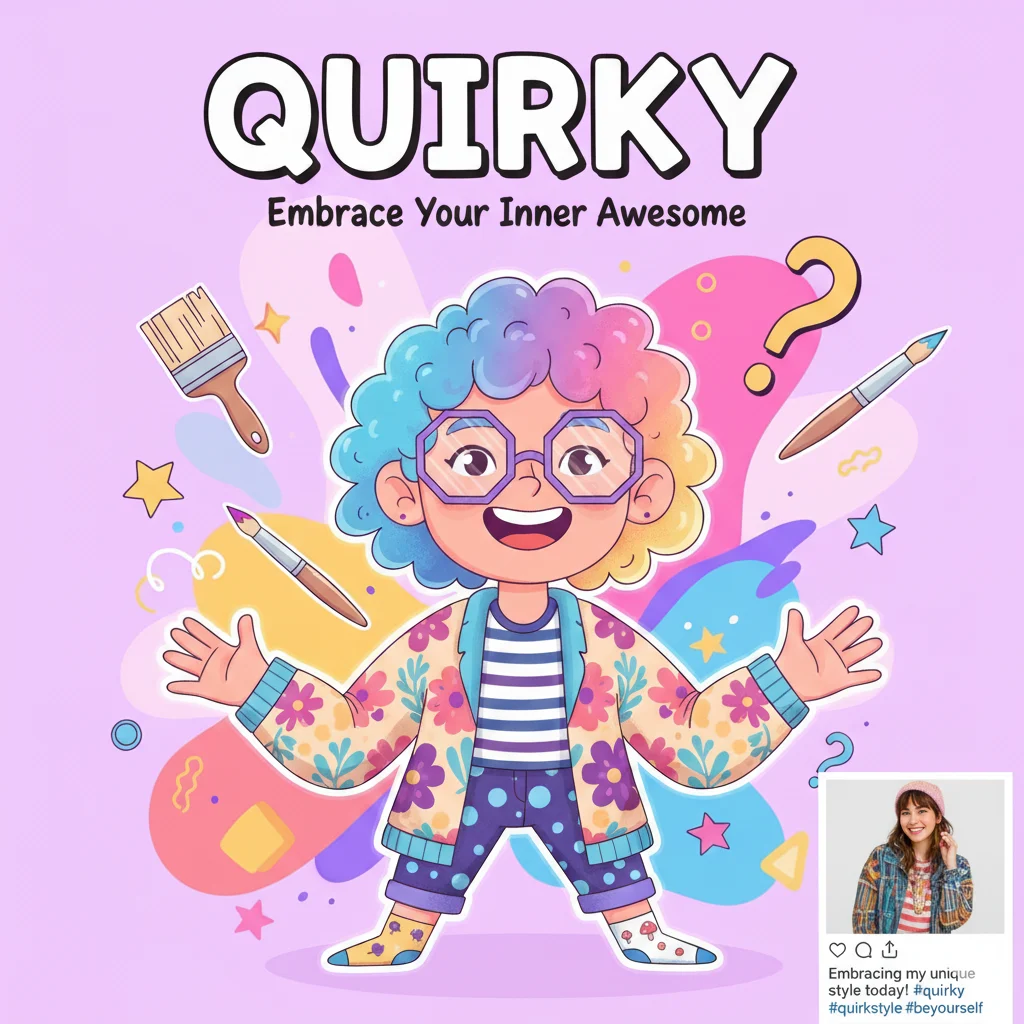
Commonly used in captions, bios, and hashtags like #quirkyvibes or #quirkyfashion, showing off individuality, creativity, or aesthetic.
“My quirky outfit of the day 🌈✨”
💼 In Business or Branding
Companies use “quirky” to describe unique, creative, or playful branding.
“Our café is known for its quirky decor and handmade mugs.”
| Platform | Meaning | Tone |
|---|---|---|
| Texting | Funny or unusual personality | Casual, playful |
| Unique, aesthetic, offbeat | Trendy, confident | |
| Business | Creative and unconventional | Professional yet approachable |
🗣️ Examples of “Quirky” in Conversations
Example 1 (Texting):
Friend 1: “Why are you wearing two different shoes?”
Friend 2: “Because I’m quirky like that 😎.”
Example 2 (Compliment):
“I love your quirky sense of humor — it’s refreshing!”
Example 3 (In a review):
“The café had a quirky vibe with mismatched chairs and colorful walls.”
Example 4 (In formal writing):
“The artist is known for her quirky yet emotionally deep paintings.”
🔄 Similar or Related Terms
| Term | Meaning | Difference |
|---|---|---|
| Eccentric | Odd or unconventional behavior | Can sound more extreme than “quirky” |
| Whimsical | Playfully fanciful or imaginative | More dreamy and artistic |
| Unique | One of a kind | Neutral tone, less playful |
| Offbeat | Not following traditional styles | Similar but more casual |
| Idiosyncratic | Peculiar to an individual | More formal and academic |
These words overlap but “quirky” usually has the warmest, most positive connotation — it’s weird in a good way.
✅ How to Use “Quirky” Correctly
When used right, “quirky” can be a huge compliment. But context matters!
Do’s
✅ Use it to describe something or someone delightfully unusual.
✅ Use it in creative writing, captions, or compliments.
✅ Pair it with positive words like funny, charming, or creative.
Don’ts
❌ Don’t use it sarcastically if you’re not close to the person.
❌ Avoid using it for something inappropriate or offensive.
Example Sentences:
- ✅ “Her quirky apartment decor makes everyone smile.”
- ❌ “That was a quirky mistake.” (wrong tone)
⚠️ Common Mistakes or Misinterpretations
- Mistake 1: Thinking “quirky” means weird in a bad way.
➤ It’s actually a positive term, celebrating uniqueness. - Mistake 2: Overusing it to describe everything “different.”
➤ Use it for traits that are distinct yet likable. - Mistake 3: Confusing “quirky” with “funny.”
➤ “Funny” is about humor; “quirky” is about character and charm.
❓ FAQ: Quirky Meaning Explained
1. What does “quirky” mean in a person?
It means someone has a unique personality or habits that make them stand out in an interesting, positive way.
2. Is “quirky” a compliment or an insult?
Usually a compliment. It celebrates originality, creativity, and individuality — unless said sarcastically.
3. What does “quirky” mean in fashion?
It describes unusual or creative styles, like mixing bright colors, vintage pieces, or mismatched patterns.
4. Can you use “quirky” in formal writing?
Yes, but carefully. In professional settings, use it for brands or artists — “Her quirky writing style attracts readers.”
5. What’s the difference between “quirky” and “weird”?
“Weird” can sound negative or strange, while “quirky” is more positive and endearing.
6. Where is “quirky” most used today?
On social media, blogs, and creative industries — describing people, outfits, brands, or designs that break norms with confidence.
🌻 Conclusion
The word “quirky” celebrates individuality, creativity, and the beauty of being different. Whether it’s a quirky sense of humor, a quirky home design, or a quirky personality, it reflects uniqueness in the best way possible.
Now that you know the full quirky meaning, you’ll never mistake it again! Embrace your quirks — they’re what make you, you.
✨ Keep exploring our site for more fun and insightful meanings behind everyday words and internet phrases!