Ever heard someone mention “perpetuity” in a legal document, financial contract, or historical context and wondered what it really means? 🤔
You’re not alone. The term “perpetuity” often shows up in professional, academic, and financial discussions — but it’s one of those words that sounds more complex than it really is.
In this guide, we’ll break down:
✅ The definition of perpetuity
✅ Its origin and usage in business, law, and everyday language
✅ Examples of perpetuity in real-world contexts
✅ Similar terms, FAQs, and how to use it correctly
💬 What Does Perpetuity Mean?
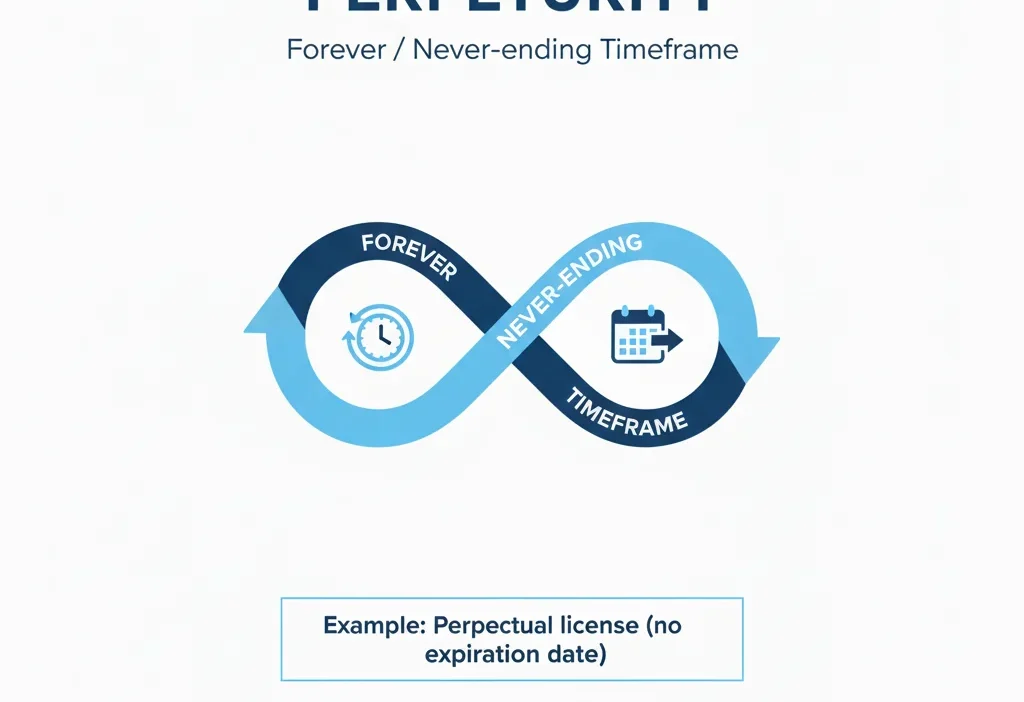
Perpetuity means something that lasts forever or indefinitely without end.
It’s commonly used in finance, law, and everyday English to describe ongoing situations or agreements that continue forever — or at least are intended to.
Example:
“The scholarship fund was established in perpetuity to support future generations.”
🕰️ Origin and Popularity
The word “perpetuity” comes from the Latin word “perpetuitas,” which means continuity or everlasting duration.
It has been used in the English language since the 15th century, mostly in formal and legal contexts.
Over time, “perpetuity” became a staple term in:
- Law: Describing rights or ownership lasting indefinitely.
- Finance: Referring to payments or cash flows that continue forever.
- General English: To describe anything meant to last permanently.
📈 Fun Fact: The concept of perpetuity is key in business valuations and financial models that estimate the value of an investment that provides endless returns.

THOT Meaning: The Tiny Detail Everyone Gets Wrong
🌐 Perpetuity Meaning in Different Contexts
| Context | Meaning / Usage | Example |
| Finance | Refers to a series of infinite payments at regular intervals. | “A bond paying $1,000 every year forever is called a perpetuity.” |
| Law | Refers to ownership or rights that never expire. | “The land was granted to the foundation in perpetuity.” |
| Everyday Use | Means something lasting forever or indefinitely. | “Their love for art continues in perpetuity.” |
💭 Examples of Perpetuity in Conversations
1. Everyday English:
A: “How long is this memorial going to last?”
B: “It’s set up in perpetuity — it’ll always be there.”
2. In Business:
“The endowment will generate funds in perpetuity to support university research.”
3. In Law:
“The property rights are transferred to the trust in perpetuity.”
4. In Finance:
“Investors often calculate the present value of a perpetuity to estimate long-term returns.”

🔁 Similar or Related Terms
| Term | Meaning |
| Eternity | Timeless existence; forever without end. |
| Forever | Continuously, with no end. |
| Infinity | Limitless or endless time, space, or number. |
| Endowment | A financial fund designed to last indefinitely. |
| Lifetime | Duration of a person or object’s life (not infinite). |
🧠 How to Use Perpetuity Correctly
✅ Do’s:
- Use it in formal or professional settings.
- Ideal for contracts, financial documents, or academic writing.
- Great when describing permanent or ongoing situations.
❌ Don’ts:
- Avoid using it casually (e.g., in text messages or slang).
- Don’t confuse it with “forever” when referring to informal timeframes.
Example:
✅ “The artist’s legacy will live on in perpetuity.”
❌ “I’ll wait for you in perpetuity 😂.”
⚠️ Common Mistakes or Misinterpretations
🚫 Mistake 1: Thinking it means “for a very long time.”
👉 Correction: It actually means forever, not just “a long time.”
🚫 Mistake 2: Using it casually.
👉 Correction: It’s best reserved for formal writing or technical contexts.
🚫 Mistake 3: Mixing it up with “perpetual.”
👉 Difference: “Perpetual” is an adjective (e.g., “perpetual motion”), while “perpetuity” is a noun (e.g., “in perpetuity”).
❓ FAQ Section
1. What does perpetuity mean in simple terms?
It means something that lasts forever or continues indefinitely without an end.
2. What does in perpetuity mean legally?
It means a right, contract, or agreement is valid forever — with no expiration date.
3. What is an example of a perpetuity in finance?
A government bond or trust that pays interest every year forever is a financial perpetuity.
4. What’s the difference between perpetual and perpetuity?
“Perpetual” is an adjective (describing), while “perpetuity” is a noun (the state of lasting forever).
5. Is perpetuity used in daily conversation?
Rarely. It’s mostly found in legal, academic, or financial writing, not casual chats.
6. Can something really exist in perpetuity?
Practically, few things last forever — but the term is used to express intention or conceptual permanence.
🏁 Conclusion
So, what does perpetuity mean?
In simple terms, it describes something meant to last forever — whether it’s a financial payment, a legal right, or a legacy that endures through generations.
From historical laws to modern finance, perpetuity represents the idea of continuity and permanence — something that doesn’t fade away.
Now that you know what perpetuity means, you’ll recognize it wherever it appears — in contracts, speeches, or even timeless works of art. 💼✨
Keep exploring our site for more clear explanations of everyday and professional terms! 📚

Evie Wyld is a word-meaning specialist at Meanovia.com. She simplifies complex words, phrases, and language trends, helping readers quickly grasp the exact meaning behind every term in a clear and approachable way.