Have you ever heard the word perdition in a sermon, poem, or dramatic speech and wondered what it actually means?
Quick answer: Perdition means eternal ruin, destruction, or damnation. It is most commonly used in religious contexts to describe spiritual loss or condemnation.
The word comes from the Latin perditio, meaning “destruction” or “utter loss.” In English, perdition often appears in biblical passages and theological discussions, where it refers to a state of final punishment or separation from salvation.
Perdition is a noun meaning eternal destruction, spiritual ruin, or complete loss. The perdition definition in English refers to a state of final condemnation or irreversible downfall, especially in religious contexts.
If you searched for “perdition meaning,” you likely want to know:
- Whether it specifically means hell
- How it is used in the Bible
- Whether it can be used outside religion
- And how to use it correctly in a sentence
Below, you’ll find a clear definition, pronunciation guide, biblical references, synonyms, and modern usage examples — so you understand both its religious depth and general meaning.
💭 What Does “Perdition” Mean?
“Perdition” means complete and eternal loss, destruction, or damnation — especially the state of a soul condemned to hell.
It’s a noun and primarily used in religious, literary, or moral contexts, not as slang or casual speech. The term conveys a sense of spiritual ruin or ultimate downfall.
In simple terms, “perdition” refers to eternal punishment or total ruin, often linked to moral or spiritual failure.
🔊 How to Pronounce “Perdition”
“Perdition” is pronounced:
per-DISH-uhn
Phonetic spelling: /pərˈdɪʃən/
The stress falls on the second syllable (“dish”).
📜 Origin and Popularity
The word “perdition” has deep historical and religious roots. It comes from the Latin word perdere, meaning “to destroy” or “to lose,” which evolved into Middle English through Old French (perdicioun).
In Greek biblical texts, perdition is often translated from the word “apoleia,” meaning destruction or ruin. In Hebrew contexts, it relates to terms implying loss or annihilation. While the English word comes from Latin, its theological meaning developed through Greek scripture.
🕰️ Timeline Snapshot:
- Biblical Era: First appeared in early Christian texts to describe the fate of the damned.
- 14th Century: Used in Old English literature and sermons.
- Modern Usage: Common in religious discussions, poetry, and historical fiction.
It became widely recognized due to the Bible — particularly in phrases like “the son of perdition” (John 17:12) and “the road to perdition,” symbolizing moral decline or inevitable ruin.
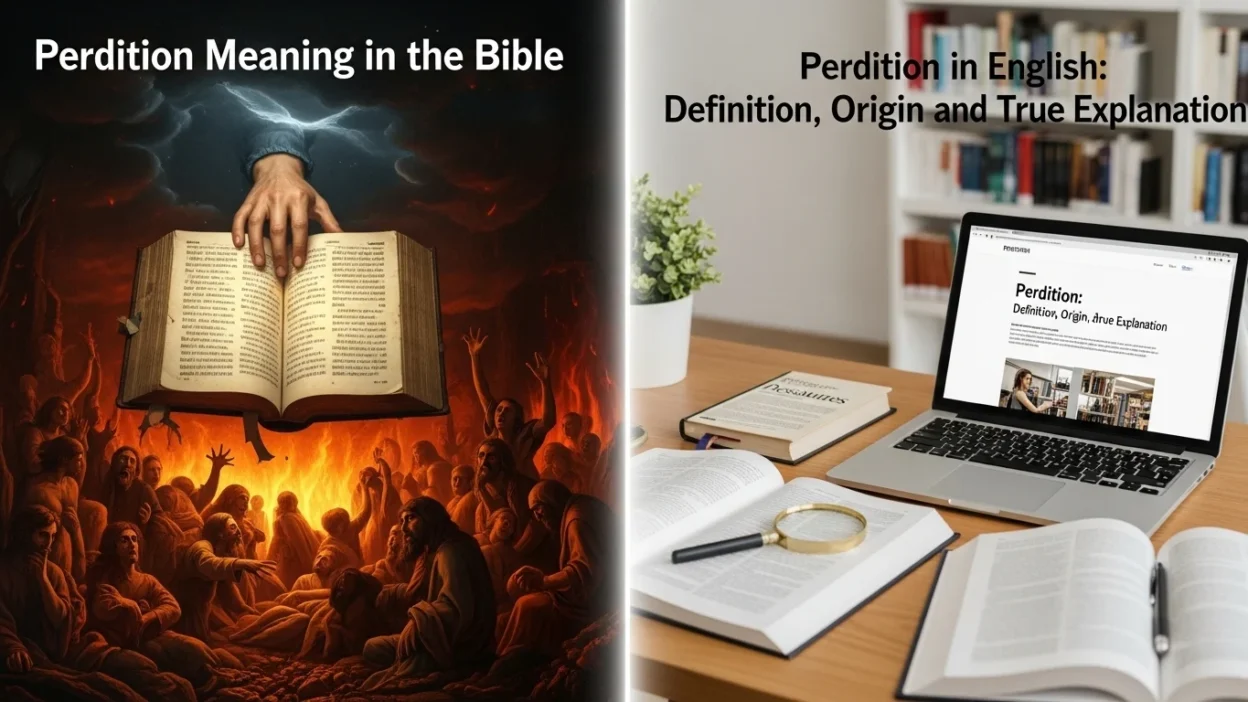
📖 Perdition Meaning in the Bible
In the Bible, perdition refers to spiritual destruction or eternal separation from God. The phrase “son of perdition” appears in John 17:12 and 2 Thessalonians 2:3. It describes someone destined for ruin, commonly associated with Judas Iscariot and, in some interpretations, the Antichrist. In biblical usage, perdition meaning in the Bible emphasizes final judgment rather than temporary punishment.
📖 What Does “Son of Perdition” Mean?
The phrase “son of perdition” appears in John 17:12 and 2 Thessalonians 2:3. It refers to a person destined for destruction or spiritual ruin. In Christian theology, it is commonly associated with Judas Iscariot and, in some interpretations, the Antichrist.
The phrase later inspired the 2002 film “Road to Perdition”, which revived interest in the term in pop culture.
🎬 What Does “Road to Perdition” Mean?
The phrase “road to perdition” means a path leading toward inevitable ruin or moral destruction. It suggests a journey that ends in downfall. The expression gained modern recognition through Road to Perdition starring Tom Hanks, but its meaning predates the movie and appears in older religious language.
🌍 Perdition Meaning in Different Contexts
“Perdition” may appear in religious, literary, or figurative contexts — each carrying slightly different nuances.
| Context | Meaning of Perdition | Example Usage |
| Religious | Eternal punishment or spiritual destruction | “Sinners will face eternal perdition.” |
| Literary | Ruin or complete downfall | “His pride led him to perdition.” |
| Figurative / Modern | Severe loss or moral decay | “The corrupt leader’s greed was his perdition.” |
Let’s look closer at how it appears across settings:
✝️ In Religion
Refers to the state of eternal damnation after death. Often associated with the concept of hell.
Example: “Those who turn from faith are warned of perdition.”
📚 In Literature
Used to describe tragic downfall or moral ruin, not necessarily spiritual.
Example: “The king’s betrayal sealed his kingdom’s perdition.”
🗣️ In Everyday Use
Rare but used metaphorically to describe total loss, destruction, or moral collapse.
Example: “Addiction led him down a path of perdition.”
💬 Examples of “Perdition” in Sentences
Here are some realistic examples of how “perdition” appears in writing and conversation:
Example 1 (Religious):
“He prayed for forgiveness, fearing his soul was bound for perdition.”
Example 2 (Literary):
“The villain’s lust for power brought about his own perdition.”
Example 3 (Modern Context):
“Ignoring the warnings, the company’s reckless spending led to financial perdition.”
Example 4 (Pop Culture):
“In Road to Perdition, Tom Hanks portrays a man caught between vengeance and redemption.”
🔄 Similar or Related Terms
To better understand “perdition,” let’s look at words and phrases that share similar meanings:
| Related Term | Meaning |
| Damnation | Eternal punishment of the soul. |
| Hell | Place or state of torment after death. |
| Destruction | The act of being destroyed or ruined. |
| Doom | Fate of inevitable destruction or death. |
| Condemnation | Expression of disapproval or sentencing to punishment. |
These terms often appear together in religious or literary works, reinforcing the idea of spiritual ruin or eternal loss.
🧠 How to Use “Perdition” Correctly
Although rare, the plural form “perditions” may appear in poetic writing to describe multiple instances of ruin. The adjective “perditional” is extremely uncommon but historically used to describe something leading to destruction.
✅ Do’s:
- Use it in formal, literary, or religious discussions.
- Pair it with terms like eternal, path to, or road to.
- Use metaphorically to describe irreversible destruction.
❌ Don’ts:
- Don’t use it in casual conversation or modern slang.
- Avoid using it interchangeably with sadness or regret — it’s far stronger and more final in meaning.
- Don’t pluralize it; “perdition” is uncountable.
Example: “The general led his army into perdition through pride and arrogance.”
⚠️ Common Mistakes or Misinterpretations
🔎 Spelling Note
The correct spelling is “perdition.” Common mistakes include “predition” or typing the word letter by letter (p e r d i t i o n). Despite variations, the meaning remains the same.
- Confusing “Perdition” with “Perdure” or “Perdurement.”
→ Truth: “Perdure” means to endure; “perdition” means to be destroyed or damned — the opposite in meaning. - Using it in casual speech.
→ Truth: It’s formal and often poetic or theological in tone. - Thinking it always means “hell.”
→ Truth: It can mean any irreversible loss, not only spiritual damnation.
❓ FAQ Section
1. What does “perdition” mean in the Bible?
In the Bible, “perdition” refers to eternal punishment or the state of spiritual ruin for those separated from God, as seen in verses like John 17:12 and 2 Thessalonians 2:3.
2. Is “perdition” a sin or a place?
Neither. It’s a state of being — the condition of being lost or destroyed spiritually.
3. What’s the difference between “perdition” and “damnation”?
They’re closely related, but “damnation” refers to the act of being condemned, while “perdition” is the resulting state of loss.
4. Can “perdition” be used outside religion?
Yes. It can describe moral or emotional ruin, such as “His greed led him to perdition.”
5. What does “Road to Perdition” mean?
It’s a phrase meaning a path toward inevitable ruin or moral destruction — popularized by the 2002 film of the same name.
The phrase “road to perdition” means a path toward inevitable ruin or moral downfall. It gained modern popularity through Road to Perdition, starring Tom Hanks, which explores themes of revenge, redemption, and moral consequence.
6. Is “perdition” still used today?
While less common in casual speech, it’s still used in religious teachings, literature, and philosophical discussions.
7. Is perdition the same as hell?
Perdition does not literally mean hell, but it is often associated with it. In religious texts, perdition describes the state of eternal ruin or separation from God, which many traditions connect with the concept of hell.
🕊️ Conclusion
To sum it up, “perdition” means eternal destruction, spiritual ruin, or total downfall — a word steeped in centuries of religious and literary history.
It remains powerful because it captures the ultimate loss of purpose or salvation, whether in moral, emotional, or spiritual terms.
✨ Now that you understand the true perdition meaning, you’ll recognize it in sermons, novels, and films — and know exactly why it carries such dramatic weight.
Keep exploring our site for more insightful meanings of classic and trending words!