
Have you ever read the word “paramour” in a novel or a historical drama and wondered, what does it really mean? It sounds romantic and mysterious — but also a little secretive, right?
A paramour is a person with whom someone has a romantic or sexual relationship, usually secret or illicit, often outside of marriage.
The word paramour is commonly used in literature, history, and conversations to describe secret romantic relationships. People search for its meaning to understand contexts where romance or love affairs are hidden or socially frowned upon. Historically, paramour referred to lovers in situations where the relationship was not officially recognized or acceptable.
Understanding the meaning of paramour helps in interpreting literature, historical accounts, and modern discussions about relationships. While the term often has a negative or scandalous connotation, it simply highlights the discreet or private nature of the romance. Knowing this meaning allows readers to grasp context and nuance in both classic and contemporary usage.
💬 What Does “Paramour” Mean?
“Paramour” means a lover, especially one in a secret or illicit romantic relationship.
It usually refers to someone’s romantic partner outside of marriage or a socially approved relationship. The term is more formal than slang, often found in literature, films, and historical texts.
In short: A paramour is a secret lover or an illicit romantic partner.
📜 Origin and Popularity of “Paramour”
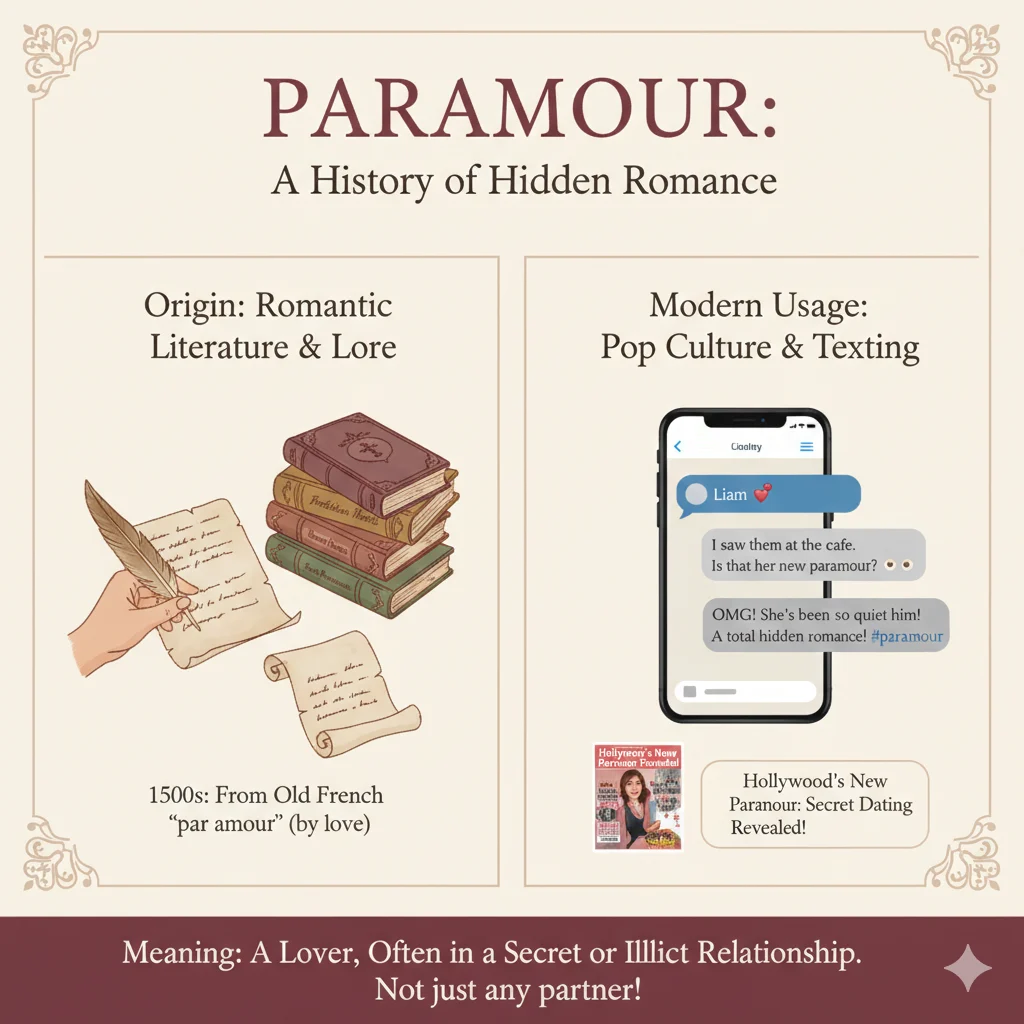
The word “paramour” has deep roots in Old French and Latin:
- It comes from the Old French phrase “par amour,” meaning “through love” or “for love.”
- The term entered Middle English around the 13th century, initially describing any beloved person — not necessarily a secret one.
By the 16th century, “paramour” took on its modern meaning: a lover outside marriage, often associated with secrecy or forbidden romance.
In modern English, while the word still appears in books, movies, and period dramas, it’s less common in everyday conversation — replaced by terms like affair partner or lover.
🌐 “Paramour” Meaning in Different Contexts
| Context | Meaning / Tone | Example Use |
| In Literature | A secret or passionate lover | “The king kept his paramour hidden from the court.” |
| In Everyday English | A romantic partner in an extramarital or secret relationship | “She was rumored to be his paramour.” |
| In Pop Culture | Used poetically to describe a forbidden love or affair | “The singer’s new album tells the story of a paramour lost to time.” |
| In Religion / History | Sometimes used in moral or cautionary contexts | “Clergy were forbidden from keeping paramours.” |
💞 Examples of “Paramour” in Conversations or Sentences
Here are some realistic examples showing how paramour appears in writing and speech:
Example 1 (Literary):
“He wrote countless letters to his paramour, sealed with wax and longing.”
Example 2 (Casual Conversation):
Friend 1: “Did you hear about that celebrity’s secret paramour?”
Friend 2: “Yeah, it’s all over the tabloids!”
Example 3 (Formal Context):
“The official resigned after his relationship with a paramour became public.”
Example 4 (Poetic Use):
“The moon watched over two paramours who could never be seen by day.”
🔍 Similar or Related Terms to “Paramour”
Here are some words with similar meanings or nuances:
| Term | Meaning | Formality / Tone |
| Lover | A person in a romantic or sexual relationship | Neutral / Common |
| Mistress | A woman in a relationship with a married man | Gender-specific, slightly outdated |
| Affair Partner | Someone involved in a romantic affair | Neutral / Modern |
| Beloved | Deeply loved person, not necessarily secret | Romantic / Literary |
| Sweetheart | Endearing term for a loved one | Affectionate / Informal |
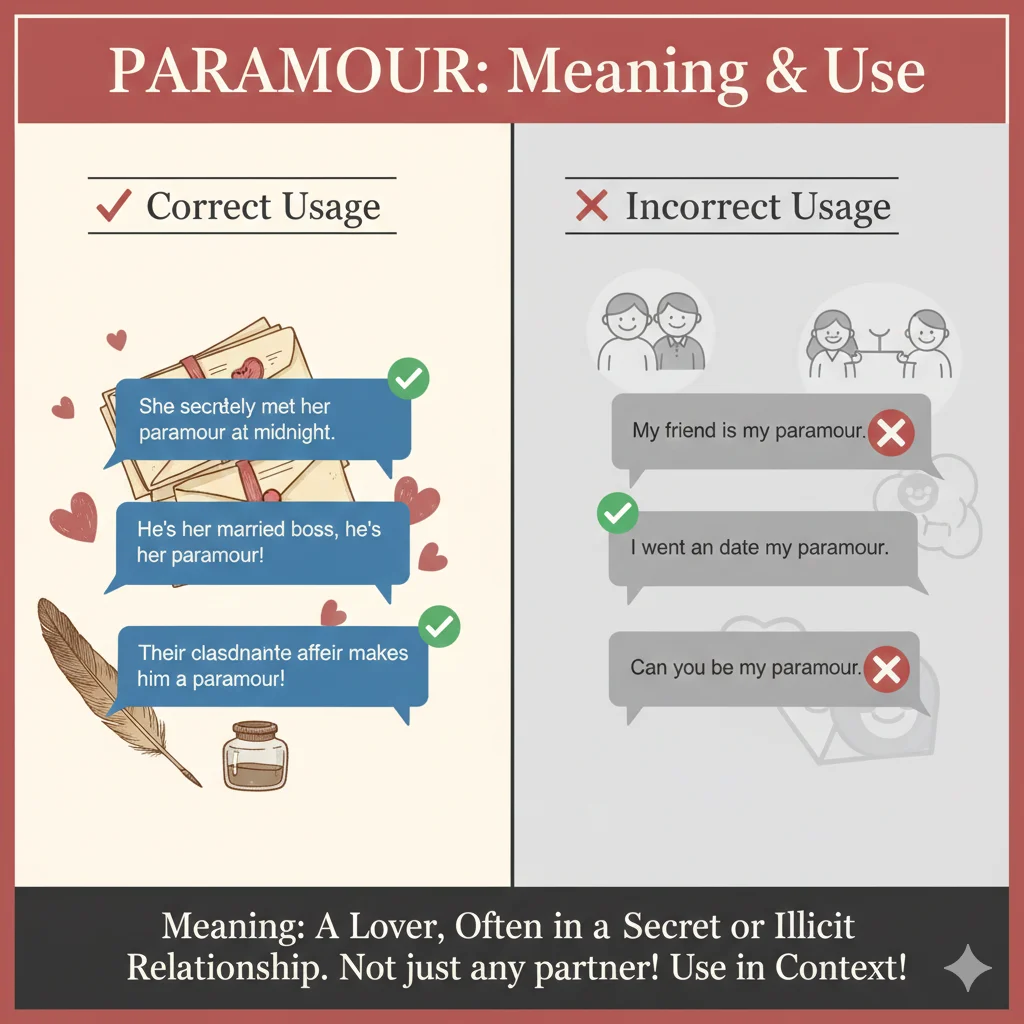
✅ How to Use “Paramour” Correctly
Here’s how to use the word naturally and appropriately:
Do’s
- ✅ Use it in literary, historical, or formal contexts.
- ✅ Use when describing a secret or extramarital romantic partner.
- ✅ Use it to sound poetic or sophisticated in writing.
Don’ts
- ❌ Don’t use it casually with friends — it can sound too formal or old-fashioned.
- ❌ Don’t confuse it with “partner” or “boyfriend/girlfriend” unless secrecy is implied.
- ❌ Avoid using it to label someone disrespectfully.
⚠️ Common Mistakes or Misinterpretations
Many people confuse “paramour” with “lover” or “partner,” but there’s a key difference:
- A lover can refer to any romantic partner.
- A paramour specifically implies secrecy or forbidden love.
Another misconception is that paramour only refers to women — but it’s actually gender-neutral.
❓ FAQ Section
1. What does “paramour” mean in simple terms?
“Paramour” means a secret lover or someone in a romantic relationship that’s hidden or socially disapproved of.
2. Is “paramour” slang or formal?
It’s formal and literary, not slang. You’ll see it more in books, movies, and journalism than in daily texting.
3. What’s the difference between a paramour and a lover?
A lover can be any romantic partner, while a paramour is specifically a hidden or illicit one.
4. Can “paramour” be used for both men and women?
Yes — paramour is gender-neutral and can refer to any person in a secret romantic relationship.
5. Where is “paramour” most commonly used?
It appears in literature, historical writing, and news articles discussing affairs or secret relationships.
6. When should you not use “paramour”?
Avoid it in casual or professional settings — it may sound too dramatic or carry a negative connotation.
🩷 Conclusion
To sum it up, “paramour” is a timeless word meaning a secret or forbidden lover — rooted in the Old French “par amour,” meaning “for love.” While its use today is mostly literary or poetic, it still adds elegance and mystery when describing passionate, hidden relationships.
Now that you know what paramour means, you’ll never be puzzled by it again! Keep exploring our site for more fascinating word meanings and linguistic gems.

Evie Wyld is a word-meaning specialist at Meanovia.com. She simplifies complex words, phrases, and language trends, helping readers quickly grasp the exact meaning behind every term in a clear and approachable way.