
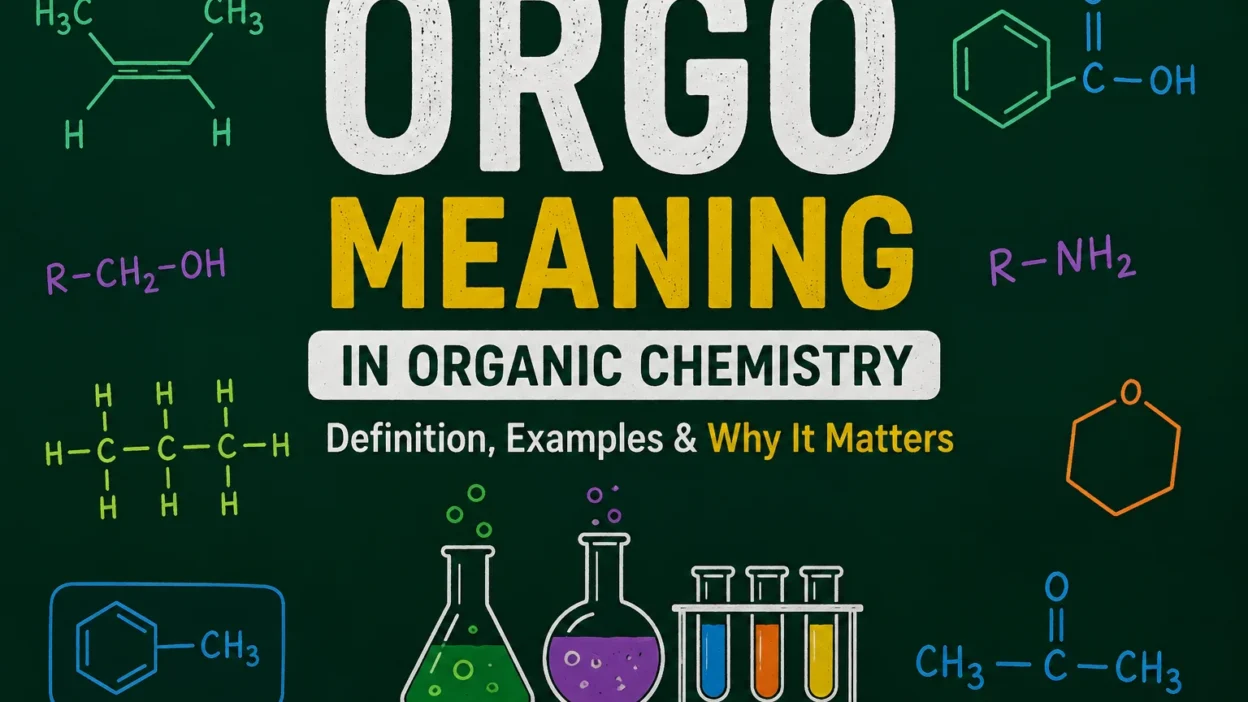
Heard a student say “I have orgo tomorrow” and wondered what this strange little word means? In most college and university contexts, “orgo” is informal shorthand for “organic chemistry.” Students use it as a quicker, more casual way to refer to the subject, a class, an exam, a lab, or their coursework.
For example, “I have an orgo exam tomorrow” simply means “I have an organic chemistry exam tomorrow.” The term is especially associated with university and student conversations, where shortening frequently used course names makes everyday communication easier.
Orgo is not the formal name of the subject, so “organic chemistry” is the better choice in formal academic writing, official documents, and professional contexts. There is also a less common informal use of orgo meaning “organic,” so the surrounding context can matter.
This guide explains the orgo meaning, what it stands for, its origin, student usage, examples, related terms, and the difference between “orgo” and “organic chemistry,” so you’ll know exactly what someone means when they use the term.
What Does Orgo Mean?
Orgo is an informal abbreviation or shorthand for organic chemistry, the branch of chemistry that studies the structure, properties, reactions, and synthesis of carbon-containing compounds.
In college conversations, students may use Orgo to mean more than the subject itself. Depending on the context, it can refer to:
- An organic chemistry course
- Orgo homework or assignments
- An Orgo exam or midterm
- An organic chemistry lab
- Reaction mechanisms
- Study sessions or study materials
- The overall organic chemistry course sequence
For example:
“I have Orgo tomorrow.”
This simply means:
“I have organic chemistry tomorrow.”
In English, Orgo is therefore best understood as an informal academic term for organic chemistry, particularly in college and university settings.
Quick Definition
Orgo means organic chemistry. It is informal student slang commonly used in college, especially by STEM, pre-med, biology, pharmacy, and chemistry students.
Is Orgo Slang or Formal?
Orgo is informal academic slang, not the standard formal name of the subject.
Students commonly use it in:
- College classrooms
- Study groups
- Text messages
- Student forums
- Pre-med conversations
- STEM communities
- Online study discussions
In formal academic or professional writing, “organic chemistry” is usually the better choice.
| Situation | Natural Choice |
|---|---|
| Talking with friends | “I have Orgo tomorrow.” |
| Texting a classmate | “Did you finish the Orgo homework?” |
| Emailing a professor | “I am enrolled in organic chemistry.” |
| Academic paper | “Organic chemistry examines…” |
| Official course description | “Organic Chemistry I” |
So, Orgo is not incorrect. It is simply more casual than the full term organic chemistry.
What Does Orgo Mean in Text?
In college-related texts, chats, and online conversations, Orgo almost always means organic chemistry.
For example:
“Can’t hang out tonight. I have to study Orgo.”
Meaning: I have to study organic chemistry.
“How did your Orgo final go?”
Meaning: How did your organic chemistry final exam go?
“Orgo lab was brutal today.”
Meaning: Organic chemistry lab was difficult today.
“I need to review Orgo mechanisms tonight.”
Meaning: I need to review organic chemistry reaction mechanisms.
The surrounding conversation usually makes the meaning obvious. If people are discussing classes, exams, professors, studying, or science, Orgo almost certainly refers to organic chemistry.
Why Do Students Say “Orgo”?
The simplest reason is convenience.
“Organic chemistry” is a relatively long course name, so students shorten it when speaking or texting. This is common across college subjects.
| Full Subject | Common Short Form |
|---|---|
| Biology | Bio |
| Calculus | Calc |
| Statistics | Stats |
| Physics | Phys |
| Organic Chemistry | Orgo |
Using a shorter term makes everyday student conversations faster:
“I have organic chemistry after lunch.”
becomes:
“I have Orgo after lunch.”
Over time, this shorthand became familiar within college and STEM culture.
Orgo vs. O-Chem: Are They the Same?
Yes. In most college contexts, Orgo and O-Chem refer to the same subject: organic chemistry.
You may also encounter OChem, Org Chem, or Orgo chem as informal variations.
| Term | Meaning | Style |
|---|---|---|
| Orgo | Organic chemistry | Informal |
| O-Chem | Organic chemistry | Informal abbreviation |
| OChem | Organic chemistry | Informal abbreviation |
| Org Chem | Organic chemistry | Shortened form |
| Orgo chem | Organic chemistry | Less common informal variant |
| Organic Chemistry | Full subject name | Standard/formal |
For example:
“I have Orgo at 10.”
and
“I have O-Chem at 10.”
would normally communicate the same thing.
If you’re searching for “Orgo or Ochem”, the answer is that both are commonly used shorthand for organic chemistry.
What Are Orgo I and Orgo II?
Orgo I and Orgo II typically refer to the first and second courses in a college’s organic chemistry sequence. Exact course titles, order, and topics can vary by university.
A typical sequence may look like this:
| Course | Typical Topics |
|---|---|
| Orgo I | Structure and bonding, functional groups, stereochemistry, acid-base chemistry, basic reactions, and introductory mechanisms |
| Orgo II | More advanced reactions, mechanisms, synthesis, carbonyl chemistry, spectroscopy, and additional functional groups |
So if a student says:
“I’m taking Orgo II.”
they generally mean they are taking the second course in their institution’s organic chemistry sequence.
Because universities organize their curricula differently, it’s better not to assume that every Orgo I or Orgo II course covers exactly the same material.
What Is an Orgo Class, Exam, or Lab?
The word Orgo can describe different parts of the same academic subject.
| Term | What It Means |
|---|---|
| Orgo class | An organic chemistry course or lecture |
| Orgo homework | Assignments for organic chemistry |
| Orgo exam | A test covering organic chemistry concepts |
| Orgo lab | Laboratory work associated with organic chemistry |
| Orgo study group | Students studying organic chemistry together |
| Orgo mechanisms | Reaction mechanisms studied in organic chemistry |
An Orgo lab may involve techniques such as extraction, distillation, recrystallization, purification, or synthesis, depending on the course.
An Orgo exam, meanwhile, may test students on structures, reactions, mechanisms, stereochemistry, synthesis, and related concepts.
Why Is Orgo Considered Difficult?
Organic chemistry has a reputation for being challenging because students must combine several kinds of thinking.
1. Conceptual reasoning
Students need to understand why a reaction happens rather than simply memorize its name.
2. Pattern recognition
Many reactions follow recognizable patterns. Learning those patterns can make unfamiliar problems easier to approach.
3. 3D visualization
Molecules have three-dimensional structures, so students may need to visualize bonds, shapes, stereochemistry, and molecular orientation.
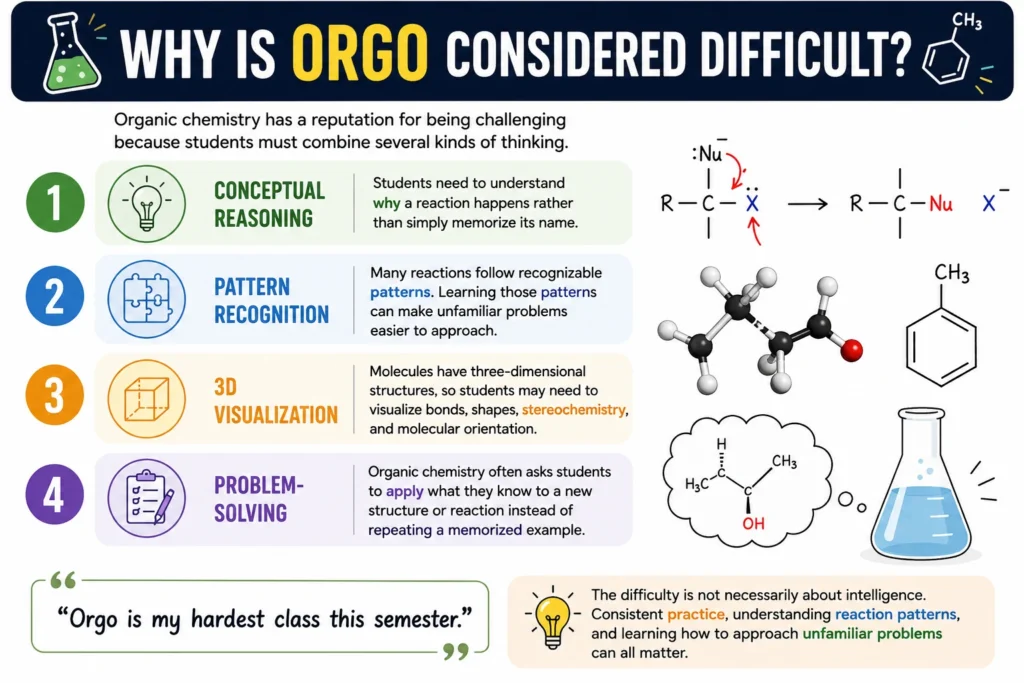
4. Problem-solving
Organic chemistry often asks students to apply what they know to a new structure or reaction instead of repeating a memorized example.
That is why you may hear:
“Orgo is my hardest class this semester.”
The difficulty is not necessarily about intelligence. Consistent practice, understanding reaction patterns, and learning how to approach unfamiliar problems can all matter.
What Does Orgo Mean in Pre-Med Culture?
Orgo is especially common in pre-med conversations because organic chemistry is part of the undergraduate science coursework required or recommended by many medical schools and programs.
Students may say:
“I need to finish Orgo before I apply.”
or:
“Orgo is taking most of my study time this semester.”
However, requirements are not identical everywhere. Medical-school prerequisites vary by institution, so students should check the current requirements of the schools they plan to apply to.
The term itself remains informal regardless of the student’s major.
Orgo on Social Media
On platforms such as TikTok, Reddit, YouTube, and other student communities, Orgo still means organic chemistry, but the word often carries a humorous or emotional tone.
Common examples include:
“POV: You have an Orgo exam tomorrow.”
“Survived Orgo somehow.”
“Orgo is destroying me.”
These expressions usually exaggerate the difficulty of the course for humor.
Online, Orgo can therefore communicate both the literal subject and the shared experience of studying a challenging science course.
Can “Orgo” Mean Something Else?
Yes, but context matters.
In college and academic conversations, Orgo overwhelmingly refers to organic chemistry. Outside that context, “Orgo” could potentially be used as:
- A company or brand name
- A username
- A product name
- An acronym
- Another proper name
For example:
“I have Orgo tomorrow.”
The academic meaning is clear.
But:
“Orgo released a new product.”
could refer to a company or brand instead.
There is also a limited informal use in which “orgo” may be shortened from “organic,” but this is much less relevant to the common college meaning. When students discuss classes, exams, labs, or studying, Orgo normally means organic chemistry.
Does Orgo Mean Organic Food?
No.
When students say “Orgo” in an academic context, they generally mean organic chemistry, not organic food.
For example:
“I have an Orgo exam Friday.”
clearly refers to an organic chemistry exam.
The meaning comes from the surrounding context, not simply from the word “organic.”
Common Examples of “Orgo” in Conversation
Here are some natural examples:
Student 1: “Are you free tonight?”
Student 2: “No, I have to study Orgo.”
Meaning: The student needs to study organic chemistry.
Student 1: “How was your Orgo exam?”
Student 2: “Hard, but the reaction questions weren’t too bad.”
Meaning: They are talking about an organic chemistry exam.
Student: “My Orgo lab starts at 9.”
Meaning: Their organic chemistry laboratory starts at 9.
Student: “I’m taking Orgo II next semester.”
Meaning: They are taking the second course in their organic chemistry sequence.
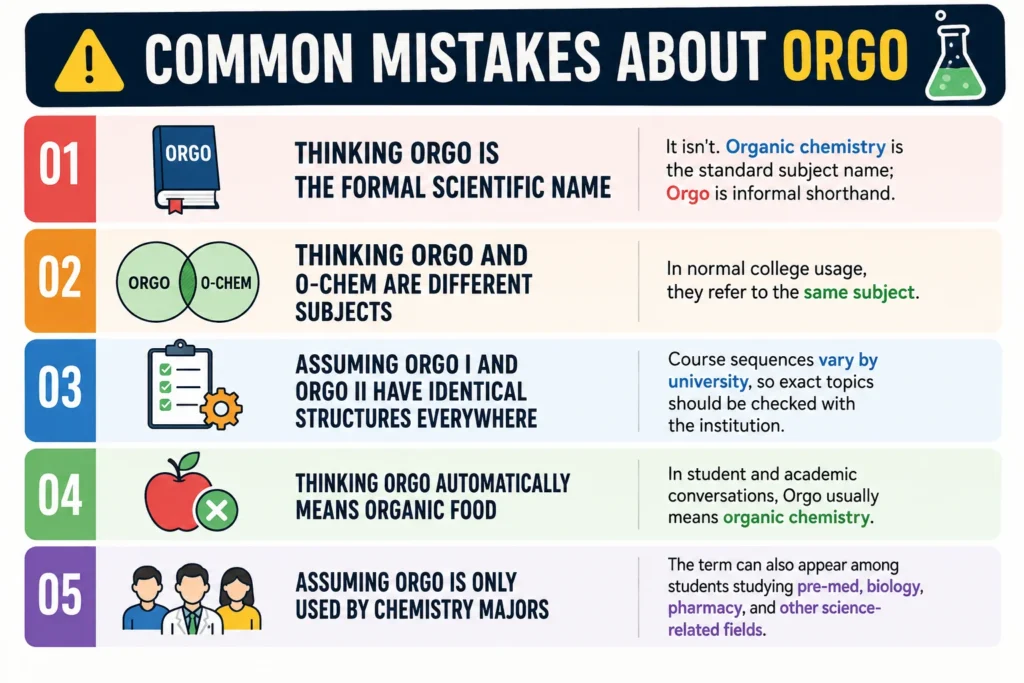
Common Mistakes About the Word “Orgo”
Mistake 1: Thinking Orgo is the formal scientific name
It isn’t. Organic chemistry is the standard subject name; Orgo is informal shorthand.
Mistake 2: Thinking Orgo and O-Chem are different subjects
In normal college usage, they refer to the same subject.
Mistake 3: Assuming Orgo I and Orgo II have identical structures everywhere
Course sequences vary by university, so exact topics should be checked with the institution.
Mistake 4: Thinking Orgo automatically means organic food
In student and academic conversations, Orgo usually means organic chemistry.
Mistake 5: Assuming Orgo is only used by chemistry majors
The term can also appear among students studying pre-med, biology, pharmacy, and other science-related fields.
Orgo vs. General Chemistry
Orgo and general chemistry are different subjects, although students may take them as part of the same broader chemistry education.
| Subject | General Focus |
|---|---|
| General Chemistry | Foundational chemistry concepts, atoms, bonding, equations, energy, equilibrium, and related principles |
| Organic Chemistry (Orgo) | Carbon-containing compounds, structures, functional groups, reactions, mechanisms, and synthesis |
This distinction matters when someone says:
“I have Orgo.”
They are talking about organic chemistry, not simply chemistry in general.
Frequently Asked Questions About Orgo
What is Orgo slang for?
Orgo is slang or informal academic shorthand for organic chemistry, especially the college course. Students may also use it when referring to Orgo homework, exams, labs, or study sessions.
What does Orgo mean in text?
In a college, STEM, or student conversation, Orgo usually means organic chemistry.
Is Orgo the same as O-Chem?
Yes. Orgo and O-Chem are commonly used informal names for organic chemistry.
What does Orgo mean in English?
In plain English, Orgo means organic chemistry when it is being used as college or academic slang.
What does “Orgo chem” mean?
Orgo chem is an informal variant of organic chemistry. It combines the shortened form “Orgo” with “chemistry.”
Is Orgo a formal word?
No. It is informal academic slang. In formal papers, official documents, and professional communication, organic chemistry is generally preferable.
What is Orgo I?
Orgo I is typically the first course in an organic chemistry sequence. Its topics often include molecular structure, bonding, functional groups, stereochemistry, acid-base chemistry, and introductory reactions.
What is Orgo II?
Orgo II is typically the second course in an organic chemistry sequence. It often builds on Orgo I with more advanced reactions, mechanisms, synthesis, and spectroscopy. Exact content varies by university.
Is Orgo only for chemistry majors?
No. Students in pre-med, biology, pharmacy, and other science-related programs may also take organic chemistry.
Does Orgo mean organic food?
No. In academic and college contexts, “Orgo” normally refers to organic chemistry, not organic food.
Why do students call organic chemistry Orgo?
Students use Orgo because it is shorter and easier to say than “organic chemistry,” especially when discussing classes, assignments, exams, and studying.
Conclusion
| Question | Answer |
|---|---|
| What does Orgo mean? | Organic chemistry |
| What type of term is it? | Informal academic slang |
| What does Orgo mean in text? | Usually organic chemistry |
| Who commonly uses it? | College, STEM, and pre-med students |
| What can it refer to? | A course, exam, lab, homework, or study session |
| Is it the same as O-Chem? | Yes, in common academic usage |
| What are Orgo I and II? | Usually the first and second courses in an organic chemistry sequence |
Bottom Line
If someone says:
“I have Orgo tomorrow.”
they mean:
“I have organic chemistry tomorrow.”
So the next time you see Orgo in a text, college conversation, study group, or social-media post, you can usually read it simply as organic chemistry.

Lucas Hayes is a content writer at Meanovia, specializing in slang, texting meanings, and internet phrases. He creates simple, clear, and engaging explanations of modern digital language 💬✨