
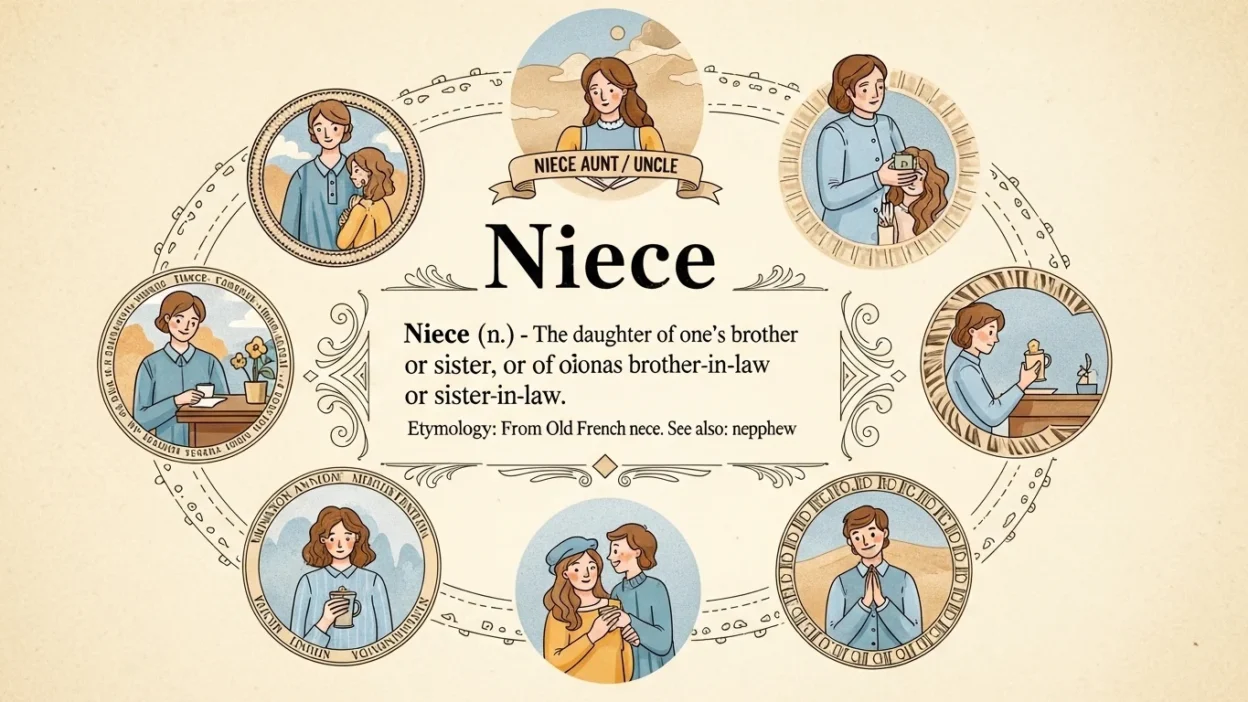
Family relationships can sometimes feel confusing — especially when describing extended relatives. So what exactly does the word niece mean?
Quick answer: A niece is the daughter of your brother or sister. The term refers to a direct female family member in the next generation.
In English, niece is a kinship term used to define a clear biological or marital relationship. If your sibling has a daughter, she is your niece. The word also applies through marriage, meaning your spouse’s sibling’s daughter is considered your niece as well.
People often search for “niece meaning” when clarifying family trees, completing legal or school documents, or improving their understanding of English family vocabulary. Because kinship terms carry social and sometimes legal importance, it’s essential to understand them correctly.
Niece meaning in English refers to the daughter of your brother or sister. If you are asking what is a niece or who is called a niece, it simply means a female child of your sibling. The niece definition describes a clear family relationship in the next generation.
👶 What Does Niece Mean?
A niece is the daughter of your brother or sister, or the daughter of your spouse’s sibling.
It’s a noun used to describe a family relationship — not slang or an abbreviation. The male counterpart is called a nephew.
The male version of a niece is a nephew. A niece is always female, while a nephew refers to a male child of your brother or sister. Together, nephew and niece describe sibling-based family relationships.
👪 What Does “My Niece” Mean?
When someone says “my niece,” they are referring to their brother’s or sister’s daughter. If you’re wondering who is a niece to you, it means your sibling’s daughter or your spouse’s sibling’s daughter. In simple terms, she is your niece if she belongs to the next generation of your immediate family.
📚 What Does “Nieces” Mean?
“Nieces” is the plural form of niece. It refers to more than one daughter of your sibling. For example, if your brother has two daughters, they are your nieces.
📜 Origin and Popularity
The word “niece” comes from the Old French term niece and the Latin word neptis, meaning “granddaughter” or “female descendant.”
It entered the English language in the Middle Ages, around the 13th century, and has remained a common term in family relationships ever since.
Over time, “niece” has also been used affectionately to describe younger female relatives or family friends who feel like part of the family.
🕰️ Timeline Snapshot:
- 13th century: Borrowed from Old French niece
- 15th century: Became widely used in English family vocabulary
- Today: Common in global English, especially in family, legal, and social contexts
🌍 Niece Meaning in Different Contexts
While the basic meaning of niece stays the same, its use can slightly vary depending on context or tone.
💬 In Everyday Conversation
Used to refer to your sibling’s daughter in daily life.
Example: “My niece just graduated from college!”
💼 In Formal or Legal Contexts
Appears in wills, inheritance laws, or family documents to define kinship.
Example: “The property will be equally divided between my nieces and nephews.”
❤️ In Affectionate or Cultural Use
Sometimes used informally for close family friends or young girls treated like relatives.
Example: “She’s not my real niece, but I love her like one.”
💬 Niece Meaning in Slang
In modern slang, “niece” is rarely used differently from its original meaning. However, some people use it affectionately for close family friends or younger girls they feel protective toward.
| Context | Meaning | Example Sentence |
| Family | Daughter of one’s sibling | “My niece lives in London.” |
| Legal | Relative in inheritance terms | “Nieces are legal heirs in some cases.” |
| Informal | Close family friend | “She’s like a niece to me.” |
💬 Examples of “Niece” in Conversations
Example 1:
Aunt: My niece just learned to ride a bike!
Friend: That’s adorable — how old is she?
Example 2:
Uncle: I’m taking my niece to the zoo this weekend.
Coworker: That sounds fun! How many nieces do you have?
Example 3 (formal context):
“The scholarship is available to employees’ children, nieces, and nephews.”
Example 4 (social media):
“Proud auntie moment 💖 My niece just performed in her first school play!”
🧩 Similar or Related Terms
Here are some family relationship terms often confused with “niece”:
👶 What Is a Great Niece?
A great niece (also written as great-niece) is the granddaughter of your brother or sister. Some people also say grand niece, which means the same thing. A great grand niece refers to the great-granddaughter of your sibling.
| Term | Meaning | Gender |
| Nephew | Son of your brother or sister | Male |
| Cousin | Child of your aunt or uncle | Male/Female |
| Aunt | Sister of your parent | Female |
| Uncle | Brother of your parent | Male |
📘 Tip: You are an aunt or uncle to your niece or nephew.
🗝️ How to Use “Niece” Correctly
✅ Do’s:
- Use when referring to your sibling’s daughter.
- Use in both formal and casual conversations.
- Use with possessive pronouns for clarity (e.g., my niece, our niece).
❌ Don’ts:
- Don’t confuse it with “cousin” — that’s your aunt or uncle’s child.
- Avoid using it as a title (e.g., “Miss Niece”) — it’s a relationship term, not a name.
⚠️ Common Mistakes or Misinterpretations
- Confusing niece with cousin:
→ Incorrect: “My niece is my uncle’s daughter.”
→ Correct: “My cousin is my uncle’s daughter.” - Misusing for male relatives:
→ Incorrect: “My niece is playing football — he loves it!”
→ Correct: “My nephew is playing football — he loves it!” - Overusing in formal writing:
→ Better option: Use “relative” or “family member” when gender or exact relationship isn’t relevant.
🔎 Spelling Reminder
The correct spelling is “niece.” Common misspellings include “neice” or “nease.” Despite spelling errors, the meaning remains the same.
🌎 Niece Meaning in Other Languages
In Hindi, niece is translated as “भतीजी” (bhatiji) for brother’s daughter and “भांजी” (bhanji) for sister’s daughter.
In Urdu, it is “بھتیجی” or “بھانجی.”
In Tamil, it is “மருமகள்” depending on context.
In Telugu, it is “అక్క కూతురు” or “అన్న కూతురు.”
The exact word may vary based on whether the niece is from a brother or sister.
❓ FAQ Section
1. What does “niece” mean in simple words?
A niece is the daughter of your brother or sister. You’re her aunt or uncle.
2. What is the male version of a niece?
The male version of a niece is a nephew — the son of your sibling.
3. Can “niece” refer to someone not related by blood?
Yes. In informal speech, some people use “niece” affectionately for close family friends.
4. What’s the difference between a niece and a cousin?
A niece is your sibling’s daughter. A cousin is your aunt’s or uncle’s child.
5. How do you pronounce “niece”?
It’s pronounced as /niːs/ — rhyming with “peace.”
6. Can I say “niece-in-law”?
Yes, “niece-in-law” can refer to your spouse’s niece or your nephew’s wife in extended family terms.
🏁 Conclusion
To sum it up, the word niece simply means the daughter of your brother or sister — a term of love, family, and connection.
Whether you’re talking about your real niece or someone you care for like family, it’s a word that captures affection and kinship beautifully.
👧 Now that you know the meaning of niece, you’ll never mix it up with cousin or nephew again! Keep exploring our site for more family relationship terms and English word meanings.

Patrick Gale is a word-meaning expert at Meanovia.com. He explains complex terms, definitions, and language trends with clarity and precision. His goal is to help readers understand the exact meaning behind every word they search.