Ever heard the term “moratorium” in the news or a financial document and wondered what it really means?
You’re not alone — moratorium is one of those formal-sounding words that often appears in legal, financial, and policy discussions, especially during times of crisis or reform.
In this guide, we’ll break down:
✅ The definition of “moratorium”
✅ Its origin and history
✅ Usage in law, finance, and government
✅ Real-life examples and related terms
✅ Common questions and misinterpretations
⚖️ What Does “Moratorium” Mean?
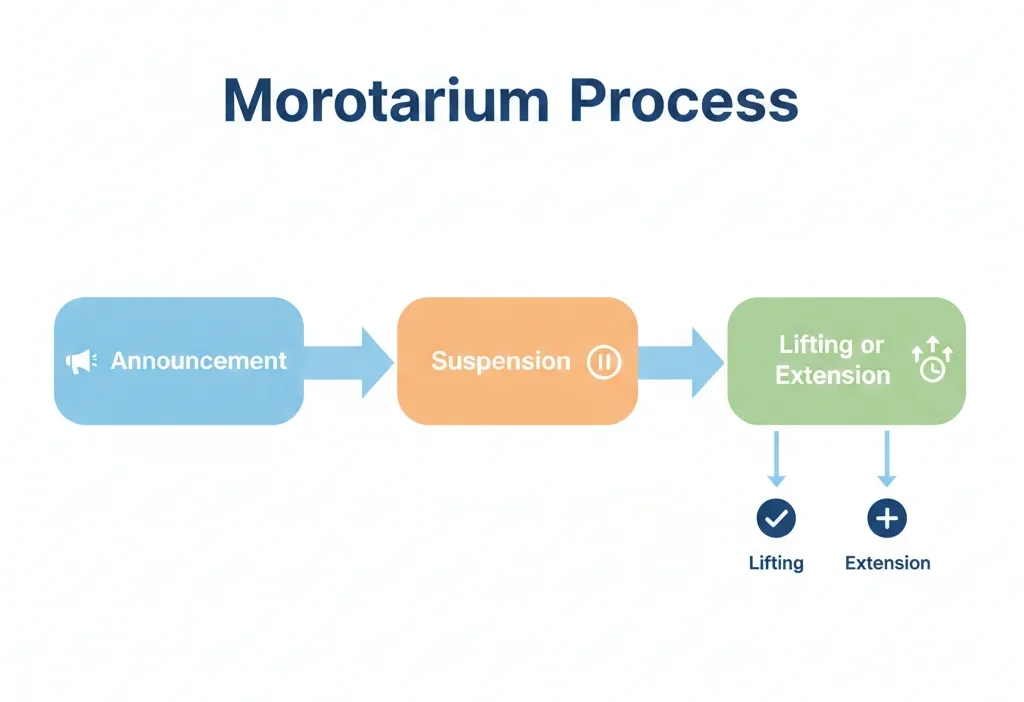
A moratorium is a temporary suspension or delay of an activity, law, or payment obligation, usually imposed by a government, court, or institution.
It’s a formal legal or policy term, most commonly used in business, banking, real estate, and governance to grant relief or pause certain actions.
🏛️ Origin and Popularity
The word “moratorium” comes from the Latin root morari, meaning “to delay.”
It first appeared in English around the 1870s, primarily in legal and financial contexts to describe postponement of debt or enforcement.
📜 Historical Snapshot:
- 19th Century: Used in Europe to describe debt relief during wars and economic downturns.
- 1930s: Gained prominence during the Great Depression, when nations declared moratoriums on debt payments.
- Modern Era: Commonly seen in contexts like loan moratoriums, eviction freezes, or construction moratoriums during crises (like the COVID-19 pandemic).
💼 Moratorium Meaning in Different Contexts
“Moratorium” can apply to various fields — here’s how it’s used across different domains:
🏦 In Finance and Banking
A loan moratorium means a temporary pause on loan repayments to help borrowers during hardship.
Example: “The central bank announced a six-month moratorium on loan repayments during the recession.”
⚖️ In Law and Policy
Refers to a temporary suspension of a law or legal process — such as executions, evictions, or specific business activities.
Example: “The government imposed a moratorium on capital punishment pending legal review.”
🏗️ In Real Estate or Urban Planning
A construction moratorium halts building permits or development temporarily, often for environmental or zoning review.
Example: “The city declared a construction moratorium to protect greenbelt areas.”
| Context | Meaning of Moratorium | Purpose |
| Finance | Pause on loan repayments | Economic relief |
| Law | Suspension of legal enforcement | Review or reform |
| Urban Planning | Halt on new projects | Environmental assessment |
| Public Policy | Temporary ban or delay | Ethical or social evaluation |
💬 Examples of “Moratorium” in Sentences
Example 1:
“The government announced a moratorium on student loan repayments to support graduates during the pandemic.”
Example 2:
“After the environmental protest, the council placed a moratorium on mining operations.”
Example 3:
“The company requested a moratorium on debt collection until its restructuring plan was approved.”
Example 4:
“The United Nations called for a global moratorium on nuclear testing.”
Example 5 (Legal context):
“The Supreme Court extended the moratorium on evictions for another 90 days.”
🔍 Similar or Related Terms
| Term | Meaning | Difference from Moratorium |
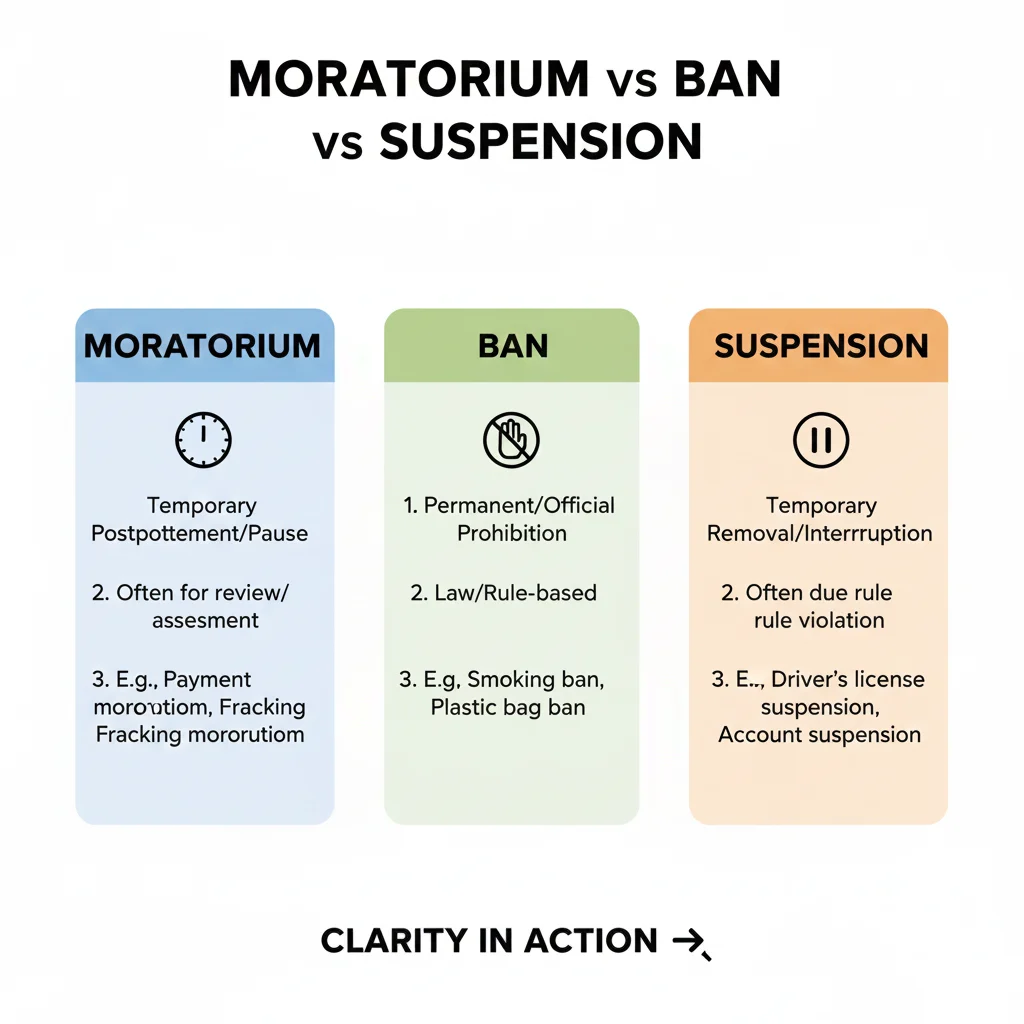
| Ban | A complete and often permanent prohibition. | A moratorium is temporary. |
| Suspension | Temporary stopping of an action or service. | Very close, but not always legally binding. |
| Freeze | Immediate halt, usually for financial assets. | A type of moratorium focused on money or credit. |
| Embargo | Government restriction on trade or goods. | Broader economic or political use. |
These terms are sometimes used interchangeably, but moratorium always implies a formal, temporary delay—not a permanent ban.
✅ How to Use “Moratorium” Correctly
Do’s:
- ✅ Use it in formal, professional, or policy-related writing.
- ✅ Pair it with nouns like “loan,” “construction,” “eviction,” “debt,” or “testing.”
- ✅ Explain its duration or purpose when possible.
Don’ts:
- ❌ Don’t use it in casual or informal chats (it’s not slang).
- ❌ Avoid saying “a permanent moratorium” — that’s contradictory, since moratoriums are temporary by definition.
- ❌ Don’t confuse it with a “ban,” which implies permanence.
⚠️ Common Mistakes or Misinterpretations
- Thinking it means a permanent stop:
→ A moratorium is always temporary, not permanent. - Using it as slang:
→ It’s a formal legal/business term, not common in everyday texting. - Forgetting to mention what’s paused:
→ Always specify: moratorium on what? (e.g., “loan moratorium,” not just “a moratorium”). - Confusing with ‘embargo’ or ‘freeze’:
→ These may overlap, but a moratorium is broader and can apply beyond trade or finance.
❓ FAQ Section
1. What does “moratorium” mean in simple terms?
It means a temporary pause or delay in an activity, law, or payment, usually ordered by an authority.
2. Is a moratorium the same as a ban?
No. A ban is permanent, while a moratorium is temporary and often used for review or relief purposes.
3. What is a loan moratorium?
It’s a temporary relief given to borrowers, allowing them to delay repayments without being penalized.
4. Who can declare a moratorium?
Usually governments, courts, or central banks — depending on the situation (e.g., financial crisis or environmental concerns).
5. How long does a moratorium last?
It varies — from a few weeks to several months — and can be extended or lifted by the issuing authority.
6. Why are moratoriums important?
They provide breathing room during emergencies, help maintain stability, and allow time for policy reassessment.
🏁 Conclusion
To sum it up, a moratorium is a temporary suspension or delay of obligations or activities — often used in law, finance, and policy to provide relief, review, or reform.
Whether it’s a loan moratorium helping citizens in crisis or a construction moratorium protecting the environment, this term represents a crucial pause that enables progress and protection.
Now that you understand what moratorium means, you’ll recognize it the next time it appears in a headline or legal document — and know exactly what kind of “pause” it refers to.

Evie Wyld is a word-meaning specialist at Meanovia.com. She simplifies complex words, phrases, and language trends, helping readers quickly grasp the exact meaning behind every term in a clear and approachable way.