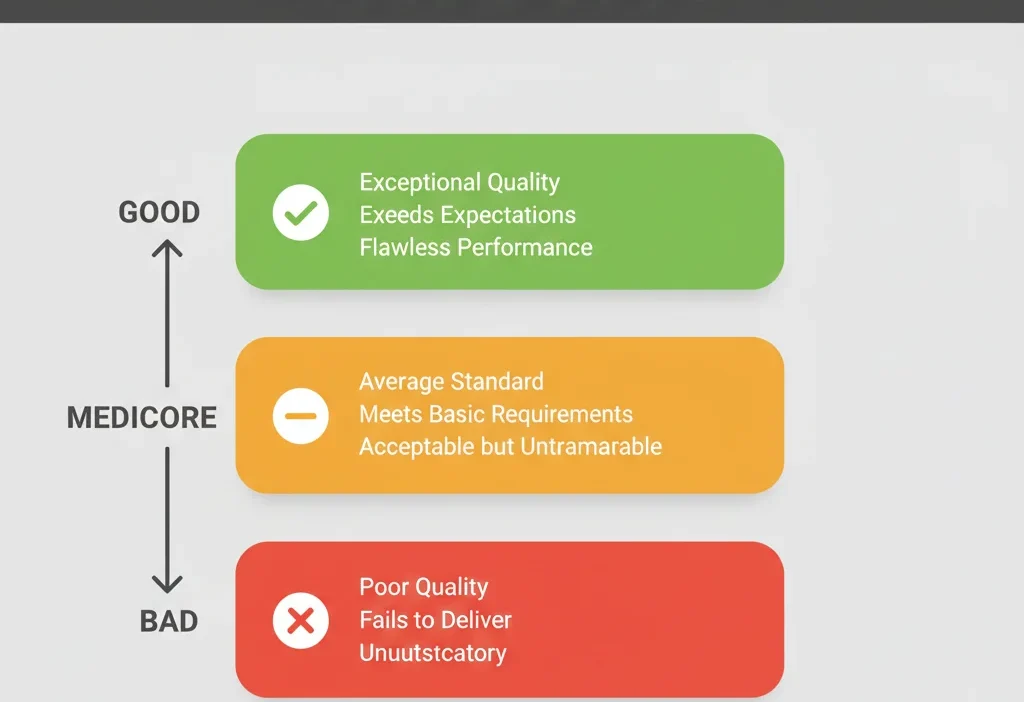
Ever heard someone say, “That movie was mediocre,” and wondered what they really meant?
The word “mediocre” is one of those sneaky terms that sounds polite but carries a subtle sting. It’s often used when something isn’t bad — but definitely not great either.
Mediocre means average or below expectations, describing something that is neither very good nor very bad.
The word mediocre is commonly used in everyday conversation, reviews, and criticism, which is why many people search for its meaning. It describes performance, quality, or results that are ordinary and unimpressive, often falling short of what was hoped for. Calling something mediocre usually carries a negative tone, suggesting a lack of effort, skill, or distinction.
Understanding the meaning of mediocre helps people interpret feedback accurately, whether it appears in school evaluations, workplace reviews, or online opinions. It also allows speakers and writers to express dissatisfaction clearly without being overly harsh, making communication more precise and honest.
💡 What Does “Mediocre” Mean?
“Mediocre” means something of average or below-average quality — not very good, but not terrible either.
It’s an adjective used to describe things that are ordinary, uninspired, or unimpressive. You’ll often hear it in casual speech, reviews, or business feedback.
👉 Quick Definition
Mediocre refers to something that is only average in quality; not very good.
📜 Origin and Popularity of “Mediocre”
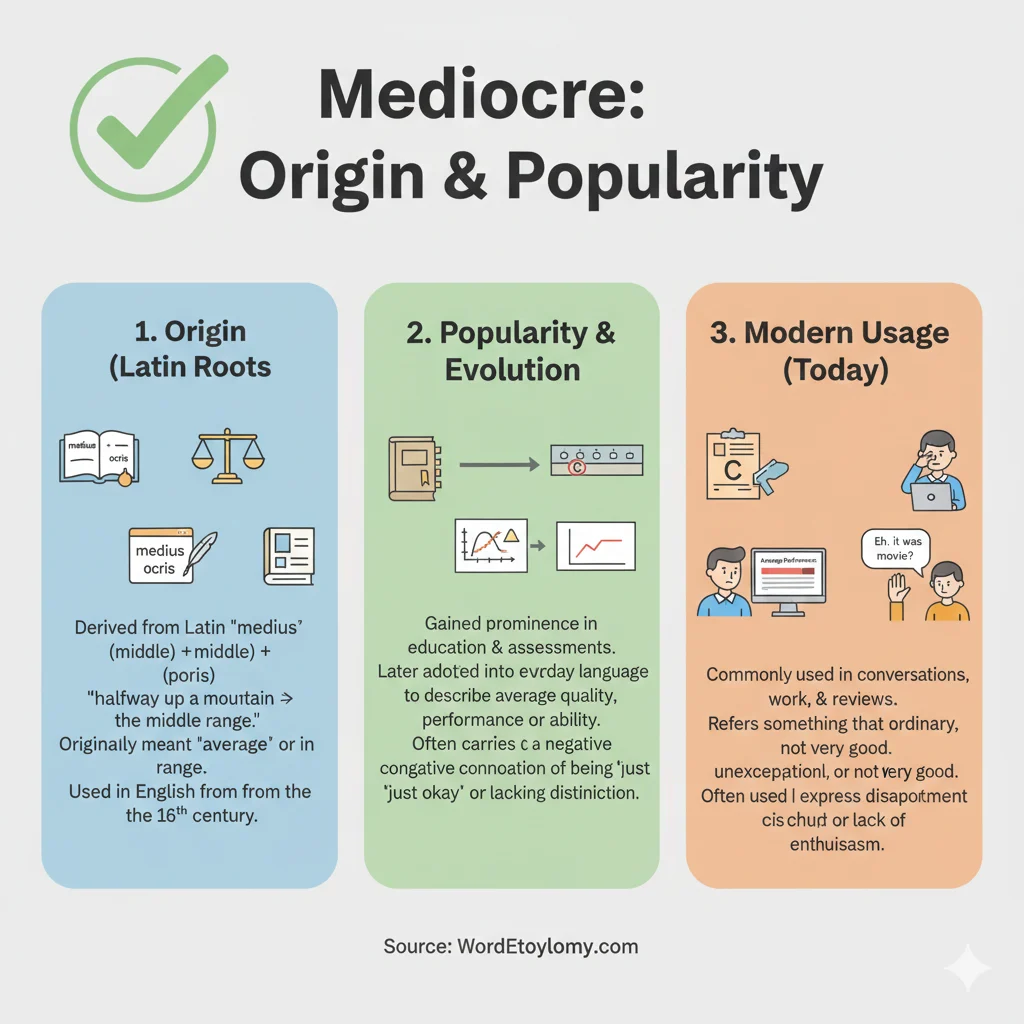
The word “mediocre” comes from the Latin word mediocris, meaning “of middle height or degree.”
It entered the English language in the late 16th century through French and Latin roots, and it literally referred to something “halfway up the mountain” — neither at the bottom nor the top.
Over time, “mediocre” evolved to describe average performance or quality, especially when better is expected.
It gained popularity in modern English for its subtly critical tone — a polite way to say something didn’t impress.
🕓 Timeline snapshot:
- 1500s: Derived from Latin mediocris (“middle”).
- 1600s: Adopted into English meaning “moderate quality.”
- Modern usage: Common in reviews, workplace feedback, and daily conversation.
🌐 “Mediocre” Meaning in Different Contexts
🗨️ In Everyday Conversation
Used to describe something average or underwhelming.
Example: “The concert was okay — kind of mediocre, to be honest.”
💼 In Business or Professional Settings
Often used in performance reviews or market analysis to express that something fails to stand out.
Example: “The company’s quarterly results were mediocre compared to competitors.”
🎬 In Entertainment or Reviews
Used to express disappointment or lack of originality.
Example: “Critics called the sequel mediocre, lacking the charm of the original.”
| Context | Meaning | Example |
| Conversation | Average or unimpressive | “The food was mediocre.” |
| Business | Below expectations | “Sales performance was mediocre.” |
| Reviews | Not exciting or original | “The show got mediocre ratings.” |
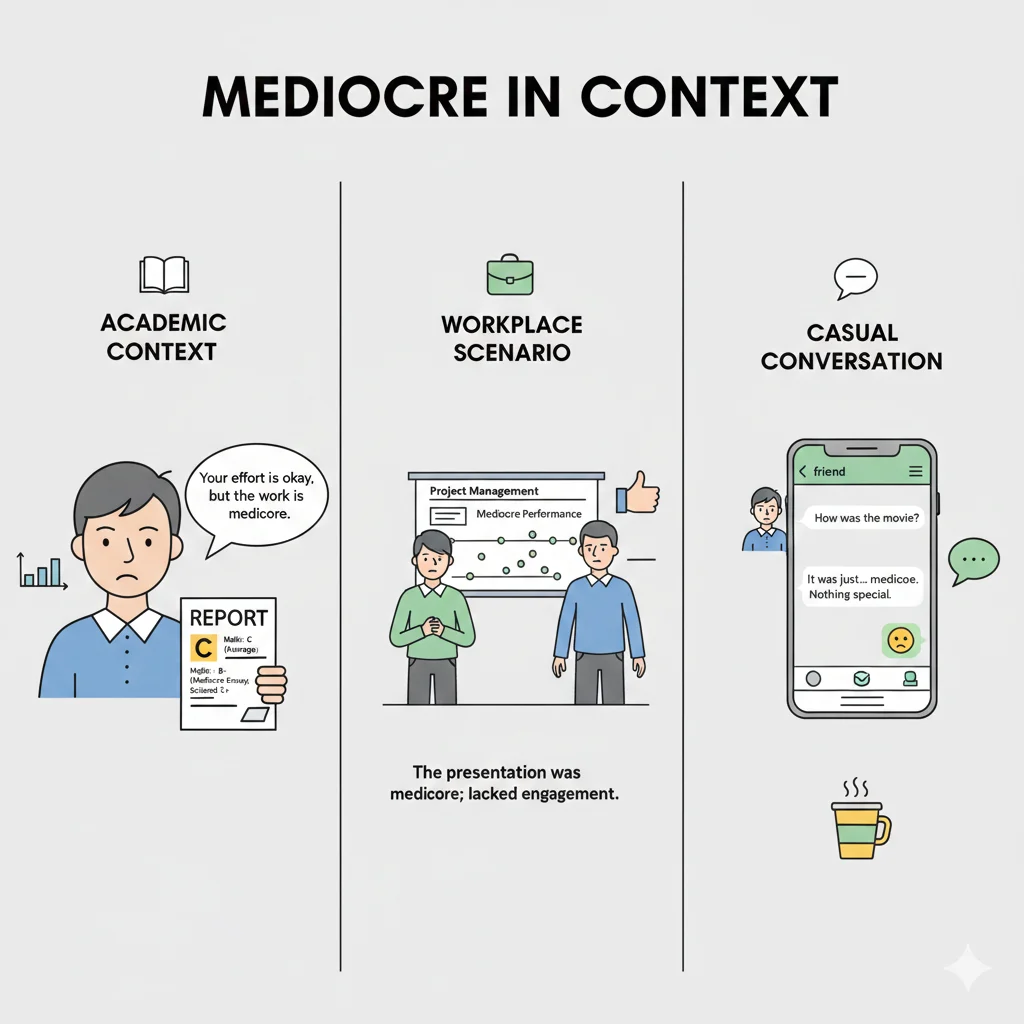
💬 Examples of “Mediocre” in Conversations
Example 1:
Friend 1: Did you like the restaurant?
Friend 2: Eh, it was mediocre — nothing special.
Example 2:
Manager: How was the client feedback?
Employee: Mostly mediocre; they weren’t too thrilled.
Example 3:
Critic’s Review: “Despite its promising trailer, the film delivered a mediocre storyline.”
Example 4 (Formal):
“The CEO warned that mediocre performance would not meet the company’s growth goals.”
🔄 Similar or Related Terms
Here are some related terms to “mediocre” that help fine-tune meaning and tone:
| Term | Meaning | Tone |
| Average | Ordinary, typical | Neutral |
| Subpar | Below expected standard | Negative |
| Decent | Acceptable but not great | Mildly positive |
| So-so | Neither good nor bad | Casual |
| Unremarkable | Fails to stand out | Neutral to negative |
🧭 How to Use “Mediocre” Correctly
✅ Do’s:
- Use it when describing something average or underwhelming.
- Suitable for reviews, casual speech, and feedback.
- Works well to politely express disappointment.
❌ Don’ts:
- Don’t use it in formal praise or motivational contexts.
- Avoid using it toward people directly (e.g., “You’re mediocre”) — it can sound insulting.
- Don’t confuse it with “moderate” (which can mean balanced or reasonable).
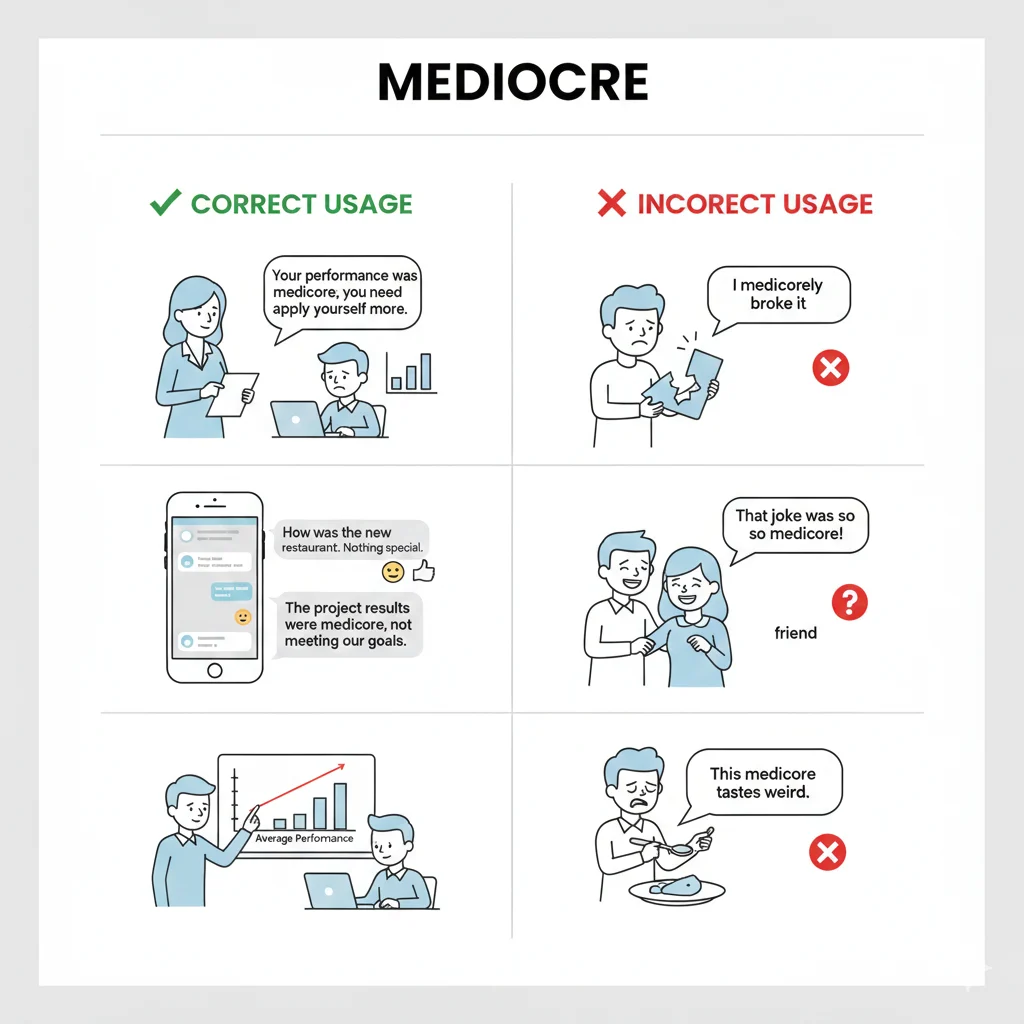
⚠️ Common Mistakes or Misinterpretations
- Confusing “mediocre” with “average”
- “Average” is neutral, while “mediocre” often carries a slightly negative tone.
- “Average” is neutral, while “mediocre” often carries a slightly negative tone.
- Thinking it means “bad”
- It doesn’t mean terrible — just not impressive.
- It doesn’t mean terrible — just not impressive.
- Using it for intensity
- “Mediocre” describes quality, not quantity or emotion. Saying “a mediocre amount” is incorrect.
- “Mediocre” describes quality, not quantity or emotion. Saying “a mediocre amount” is incorrect.
❓ FAQ: Mediocre Meaning Explained
1. What does “mediocre” mean in simple terms?
“Mediocre” means average or not very good — something that’s fine, but not impressive.
2. Is “mediocre” an insult?
Not always, but it can be mildly negative. It suggests something lacks excellence or effort.
3. What’s the difference between “mediocre” and “average”?
“Average” is neutral, while “mediocre” implies disappointment or underperformance.
4. How do you use “mediocre” in a sentence?
Example: “The pizza was mediocre — I’ve had better.”
5. Can a person be described as “mediocre”?
Yes, but it’s often insulting. It means the person is ordinary or uninspired in performance or ability.
6. What’s a stronger word for “mediocre”?
Alternatives include subpar, uninspired, or lackluster, depending on the tone.
🏁 Conclusion
To sum it up, “mediocre” means something that’s just okay — neither great nor terrible.
It comes from Latin roots meaning “middle,” perfectly capturing the idea of being in-between good and bad.
Now that you know what “mediocre” really means and how to use it, you’ll never mistake it for a compliment again!
Keep exploring our site for more simple, smart explanations of everyday words and slang.

Jon McGregor is a language and word-meaning expert at Meanovia.com. He specializes in explaining complex words, phrases, and modern language trends in a clear, approachable style. His mission is to help readers quickly grasp the true meaning behind every term, making language learning and understanding effortless and engaging.