
Have you ever heard someone say, “They acted out of malice,” and wondered what that really means?
It’s a word that often appears in movies, court cases, and everyday conversations — but it’s not always clear what it implies about someone’s intentions.
In this article, we’ll break down:
✅ The definition of malice
✅ Its origin and how it became a common English term
✅ Different contexts (legal, everyday, and emotional)
✅ Examples of how to use “malice” correctly
✅ Related words, common mistakes, and FAQs
⚖️ What Does Malice Mean?
Malice means the intention or desire to cause harm, pain, or suffering to someone — either through words, actions, or decisions.
It’s not slang or an abbreviation but a formal English noun commonly used in legal, moral, and social contexts.
📜 Origin and Popularity
The word malice comes from the Latin term malitia, meaning “badness” or “wickedness.” It entered Middle English through Old French (malice) around the 13th century.
Over time, it evolved from describing pure evil to any intentional act meant to harm another — whether emotionally, physically, or reputationally.
Today, “malice” is widely recognized across legal systems and everyday speech. You’ll find it in phrases like:
- “Acted with malice”
- “Out of malice”
- “Malicious intent”
🕰️ Timeline Snapshot:
- 1200s: First recorded in English legal writings.
- 1800s: Used in literature and public discourse to describe cruelty.
- Modern day: Common in legal, moral, and social discussions about intent and ethics.
🧠 Malice Meaning in Different Contexts
The meaning of malice depends on where and how it’s used. Let’s explore some common scenarios:
💬 In Everyday Conversations
In daily speech, “malice” describes a person’s ill will or desire to hurt someone emotionally or socially.
Example: “She spread those rumors out of malice, not truth.”
⚖️ In Legal Contexts
In law, malice refers to the intent to commit a wrongful act without justification. It’s often mentioned in cases like defamation, assault, or murder.
Example: “The court found that the defendant acted with malice aforethought.”
🧘 In Emotional or Psychological Contexts
“Malice” can also describe deep resentment or bitterness that motivates harmful actions or thoughts.
Example: “He smiled without malice, showing genuine forgiveness.”
| Context | Meaning | Tone |
| Legal | Intent to harm or act unlawfully | Formal, Objective |
| Everyday | Ill will or spiteful behavior | Conversational |
| Emotional | Deep resentment or bitterness | Reflective, Personal |
🗣️ Examples of “Malice” in Conversations
Example 1:
Friend 1: Why did she post that about you?
Friend 2: Honestly, I think it was out of malice — she’s still upset.
Example 2:
“He criticized her work, but not out of malice — he just wanted to help her improve.”
Example 3 (legal setting):
“The prosecution argued that the crime was committed with malice aforethought.”
Example 4 (literary):
“Her eyes glimmered with malice, a subtle sign of the storm brewing inside her.”
🧩 Similar or Related Terms
| Term | Meaning | Usage Example |
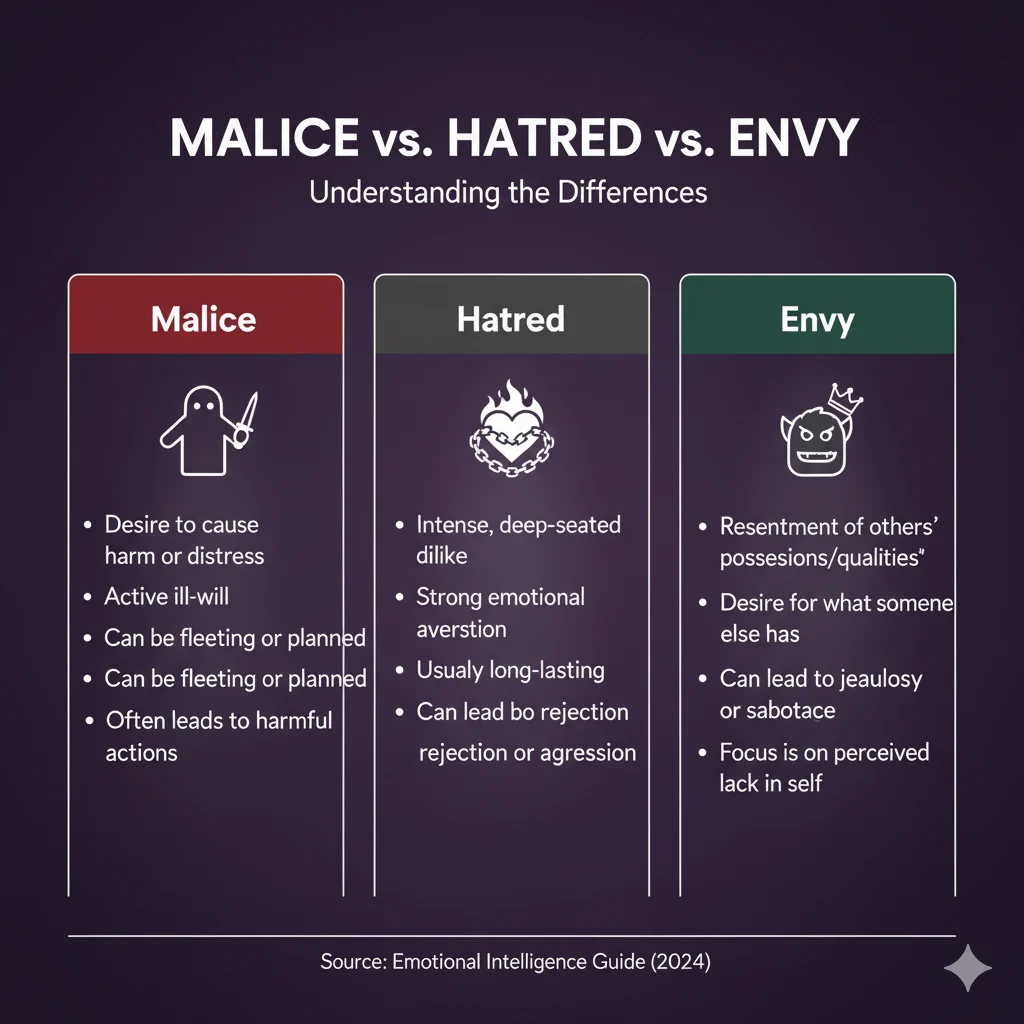
| Hatred | Deep dislike or hostility | “He acted out of hatred, not reason.” |
| Spite | Petty desire to annoy or hurt | “She ignored him out of spite.” |
| Envy | Resentment of another’s success or qualities | “His envy turned into malice over time.” |
| Ill Will | General bad feeling toward someone | “There was no ill will between them.” |
These words share emotional roots but vary in intensity and motivation.
Malice specifically implies intentional harm — not just bad feelings.
✍️ How to Use “Malice” Correctly
✅ Do’s:
- Use it to describe intentional harm or cruelty.
- Appropriate in formal writing, essays, and legal contexts.
- Can be used metaphorically in literature or emotional discussions.
❌ Don’ts:
- Avoid using it casually or humorously (it’s a serious term).
- Don’t confuse it with anger or annoyance — malice implies purposeful harm, not just emotion.
Example:
✅ “He acted with malice.”
❌ “I’m malice at him.” (Incorrect grammar and usage)
🚫 Common Mistakes or Misinterpretations
- Confusing “malice” with “malicious.”
→ “Malice” is a noun; “malicious” is an adjective.
Example: “She acted with malice.” vs. “She had a malicious plan.” - Assuming malice is always visible.
→ Not all malice is obvious — it can be hidden behind kind gestures or subtle words. - Using it too casually.
→ Because of its gravity, it’s better suited for formal or emotional discussions, not jokes.
❓ FAQ Section
1. What does malice mean in simple words?
Malice means wanting to hurt someone on purpose — either emotionally, physically, or socially.
2. What’s the difference between malice and hatred?
Hatred is an emotion; malice is an intent. You can hate someone silently, but acting with malice means trying to cause harm.
3. Is malice a crime?
Not by itself — but acting with malice can make certain crimes more serious, such as “malice aforethought” in murder cases.
4. What does “malicious intent” mean?
It refers to planning or doing something harmful on purpose, knowing it could hurt someone.
5. Can someone act with malice unintentionally?
No. By definition, malice involves intentional wrongdoing — it’s not accidental.
6. How do you use “malice” in a sentence?
“He destroyed the evidence out of malice toward his rival.”
🪞 Conclusion
To sum up, malice means the deliberate intention to cause harm or suffering.
It’s a timeless concept found in literature, law, and human behavior — a reminder of how powerful and dangerous human intent can be.
Now that you know what malice truly means, you’ll recognize it in conversations, stories, and even headlines — and understand when it’s being used seriously.
✨ Keep exploring our site for more word meanings, language insights, and real-world examples that make communication clearer and smarter.

Claire Fuller is a word-meaning specialist at Meanovia.com. She explains complex words, phrases, and language trends in a clear, relatable way, helping readers quickly understand the exact meaning behind every term.