

Ever heard the word “krill” and wondered what it really means?
Krill are small crustaceans (sea creatures with a hard outer shell, like shrimp or prawns). They swim in huge groups called swarms and are a very important part of the ocean food chain.
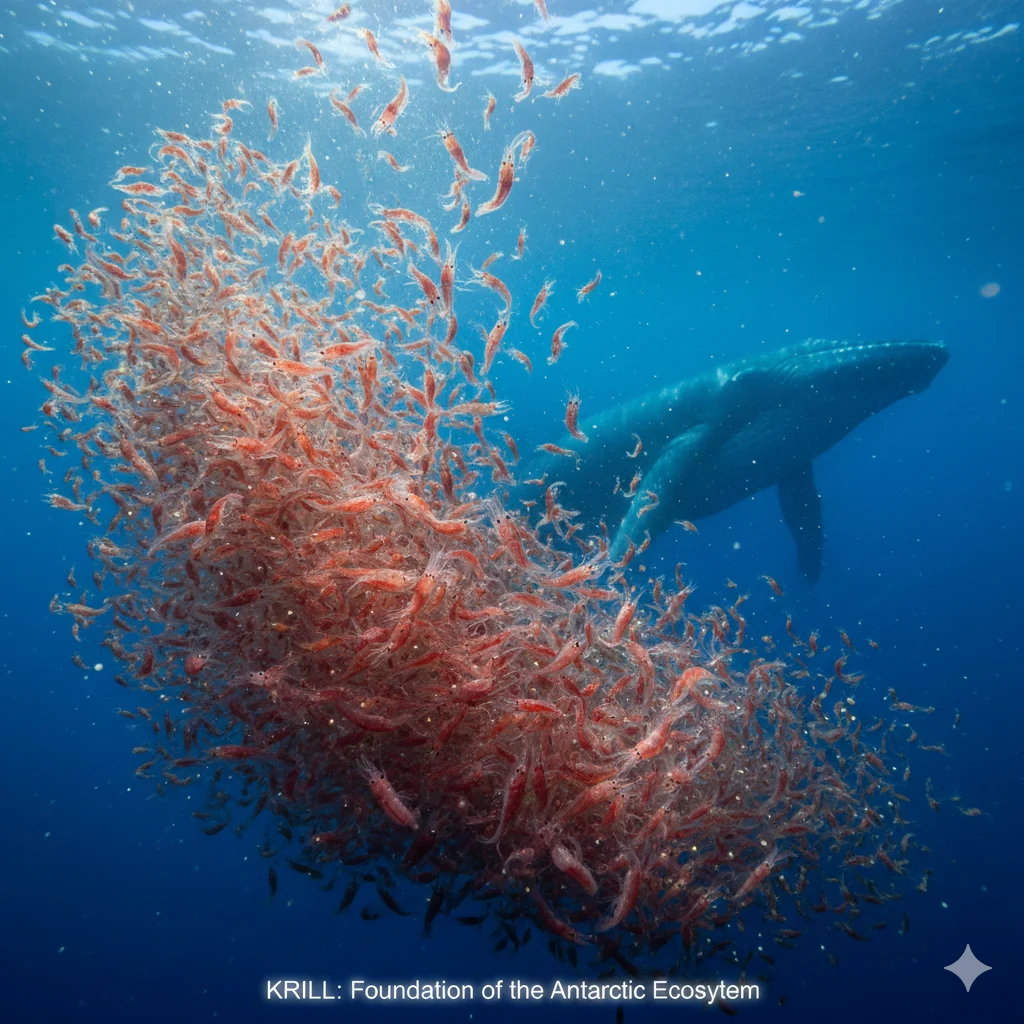
Key Facts:
Where they live: Found in all oceans, but they are most abundant in the cold waters around Antarctica.
Scientific name: They belong to the order Euphausiacea. The most famous type is Antarctic krill (Euphausia superba).
Size: Most krill are about 1 to 6 cm (0.4 to 2.4 inches) long — roughly the size of your little finger.
Appearance: They look like miniature transparent shrimp with big black eyes and many tiny legs.
You have probably seen it in nature documentaries, nutrition blogs, supplement labels, or maybe a biology class. But most people do not realize just how important this tiny creature actually is — to the ocean, to animals, and even to human health.
In this complete guide, you will learn:
- What krill means in simple English
- The Norwegian origin of the word krill
- Krill meaning in Hindi, Urdu, Bengali, Tamil, Telugu, Arabic, Sinhala, and more
- What “krill” means in slang
- Krill vs crill — which is correct?
- The plural of krill
- Blue whales and their krill diet
- Krill oil, nutrition, and health benefits
- Krill in the ocean ecosystem
- Krill meaning in urban slang
- Real examples and a complete FAQ section
Let’s get into it.
What Does Krill Mean?
Krill refers to small, shrimp-like marine crustaceans that live in the world’s oceans.
They are one of the most important animals on Earth — even though they are tiny. Krill are a primary food source for whales, seals, penguins, squid, and many fish species.
Krill definition in simple words:
Krill = tiny, shrimp-like sea creatures that live in huge swarms in the ocean and feed animals much bigger than themselves.
The word “krill” is not slang or an acronym. It is a real scientific and ecological term used in marine biology, environmental science, nutrition, and everyday conversation.
Is krill a word? Yes — absolutely. It is a real English word with a specific scientific meaning. It appears in biology textbooks, health magazines, news articles, and conversations about the ocean.
Krill Etymology — Norwegian Origin of the Krill Name
Krill etymology Norwegian and Norwegian origin of krill name and Norwegian word origin — the story of where the word “krill” comes from is really interesting.
The word “krill” comes directly from the Norwegian word “krill,” which means “small fry of fish” or “tiny creatures.”
Norwegian sailors and fishermen were some of the first people to study the deep, cold waters of the North Atlantic and Antarctic oceans. When they encountered the massive swarms of tiny shrimp-like creatures floating through the water, they called them “krill” — their word for the smallest, tiniest sea creatures.
Krill etymology Norwegian — the Norwegian word itself likely came from older Dutch and Low German words for small creatures or small fry. The root relates to the idea of something extremely tiny — so small it barely seems significant on its own.
When did “krill” enter English? The word was first recorded in English in the early 19th century — borrowed directly from Norwegian by sailors and scientists studying ocean life.
Over time, the word moved from the language of sailors to the language of scientists, then to health magazines, documentaries, and everyday speech.
Timeline of krill’s journey through language:
- Norwegian sailing tradition: Sailors call tiny ocean creatures “krill”
- 1800s: The word enters English scientific literature
- 1900s: Krill recognized as a vital species in Antarctic ecosystems
- 2000s–Present: Krill popularized globally through BBC Earth, National Geographic, and health supplement marketing
So every time you say the word “krill” in English — you are using a Norwegian sailor’s word for the tiniest creatures of the sea.
Krill Meaning in Different Languages
Krill is a global creature — and people around the world search for its meaning in their own languages. Let’s cover the most common ones.
Krill Meaning in Hindi
Krill meaning in Hindi:
Krill = क्रिल (Kril) — छोटे समुद्री झींगा जैसे जीव जो समुद्र में रहते हैं।
In simple Hindi:
Krill = समुद्री क्रिल — ये बहुत छोटे जीव होते हैं जो समुद्र में झुंडों में रहते हैं और व्हेल, सील और पेंगुइन का मुख्य भोजन हैं।
Krill oil is also well known in India as a health supplement — many people search for krill meaning in Hindi when reading supplement labels or watching nature documentaries.
Krill Meaning in Urdu
Krill meaning in Urdu:
Krill = کرل — سمندر میں رہنے والے چھوٹے جھینگا نما جانور جو وہیل اور سیل کی غذا ہیں۔
In simple Urdu:
Krill چھوٹے سمندری جانور ہیں جو جھنڈوں میں سفر کرتے ہیں اور سمندری خوراک کی زنجیر میں بنیادی کردار ادا کرتے ہیں۔
Krill Meaning in Bengali
Krill meaning in Bengali:
Krill = ক্রিল — সমুদ্রে বসবাসকারী ছোট্ট চিংড়ি-সদৃশ প্রাণী যারা তিমি, পেঙ্গুইন ও সিলের প্রধান খাদ্য।
In simple Bengali:
ক্রিল হলো সমুদ্রের ক্ষুদ্র প্রাণী — এরা দলে দলে চলে এবং সামুদ্রিক খাদ্যশৃঙ্খলের সবচেয়ে গুরুত্বপূর্ণ অংশ।
Krill Meaning in Tamil
Krill meaning in Tamil:
Krill = கிரில் — கடலில் வாழும் சிறிய இறால் போன்ற உயிரினங்கள், இவை திமிங்கலம், பெங்குயின் மற்றும் கடல் சிங்கங்களின் முக்கிய உணவு.
In simple Tamil:
கிரில் என்பது மிகவும் சிறிய கடல் உயிரினங்கள் — இவை கூட்டமாக நீந்தி பெரிய கடல் விலங்குகளுக்கு உணவாகின்றன.
Krill Meaning in Telugu
Krill meaning in Telugu:
Krill = క్రిల్ — సముద్రంలో నివసించే చిన్న రొయ్యల లాంటి జీవులు, ఇవి తిమింగలాలు, పెంగ్విన్లు మరియు సీళ్ళకు ప్రధాన ఆహారం.
In simple Telugu:
క్రిల్ అంటే చాలా చిన్న సముద్ర జీవులు — ఇవి గుంపులలో తిరుగుతాయి మరియు సముద్ర ఆహార గొలుసులో చాలా ముఖ్యమైన పాత్ర పోషిస్తాయి.
Krill Meaning in Sinhala
Krill meaning in Sinhala:
Krill = ක්රිල් — සමුද්රයේ ජීවත් වන කුඩා ඉස්සන් වැනි සත්ත්වයන් වන අතර, ඔවුන් තල්මසුන්, පෙන්ගුයින් සහ මුද්රාවන්ගේ ප්රධාන ආහාරය වේ.
Krill Meaning in Arabic
Krill meaning in Arabic:
Krill = كريل (Kril) — حيوانات بحرية صغيرة تشبه الروبيان، تعيش في المحيطات وتُشكّل الغذاء الرئيسي للحيتان والأختام وطيور البطريق.
In simple Arabic explanation:
الكريل هي مخلوقات بحرية صغيرة جداً تسبح في أسراب ضخمة وتُغذّي أكبر الحيوانات في المحيطات.
(The krill are very tiny sea creatures that swim in huge swarms and feed the largest animals in the oceans.)
Krill Betekenis (Dutch)
Krill betekenis — in Dutch, “betekenis” means “meaning.” For Dutch speakers:
Krill betekenis: Krill zijn kleine garnaalachtigen die in de oceanen leven en het belangrijkste voedsel zijn voor walvissen, pinguïns en zeehonden.
(Krill are small shrimp-like crustaceans living in the oceans and are the main food source for whales, penguins, and seals.)
Krill 복수형 (Korean)
Krill 복수형 — in Korean, “복수형” means “plural form.” Korean speakers want to know the plural of krill.
Korean explanation:
크릴(krill)의 복수형은 그냥 “krill”입니다 — 단수와 복수가 같은 형태입니다. “krills”라고 하지 않습니다.
(The plural of krill is simply “krill” — the singular and plural are the same form. Do not say “krills.”)
Krill Plural — What Is the Correct Form?
Plural of krill and krill plural — this is one of the most common questions about the word.
The correct plural of krill is: krill.
That is right — krill is both singular AND plural. You do not add an “s.”
| Wrong | Correct |
|---|---|
| “I saw many krills in the ocean.” | “I saw many krill in the ocean.” |
| “The whale ate hundreds of krills.” | “The whale ate hundreds of krill.” |
| “Krills are important to the ecosystem.” | “Krill are important to the ecosystem.” |
This is similar to other words in English that do not change in their plural form — like “sheep,” “fish,” or “deer.”
“One krill” → “Many krill” ✅ “One krill” → “Many krills” ❌
Crill vs Krill — Which Is Correct?
Many people search for “crill meaning,” “crill definition,” “crill or krill,” and “is crill a word?”
The correct spelling is KRILL — not “crill.”
“Crill” is simply a common misspelling or mishearing of the word “krill.” There is no such word as “crill” in standard English. If you have seen “crill” somewhere, it was either:
- A typo or spelling mistake
- An autocorrect error
- A brand name or slang in a very specific context
Crill definition — there is no standard definition for “crill” because it is not a real word. The animal you are thinking of is called krill — K-R-I-L-L.
Cryll meaning — same situation. “Cryll” is not a real word. It is a misspelling of krill.
Is crill a word? No — not in standard English. The correct word is krill.
Krill Meaning in Slang and Urban Context
Krill meaning slang, krill slang, krills slang, and krill meaning urban — does krill have a slang meaning?
In formal language, krill is purely a scientific term for the small ocean creatures. However, in informal internet culture and slang, krill has been used in a few creative ways:
1. Something Small but Surprisingly Important
In internet memes and casual conversations, “krill” is sometimes used metaphorically to describe something that looks tiny and insignificant but actually plays a huge role in a bigger system.
“I know I’m just an intern but I’m not going to be krill forever 😤” “Don’t underestimate the krill in this operation.”
2. A Small Person in a Big System
Sometimes used humorously to describe feeling like a tiny, unimportant part of something massive.
“In this corporate machine, I am literally krill.” “Me trying to fix the global economy: krill energy 😂”
3. Urban Slang — Minor but Essential
In some online communities, “krill” has become a playful way to say something is small-scale but essential.
“Our group chat is the krill of the friend group — without us, the whole thing collapses.”
Krill meaning urban — Urban Dictionary-style use of krill often references the scientific reality (tiny but crucial) and applies it humorously to social situations.
These slang uses are all inspired by the real biological meaning — krill are tiny creatures that hold up entire ocean ecosystems. The metaphor is powerful.
What Are Krill? — The Science Explained Simply
Now let’s go deeper into what krill actually are — for students, curious readers, and anyone who wants the full picture.
What Kind of Animal Is a Krill?
Krill are crustaceans — the same animal family as shrimp, crabs, and lobsters. They belong to the scientific order Euphausiacea.
They are NOT fish. They do not have scales or a backbone. They are invertebrates — animals without a spine.
A single krill looks like a tiny transparent shrimp. Most species are between 1 and 6 centimeters long — about the size of your finger or smaller.
Their bodies are semi-transparent, and you can often see their internal organs through their shell. They have multiple legs, two antennae, and a small tail fan for swimming.
Where Do Krill Live?
Krill live in all of the world’s major oceans. However, they are most abundant in:
- The Southern Ocean (around Antarctica) — home to the most studied species, Antarctic krill (Euphausia superba)
- The North Pacific Ocean
- The North Atlantic Ocean
A common mistake is thinking krill only live in Antarctica. They exist in cold and deep waters worldwide — the Antarctic population is just the largest and most studied.
How Do Krill Move?
Krill swim in massive groups called swarms or superswarms. These swarms can be enormous — sometimes covering hundreds of square kilometers of ocean and containing billions of individual krill.
From the surface, a krill swarm can turn the water a reddish-pink color because of the sheer number of creatures packed together.
What Do Krill Eat?
Krill feed primarily on phytoplankton — microscopic plant-like organisms that float near the surface of the ocean and use sunlight to grow.
Krill are one of the most important links in the ocean food chain because they convert tiny phytoplankton energy into something that much larger animals can eat.
Blue Whales and Their Krill Diet
Blue whales krill diet — this is one of the most fascinating facts in all of nature.
The blue whale is the largest animal that has ever existed on Earth. It can grow up to 30 meters (100 feet) long and weigh up to 200 tons.
And yet — its almost entire diet consists of krill. Creatures smaller than your thumb.
How much krill does a blue whale eat?
An adult blue whale can eat up to 4 tons (4,000 kilograms) of krill per day during feeding season. That is roughly 40 million individual krill — every single day.
To feed, a blue whale uses a technique called lunge feeding. It swims fast toward a dense swarm of krill, opens its enormous mouth, takes in a huge gulp of water and krill, then pushes the water out through its baleen plates (comb-like filters) while the krill stay trapped inside. Then it swallows.
Why does the largest animal on Earth eat the tiniest? Because krill exist in such massive quantities and such dense swarms that they represent the most efficient food source in the ocean. One lunge can deliver millions of calories. The blue whale does not need to chase individual prey — it just swims into the swarm.
This is one of nature’s most powerful examples of small things having enormous impact.
Other animals that depend heavily on krill:
- Humpback whales — also lunge feeders
- Minke whales
- Penguins (especially Emperor and Adélie penguins)
- Leopard seals and crabeater seals
- Squid
- Many species of fish
Krill in the Ocean Ecosystem
Krill are not just food — they are one of the most important animals in the entire ocean ecosystem.
The Ocean Food Chain
Here is how krill fit into the ocean food web:
Sunlight → Phytoplankton → Krill → Whales, Seals, Penguins, Fish
Without krill, this chain breaks down. If krill disappeared:
- Whale populations would collapse
- Penguin populations would collapse
- Fish populations would drop dramatically
- The entire Southern Ocean ecosystem would be destabilized
Carbon Cycling
Krill also play an important role in carbon cycling — one of the processes that helps regulate Earth’s climate.
When krill eat phytoplankton, they absorb carbon. When krill die and sink to the ocean floor, that carbon gets buried deep in the sea — effectively removing it from the atmosphere.
Scientists estimate that krill may be responsible for removing hundreds of millions of tons of carbon from the atmosphere each year. This makes them important players in fighting climate change.
Bioluminescence
Many krill species are bioluminescent — they can produce their own light. Small organs along their body glow with a pale blue-green light, especially at night. Scientists are still studying exactly why krill glow, but it may help them communicate or coordinate within their swarms.
Krill Oil — Health and Nutrition
Krill in health and nutrition — one of the most practical reasons people search for krill meaning is because of krill oil supplements.
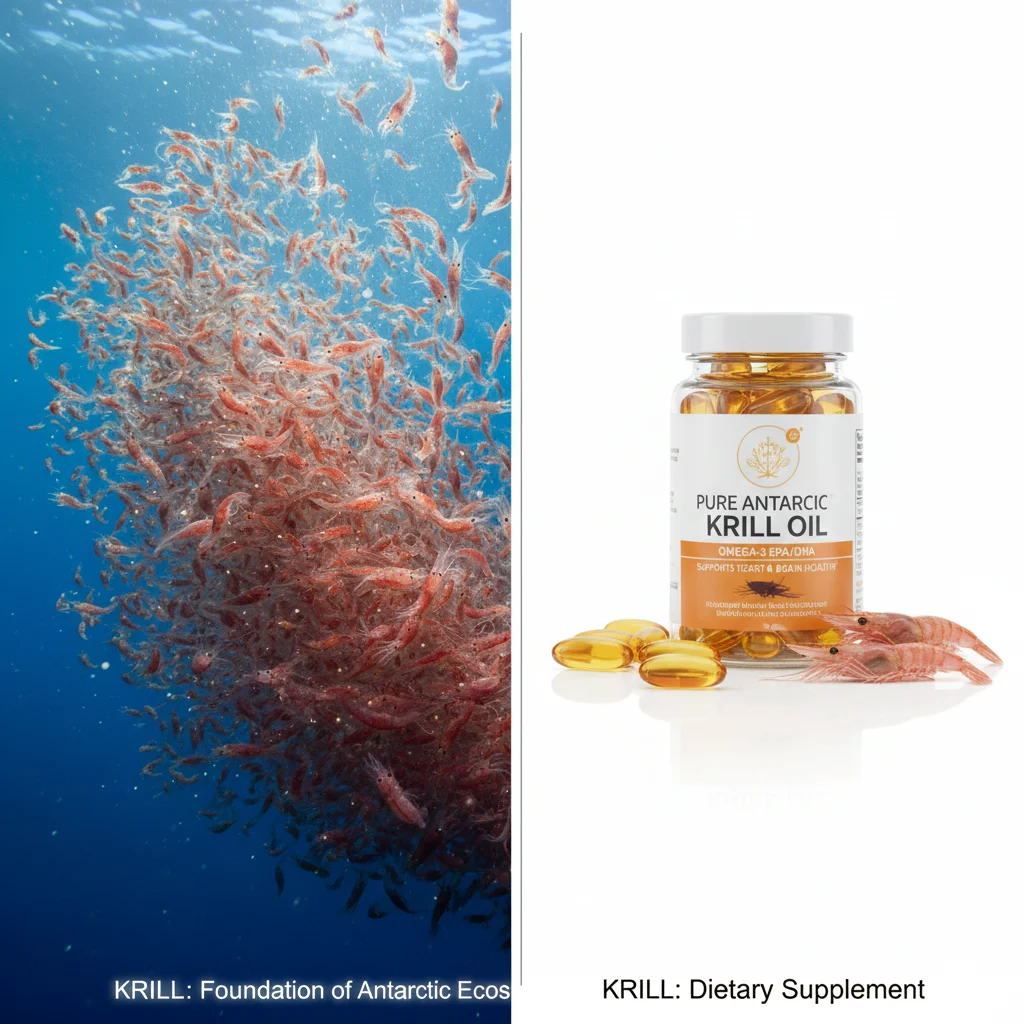
What is krill oil? Krill oil is an oil extracted from Antarctic krill. It is rich in omega-3 fatty acids — specifically EPA (eicosapentaenoic acid) and DHA (docosahexaenoic acid).
What is krill oil used for? Krill oil is taken as a dietary supplement to support:
- Heart health — omega-3s help reduce triglycerides and support healthy cholesterol
- Brain health — DHA is important for brain function and development
- Joint health — omega-3s have anti-inflammatory properties that may help with joint pain
- Eye health — DHA is a key component of the retina
Krill oil vs fish oil: Both contain omega-3 fatty acids, but krill oil has some advantages:
| Krill Oil | Fish Oil | |
|---|---|---|
| Omega-3 form | Phospholipid (absorbs better) | Triglyceride |
| Absorption | Easier for the body to absorb | Standard absorption |
| Antioxidants | Contains astaxanthin (powerful antioxidant) | Minimal antioxidants |
| Smell | Less fishy smell | Can have strong fishy odor |
| Sustainability | Often more sustainable | Varies by source |
| Price | Usually more expensive | Generally cheaper |
“Many people prefer krill oil to fish oil because it is easier to digest and has less of a fishy aftertaste.”
Krill in Pop Culture and Media
Krill has appeared in various forms of pop culture and media:
Nature documentaries: BBC Earth’s Blue Planet and Our Planet series have featured stunning footage of krill swarms and the whales that feed on them. These documentaries brought krill to mainstream global audiences.
Environmental awareness: As climate change threatens ocean temperatures and sea ice, krill populations are increasingly in the news. Krill depend on sea ice algae for food in winter, so melting ice affects their survival — which then affects everything that eats them.
Metaphorical use: As discussed in the slang section, krill is sometimes used metaphorically to describe something tiny but essential.
“Like krill in the ocean, every small effort counts in making a global impact.” “Don’t sleep on the krill — without them, the whole ocean collapses.”
Examples of Krill in Sentences
Here are natural examples showing how “krill” is used in different contexts:
Scientific:
“Antarctic krill form the foundation of the Southern Ocean’s food web.” “Blue whales can eat up to 4 tons of krill a day during feeding season.” “Krill swarms can stretch for hundreds of kilometers across the ocean surface.”
Health and nutrition:
“Many people take krill oil as an alternative to fish oil for omega-3 supplements.” “Krill oil contains astaxanthin, a powerful antioxidant not found in regular fish oil.”
Educational:
Teacher: “Who knows what blue whales eat?” Student: “Krill!” Teacher: “Exactly — and a blue whale eats 40 million of them every single day.”
Metaphorical:
“In this massive organization, I sometimes feel like krill in the ocean.” “We might be krill right now, but krill run the ocean.”
Slang / Humorous:
“Not me having full krill energy at this company meeting 😂” “I’m the krill of this friend group and I own it.”
Similar and Related Terms
Here are related terms often used alongside “krill” in biology and nutrition:
| Term | Meaning |
|---|---|
| Plankton | Microscopic organisms floating in the ocean; krill feed on them |
| Zooplankton | Animal-like plankton, including krill |
| Phytoplankton | Plant-like microorganisms that krill consume |
| Euphausiids | The scientific family name for krill (order Euphausiacea) |
| Fish oil | Oil from fish tissues — similar omega-3 content to krill oil |
| Omega-3 | Essential fatty acids found in krill oil |
| Astaxanthin | A powerful antioxidant found specifically in krill oil |
| Baleen | The filter structure in whale mouths used to trap krill |
| Bioluminescence | The ability to produce light — found in many krill species |
| Crustacean | The animal class krill belong to — like shrimp and crabs |
How to Use “Krill” Correctly
Do’s:
- Use “krill” when referring to small ocean crustaceans or marine food sources
- Use “krill oil” in health or nutrition contexts
- Remember that krill is both singular and plural — do not say “krills”
- Mention it when discussing ocean ecosystems, omega-3 supplements, or blue whale diets
Don’ts:
- Do not spell it “crill” or “cryll” — the correct spelling is K-R-I-L-L
- Do not say “krills” — the plural is still just “krill”
- Do not confuse krill with plankton — krill are animals, plankton are microscopic organisms
- Do not assume krill only live in Antarctica — they exist in all major oceans
Common Mistakes and Misunderstandings
Thinking krill are fish: Krill are crustaceans — the same family as shrimp and crabs. They have a hard shell, multiple legs, and no backbone. They are not fish.
Saying “krills”: The plural of krill is krill. Always. “I saw thousands of krill” — not “krills.”
Spelling it “crill”: The correct spelling is krill with a K. “Crill” is not a word.
Thinking krill only live in Antarctica: Antarctic krill are the most famous and abundant, but krill species live in all major oceans around the world.
Confusing krill with plankton: Krill feed on plankton — they are not the same thing. Plankton are microscopic (often invisible to the naked eye). Krill are small but visible — up to 6 centimeters long.
FAQ Section
Q: What does krill mean in simple terms?
A: Krill are tiny shrimp-like creatures that live in oceans worldwide and serve as the main food source for blue whales, seals, penguins, and many fish species. They are crustaceans — related to shrimp and crabs — and they travel in massive swarms that can turn the ocean reddish-pink.
Q: Where does the word krill come from?
A: The word krill comes from the Norwegian word “krill,” meaning “small fry of fish” or “tiny creatures.” Norwegian sailors used this word for the tiny ocean creatures they saw in cold Atlantic waters. The word entered English in the early 19th century through scientific and maritime use.
Q: Is krill a fish or crustacean?
A: Krill are crustaceans — not fish. They are related to shrimp, crabs, and lobsters. They have a hard external shell, multiple legs, and no backbone. A common mistake is thinking they are fish because they live in the ocean — but they are a completely different type of animal.
Q: What is the plural of krill?
A: The plural of krill is simply krill — the word does not change. You never say “krills.” This is similar to “fish” and “sheep” in English — the singular and plural are the same form.
Q: What is krill oil used for?
A: Krill oil is a nutritional supplement rich in omega-3 fatty acids (EPA and DHA) and the antioxidant astaxanthin. It is taken to support heart health, brain function, joint health, and eye health. Many people prefer it to fish oil because it absorbs more easily and has less of a fishy smell.
Q: How much krill does a blue whale eat per day?
A: A blue whale can eat up to 4 tons (4,000 kilograms) of krill per day — that is roughly 40 million individual krill. Despite being the largest animal on Earth, the blue whale feeds almost entirely on some of the ocean’s tiniest creatures. They use baleen plates to filter krill from huge gulps of seawater.
Q: Is “crill” a real word?
A: No. “Crill” is not a real word in standard English — it is a common misspelling of “krill.” The correct spelling is always krill with a K. If you see “crill” somewhere, it is either a typo, an autocorrect error, or a very specific brand/slang usage.
Q: Does krill have a slang meaning?
A: In informal internet culture, krill is sometimes used metaphorically to describe something tiny but surprisingly essential — like being a small but crucial part of a bigger system. For example: “I may just be krill in this company but krill run the whole ocean.” It is a humorous, self-aware use inspired by krill’s real biological importance.
Conclusion
In summary, krill are small but mighty ocean creatures that play a vital role in Earth’s ecosystems — and in human health through krill oil supplements.
The word comes from Norwegian — meaning “tiny creatures” — and entered English in the 19th century through sailors and scientists. Krill are crustaceans, not fish. The plural is krill — never “krills.” The correct spelling is krill — not “crill” or “cryll.”
From feeding blue whales 4 tons per day to supporting human heart and brain health through krill oil, these tiny creatures punch far above their weight. They hold up entire ocean ecosystems, help regulate Earth’s carbon cycle, and even glow in the dark.
In Hindi they are क्रिल, in Urdu they are کرل, in Arabic كريل, in Bengali ক্রিল, in Tamil கிரில் — but in every language, krill means the same thing: small, essential, and absolutely irreplaceable.
So next time you hear the word krill — remember these tiny crustaceans keep the ocean’s life cycle thriving, feed the largest animals on Earth, and even support human health. Small does not mean unimportant.
🌎 Now that you know the meaning of krill, you’ll never overlook how essential they are to life on our planet. Keep exploring our site for more scientific terms and nature meanings explained simply

Ethan Cole is a content writer at Meanovia who explains internet slang, texting abbreviations, and social media language in a simple and reader-friendly way._)